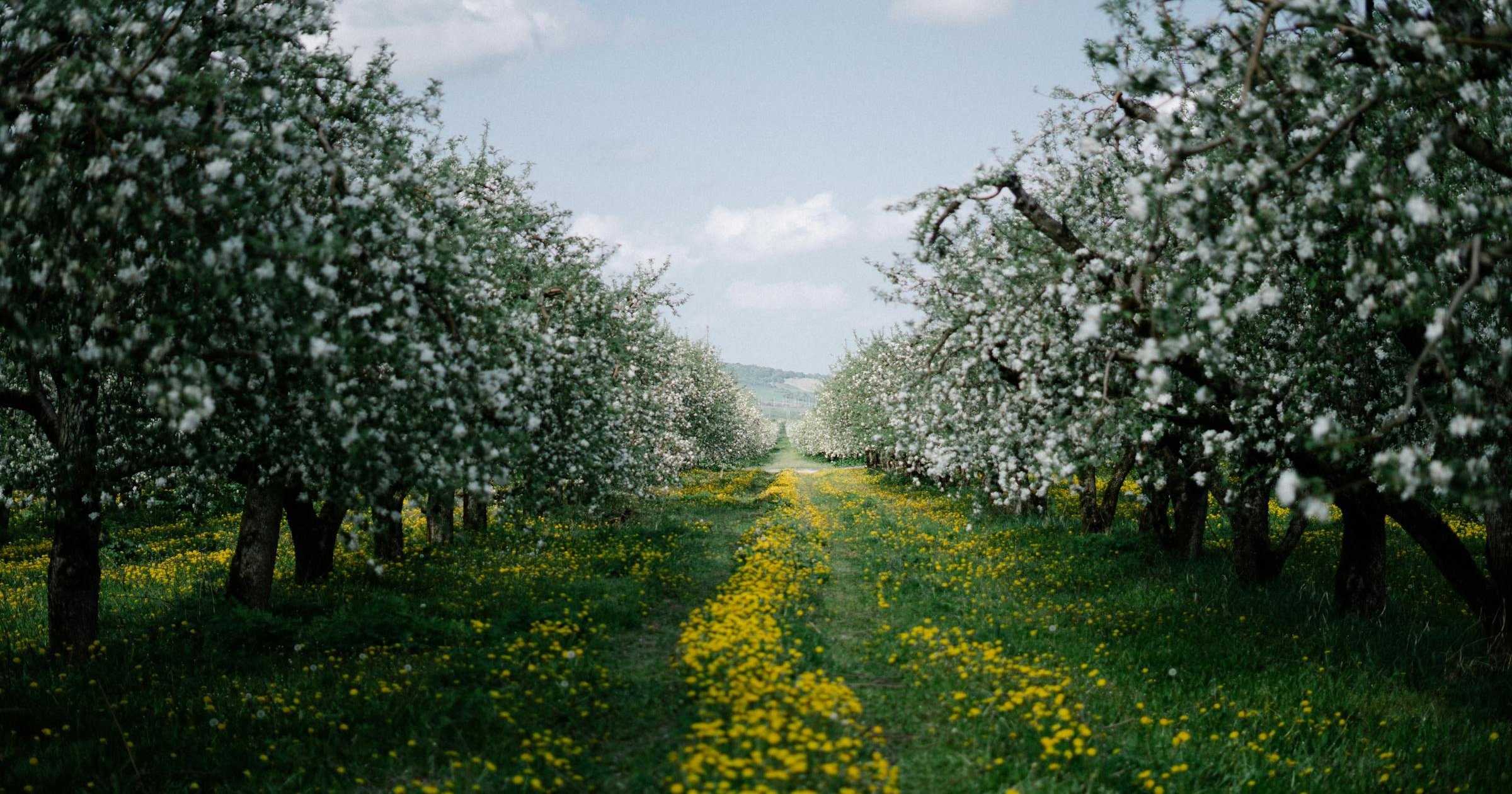
The forecast says 72°F and rain on Friday. Your pears are in full bloom. Your apples opened their first flowers two days ago. You already know fire blight is rare in this region and that most spring shoot blight is Pseudomonas. But warm and wet during open bloom is exactly the scenario that flips that calculation. This is the week where the question stops being “is this fire blight?” and starts being “is the risk high enough to act, and what do I actually do?”
Before reading further: step outside and look at your trees. Which stage are they at right now? That answer determines where you are in this guide.
The Two Bloom Windows to Watch
Knowing which bloom stage you are looking at is the foundation of everything else in this guide. The infection risk is zero before flowers open and drops sharply after petal fall. Everything in between is the window.
Silver tip to green tip: The bud scales are just beginning to separate and you can see the first hint of green. No color, no flowers. This is the pre-bloom copper window, and fire blight risk is essentially zero.
Pink bud: Color is visible in the bud but the flower has not opened. Individual petals are pressed together and flushed pink or white depending on the variety. I walked my front yard this morning and found my Chehalis and Red Jonagold at this stage. First bloom is four to seven days out. This is when to start watching the forecast closely.
First bloom through full bloom: One to a few flowers open per cluster at first, expanding to most flowers open at full bloom. This is when the infection clock is running. Note the date when you see your first open flower. That date, plus the weather over the next ten to fourteen days, is what determines your risk.
Petal fall through rattail bloom: Petals drop and the central fruitlet is visible. Most people think the window closes here. It does not. Secondary flowers on water sprouts and late-emerging clusters continue to provide entry points for up to three weeks after petal fall. This is the detail most home orchardists miss.
Pear blooms first. In the Kent area, full bloom typically arrives in the second half of April, ahead of apple by a week to ten days. Apple follows close behind. Two host species with staggered bloom means the total window from first pear flower to last apple secondary flower can span six weeks or more. The risk is not uniform across that window. It spikes when temperatures are warm and a wetting event, dew, light rain, or sustained high humidity, coincides with open flowers.
Two host species with staggered bloom means the total window from first pear flower to last apple secondary flower can span six weeks or more. The risk is not uniform across that window. It spikes when temperatures are warm and a wetting event, dew, light rain, or sustained high humidity, coincides with open flowers.
How Infection Actually Happens
Erwinia amylovora bacteria spend winter in the margins of living cankers from prior infections. As temperatures warm in late March and April, bacteria multiply at those canker edges and produce the amber ooze that insects pick up and carry to open flowers.
The bacteria need two things to infect: access to a flower and the right temperature during a wetting event. The temperature floor is meaningful. Below 65°F, the bacteria reproduce slowly enough that infection is unlikely even during rain. Above 65°F with a wetting event of just two to three hours, including dew, the bacteria can move into floral tissue and establish. The optimal range for rapid infection is 75 to 85°F. A single open flower remains vulnerable for only one to three days after opening.
This is why the cool, cloudy springs typical of the Puget Sound lowlands rarely produce fire blight: the warm and wet combination during bloom is episodic here, not reliable. But warm, dry April weather punctuated by a rain event is not unusual, and that combination is exactly the scenario this guide is written for.
Our six-year weather record from Kent (2020-2025) puts a number on that pattern. Across 299 bloom-period days from April 1 through May 20, 79 percent never reached the 65°F infection threshold; temperature alone ruled out fire blight on four days out of five before moisture was even a consideration. In the seasons where both conditions did align, they coincided one to four times per season at most, with 2020 being the highest-risk year on record at four such days; most seasons logged just one. The pattern reflects the maritime tendency to decouple the two risk factors: warm stretches arrive under high pressure with low humidity, wet periods keep temperatures suppressed. Six seasons is a limited sample, and high ambient humidity can create wetting conditions without measurable rain, so treat this as typical rather than guaranteed. Current-season bloom-period conditions are tracked at the Kent weather station.
The CougarBlight Decision Tool
The question of whether a given bloom period warrants intervention comes down to whether conditions are actually accumulating toward an infection event. Guessing at this based on the weather app is imprecise. The CougarBlight model gives you a quantified answer.
CougarBlight was developed specifically in Washington state to calculate the fire blight infection risk during bloom. It works by accumulating Temperature Risk Values (TRV) based on hourly temperatures relative to the documented growth rate of Erwinia amylovora. When a wetting event coincides with an elevated TRV, the model calculates infection risk. It factors in your orchard’s history to set the appropriate threshold: whether fire blight has never been documented nearby, occurred in the area last year, or is currently active.
The model is free and available to anyone at decisionaid.systems during bloom season (March 11 through June 20). You enter your location and your inoculum scenario and the tool shows a running TRV and a three-day risk forecast. An Excel spreadsheet version is also downloadable if you want to run it against your own weather station data.
How to read the output: TRV thresholds depend on your inoculum scenario.
| Inoculum Scenario | Marginal Risk | High Risk | Extreme Risk |
|---|---|---|---|
| No fire blight in area last year | 0-399 TRV | 400-799 | 800+ |
| Occurred nearby last year | 0-149 TRV | 150-349 | 350+ |
| Active in the orchard now | 0-79 TRV | 80-199 | 200+ |
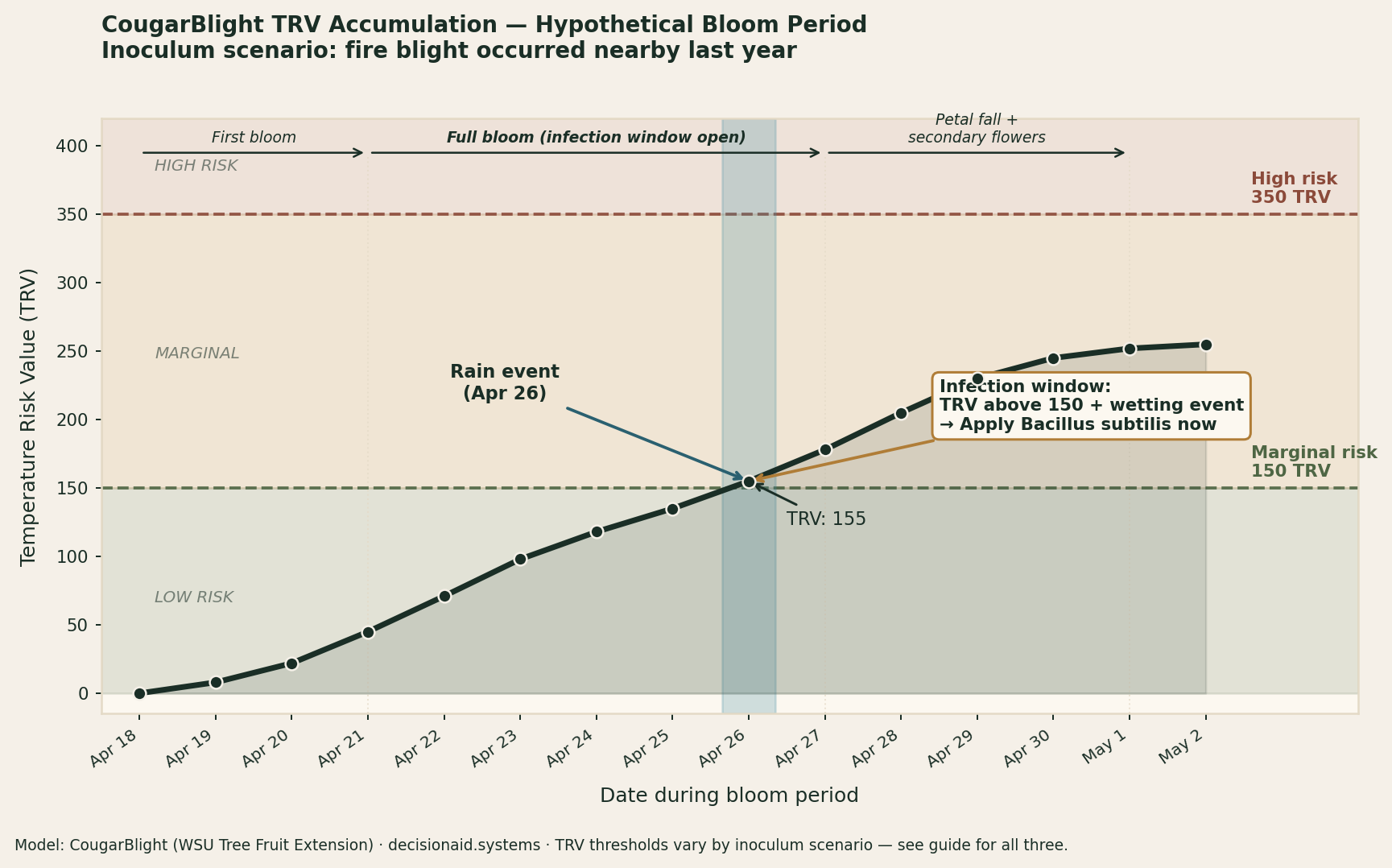 How TRV accumulates during a warm bloom period. When the value crosses the marginal threshold and a wetting event arrives, the window for Bacillus subtilis application opens. Model: CougarBlight, WSU Tree Fruit Extension — decisionaid.systems.
For most home orchardists in the Puget Sound lowlands with no documented fire blight history, the relevant thresholds are the top row. Most of our bloom periods never reach 400 TRV because temperatures during open flowers don’t sustain the warm stretch the bacteria need. When the model shows you pushing into the high range ahead of a forecast rain event, that is the signal to act.
If you are not ready for the model yet, use this three-question check each morning during bloom: Are flowers open on your tree right now? Has it been above 65°F for most of the day? Is rain or heavy dew forecast in the next 24 hours? If you answer yes to all three, your risk is elevated and Bacillus subtilis is worth applying before the rain arrives. Most mornings here during April, the temperature question alone clears you: our cool, marine-influenced springs rarely sustain 65°F through a full day during bloom. When they do, pay attention.
Either way, keep a simple log during bloom season. Date, bloom stage, high temperature, whether it rained. After a few seasons, patterns emerge that are more useful than anything a general guide can tell you. Your trees, your microclimate, your spring.
What to Do About It
Management for home orchardists operates in two phases: before bloom and during bloom.
Before bloom. Copper bactericide applied at silver tip to green tip, the earliest visible stage of bud development, reduces the inoculum load from overwintering canker margins. This is not a bloom spray. Copper applied to open flowers provides negligible protection against fire blight and risks russetting pear fruit, particularly on ‘Anjou’, ‘Comice’, and ‘Forelle’. The window for useful copper application is narrow: once you have a quarter-inch of green tissue showing, the spray is better aimed at Pseudomonas prevention anyway. If you missed the pre-bloom copper window, let it go for this year.
During bloom. If CougarBlight shows you approaching high-risk territory ahead of a forecast rain event during open bloom, Bacillus subtilis (sold as Serenade Garden) is the option scaled to home orchardists. It is a biological bactericide, OMRI-listed for organic use, and available at most farm and garden retailers. Apply it to open flowers within the 24-hour window before the forecast wetting event. Timing the application ahead of the wetting event is important; post-wetting applications are less effective. Repeat applications every three to five days while bloom continues if temperatures stay elevated and rain continues.
If you have young trees in their first or second leaf and do not want any chemical exposure, WSU trials found that removing all flowers at the pink bud stage eliminated infection in treated trees entirely, compared to 70+ infections per 100 flower clusters in untreated controls. It costs you the fruit for one year on young non-bearing trees, but it works cleanly.
Commercial antibiotics exist for situations with confirmed fire blight pressure and higher stakes. That tier is documented at WSU Tree Fruit’s fire blight resource for growers managing bearing orchards with known disease history.
One cultural control matters throughout bloom: avoid overhead irrigation while flowers are open. Any irrigation that wets flower clusters extends the window for infection and can substitute for a natural wetting event in the model.
If Infection Happened: The Shoot Blight Response
Five to seven days after an infection event at 75°F, you begin to see symptoms. A shoot tip curves into the shepherd’s crook. Blossoms that had opened turn brown and remain attached. The damage progresses backward down the branch from the flower cluster.
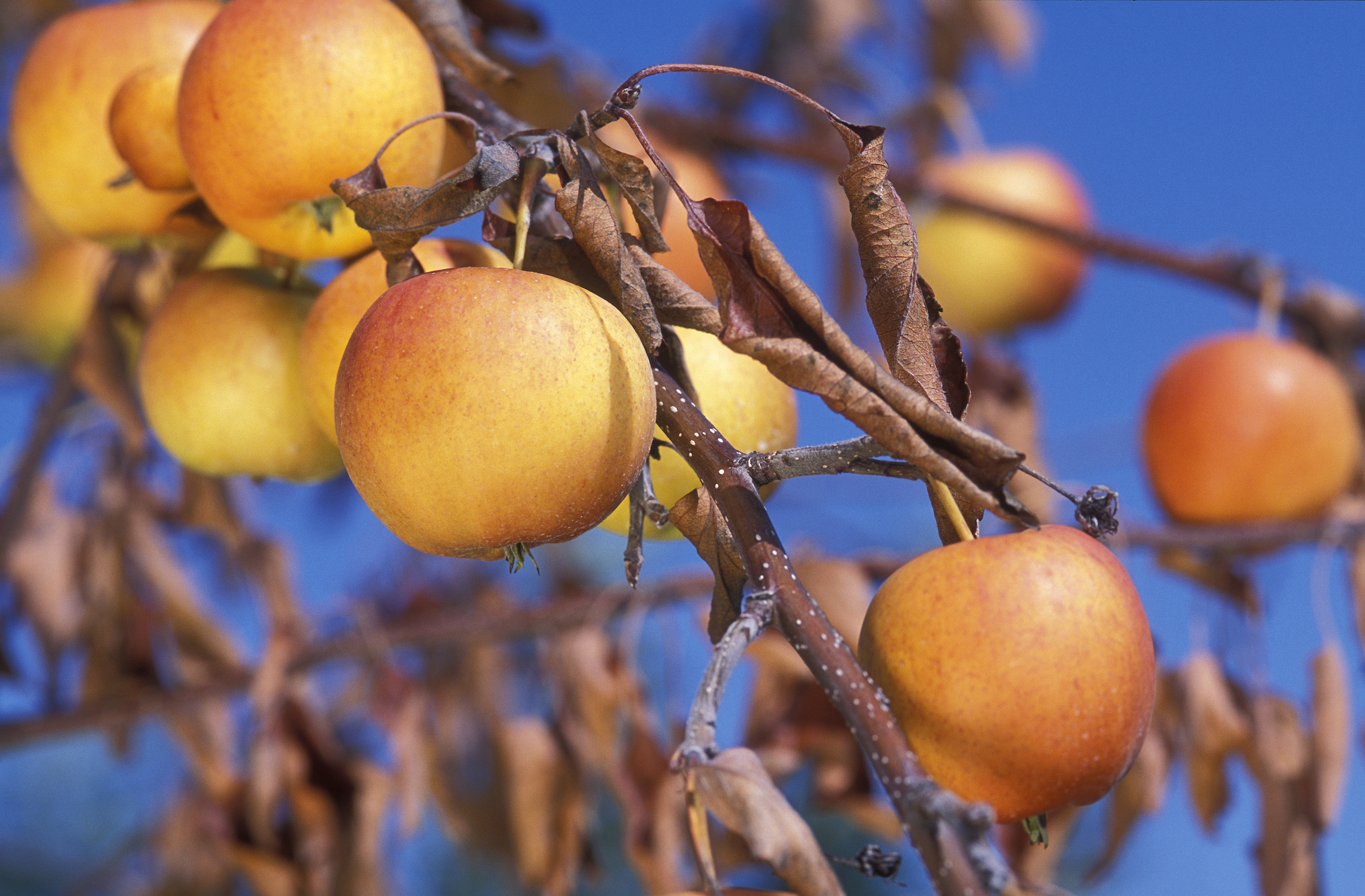 The characteristic scorching that gives fire blight its name — a Gala apple branch after infection. Photo: Peggy Greb, USDA ARS.
When you see this, the response is clear, but it requires discipline.
Cut at least 8 to 12 inches below the last visible symptom, into wood that looks and feels healthy. The bacteria travel through vascular tissue ahead of visible symptoms, so cutting at the symptom line leaves infected tissue in place. Sterilize your pruning tools between every cut, not between trees, between individual cuts. A quick dip in 70% isopropyl alcohol or 10% bleach solution is sufficient. Skipping tool sterilization turns your pruners into the primary vector.
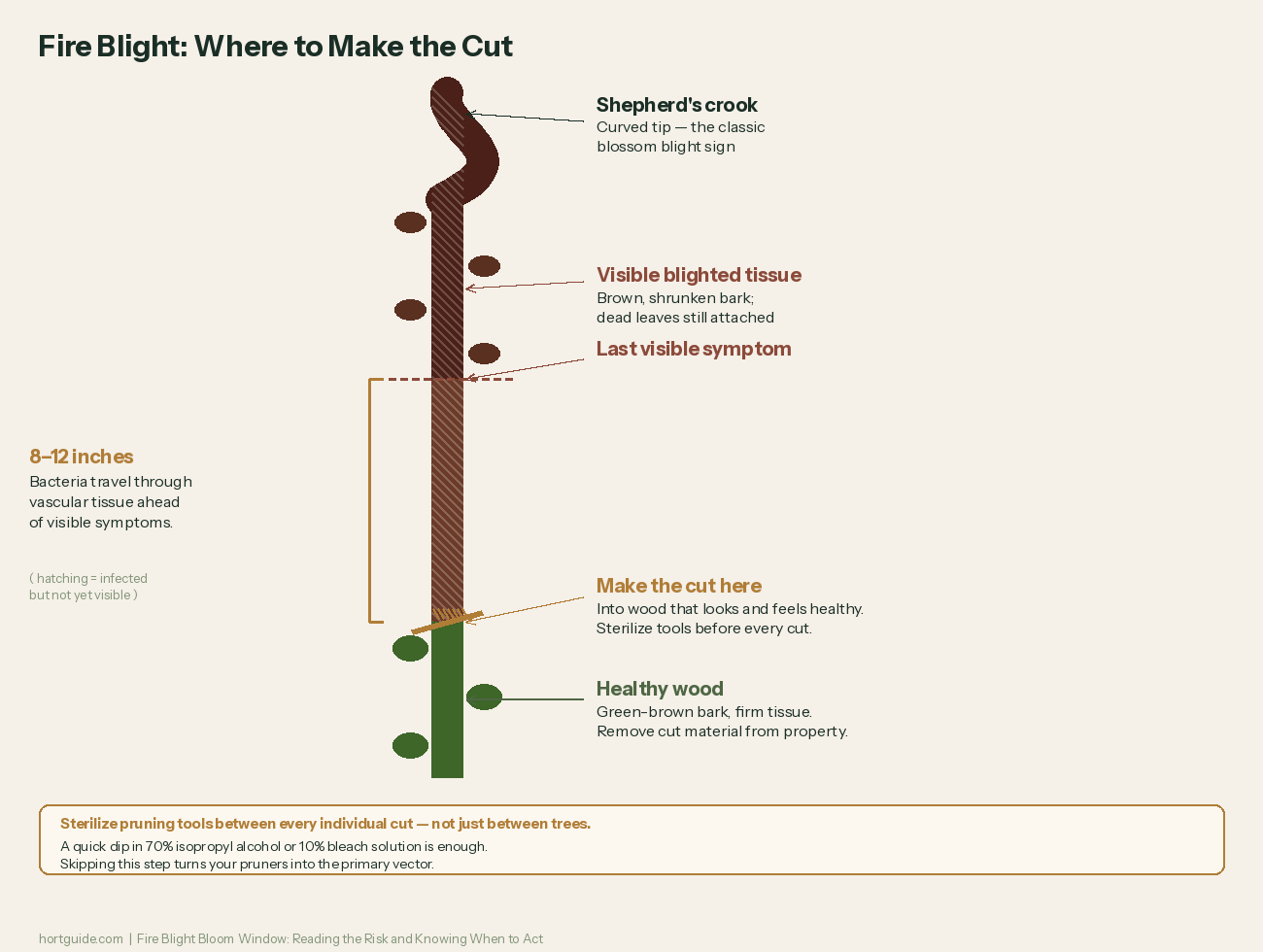 Bacteria travel through vascular tissue ahead of visible symptoms. The cut goes well into healthy-looking wood — and every cut requires fresh sterilization.
Do not combine shoot blight removal with structural pruning on the same day. Structural pruning creates fresh wounds and disturbs the canopy in ways that complicate disease spread assessment. Keep these two operations separate.
Remove infected material from the property entirely. Do not compost it.
Cultivar and Rootstock: Where Protection Starts
Variety choices made at planting shape how much work any given bloom season will require.
On apple, fire blight susceptibility ratings vary from very resistant to very susceptible. Liberty and Prima sit at the resistant end; Gala, Fuji, and Jonagold cultivars at the susceptible end. Red Delicious and Spur Delicious, despite their other drawbacks, carry real resistance. Chehalis, a WSU-bred variety, has not been formally rated but shows promise in informal observation. Honeycrisp and Enterprise also lack published ratings in the PNW Handbooks.
| Resistance Level | Apple Cultivars |
|---|---|
| Very resistant | Liberty, Prima, Redfree, Spur Delicious |
| Susceptible | Braeburn, Empire, Gravenstein, Golden Delicious, McIntosh |
| Very susceptible | Fuji, Gala, Jonagold family, Cripps Pink, Granny Smith |
| Unknown | Chehalis, Enterprise, Honeycrisp |
Pear offers less flexibility. All major commercial fruiting varieties, including Bartlett, Bosc, D’Anjou, and Comice, are susceptible. Seckel and Bradford show intermediate resistance, and resistant fruiting pear varieties are limited. If you grow pear, management is the primary tool.
Rootstock matters especially for young trees. Malling 9 and Malling 26, still common in nurseries, are susceptible to rootstock blight, a form where bacteria reach the graft union and can kill the tree without obvious canopy symptoms. The Geneva series rootstocks (G.11, G.30, G.41, G.65, and others) carry meaningful resistance. If you are planting apple trees now, choosing a Geneva rootstock is the single most durable fire blight management decision you can make.
Seasonal Management Calendar
| When | What | Why |
|---|---|---|
| October | Apply copper fungicide before fall rains | Reduces Pseudomonas inoculum; also targets fire blight canker margins heading into winter |
| Nov-Jan | Remove holdover fire blight cankers during full dormancy | Eliminates primary inoculum source; cutting in full dormancy minimizes risk of spreading bacteria |
| Feb, at silver tip to green tip | Optional second copper application | Reduces bacterial load before bud break; last window before bloom makes copper unsafe |
| Pear bloom | Begin checking CougarBlight (decisionaid.systems) daily | Pear is the highest-risk host and blooms first; establish your baseline TRV |
| Apple pink bud to first bloom | Continue CougarBlight monitoring; deploy Bacillus subtilis if TRV approaching high threshold + rain forecast | Apple bloom opens a second infection window; secondary flowers extend it 3 weeks post-petal-fall |
| During bloom (any variety) | Avoid overhead irrigation; hold nitrogen fertilization | Wet flowers extend infection window; nitrogen flush promotes succulent shoot growth that is more susceptible |
| 5-14 days after warm+wet event | Scout for shepherd’s crook and blighted blossoms | Symptom timeline at 75°F; earlier detection means less spread |
| As symptoms appear | Remove infected shoots 8-12” below symptoms; sterilize tools between every cut | Pruning tool sterilization is non-negotiable; each unsterilized cut can move bacteria to healthy tissue |
| August-October | Assess canker formation on branches; mark for dormant removal | Symptoms harden into persistent cankers by late summer; identification now enables safe winter removal |
Sources
- Fire Blight of Apple and Pear, WSU Tree Fruit Extension
- CougarBlight Model, WSU Tree Fruit Extension
- Fire Blight, Apple, UC Davis IPM Program
- Fire Blight, Pear, UC Davis IPM Program
- Home Orchard Fire Blight Management, Penn State Extension
- Fire Blight in Ornamentals, Penn State Extension
- Fire Blight of Apples and Pears, OSU Extension
- PNW Plant Disease Management Handbook, cultivar resistance ratings (Van Der Zwet et al. 2012, APS Press)
- WSU HortSense, fire blight fact sheets (Apple, Pear), reviewed Feb 2026
Always follow current pesticide label directions. Product registrations change. Confirm WA state registration before purchase.
Field Brief delivers week-by-week timing updates for the Puget Sound lowlands through the growing season.