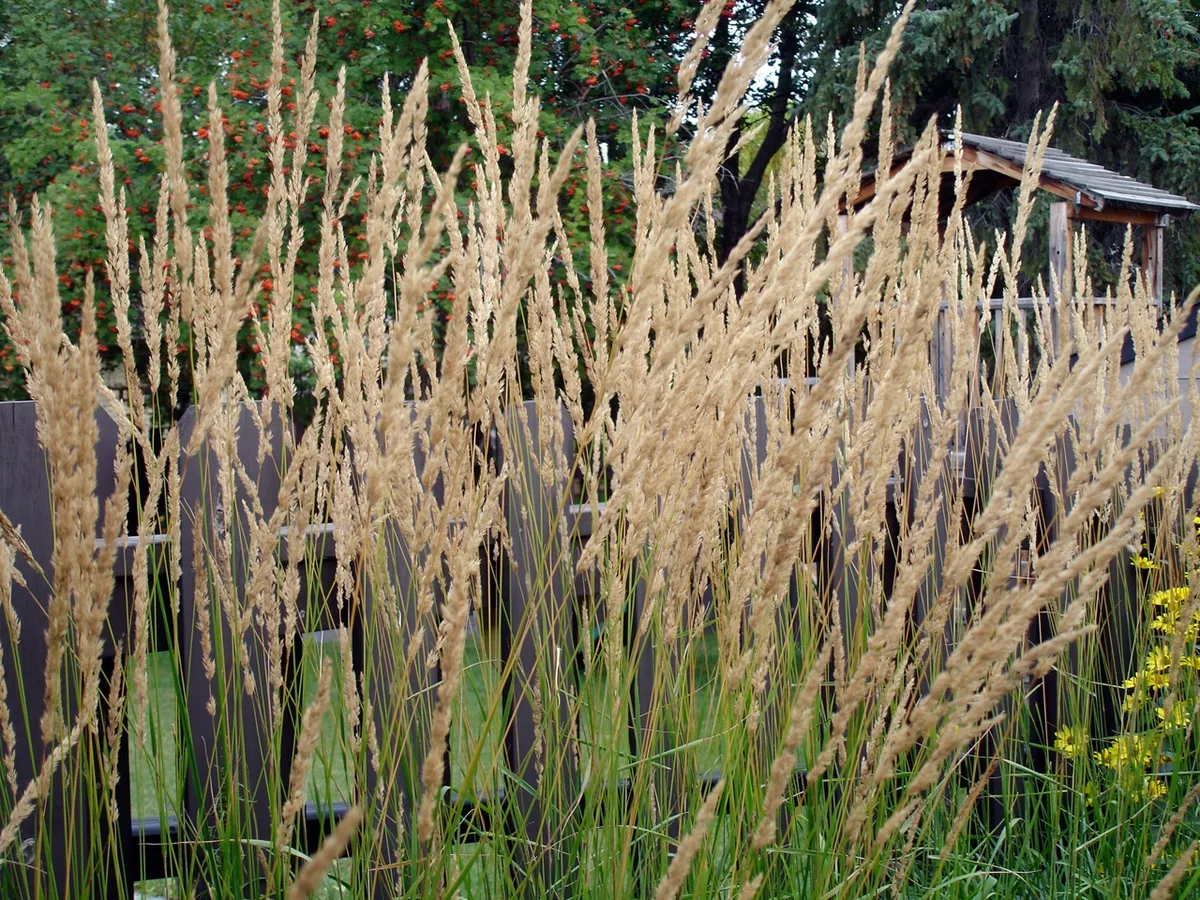
You have seen this grass. Every new development, streetscape project, and designer garden in the Puget Sound region has it: tall columnar clumps standing through winter, feathery plumes catching afternoon light. Calamagrostis x acutiflora ‘Karl Foerster’ is the ornamental grass that solved the vertical structure problem for maritime landscapes. It is so common that gardeners overlook what makes it worth planting, particularly for our climate.
The key fact: this is a sterile hybrid. It produces seed that does not germinate. That single trait separates it from most ornamental grasses and makes it a responsible choice where invasive spread is a concern.
What You’re Looking At
Karl Foerster is a clump-forming grass in the Poaceae family, a hybrid of Calamagrostis arundinacea and Calamagrostis epigejos. The cultivar honors Karl Foerster (1874-1970), a German nurseryman who spent his career breeding perennials for reliability. It won the Perennial Plant of the Year award in 2003.
In bloom, it reaches 4 to 6 feet tall and 2 to 3 feet wide. The height is almost entirely vertical: this grass does not sprawl or lean. Even during heavy winter rain and wind, when softer ornamental grasses collapse, Karl Foerster stands upright. Its columnar form is genetic, not a trick of cultivation. Narrow leaves emerge from a tight basal clump, and by midsummer the flowering stems rise with visible geometry. Feathery plumes appear in late summer, ranging from pink-purple to silvery buff depending on light and moisture, and persist through fall and winter.
Leave the dried stems standing through December and January for winter texture and frost interest. Cut the entire clump to 4 to 6 inches in late February, just as new growth emerges. This timing matters here: cutting too early exposes fresh growth to hard freezes; cutting too late damages emerging shoots.
Why It Works Here
Our climate breaks most ornamental grasses. Mediterranean species rot in waterlogged winters. Tropical types freeze. Miscanthus species, while attractive, self-seed aggressively in mild climates, and several have naturalized in Puget Sound lowlands and the Willamette Valley, outcompeting native vegetation and altering fire ecology.
Karl Foerster was bred for Central European conditions: cold winters, unpredictable spring frosts, wet dormant seasons. It thrives in our clay, even compacted clay, and tolerates high winter water tables. Plant it in full sun for the most robust clumps and best plume color, though it performs acceptably in part shade on south-facing slopes.
Because it is sterile, there is no risk of seed dispersal into adjacent properties or natural areas. That matters more in a year-round wet climate than in drier regions where aggressive seeding is easier to manage. The grass also tolerates drought once established, a useful trait as our summers trend drier, and does not require supplemental irrigation after the first growing season.
Cultivation and Placement
Full sun to part shade, well-drained to moderately moist soil. The grass handles standing winter water provided it drains by spring. Poor drainage combined with heavy shade can lead to basal rot, though this is uncommon in Puget Sound gardens with typical spacing.
Use it as a vertical accent alongside broad-leafed perennials and shrubs. In a mixed border with Japanese maples, hostas, and sedges, Karl Foerster provides repeating vertical lines every 8 to 10 feet. In parking lot islands and median strips, it adds movement without aggressive sprawl.
For immediate impact, space clumps 3 to 4 feet apart center to center. For dense commercial plantings, 2 to 3 feet works; plants will touch but not overtake one another. Expect 3 to 4 years for full size.
Maintenance
Beyond the late-February cutting, Karl Foerster needs almost nothing. It does not benefit from spring fertilizer. It does not require division unless you want to propagate (dig and split crown pieces in early spring). Pests are not an issue. Deer may browse lightly but rarely cause damage.
A sharp hedge trimmer handles a mature clump in about 10 minutes. Bag or mulch the trimmings, and inspect the center of the clump for dead material or accumulated debris while you are in there.
Sources: Perennial Plant Association (2003 Plant of the Year), Rick Darke (The Color Encyclopedia of Ornamental Grasses, Timber Press 1999), PNW Native Plant Database (Center for Urban Horticulture, UW).