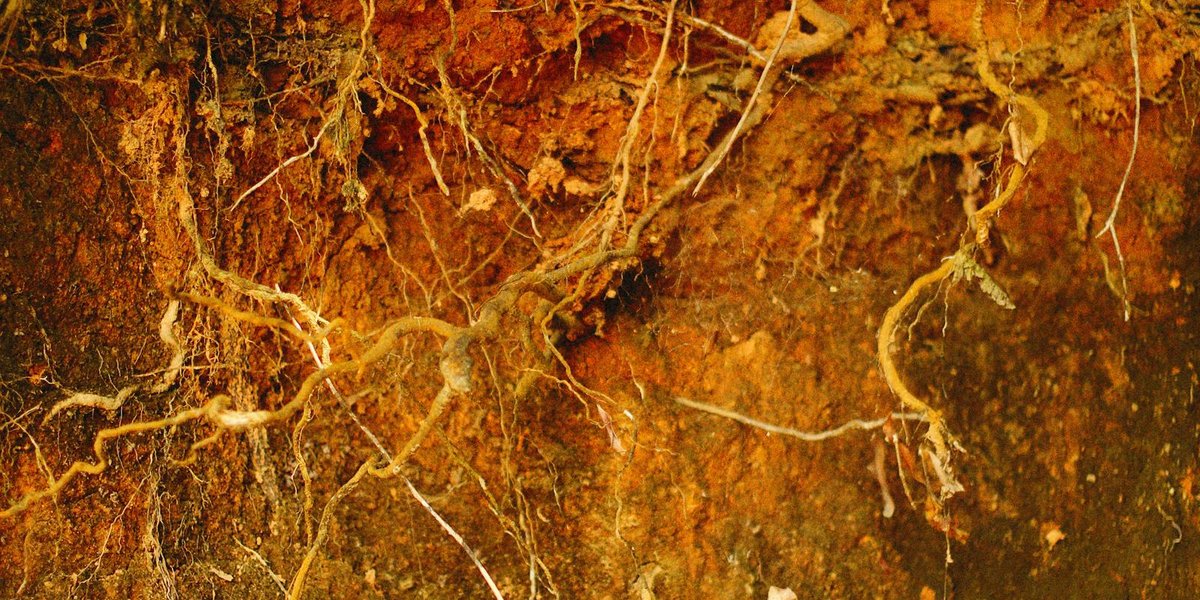
You dig a hole for a new shrub in April and the bottom fills with water. You wait two weeks, try again, and get the same result. By July you are watering the same spot every three days because the soil has dried to concrete. A neighbor one street over, slightly uphill, never deals with either problem. Your gardening friends all say the same thing: “We have clay here.”
Most of them are wrong.
The Puget Sound lowlands sit on glacially deposited soils that were mapped and classified decades ago by NRCS soil scientists. Your soil has a name, a texture class, a drainage profile, and a management playbook. You do not need to guess. You can look it up in five minutes using the USDA’s Web Soil Survey. Once you know your soil series, the advice gets specific and the amendments stop being a gamble.
The first step is separating two things most gardeners treat as one: texture and drainage. Texture is what particles your soil is made of. Drainage is how water moves through it. They are related but not the same, and confusing them leads to the wrong fix.
Why Texture Is Not What You Think
Soil texture describes the ratio of three particle sizes: sand (the largest, visible to the eye), silt (smaller, feels floury when dry), and clay (the smallest, sticky when wet). These proportions are a permanent physical property of your soil. No amendment changes them. You can improve soil structure, organic matter content, and biological activity, but the sand-silt-clay ratio you started with is the sand-silt-clay ratio you will always have.
This matters because the “fix” depends on what you are actually standing on. If your soil is silt loam (the dominant texture on Puget Sound valley floors), adding gypsum does nothing. Gypsum improves structure only in sodic soils with high sodium content, which are rare here. If your soil is gravelly sandy loam (the dominant texture on upland hills), adding sand makes no sense because you already have plenty. And if your soil is true clay, working it when wet creates compacted layers that persist for years. Knowing the texture tells you which interventions are worth your money and which are waste.
The persistent myth in this region is that everyone has clay. Walk into any garden center from Kent to Olympia and you will hear it. But pull up the USDA soil survey data and the picture shifts. The valley floor soils (Woodinville, Briscot) are silt loam, not clay. The upland soils (Alderwood, Everett) are sandy loam or gravelly sandy loam. True clay with shrink-swell properties (Bellingham Series) exists, but it is not the norm. What most gardeners experience as “clay” is actually wet silt loam: heavy, sticky, slow to drain, and miserable to dig. The distinction matters because the management strategy for silt loam is different from the strategy for clay, and the amendment advice for one can damage the other.
Three Tests You Can Do This Weekend
You do not need a lab to figure out what you have. Three field tests, done in your yard with no special equipment, give you enough information to manage your soil intelligently.
The jar test (texture). Fill a quart mason jar one-third with soil from 6 to 8 inches deep. Add water to the top, cap it, shake hard for two minutes, and set it on a counter. Sand settles in the first minute. Silt takes one to two hours. Clay takes 24 hours or longer. After a full day, mark the layers on the glass with a permanent marker. The proportions tell you your texture class. If your layers are roughly 40% sand, 40% silt, 20% clay, you have loam. If the silt band dominates and sand is thin, you have silt loam. If the clay band is more than a third of the total, you may have true clay.
 USDA Soil Texture Triangle. Once you know your jar test percentages, find your texture class on the triangle. Most Puget Sound valley soils land in the silt loam zone. Diagram by Christopher Aragón, CC BY-SA 4.0, via Wikimedia Commons. Based on USDA-NRCS classification.
The ribbon test (texture confirmation). Grab a golf-ball-sized lump of moist soil, work it in your hand until it is uniformly damp, and squeeze it between your thumb and forefinger into a flat ribbon. Sand will not form a ribbon at all; it crumbles. Silt loam makes a ribbon 1 to 2 inches long that cracks and breaks. True clay makes a ribbon longer than 2 inches that holds together, feels slick, and resists tearing. This is the quickest field check: 30 seconds, no equipment, and it separates the three major groups immediately.
The percolation test (drainage). Dig a hole 12 inches deep and 12 inches wide. Fill it with water and let it drain completely (this saturates the surrounding soil). Fill it again and time how fast the water level drops. Less than half an inch per hour means poor drainage: your soil holds water too long for most plants, and raised beds or drainage improvements are worth considering. Half an inch to 6 inches per hour is the acceptable range for most landscape plants. More than 8 inches per hour means your soil drains too fast and will need organic matter and irrigation to sustain anything that is not drought-adapted.
The perc test is the most valuable of the three because it captures something the texture tests miss. Texture tells you about particle size. Drainage depends on particle size, soil structure, slope, and what lies underneath. Alderwood soil has sandy texture that drains beautifully until you hit the glacial hardpan at about 35 inches, where water stops dead. Your perc test will show fast drainage in a shallow hole and miserable drainage in a deeper one. That information is worth more than any soil amendment you can buy.
What Is Under Your Yard
The Vashon ice sheet covered the Puget Sound lowlands roughly 15,000 years ago. When it retreated, it left behind a patchwork of deposits that became the soils mapped today. Where you sit in the landscape, upland hill, valley floor, or low depression, determines which deposit you garden on.
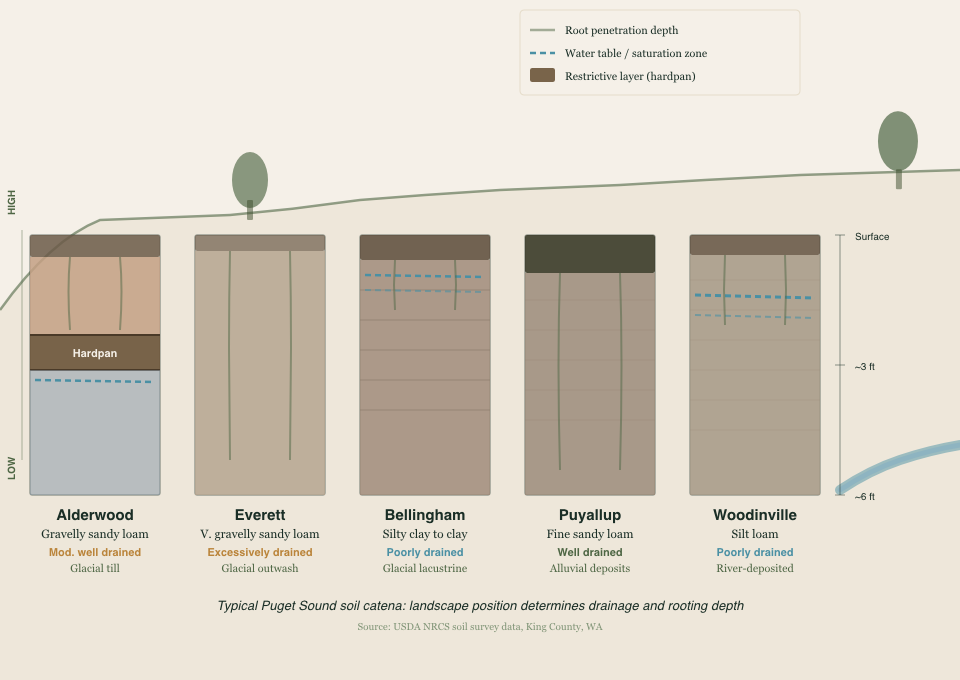 Puget Sound soil catena: landscape position determines drainage and rooting depth. Source: USDA NRCS soil survey data, King County, WA.
Alderwood (gravelly sandy loam, moderately well drained). The most common soil in residential landscapes from Everett to Tacoma. If you garden on any hill or ridge in King, Snohomish, or Pierce County, you are likely on Alderwood. The top two to three feet is loose, gravelly material that drains quickly. Below that sits a layer of compacted glacial material so dense that roots cannot penetrate it and water cannot move through it. This creates the defining challenge: waterlogged roots in winter when rain pools above the hardpan, then drought stress in summer when the shallow root zone dries out. Your perc test will reveal this if you dig deep enough.
Woodinville (silt loam, poorly drained). The valley floor soil that everyone calls clay. It is not clay. It is fine-textured silt deposited by river flooding over millennia. It drains poorly, compacts easily, and feels heavy and sticky when wet, which is why people reach for the clay label. But it does not shrink and swell the way true clay does, and the management is different. The critical rule: never work Woodinville silt loam when it is wet. WSU Extension’s test is simple: grab a handful, squeeze it into a wire shape. If it holds the wire shape, it is too wet to dig. Working wet silt loam destroys the aggregate structure and creates hardened layers that take years to recover.
Everett (very gravelly sandy loam, somewhat excessively drained). The opposite problem. Coarse glacial outwash that drains so fast it barely holds water or nutrients. If your yard is on a gravel terrace, you may have Everett. Mediterranean and drought-adapted species thrive. Everything else needs supplemental irrigation and more frequent, lighter fertilizer applications because nutrients wash through before roots can absorb them.
Puyallup (fine sandy loam to loam, well drained). The agricultural gold standard. Deep, fertile, river-terrace soil with a rich organic surface layer. If you garden on Puyallup soil, you already have ideal conditions. Your soil does what soil is supposed to do. The main risk is compaction from machinery or foot traffic, which destroys the structure that makes it productive.
Bellingham (silty clay to clay, poorly drained). This is the actual clay. Bellingham soil has vertic properties: it shrinks when dry, forming surface cracks, and swells when wet. It drains slowly year-round. If the ribbon test gives you a ribbon longer than two inches that feels slick and holds together stubbornly, and your yard is in a low-lying area near Bellingham or along the northern Puget Sound, you may have the real thing. Management centers on organic matter to create macropores (large channels for water movement), raised beds, and never working the soil outside the narrow moisture window between too wet and too dry.
Four additional series (Seattle, Briscot, Snohomish, Norma) appear in specific landscape positions. The soil series library on this site has complete profiles for all nine, including native vegetation, pH, drainage class, and management recommendations.
Look Up Your Soil
The USDA’s Web Soil Survey is free, covers every address in the region, and takes about five minutes. Enter your address, zoom in, click on your property, and the tool returns your soil series, texture class, drainage class, depth to restrictive layer, and a description of the soil profile. The data comes from county soil surveys conducted by NRCS soil scientists who physically mapped these deposits. It is the most authoritative information available about what is under your yard.
Once you have your series name, come back to the soil library here and look up the management profile. That is where the generic internet advice ends and the specific guidance for your ground begins.
Three Myths That Cost Money
“Add sand to improve clay drainage.” This is the single most persistent soil amendment myth in American gardening, and it does the opposite of what people expect. Clay particles pack into the spaces between sand grains, creating a material denser and harder than either component alone. The result resembles low-grade concrete. Even if you could work enough sand into your soil to change the texture (you would need roughly equal parts by volume, which means stripping and replacing your topsoil), the effort and cost far exceed the benefit. Organic matter is the path to improved structure, not sand.
“Gypsum loosens clay.” Gypsum (calcium sulfate) improves soil structure in sodic soils, which have high sodium levels that cause clay particles to disperse and seal the soil surface. This condition is common in irrigated agricultural valleys in the arid West. It is rare in the Puget Sound lowlands, where rainfall leaches sodium naturally. Applying gypsum to non-sodic soil wastes money and adds calcium your soil may not need.
“My soil is clay.” As described above, most gardeners in this region are standing on silt loam or gravelly sandy loam, not true clay. The ribbon test takes 30 seconds. If your ribbon breaks before two inches, you do not have clay, and the clay management advice you have been following (gypsum, sand, aggressive tilling) may be causing more harm than good. Identify what you actually have before spending money on amendments designed for something else.
Managing for What You Have
The universal improvement is organic matter. Compost, aged bark, leaf mold, and arborist wood chips all build soil structure over time by creating aggregates (clumps of soil particles held together by organic glue from microbial activity). Aggregates create macropores, the large channels that allow water and air to move through soil. This works in every texture class: organic matter opens up tight silt loam, and it helps sandy soil hold moisture and nutrients.
The timeline is years, not weeks. A single application of two inches of compost incorporated into the top six inches of soil measurably improves structure, but the full benefit builds over three to five seasons of consistent additions. Mulching with arborist wood chips (not bark nuggets, which float away) builds organic matter from the surface down without any digging, which is the preferred approach for established plantings where root disturbance is a concern.
Beyond organic matter, the strategy depends on your drainage class:
Fast-draining soils (Everett, upland Alderwood above the hardpan). Irrigate more frequently in summer. Apply fertilizer in smaller, more frequent doses because nutrients leach quickly. Mulch to 3 to 4 inches to slow evaporation. Select Mediterranean, native, and drought-adapted species that match the soil’s character rather than fighting it.
Slow-draining soils (Woodinville, Bellingham, Briscot). Build raised beds for vegetables and annual flowers. Install French drains above the restrictive layer if water pools for more than 48 hours after rain. Never work the soil when it is wet. Mulch to 2 inches maximum (deep mulch on wet soil holds excess moisture against the crown). Select species that tolerate winter-wet conditions: red-twig dogwood, Oregon grape, western redcedar, and red alder all evolved in these soils.
The Alderwood paradox. This soil creates both problems in the same year. Manage for winter wet with drainage above the hardpan and species selection that tolerates seasonal saturation. Manage for summer dry with mulch, deep infrequent irrigation, and realistic expectations about what the shallow root zone can support. The soil profile pages on this site list recommended species for each condition.
When to Do What
| Season | Fast-Draining Soils | Slow-Draining Soils |
|---|---|---|
| Early spring (Mar-Apr) | Workable earlier; begin planting when soil is warm | WSU squeeze test before digging; may wait until late April |
| Late spring (May) | Begin supplemental irrigation | Soil warming; main planting window opens |
| Summer (Jun-Sep) | Irrigate 2-3 times per week; lighter fertilizer doses | Irrigate once per week; watch for root rot in low spots |
| Fall (Oct-Nov) | Add compost and mulch to build water retention | Install drainage; add compost; build raised beds |
| Winter (Dec-Feb) | Minimal concern | Observe where water pools longer than 48 hours: free drainage map |
Winter is the cheapest soil assessment you will ever get. After a sustained rain, walk your property and note where water sits. Those are the spots that need drainage work, raised beds, or species that tolerate seasonal saturation. The information costs nothing, and it is more accurate than any lab test for understanding how water moves through your specific site.
Sources
- USDA NRCS, “Soil Texture Calculator” and field feel method guide (nrcs.usda.gov)
- Clemson Extension HGIC, “Soil Texture Analysis: The Jar Test” (hgic.clemson.edu)
- Colorado State Extension, “Estimating Soil Texture (GardenNotes #214)” (cmg.extension.colostate.edu)
- Iowa State Extension, “Testing and Improving Soil Drainage” (yardandgarden.extension.iastate.edu)
- WSU Extension EM063E, soil texture and wet-soil workability test
- USDA NRCS Web Soil Survey (websoilsurvey.nrcs.usda.gov)
- USDA NRCS Washington Soil Atlas (nrcs.usda.gov)
- WA Dept of Ecology, “Soil Quality BMP T5.13” (ecology.wa.gov)
- Oregon State Extension, “Understanding Soil Texture” (extension.oregonstate.edu)
- ISA A300 Part 2: Soil Management (professional standard)
Image: USDA Soil Texture Triangle by Christopher Aragón, CC BY-SA 4.0, via Wikimedia Commons. Based on USDA-NRCS classification.

This guide links to species profiles and management data in the hortguide.com soil library. Sign up for the Field Brief for seasonal soil management timing matched to current conditions across seven Puget Sound weather stations.