You are standing in the garden center in March, looking at a row of bare-root apple trees. The tags say Gala, Fuji, Honeycrisp. They tell you the fruit is sweet, the harvest is fall, the zones are 4 through 8. What the tags do not tell you is that Gala rates a 4 out of 4 for apple scab susceptibility and a 4 out of 4 for fire blight, which in this climate means you are buying a spray schedule along with the tree. Western Oregon data from 1989 to 2001 recorded an average of eight scab infection periods per year, each lasting nearly 29 hours. That is not occasional risk. That is the weather pattern every spring.
The question is not which apple tree to plant. The question is which apple tree will produce fruit here without requiring you to become an amateur fungicide applicator.
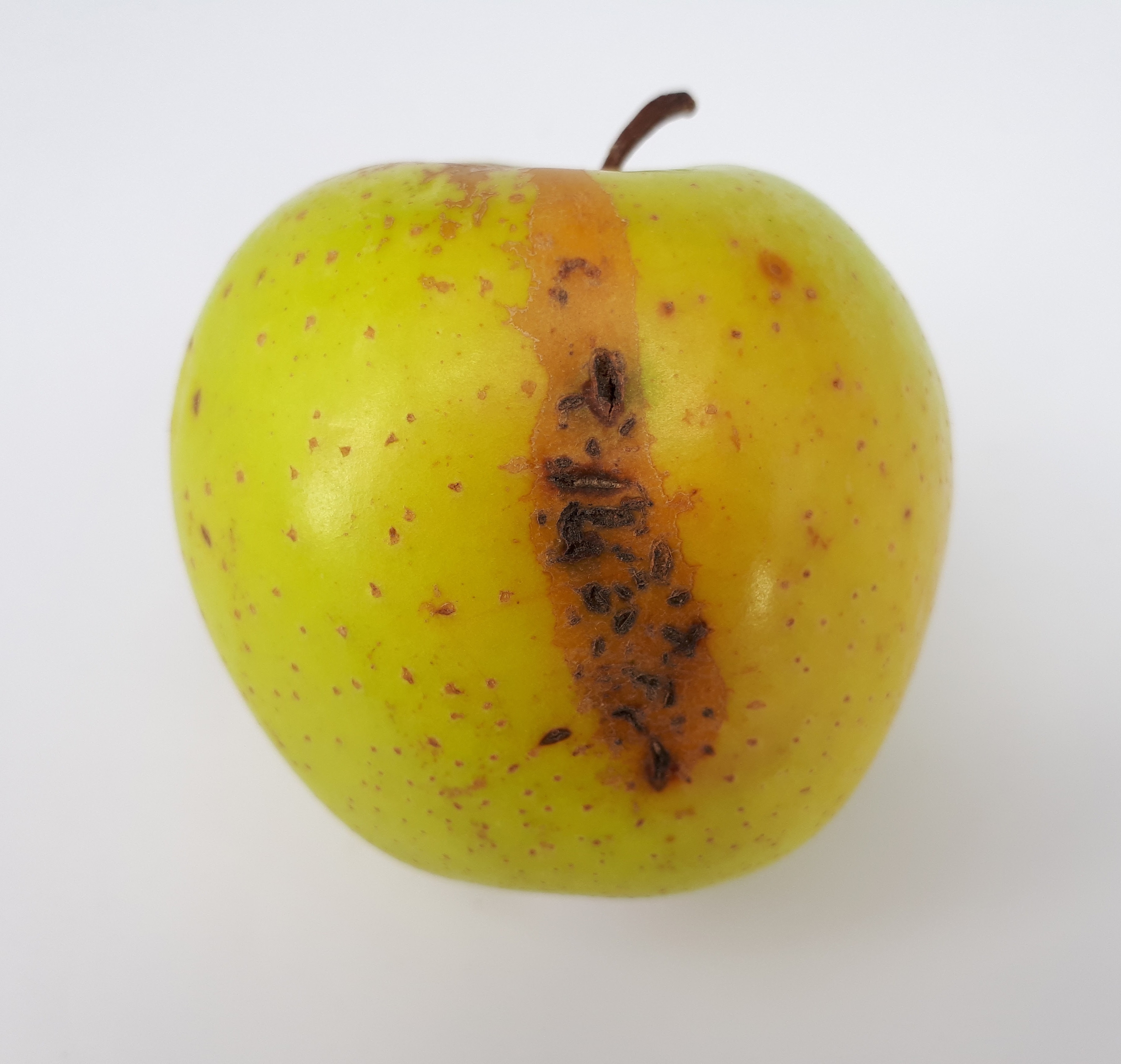 Apple scab on fruit: the dark, corky lesions that develop on susceptible varieties by late summer. Photo by Fructibus, Wikimedia Commons (CC0).
What Actually Limits You
National variety guides rank apples by flavor, harvest date, and chill hours required. In the Puget Sound lowlands, that hierarchy is inverted. Chill hours are effectively irrelevant: this region accumulates 850 to 1,000 chill hours in a typical winter, and most apple varieties need only 600 to 800. You will never fail to meet the requirement. Every apple variety sold in a nursery here will get enough cold.
Disease pressure is the actual filter. Three fungal and bacterial diseases dominate: apple scab (Venturia inaequalis), fire blight (Erwinia amylovora), and powdery mildew (Podosphaera leucotricha). The PNW Plant Disease Management Handbook rates apple cultivars on a 1 to 4 scale for each: 1 means very resistant, 4 means very susceptible. A variety that scores 1 or 2 across all three needs no fungicide program. A variety that scores 3 or 4 on any one of them needs intervention most years, and a 4 on scab in particular means you are spraying or you are watching your tree defoliate by August.
There is a fourth consideration that national guides ignore entirely: fall rain tolerance. Late-harvest varieties ripen during October, which is when the Puget Sound region gets its first serious rain. OSU Extension documented that 4.5 inches falling over two days in mid-October caused widespread fruit splitting across apple trials, but Hauer Pippin came through unscathed. If you are planting a variety that ripens after mid-October, you are gambling against the weather. This is developing data, not settled science, but it is worth knowing before you commit to Granny Smith.
One regional advantage: powdery mildew is less severe in maritime climates than in continental ones. The humidity that drives our scab pressure actually suppresses mildew. A variety with a moderate mildew rating (3) may perform better here than its number suggests.
The Recommended List
These nine varieties have documented disease resistance and proven performance in maritime Pacific Northwest conditions. The numbers in parentheses are PNW Handbooks ratings for scab, fire blight, and powdery mildew, with 1 being best.
Liberty (1/2/2). The best all-around choice for this region. Highly resistant to scab, resistant to fire blight and mildew. Self-fruitful, though it sets heavier crops with a pollinizer nearby. Midseason harvest, September into early October. Tart-sweet, crisp, good for both fresh eating and cooking. If you plant one apple tree and want the least maintenance, this is the one.
Redfree (1/2/2). Matches Liberty’s resistance profile but ripens earlier, late August into September. A good early apple for fresh eating. Medium-sized fruit with red skin over yellow-green. If you want fruit before Labor Day, Redfree delivers without a spray program.
Prima (1/2/?). Outstanding scab resistance, good fire blight resistance, but rated 4 for bitter pit, a calcium disorder that causes brown corky spots inside the fruit. Not a disease you spray for; it is a soil and irrigation management issue. Worth planting if you can manage consistent watering.
Chehalis (1-2/?/?). A Pacific Northwest regional cultivar that deserves wider recognition. Early bloom, good scab resistance. Fire blight and mildew data are incomplete in the published literature, but field performance in this region has been strong. If you see one at a local nursery, buy it.
Enterprise (2/?/2). Good scab and mildew resistance. Late harvest, October, with fruit that stores well into winter. A solid choice if you want apples in December.
Pristine (2/?/2). Early harvest, August, with good scab and mildew resistance. Yellow-skinned, sweet-tart. One of the first to ripen, which means you avoid the fall rain question entirely.
Freedom. Scab immune in Cornell trials, with good fire blight resistance. An underplanted variety that deserves more attention. Cornell’s multi-reference disease susceptibility database rates it highly resistant across multiple diseases.
Akane (2-3/3/3). Popular in this region for decades. Moderate resistance across the board, not as bulletproof as Liberty or Redfree, but it performs. Crisp, early apple that ripens in August. You may see minor scab in wet years.
Elstar (2/3/?). A Cox-type apple with good flavor for maritime climates. Moderate scab resistance. Originally bred in the Netherlands, which means it was selected for conditions not unlike ours. The RHS rates Fiesta, a related Cox-type, as one of the best scab-resistant dessert apples for maritime gardens.
Honorable Mentions
Honeycrisp (2/?/3-4). Everyone wants Honeycrisp, and it can be grown here. Moderate scab resistance is manageable. The problems are powdery mildew (3-4) and bitter pit (rated 4), which makes fruit quality inconsistent without careful calcium management. It will produce, but it asks more of you than Liberty does.
Gravenstein (3/3/4). A heritage Puget Sound variety with outstanding flavor for sauce, pies, and cider. Susceptible to all three diseases, and triploid (see pollination section below). You are planting this for tradition and flavor, not for low maintenance.
Jonagold (3/4/3). Excellent flavor, poor disease profile. Fire blight susceptible and triploid. A good apple in the wrong climate for easy growing.
The Avoid List
These are the varieties you will find front and center at the garden center. They sell nationally because they store and ship well. They are not good choices here.
Gala (4/4/?). The default big-box apple. Very susceptible to both scab and fire blight. In the Midwest, where springs are drier, Gala can perform without heavy intervention. Here, you are committing to 6 to 10 spray applications per season or accepting a tree that looks progressively worse from May onward.
Fuji (3/4/2-3). Fire blight magnet. Late harvest means it sits through October rain.
Red Delicious (4/2/2-3). The worst scab rating in the PNW Handbooks. Whatever you think about the flavor, the tree itself will struggle.
McIntosh (4/3/3). Very high scab susceptibility.
Granny Smith (3/4/4). Severe mildew plus fire blight susceptibility, and it ripens so late that most years the fruit does not fully mature before fall rain arrives. Not suited to this side of the Cascades.
For the full 40-cultivar resistance chart, see the apple scab guide.
Rootstock: The Underground Decision
The variety determines what fruit you get. The rootstock determines whether the tree survives the first three winters.
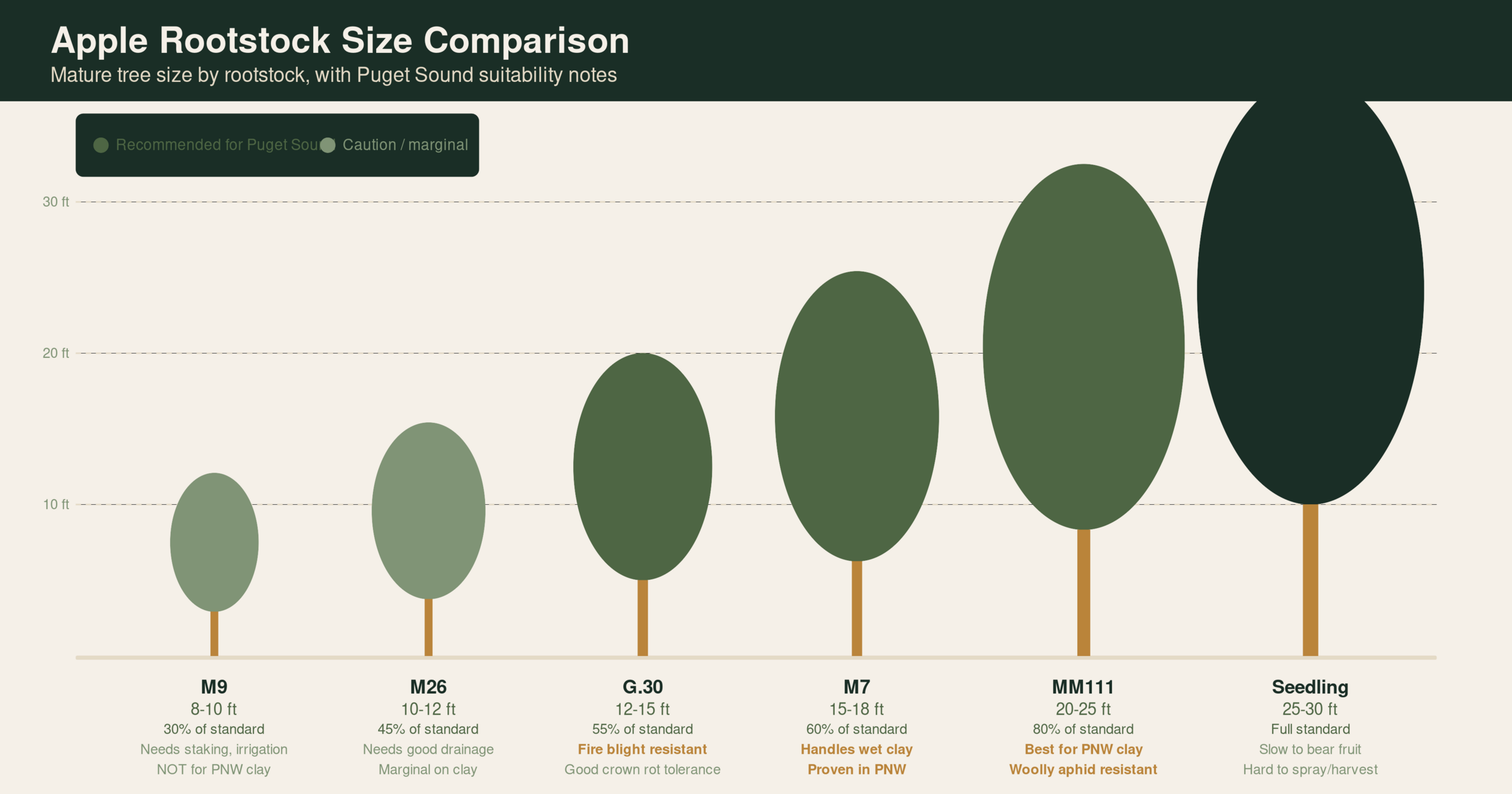 Rootstock determines mature tree size and soil tolerance. Green silhouettes are recommended for Puget Sound clay; gray are marginal.
Rootstock controls tree size, disease resistance at the root level, and tolerance for soil conditions. In the Puget Sound lowlands, where clay soils are common and winter drainage is poor, rootstock choice is more consequential than it is in sandy, well-drained regions.
If your soil stays wet for more than 48 hours after a hard rain, you have two safe options:
MM111 tolerates heavy clay, resists woolly apple aphid, and shows tolerance to fire blight, crown rot, and root rot. The tradeoff is size: trees on MM111 reach 80 to 85 percent of standard, which means a large tree that needs space. For a home orchard with room, it is the safest rootstock in the region.
M7 also handles wet clay. Trees reach about 60 percent of standard, a manageable size for most yards. Well-proven in Pacific Northwest conditions over decades.
If your soil drains well, you have more choices:
G.30 (Geneva 30) is a modern rootstock with high fire blight resistance and good tolerance to crown and root rots. Precocious, producing fruit earlier than MM111 or M7. One vulnerability: woolly apple aphid. If you have had aphid problems on apple roots, choose MM111 instead.
M26 produces a true semi-dwarf tree with good production, but it needs excellent drainage. On clay, roots sit in water and die. Only if you can confirm your soil drains freely.
M9 is the commercial orchard standard. It produces a small tree that needs permanent staking, irrigation, and perfect drainage. Not for home gardens on typical Puget Sound soils unless you are willing to build raised beds with amended drainage.
For more on fire blight-resistant rootstocks, including the Geneva series (G.11, G.41, G.202, G.210), see the fire blight guide.
Pollination and the Crabapple Bridge
Most apple varieties need a second apple or crabapple nearby for cross-pollination. “Nearby” means within 50 feet for semi-dwarf trees, 20 feet for dwarfs. The two trees must bloom at the same time.
A few varieties are self-fruitful and will set fruit alone: Liberty, Golden Delicious, and Granny Smith are the most common. Even these produce heavier crops with a pollinizer nearby.
The triploid trap. Jonagold, Mutsu, Gravenstein, and Winesap produce sterile pollen. They cannot pollinate anything, including themselves. If you plant a solo Jonagold, you get zero fruit. If you plant a Jonagold and a Gravenstein, you still get zero fruit, because neither tree can pollinate the other. Triploid varieties need two additional diploid pollinizers nearby, not one. This is the single most common cause of “my apple tree doesn’t produce” calls, and the nursery tag rarely explains it.
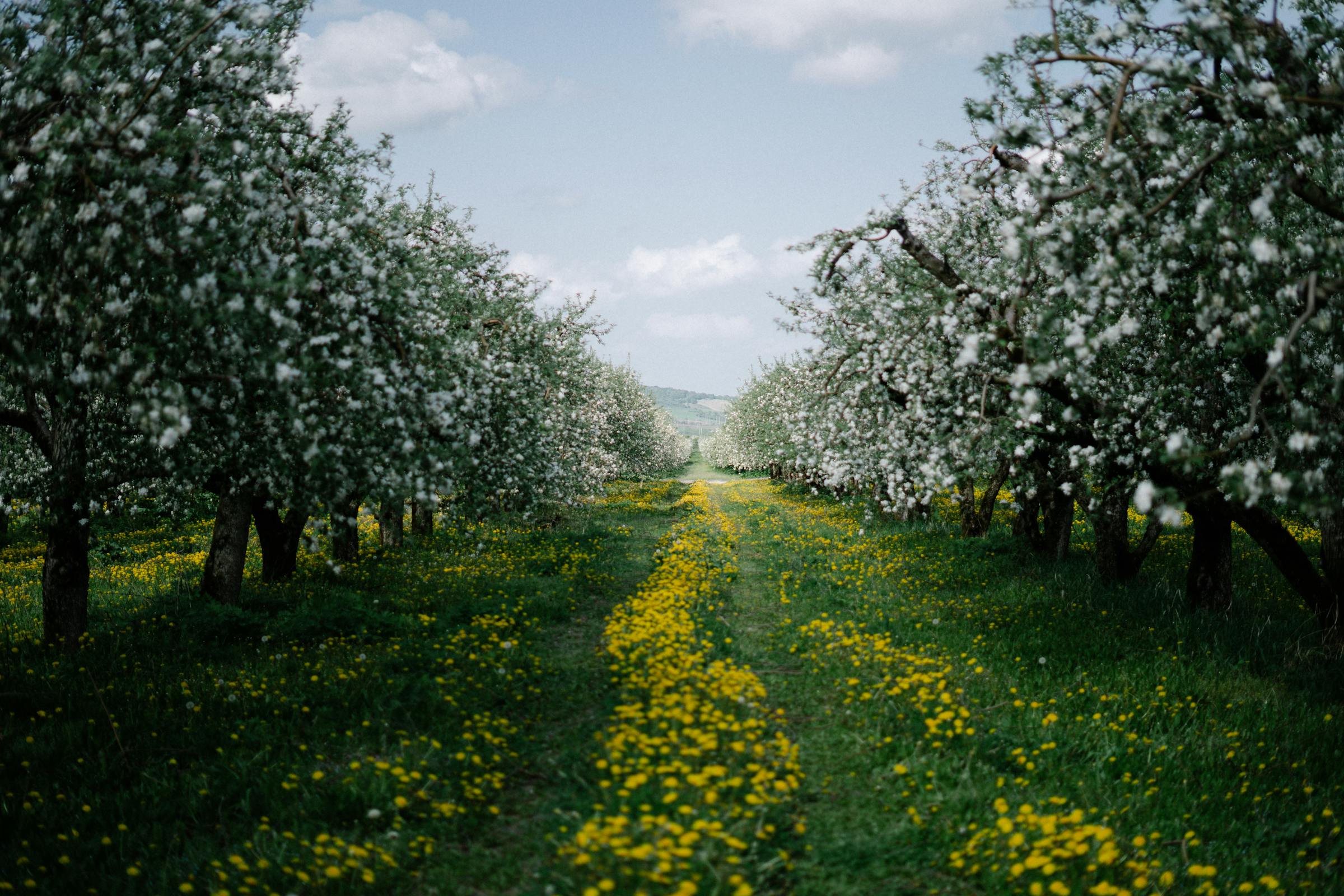 A single disease-resistant crabapple can pollinate every fruiting apple within range. Photo by Albina White / Pexels.
The crabapple solution. Ornamental crabapples are universal pollinizers. They bloom heavily over a long period, they are genetically compatible with all apple pollination groups, and a single disease-resistant crabapple can pollinate every fruiting apple within range. If you have room for only two trees, plant one fruiting apple and one crabapple. You get reliable pollination, ornamental value, and wildlife habitat.
Manchurian crabapple covers early-to-mid bloom varieties. Snowdrift covers mid-to-late. Sargent crabapple blooms mid-season and has outstanding disease resistance. For the full list of disease-resistant ornamental crabapples, including which ones double as pollinators, see Crabapple Varieties That Earn Their Space.
Seasonal Action Summary
| When | What | Why |
|---|---|---|
| Oct - Nov | Plant bare-root trees; clean up all fallen apple leaves | Bare-root planting establishes before winter. Leaf removal cuts scab inoculum by up to 90%. |
| Dec - Feb | Prune during full dormancy; apply dormant oil | Dormant pruning reduces disease entry points. Dormant oil smothers overwintering pests. |
| Mar | Assess bud swell; plan fungicide if on a susceptible variety | Green tip is the start of scab primary infection. Resistant varieties need no action. |
| Apr - May | Bloom period; confirm pollinizer overlap; watch for fire blight strikes | Pollination window. Remove any fire blight strikes 12 inches below visible symptoms. |
| Jun - Jul | Thin fruit to one per cluster, 6 inches apart on the branch | Thinning improves size, reduces biennial bearing, and reduces disease on crowded fruit. |
| Aug - Oct | Harvest by variety; begin fall leaf cleanup as leaves drop | Early varieties (Pristine, Redfree) in August. Late varieties (Enterprise) into October. |
Sources
- PNW Plant Disease Management Handbook, “Apple Cultivar Susceptibility,” Oregon State University / Washington State University.
- Khan Lab, “Disease Susceptibility Ranking of Apples,” Cornell University. blogs.cornell.edu/applevarietydatabase
- “Plant Disease-Resistant Apple Varieties,” OSU Extension Service.
- G6001, “Pollinating Fruit Crops,” University of Missouri Extension.
- “Which Apple Rootstock Should You Grow With?” Good Fruit Grower / Michigan State University.
- “Apple Orchard Diversity: Every Weather Event Selects for Resilience,” OSU Extension Service.
- “Apples: Choosing Cultivars,” Royal Horticultural Society. rhs.org.uk/fruit/apples/choosing-cultivars
- “Fire Blight Susceptibility of Common Apple Cultivars,” Khan Lab, Cornell University. blogs.cornell.edu/khanlab
- WSU Maritime Fruit Research Program, Variety and Cultural Trials.
Pesticide products mentioned in this guide are for informational purposes. Always read and follow the label. Washington State law governs pesticide use; verify current registration status before purchase.