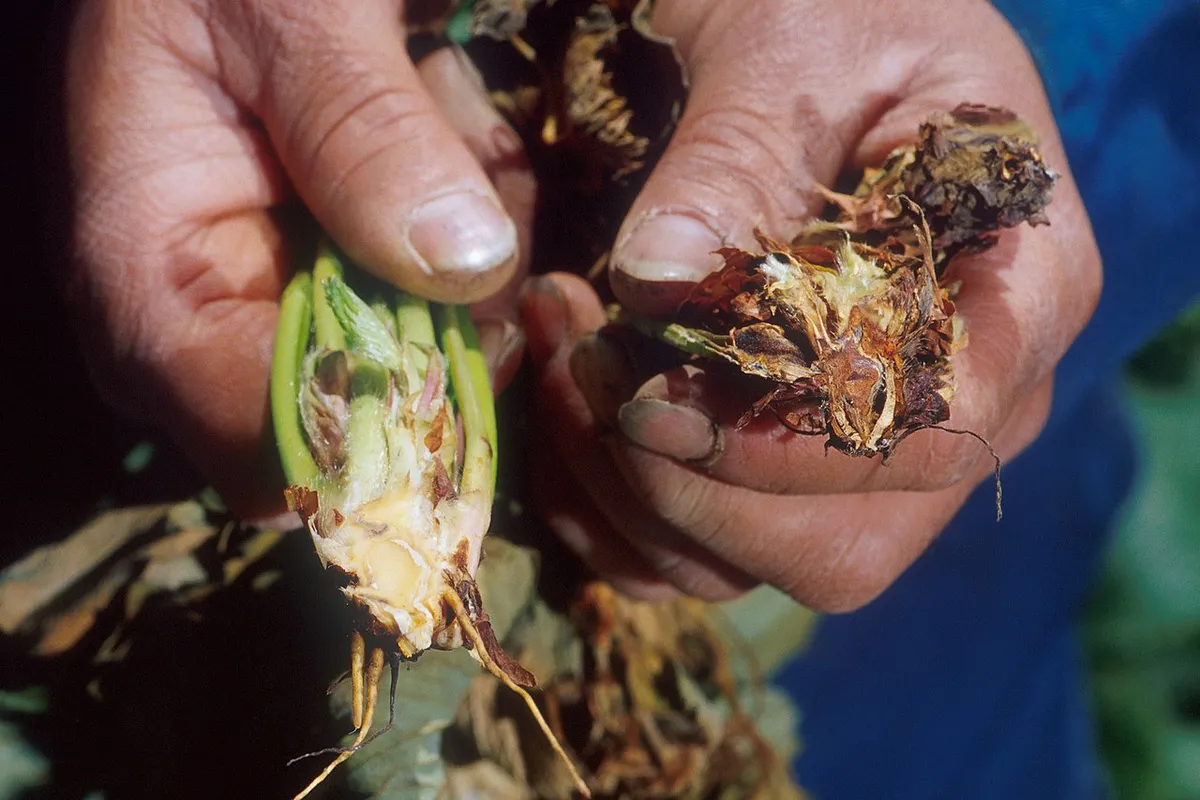
You notice it on a Tuesday in July. One side of your Japanese maple wilts while the other side looks fine. You water it, and the wilted side perks up slightly, then droops again by afternoon. A week later another branch goes. By September, half the canopy has yellowed and dropped leaves while the other half holds its fall color normally. You spend the winter hoping it recovers. It does not. The following spring, fewer buds break on the affected side. By the second summer, the pattern is unmistakable: the tree is dying in sections, and nothing you do stops it.
That is Verticillium wilt. The fact that defines everything else about this disease: once it is in your soil, it stays for decades. No fungicide touches it. No cultural practice eliminates it. No amount of water, fertilizer, or good intentions reverses an infection. The only real strategy is knowing whether it is present and planting accordingly.
Reading the Wilt Pattern
Verticillium wilt announces itself through asymmetry. One branch or one side of the canopy fails while the rest looks healthy. That lopsided decline is the diagnostic signature of a vascular disease, where the pathogen blocks water transport unevenly through the tree’s internal plumbing.
The progression follows a predictable rhythm. Affected leaves yellow from the margins inward, sometimes with a reddish tint. The wilting intensifies on warm days when transpiration demand is highest and eases on cool, overcast days when the tree needs less water. A branch that wilts in July may partially recover in August, then collapse permanently during the next heat wave. This intermittent pattern, stress that comes and goes before becoming permanent, is characteristic.
Cut into a suspect branch and you may find greenish-to-black streaking in the sapwood, following the grain. Cornell’s plant pathology program describes the same diagnostic: in cross-section, the discoloration appears in arcs or rings. This vascular staining confirms the fungus is colonizing water-conducting tissue. But it is not always visible, especially in early infections or smaller branches. Absence of streaking does not rule out the disease.
The risk of misdiagnosis is real. Drought stress, root damage, soil compaction, and transplant shock all produce wilting that looks similar in the early stages. The difference: those problems respond to correction. Water a drought-stressed tree and it recovers. Relieve compaction and you see improvement within weeks. Verticillium does not respond to any intervention. It only progresses.
One complication worth knowing: the PNW Plant Disease Management Handbook notes that trees with Verticillium are more prone to secondary infections. Bacterial dieback (Pseudomonas syringae), Nectria canker, and Cytospora canker all show up more frequently on Verticillium-infected maples. If you are seeing multiple problems on the same tree, Verticillium may be the underlying condition enabling the rest.
The Fungus in the Plumbing
Verticillium dahliae is a soilborne fungus that survives as microsclerotia, tiny dark resting structures that persist in soil for years. They wait. When roots of a susceptible plant grow nearby, the microsclerotia germinate in response to chemical signals from the root and infect through the root tissue.
From the roots, the fungus enters the xylem, the network of vessels that moves water from roots to leaves. Once inside, it does two things simultaneously. It grows as thread-like mycelium through the vessels and produces spores (conidia) that float passively in the water column. The same upward water flow that keeps the tree alive carries the disease through the trunk and into the branches. The fungus also produces toxins that disrupt the tree’s ability to conduct water, compounding the physical blockage with chemical damage.
As infected tissue dies, the fungus produces new microsclerotia within that dead wood. When branches decay and fall, those microsclerotia enter the soil and the cycle begins again. This is why the disease is permanent: every infected tree that dies or drops branches returns inoculum to the ground.
The host range is staggering. UC Davis IPM puts the number at over 300 susceptible plant species, including ornamental trees, vegetables, berries, and common weeds. Tomatoes, potatoes, strawberries, peppers, raspberries, and roses all host V. dahliae. Many common weeds in the nightshade family sustain the fungus between susceptible crops. Plant-parasitic nematodes in the soil can increase both disease incidence and severity, creating a compounding problem in depleted or poorly managed soils.
One regional detail matters: the wet winters here do nothing to suppress Verticillium. The microsclerotia survive freeze-thaw cycles, saturated soil, and dry summers equally well. This is not a pathogen with a seasonal weakness you can exploit.
What It Attacks
In residential and municipal landscapes across the Puget Sound region, maples bear the heaviest burden.
The Oregon State University Plant Clinic reports that Verticillium wilt has dominated maple disease diagnoses. Japanese maple (Acer palmatum) is the most commonly affected species in regional landscapes because it is the most commonly planted susceptible maple. If you see a declining Japanese maple in this region, Verticillium belongs at the top of your diagnostic list. Among Japanese maple cultivars, Bloodgood shows moderate tolerance, while Sango Kaku and other cultivars show less resistance.
Vine maple (Acer circinatum), despite being native, carries documented susceptibility. Cases are less frequent than Japanese maple, but the vulnerability exists. If a vine maple dies without obvious cause in a site where susceptible plants have grown before, consider Verticillium.
Norway maple (Acer platanoides) is susceptible, though the cultivars ‘Jade Glen’ and ‘Parkway’ are reported as tolerant. Sugar maple (Acer saccharum), red maple (Acer rubrum), and silver maple (Acer saccharinum) are all within the host range. Among maples, Japanese, Norway, red, silver, and sugar are the most susceptible group.
Beyond maples, several commonly planted ornamentals are at risk: smoke tree (Cotinus coggygria), catalpa, redbud (Cercis spp.), cherry and ornamental plum (Prunus spp.), magnolia, daphne, lilac, nandina, photinia, and viburnum. The vegetable garden connection is critical to understand: if you have grown tomatoes, potatoes, or strawberries in the same soil where you want to plant a Japanese maple, Verticillium is very possibly already present.
The host list also tells you what is safe. All conifers resist Verticillium. Birch, dogwood, sycamore, oak, holly, willow, apple, and juniper are not susceptible. Among ground-level plants, ageratum and impatiens are resistant. These are your replanting options when Verticillium is confirmed.
Living with an Infected Tree
There is no cure. Accept that early, because it changes the questions you ask. The question is not “how do I fix this” but “how long does this tree have, and what do I do with the site after?”
Prune infected branches promptly. Cut well below visible symptoms, at least six inches into healthy-looking wood. The goal is to remove tissue before it decays and releases microsclerotia into the soil beneath the tree. Disinfect pruning tools between every cut with 70% alcohol or a 10% bleach solution. Do not skip this. Contaminated tools spread the fungus to healthy tissue.
Dispose carefully. Do not chip infected wood and spread it as mulch. Do not leave dead branches in a pile where material might be moved to other parts of your property. Burn it where legal, bag it for landfill disposal, or arrange professional removal. Every piece of infected wood that decays on your property returns inoculum to the soil.
Keep nitrogen low. Excess nitrogen pushes soft, succulent growth that the fungus colonizes more easily. Fertilize minimally, enough for normal growth and no more. The same caution applies to irrigation: overwatering does not help a tree with blocked vascular tissue. It can make the problem worse.
Do not panic into removal. Some trees live for years with Verticillium, maintaining partial canopies and enough vigor to remain landscape-worthy. Others crash within a season. You cannot predict which path your tree will take. Remove it when the decline becomes unsightly or when dead branches create a safety risk, not at the first sign of infection.
The Planting Decision
This is where you win or lose with Verticillium. Not at diagnosis, not at management, but at the moment you put a new plant in the ground.
Test before planting. If you are moving to a new property, buying a house with a landscape you intend to replant, or converting a vegetable garden to ornamental plantings, find out what grew there before. A history of tomatoes, potatoes, strawberries, raspberries, or previous maple failures is a red flag. Preplant soil testing for Verticillium propagules is available through WSU Extension and private labs. The presence of any microsclerotia in the soil should be interpreted as a disease risk.
Choose resistant species for confirmed sites. When Verticillium is present, your planting palette narrows but does not disappear. Conifers (Douglas fir, western redcedar, hemlock, spruce), birch, dogwood, sycamore, oak, holly, willow, apple, and juniper are all options. Among maples, the Norway maple cultivars ‘Jade Glen’ and ‘Parkway’ show tolerance. Among roses, rootstocks bred from Rosa multiflora and ‘Dr. Huey’ show more resistance than R. odorata or ‘Ragged Robin’. R. chinensis var. manetti is very resistant.
Do not replant susceptible species in the same hole. If a Japanese maple died from Verticillium, planting another Japanese maple in the same location is not optimism; it is a guaranteed repeat of the same outcome. The microsclerotia are concentrated exactly where the previous root system was. Plant something resistant, or plant a susceptible species at least 20 feet away in soil that has not hosted the fungus.
One research finding worth noting: the PNW Plant Disease Management Handbook cites a Netherlands nursery trial where incorporating freshly mown Italian ryegrass into soil, followed by covering with plastic for three months in late summer, reduced Verticillium disease incidence in a subsequent Norway maple crop. The effect lasted up to four years. This is not a home gardener technique, but it points toward soil biofumigation as a future management direction.
Keeping Clean Soil Clean
If Verticillium is not in your soil, the strategy is simple: do not let it arrive.
The fungus moves through soil, in infected plant material, on equipment, and on boot soles. Do not import soil, mulch, or compost from unknown sources. Mulch with conifer-based products where possible, since conifers do not host the fungus. General yard waste mulch could contain infected plant tissue. Do not share gardening tools or equipment with properties known to have Verticillium without thorough cleaning.
If you hire landscape contractors, understand that their equipment moves between properties. Mowers, tillers, and shovels that contact infested soil carry microsclerotia. Ask whether they clean equipment between sites. This is not an unreasonable question for a disease that permanently alters what you can grow.
Weed management matters more than most people realize. Many common weeds in the nightshade family sustain the fungus. Keeping the soil around susceptible plantings weed-free reduces the reservoir of hosts that maintain Verticillium between ornamental crops.
Why This Region Is Different
National gardening resources treat Verticillium wilt as a warm-climate problem concentrated in the Southeast and Midwest. On this side of the Cascades, the story is more nuanced.
The maritime climate and shorter growing season likely slow the fungus compared to warmer regions. But “slower” does not mean “absent.” The OSU Plant Clinic’s experience with maple diagnoses confirms the disease is active on the west side of the Cascades. The wet winters that suppress some other pathogens have no effect on Verticillium microsclerotia. And the region’s popularity of Japanese maple, planted in dense residential landscapes where soil has often supported vegetable gardens, creates ideal conditions for the disease to establish and persist.
The practical difference is timing. In hotter climates, Verticillium can crash a tree in a single growing season. Here, the decline tends to stretch over multiple years, which gives the false impression that the tree might recover. It will not. The slower progression is not mercy; it is a longer window to make replanting decisions before the tree becomes unsightly.
When to Act
| When | What | Why |
|---|---|---|
| Mar - May | Scout susceptible trees as new growth emerges | Vascular blockages become obvious when transpiration demand rises. Failed bud break or thin leafout on one side signals infection. |
| Jun - Aug | Monitor for one-sided wilt during warm spells | Heat stress reveals what the fungus has been doing all year. Asymmetrical wilting on warm days is the diagnostic signature. |
| Jun - Sep | Prune dead and declining branches as they appear | Remove infected tissue before it decays and returns microsclerotia to soil. Cut 6+ inches below symptoms. Disinfect tools between cuts. |
| Sep - Oct | Complete branch removal before leaf drop | Fallen infected leaves add inoculum to soil. Remove diseased material before it hits the ground. |
| Oct - Nov | Clean up all fallen debris from infected trees | Rake thoroughly. Bag and dispose, do not compost. Reducing soil inoculum slows the cycle. |
| Before planting | Test soil if property has history of susceptible crops | Preplant soil assay for Verticillium propagules. Any detection indicates risk. Contact WSU Extension or private labs. |
| At planting | Choose resistant species for confirmed Verticillium sites | Conifers, birch, dogwood, sycamore, oak, holly, juniper. Do not replant susceptible species in the same location. |
| Ongoing | Prevent soil movement from infested to clean areas | Clean tools, equipment, and boots. Do not import unknown soil or mulch. Weed nightshade family hosts. |
For diagnosis of suspected Verticillium wilt, contact your county WSU Extension office or an ISA Certified Arborist.
Sources
Disease management:
- PNW Plant Disease Management Handbook: Verticillium Wilt entries (maple, cherry, rose, strawberry, raspberry, blueberry)
- WSU HortSense: Maple Verticillium Wilt
- UC Davis IPM: Verticillium Wilt
- Cornell Plant Pathology: Verticillium Wilt of Trees and Shrubs
Research:
- Serdani, M. et al. 2017. “First Report of Verticillium dahliae causing dieback of highbush blueberry in Oregon and Washington.” Plant Disease
- Cirulli, M., Amenduni, M. and Paplomatas, E. J. 1998. “Stone Fruits.” In A Compendium of Verticillium Wilts in Tree Species. CPRO. ISBN 90-73771-25-0
- Betzen, J. J. et al. 2021. “Bigleaf maple decline in western Washington, USA.” Forest Ecology and Management 501
- Brooks, R. K. et al. 2023. “Cryptostroma corticale appears widespread in western Washington State, USA.” Forest Pathology 53:e12835
General reference: