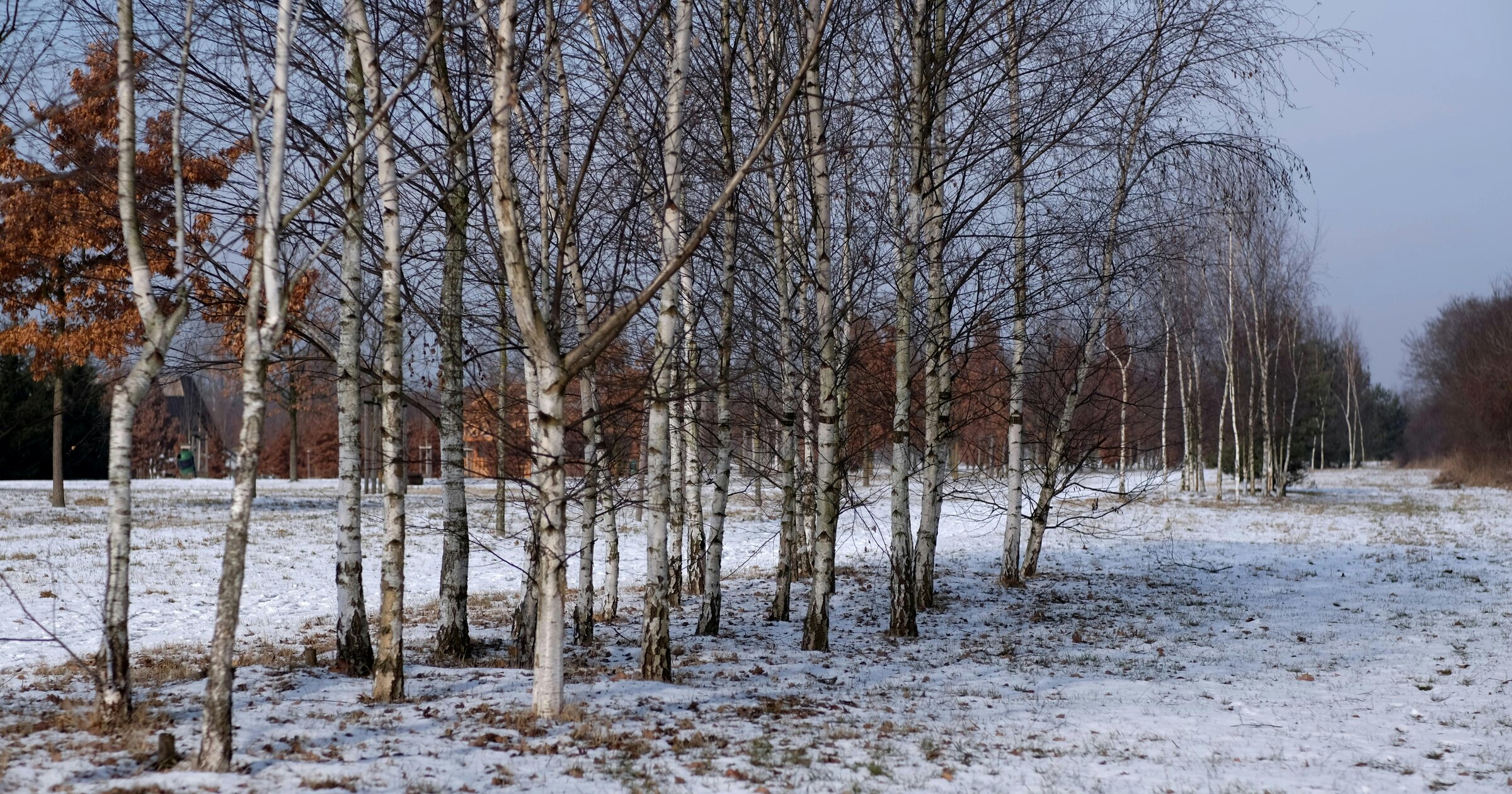
You planted a European white birch because you wanted that white bark against a dark fence, or because the developer put one in twenty years ago and you inherited it. For a decade or more, the tree looked fine. Now the top of the canopy is thinning. Leaves up there are smaller and yellower than they should be. You water it, and the lower branches stay green while the crown keeps dying back. By the time you notice D-shaped exit holes the size of a grain of rice punched through the bark, the insect responsible has been feeding inside the tree for one to two years.
That is bronze birch borer (Agrilus anxius), and the damage you see now reflects drought stress from one or two growing seasons ago. The tree did not suddenly get sick. It has been losing a slow war inside its own bark since the last dry summer you forgot to water through.
What You Are Looking At
The pattern is top-down dieback, and it is the signature of this pest. Upper crown branches thin and die first because they are farthest from the roots and most vulnerable when water transport gets disrupted. Lower branches stay green longer, which is why homeowners assume the tree just needs water. It does need water, but the real problem is what the lack of water invited.
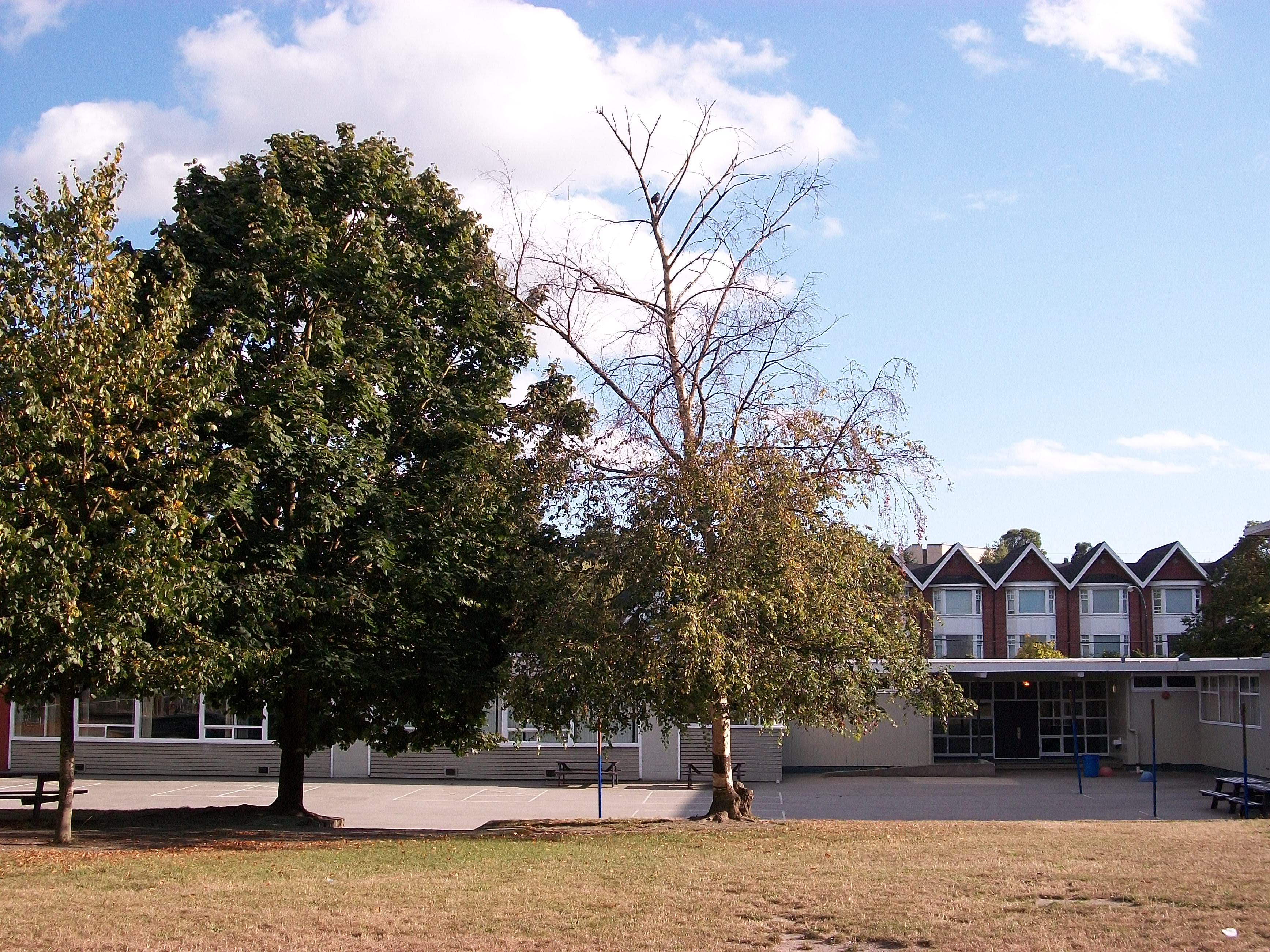 Top-down crown dieback in birch, the signature pattern of bronze birch borer infestation. Photo: Mathew5000, Wikimedia Commons, CC BY-SA 3.0.
Look for raised, bumpy bark on affected branches. Beneath those ridges, larvae have been carving S-shaped galleries through the cambial layer, the thin tissue between bark and wood that moves water and nutrients. The tree tries to callus over the galleries, which creates that rumpled texture you can feel with your hand. On branches where the bark has loosened, peel it back and you will see the winding, packed-frass galleries underneath.
The definitive confirmation is the D-shaped exit hole. When adult beetles chew their way out of the bark, they leave a hole shaped like a capital D, roughly 3 mm across. If you find these holes, you are looking at last year’s generation. The adults that made those holes have already mated, laid eggs, and died. Their larvae are feeding inside the tree right now, invisible.
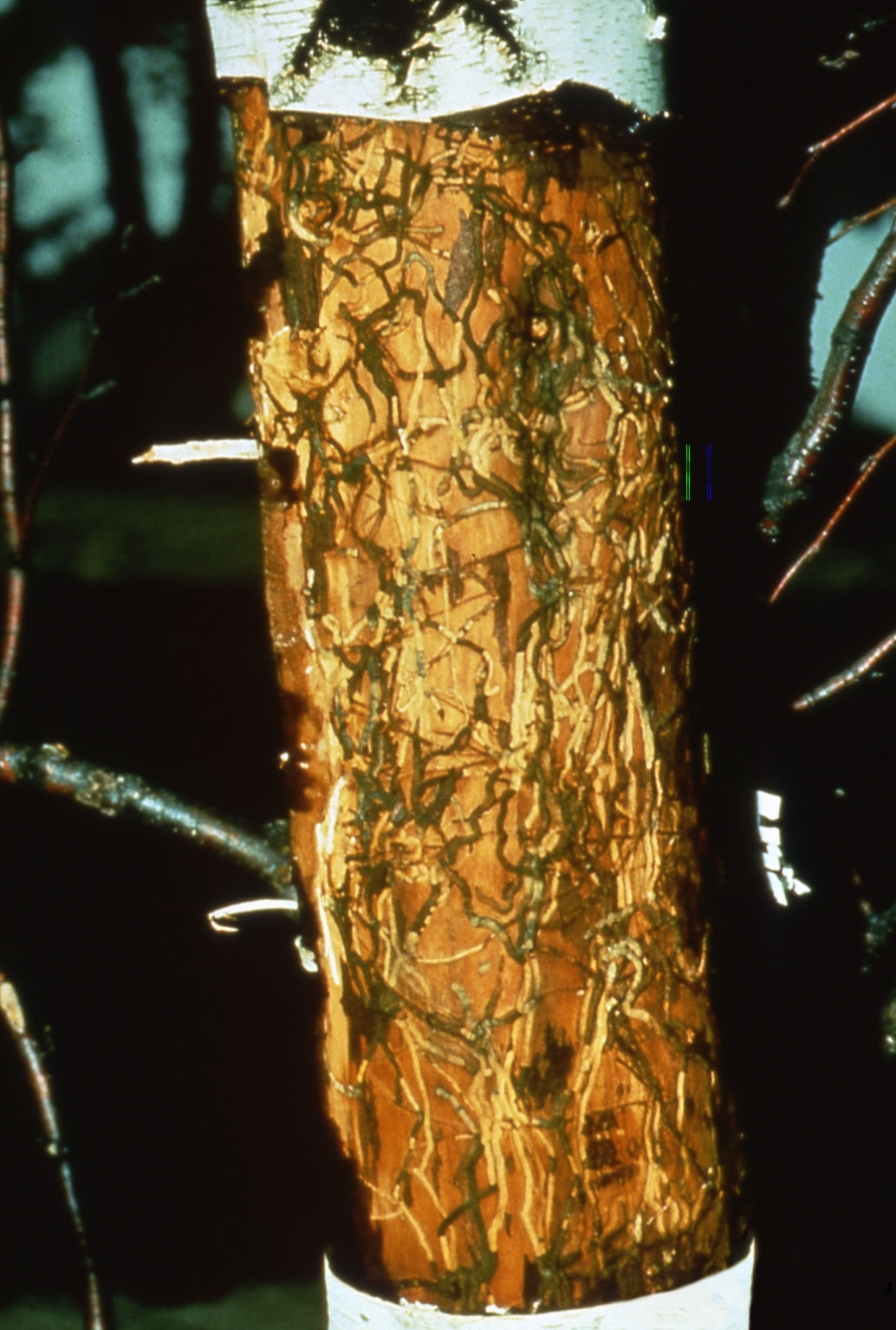 Bronze birch borer adult beetle and D-shaped exit holes on birch bark. Photo: Joseph O’Brien, USDA Forest Service (public domain).
Other signs: liquid ooze or amber-stained blotches on the bark, especially on the sunny side of the trunk. Epicormic sprouts (clusters of small shoots erupting from the trunk) as the tree desperately tries to replace lost canopy. Woodpecker activity, because woodpeckers feed on the larvae through winter, leaving rectangular bark excavations that are easy to spot.
Why This Happens (And Why It Started Last Year)
Bronze birch borer is native to North America and is an obligate stress-exploiter. Healthy birches resist it. The larvae simply cannot establish in vigorous trees with enough sap pressure and defensive chemistry to drown or wall off young larvae before they can feed. The pest targets trees whose defenses are already compromised, and in the Puget Sound lowlands, the primary trigger is summer drought.
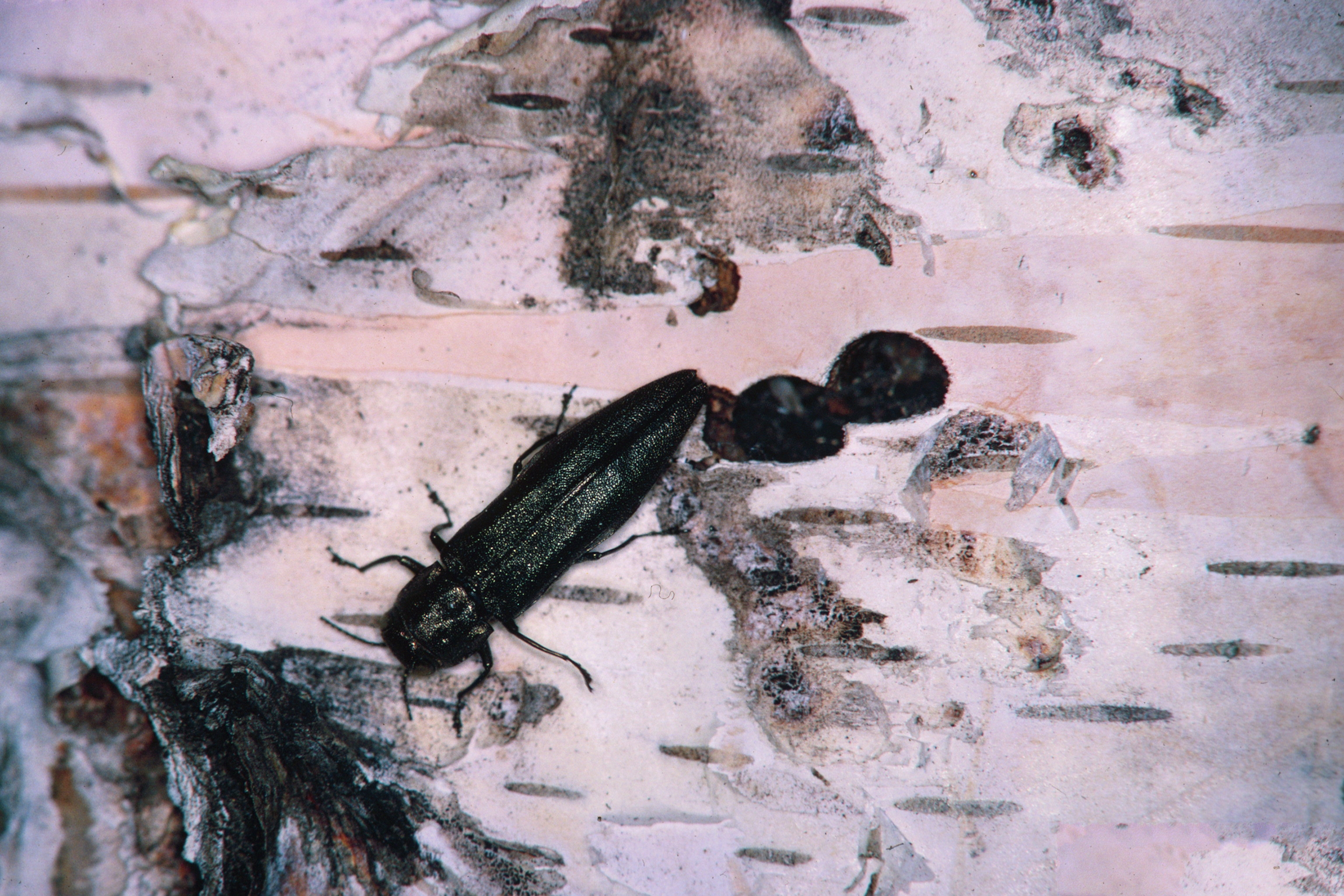 Larval galleries carved through the cambial layer under birch bark. This is the damage that girdles branches and kills trees from the inside. Photo: Steven Katovich, USDA Forest Service (public domain).
This creates a temporal disconnect that catches homeowners off guard. The stress event (a dry July and August where the tree received no supplemental irrigation) happens in Year 1. Female beetles detect the stressed tree and lay eggs in bark crevices during their flight window. Larvae hatch, bore in, and begin feeding in the cambial layer. They may feed for one to two years depending on climate. Visible crown dieback appears in Year 2 or Year 3, by which point the infestation is well established. You are always seeing the consequence of a problem that started one to two seasons earlier.
The Puget Sound region has a particular vulnerability. Our summers are consistently dry from July through September, and birch is a moisture-demanding genus. National BBB guidance is written mostly for the upper Midwest and Northeast, where drought comes in unpredictable heat waves. Here, the dry season is predictable and manageable with irrigation. The problem is that homeowners with European white birch often do not realize their tree needs summer water. The Puget Sound region feels wet. It is wet, for nine months of the year. Those three dry months are when birches get stressed and borers get in.
Clay soils compound the problem. In Kent and across the lowland river valleys, clay soils hold water through the wet season (sometimes too much, waterlogging roots in winter) and then lock up tight in summer. The soil surface cracks, the root zone dries rapidly, and the tree faces a whiplash cycle: soggy roots in February, desiccated roots in August. Both conditions stress the tree. Both open the door for borers.
Why Some Birches Resist and Others Do Not
This is not random. Research published in Arboriculture & Urban Forestry by Frank Santamour identified a bark compound called rhododendrin that correlates directly with susceptibility. When a birch tree is drought-stressed, rhododendrin breaks down into rhododendrol, which acts as an oviposition stimulant: it signals to female beetles that this is a suitable host for egg-laying.
Species that evolved alongside bronze birch borer in North America either lack rhododendrin entirely or carry it in trace amounts. Species from Europe and Asia, which never encountered this beetle in their evolutionary history, produce the compound in concentrations that make them easy targets.
The numbers are specific. River birch (Betula nigra) contains 0% rhododendrin. Sweet birch (B. lenta), Dahurian birch (B. davurica), and water birch (B. occidentalis) carry 0.02 to 0.06%. These species are functionally immune. Paper birch (B. papyrifera), native and moderately resistant, ranges from 0.05 to 0.4%, with variability between individual trees.
At the other end: European white birch (B. pendula) carries 0.6%. Himalayan birch (B. utilis subsp. jacquemontii) carries 1.2%. Japanese white birch (B. platyphylla) hits 2.0%. Gray birch (B. populifolia) reaches 2.2%, and downy birch (B. pubescens) tops the list at 3.3%. The exotic species in this group are all highly susceptible. Gray birch is the exception: despite its high rhododendrin concentration, it is native and carries co-evolutionary defenses that partially compensate, which is why WSU rates it as having “some resistance” rather than none.
Monarch birch (B. maximowicziana) is an interesting exception. Santamour’s chemistry shows 0% rhododendrin, which should make it resistant. Some field reports from Ohio suggest it is susceptible because, as an East Asian species, it lacks co-evolutionary defenses beyond the chemical ones. The likeliest explanation: it is biochemically resistant but often environmentally stressed in North American conditions, making it functionally susceptible despite lacking the attractant compound. If you are considering monarch birch, understand that the data is conflicting.
One taxonomic note: the birch cultivar ‘Whitespire,’ widely sold as B. platyphylla var. japonica, is actually B. populifolia (gray birch). Santamour proved this through secondary chemical analysis. This matters because the two species have different resistance profiles. True gray birch carries some resistance; Japanese white birch does not. If you bought ‘Whitespire’ for BBB resistance, it is more resistant than the label implies, though not immune.
Susceptibility at a Glance
Highly resistant: River birch (B. nigra), Heritage river birch, Fox Valley river birch, sweet birch (B. lenta), Dahurian birch (B. davurica), water birch (B. occidentalis)
Moderately resistant: Paper birch (B. papyrifera), yellow birch (B. alleghaniensis), gray birch (B. populifolia) including ‘Whitespire’
Highly susceptible: European white birch (B. pendula), Himalayan birch (B. utilis subsp. jacquemontii), Japanese white birch (B. platyphylla), downy birch (B. pubescens)
European white birch is the dominant ornamental birch in the Puget Sound lowland installed base, planted extensively in suburban development from the 1960s through the 1990s. The trees most at risk are the trees already everywhere.
When to Act: GDD Timing and Indicator Plants
Adult beetles emerge in early summer when accumulated growing degree days reach approximately 2,500 to 3,000 GDD₃₂ in the Puget Sound lowlands. Most university extension research reports bronze birch borer emergence at 400 to 550 GDD base 50°F, and six independent sources (MSU, UMD, UMass, Pest Prophet, USA-NPN, Rutgers) converge on that range. We convert to base 32 on this site because base 50 is blind to the biologically active heat that accumulates during our mild maritime winters and springs; a day averaging 45°F registers nothing on a base-50 model but banks 13 degree-days on base 32. For a fuller explanation of why this matters here, see our growing degree days guide. Translated through five years of Kent station data, the published emergence range corresponds to roughly 2,500 to 3,000 GDD₃₂ depending on how the spring played out. Peak oviposition activity extends through approximately 3,400 GDD₃₂, with the full activity window running to about 3,600 GDD₃₂ in some years.
In practice, that means adult emergence beginning in late June to early July here, with peak activity through mid to late July and the full flight window running into August. This is later than national calendars indicate (UMN Extension says “early June” for Minnesota; Morton Arboretum says “late May or June” for Chicago), because our maritime climate accumulates heat more slowly than continental interiors.
Two indicator plants give you a visual signal without needing to track degree days. When black locust (Robinia pseudoacacia) blooms and Vanhoutte spirea (Spiraea × vanhouttei) is in full flower, bronze birch borer adults are emerging. Both are common in the regional landscape and easy to spot from the road. When you see them blooming, start monitoring your birches.
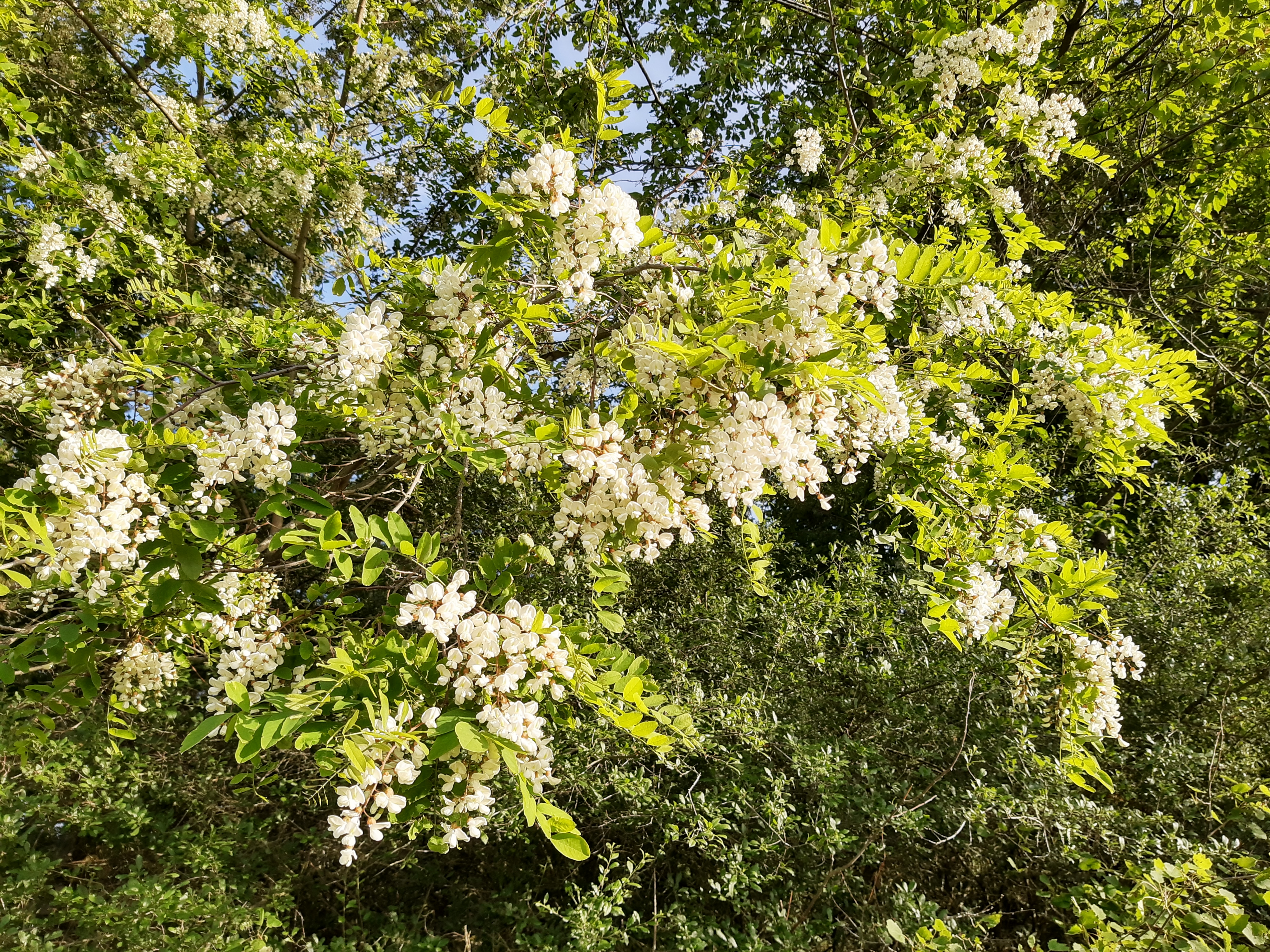 Black locust in full bloom. When you see this, bronze birch borer adults are emerging. Photo: Gerda Arendt, Wikimedia Commons, CC BY-SA 4.0.
The pruning avoidance window runs from late April through mid-July. Adult beetles are attracted to fresh pruning wounds, and pruning during the flight window invites egg-laying on freshly cut tissue. Schedule any birch pruning for late summer (September) through winter dormancy.
For readers who want precise local forecasts, the USA National Phenology Network publishes real-time BBB emergence forecast maps, and Oregon State runs a degree-day prediction model calibrated for the Pacific Northwest.
Can This Tree Be Saved?
That depends on how far the damage has progressed. OSU Extension developed a five-level crown damage assessment that maps directly to treatment decisions.
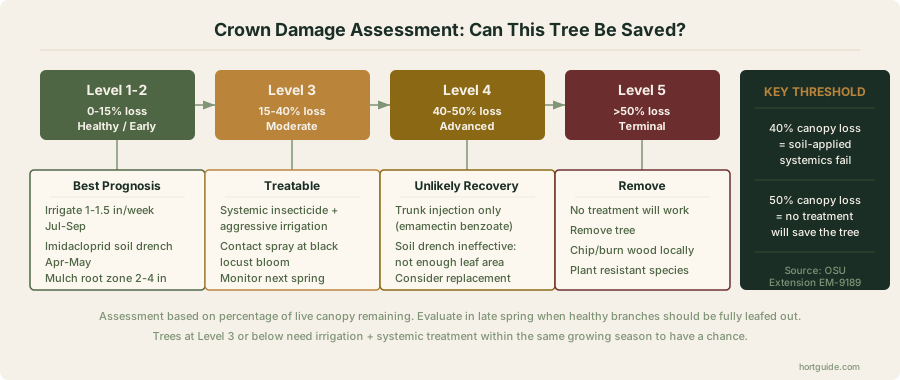 Crown damage assessment adapted from OSU Extension EM-9189. The 40% and 50% canopy loss thresholds determine whether treatment can succeed.
Level 1 to 2 (healthy to early symptoms). Upper crown may be slightly thinner than normal. Few or no exit holes visible. This is the best window for intervention. Systemic insecticides are highly effective at this stage because the tree still has enough leaf area to transport the chemical through its vascular system.
Level 3 (moderate canopy loss, under 40%). Significant thinning in the upper crown. Exit holes present. Branches dying back. Treatment is still worthwhile, but success depends on aggressive irrigation and prompt insecticide application during the treatment window.
Level 4 (40 to 50% canopy loss). OSU’s assessment: “saving the tree is unlikely, but possible under ideal conditions.” Those ideal conditions mean abundant water, professional trunk injection with emamectin benzoate, and acceptance that recovery will take years if it happens at all.
Level 5 (over 50% canopy loss). No treatment will save this tree. Removal is the only option. The Klamath Basin experience is instructive: an OSU survey in 2022 found that 91.6% of 312 birch trees showed BBB damage, with 51.5% rated Level 4 or 5. That is what unmanaged BBB looks like at a landscape scale.
What to Do
Prevention (Healthy Tree, No Signs)
Water is the single most important intervention. During July through September, provide 1 to 1.5 inches of water per week over the root zone. This is the cheapest and most effective defense against BBB, because a well-hydrated tree resists larval establishment. Mulch the root zone with 2 to 4 inches of arborist wood chips, keeping mulch away from the trunk, to conserve soil moisture and moderate root zone temperature. Avoid soil compaction in the root zone from foot traffic, parking, or equipment.
Early Intervention (Level 1 to 3)
Systemic insecticides are the primary tool. Three active ingredients are used for BBB:
Imidacloprid (soil drench): the most accessible option for homeowners. Apply mid-April through late May, when soil warms and the tree begins active transpiration. The product is taken up by roots and transported through xylem to the canopy. This is why tree health and timing both matter: the tree must have enough functioning leaf area to pull the chemical upward, and it must be actively transpiring (not dormant, not drought-shuttered). Fall applications are ineffective because transpiration slows approaching dormancy. Annual application is required.
Emamectin benzoate (trunk injection): the professional standard for maintaining high-value European birch. Injection delivers the active ingredient directly into the vascular system, bypassing the transpiration bottleneck that limits soil-applied systemics on stressed trees. Effective for three years per treatment. Requires a licensed applicator.
Dinotefuran (soil drench or granules): uptake is faster than imidacloprid, which can be an advantage when treatment is urgent, but persistence in the tree is shorter. May require more frequent reapplication.
The mechanism behind these recommendations matters. All three compounds travel through xylem, the water-conducting tissue. BBB larvae feed in the cambial layer at the xylem-phloem interface, so xylem-transported insecticides reach the feeding site. But only if the tree can move water. A tree with 40% canopy loss has lost 40% of its transpiration engine. This is the cruel arithmetic of BBB management: the trees that need treatment most are least able to benefit from soil-applied systemics. For advanced infestations, trunk injection is the better delivery method precisely because it does not rely on the tree’s own failing plumbing.
Contact sprays (permethrin, bifenthrin) can supplement systemic treatments during adult flight. Apply at black locust bloom and repeat according to label. These kill adults and eggs on the bark surface but do not reach larvae already inside the tree. Impractical for large trees. Carbaryl is effective but highly toxic to bees and not recommended where pollinators are present.
Pollinator protection: Apply soil-drench systemics after spring flowering is complete. Birch is wind-pollinated, but bees do visit catkins. Avoid broad-spectrum contact sprays during bloom of any nearby plants.
Too Late (Level 4 to 5)
Remove the tree. Chip or burn the wood locally; do not move unprocessed birch firewood off the property, because emerging adults can colonize new trees wherever the wood is stored. Plan a replacement planting with a resistant species.
What to Plant Instead
If you are removing a dead European white birch and want another birch, Heritage river birch (B. nigra ‘Heritage’) is the standard replacement. Exfoliating cinnamon-to-cream bark, multi-stem form, and proven BBB resistance across a wide geographic range. It tolerates wet soils and clay, which makes it well-suited to Puget Sound lowland conditions. One requirement: river birch prefers acidic soils (pH 3.0 to 6.5). In the naturally acidic soils typical of this region, that is rarely a problem. In heavily amended or alkaline soils, watch for iron chlorosis.
Fox Valley river birch (B. nigra ‘Little King’) is a dwarf form reaching about 10 feet, very resistant to BBB, and useful where a full-sized birch does not fit.
Sweet birch (B. lenta) is resistant and offers excellent fall color but has dark bark, not the white bark most birch buyers are looking for.
Paper birch (B. papyrifera) offers the white bark of B. pendula with moderate resistance to BBB, being a native co-evolved species. It still needs supplemental irrigation during dry summers. A better choice than European white birch but not bulletproof.
For any new birch, siting matters. East-facing exposures or locations with afternoon shade reduce summer heat load on the trunk. Mulch the root zone from the start. Plan for summer irrigation as a permanent part of the tree’s care, not an emergency response. These are moisture-demanding trees in a region with a predictable three-month drought.
Seasonal Action Summary
| When | What | Why |
|---|---|---|
| January through March | Inspect bark for D-shaped holes, gallery ridges, woodpecker damage. Pruning is safe during dormancy. | Assess current damage level before the growing season. |
| Mid-April through late May | Apply imidacloprid soil drench if treating. Begin irrigation as soil dries. | Treatment window: soil is warm, tree is transpiring, chemical uptake is highest. |
| Late April | Stop pruning birch. | Adult beetles are attracted to fresh wounds. Pruning avoidance runs through mid-July. |
| Late June through July | Monitor for fresh exit holes and adult beetles. Watch for black locust bloom and Vanhoutte spirea as emergence indicators. | Peak adult emergence at roughly 2,500 to 3,000 GDD₃₂. Contact sprays, if used, start now. |
| July through September | Irrigate: 1 to 1.5 inches per week over the root zone. | The single most important cultural control. Summer drought is the primary stress trigger. |
| Mid-September | Pruning window reopens. Remove dead or dying branches. | Assess crown damage level. Decide: treat next spring, remove, or replace. |
| October through November | Schedule professional trunk injection (emamectin benzoate) for next spring if pursuing long-term maintenance. Plan replacement planting for fall or next spring. | Professional treatments require scheduling. Fall is ideal for planting replacement species. |
Sources
- OSU Extension EM-9189: Homeowner Guide to Managing Bronze Birch Borer
- Santamour, F. S. Jr. (1999). “Progress in the Development of Borer-Resistant White-Barked Birches.” Arboriculture & Urban Forestry 25(3): 151-162. DOI: 10.48044/jauf.1999.021
- Nielsen, D. G. et al. (2012). “A Review of Bronze Birch Borer Life History, Ecology, and Management.” Environmental Entomology 41(6): 1372-1385. DOI: 10.1603/EN12238
- UMN Extension: Metallic Wood-Boring Beetles
- UC Davis IPM: Bronze Birch Borer
- UMass Extension: Bronze Birch Borer Fact Sheet
- Purdue Extension E-50: Bronze Birch Borer
- Morton Arboretum: Bronze Birch Borer
- WSU HortSense: Birch: Bronze Birch Borer
- OSU Degree-Day Model: BBB Prediction Tool
Always read and follow pesticide label directions. The label is the law.