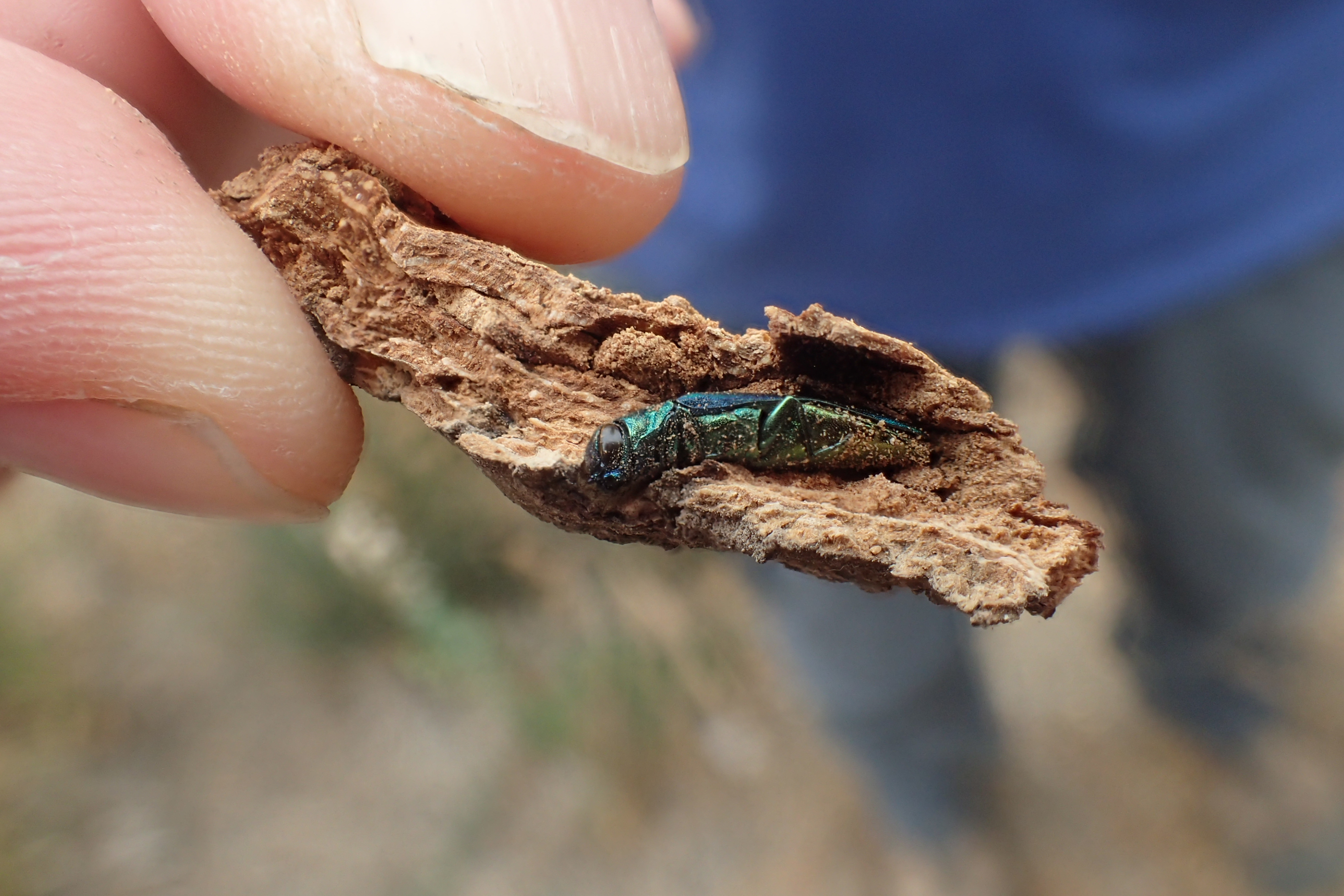
In July 2025, a private arborist in Portland noticed stress symptoms on a green ash near a swimming pool parking lot. The crown was thinning from the top. Bark had started splitting on the trunk. Purple prism traps confirmed what Oregon had been bracing for since 2022: emerald ash borer had reached the state’s largest city. By the time that arborist saw the damage, the beetles had likely been there for years.
That is the pattern with emerald ash borer (Agrilus planipennis). By the time you see the damage, the infestation is established. EAB does not give you warning symptoms you can act on incrementally. It gives you a countdown you did not know started. Portland is 145 miles south of Kent. The beetle disperses naturally at 2 to 20 kilometers per year, but one load of infested firewood moved up I-5 skips the whole timeline. This guide exists because you still have time to act. Oregon did not have a guide like this before Forest Grove. We do.
Where Are We Now
| Date | Event | Distance to Kent |
|---|---|---|
| June 2022 | First West Coast detection: Forest Grove, OR | ~180 mi |
| 2023-2024 | Spread confirmed in 4 OR counties (Washington, Yamhill, Marion, Clackamas) | ~160 mi |
| September 2025 | Confirmed in Portland (Multnomah County) | ~145 mi |
| January 2026 | Oregon establishes permanent 5-county quarantine | ~145 mi |
| April 2026 | Not detected in Washington state | n/a |
This guide is updated monthly. We check Oregon Department of Agriculture, Washington State Department of Agriculture, and the WA Invasive Species Council for new detections on the first of each month. Last checked: April 7, 2026.
The spread pattern from eastern North America is consistent: slow buildup for the first few years after arrival, then rapid acceleration. Oregon’s pest prevention manager described it to the Capital Press in September 2025: populations increase slowly at first, then build rapidly and spread in all directions at a faster pace. Every city that has dealt with EAB says the same thing: prepare before detection, because the window after detection is shorter than you expect.
What You Are Looking At
If EAB reaches your ash trees, here is how you will know.
Crown dieback starting at the top. The canopy thins from the upper third downward. This looks like drought stress, and many people mistake it for exactly that. The difference: drought stress on ash tends to produce leaf scorch and premature drop. EAB dieback produces bare branches with no leaves at all while the lower canopy stays green.
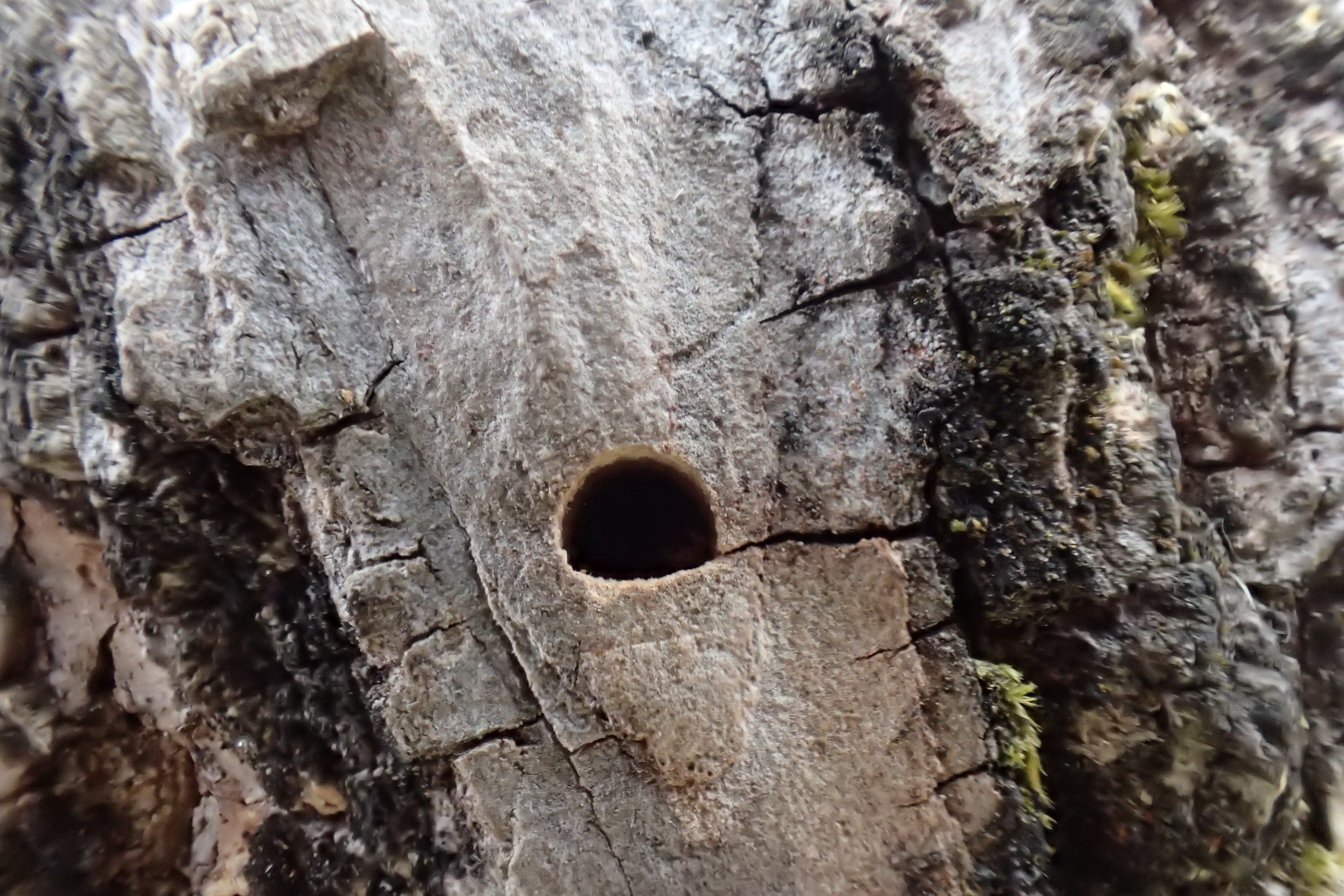
D-shaped exit holes. This is the diagnostic marker. When adult beetles emerge through bark in late spring, they leave a hole shaped like a capital D, approximately 3 to 4 millimeters across. Round holes are other borers. D-shaped holes on ash are EAB until proven otherwise.
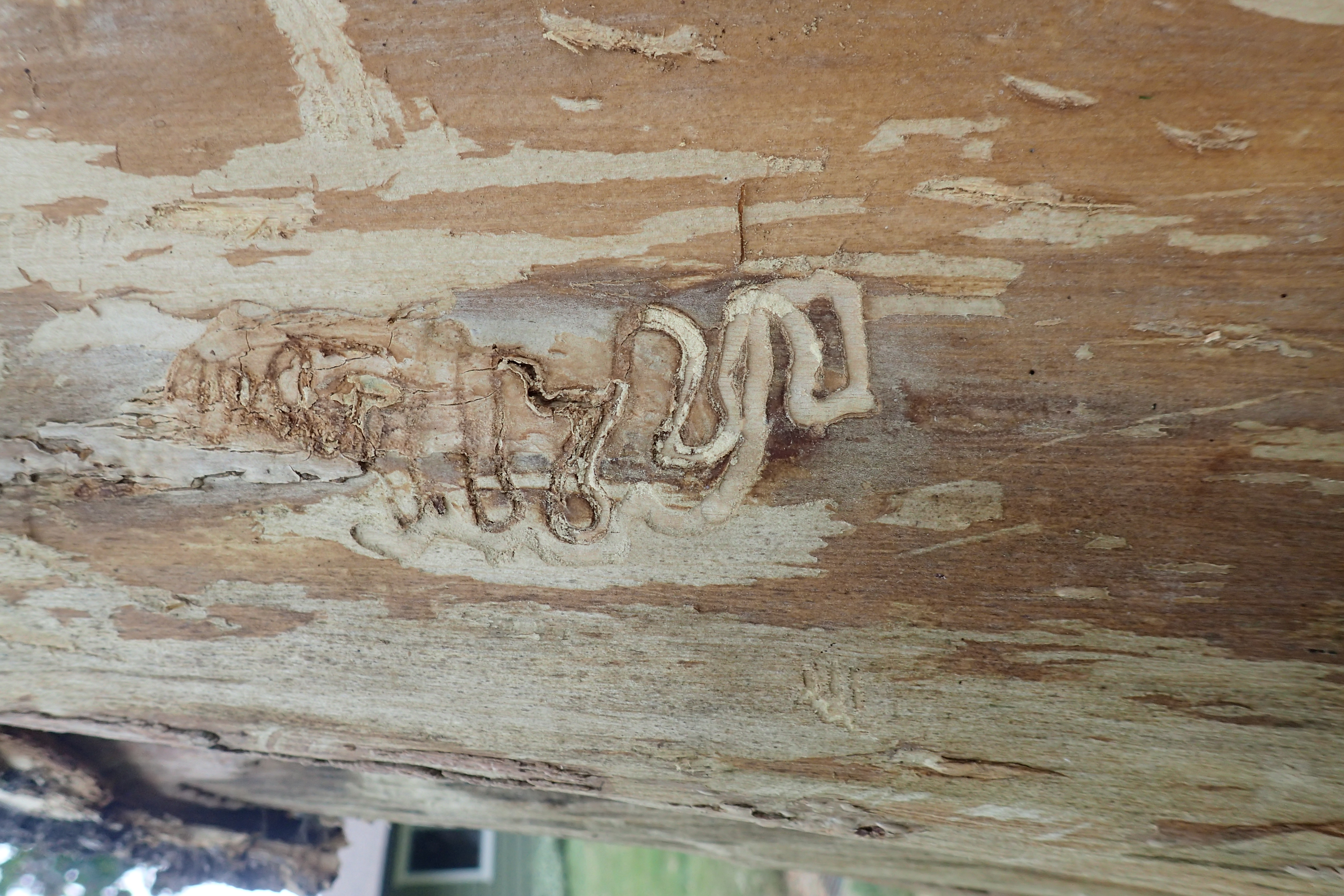
S-shaped larval galleries. Peel loose bark on a symptomatic tree and you will find serpentine galleries packed with frass winding through the phloem and outer sapwood. The galleries widen as the larva grows through four instars over the feeding season.
Epicormic sprouting. Clusters of small shoots erupting from the trunk and major limbs below the dying canopy. The tree is trying to replace the leaf area it is losing above. Heavy epicormic growth on the trunk of an ash is a late-stage symptom.
Bark blonding. Woodpeckers learn to forage for EAB larvae and excavate patches of outer bark, exposing the lighter inner bark. If your ash suddenly has more woodpecker activity than usual, look closer.
What you might confuse it with. Bronze birch borer is the same genus (Agrilus) and causes the same top-down dieback pattern, but on birch, not ash. The flatheaded appletree borer is larger, bronze-colored, and attacks a much broader host range. Native ash bark beetles leave round exit holes, not D-shaped ones.
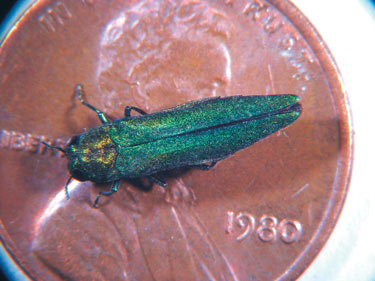
Who Gets Hit
Every ash species in North America is susceptible. In the Puget Sound lowlands, two species carry most of the risk.
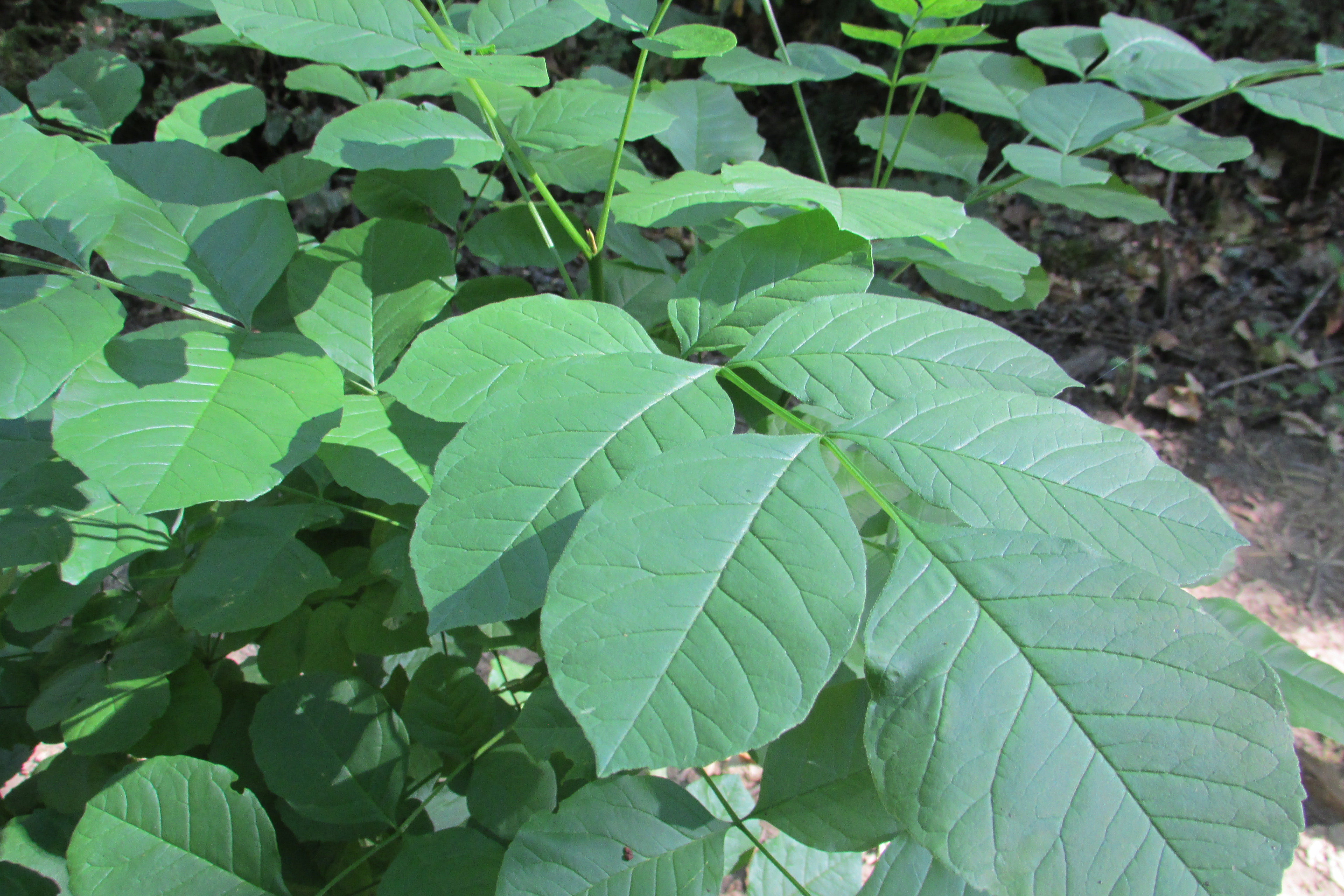
Oregon ash (Fraxinus latifolia) is the ecological story. It is the only ash species native to the Pacific Northwest, and it dominates riparian corridors, wetland margins, and floodplain forests throughout this region. Oregon ash stabilizes streambanks, provides shade over salmon-bearing waterways, and anchors a specific ecological community. Losing it would fundamentally change riparian landscapes across western Washington. In the Midwest, EAB killed landscape trees in subdivisions. Here, it threatens an irreplaceable native species in habitat that cannot be replanted with something else and function the same way.
Green ash (Fraxinus pennsylvanica) is the urban story. Fast-growing, wet-soil tolerant, and widely planted as a street and park tree across the region. If your municipality or HOA planted ash in the last 40 years, green ash is the likely species. Municipal ash inventories in Puget Sound cities are still incomplete, which means many communities do not yet know how many trees they will need to assess.
White ash (F. americana), European ash (F. excelsior), and flowering ash (F. ornus) are present in some landscapes. European ash faces a compounding threat: ash dieback (Hymenoscyphus fraxineus) is decimating it across Europe, and EAB would be a second blow wherever it has been planted here.
Blue ash (F. quadrangulata) shows some documented resistance, surviving at higher rates than other North American species at low EAB densities. It is still killed when beetle populations build. White fringetree (Chionanthus virginicus) is a secondary host attacked only at high population densities.
What Oregon Is Doing (And What We Will Do)
Oregon’s response since 2022 is the template for Washington’s future. Three phases, each with specific actions.
Phase 1: Pre-detection. This is where Washington stands now. WA DNR published the Urban Forestry Pest Readiness Playbook and Recommendations for EAB Response in Washington Communities in March 2025. Communities are urged to inventory their ash, develop response plans, and build budget projections for treatment and removal. Portland stopped approving ash as street trees in 2019, three years before the first detection. Oregon nurseries have largely transitioned away from ash species. If you are still planting ash, stop.
Phase 2: Detection and quarantine. Oregon’s permanent quarantine (OAR 603-052-1075) now covers five counties and restricts movement of ash, olive, and white fringetree materials: logs, green lumber, nursery stock, chips, mulch, stumps, roots, branches, and all hardwood firewood. When EAB is detected in Washington, expect similar restrictions. The key rule for homeowners: do not move ash firewood. Human-assisted transport via firewood is the primary mechanism for long-distance spread, and it is the one thing you can personally prevent.
Phase 3: Treatment, biocontrol, and managed decline. Portland completed its EAB Response Plan in June 2025. The city treats healthy, mature ash in low-canopy neighborhoods where losing tree cover would hit hardest. Declining and poorly sited ash get removed and replaced. Oregon received federal funding for biocontrol releases (parasitoid wasps from EAB’s native range in China) starting in 2025, with additional releases planned through 2026.
The Treatment Decision
Not every ash is worth treating. This is the hardest conversation, and having it now, before EAB arrives, is the entire point of this guide.
When to treat:
- Tree has less than 50% canopy loss
- Trunk diameter is greater than 6 inches DBH
- Tree is within 15 miles of a confirmed EAB detection (or you are preemptively protecting a high-value specimen)
- Tree has structural significance: heritage status, major canopy contribution to the property, streambank stabilization
When to remove:
- Greater than 50% canopy loss
- Trunk diameter under 6 inches (too small for effective trunk injection; remove and replant)
- Tree is in decline from other causes (poor structure, root damage, competing stressors)
- Cost of repeated treatment exceeds replacement value
Emamectin benzoate trunk injection is the professional standard, and the data is strong. A study published in Arboriculture & Urban Forestry found 100% larval control in 98 of 99 treated trees. Protection lasts 2 to 3 years with a 16-port injection system. The active ingredient is delivered directly into the vascular system, bypassing the root uptake limitations that reduce effectiveness of soil-applied products. Application must happen after full leaf emergence in spring, when the tree is actively transpiring. A licensed applicator is required.
The same transpiration bottleneck that limits soil drench for bronze birch borer applies here. A tree that has lost significant canopy cannot pull a soil-applied systemic into its remaining branches effectively. For trees already showing decline, trunk injection is the only delivery method with a reasonable chance of working.
Cost reality. Professional trunk injection runs $200 or more per application, repeated every 2 to 3 years. Homeowner-applied soil drenches (imidacloprid, dinotefuran) cost $20 to $50 per year but are less effective on large or stressed trees. Compare that against removal of a mature ash: $1,000 or more, plus the cost of a replacement tree and the years it takes to grow. This is investment math. A healthy, structurally sound ash that provides meaningful canopy is often worth treating. A declining ash in a poor location is not.
The Oregon Ash Conservation Story
While individual treatment decisions play out in yards and along streets, a larger effort is underway to save the species itself.
Before EAB arrived in Oregon, the state collected nearly one million Oregon ash seeds from populations across western Oregon. Those seeds are stored at the USDA Forest Service’s Dorena Genetic Resource Center in Cottage Grove, Oregon, and at the USDA National Seed Laboratory in Georgia. Scientists at OSU and the Forest Service have now collected seeds from over 350 individual maternal parent trees and are planting thousands of seedlings in infested territory to screen for genetic resistance.
A genomics study published in 2024 sequenced over 1,000 individuals from 61 Oregon ash populations across the species’ range. The research found that most of the species’ genetic variation follows a north-to-south climate gradient. This matters for Washington: our Oregon ash populations may carry genetic variation not yet represented in the seed collections, which were concentrated in Oregon. The researchers acknowledged that existing collections do not yet cover the full genomic range of the species.
If you have Oregon ash on your property, particularly mature, healthy trees along riparian corridors, know that these trees may carry genetic material that contributes to the species’ long-term survival. That does not mean every Oregon ash should be treated. It means the decision has dimensions beyond your property line.
What to Do Right Now
You are in Phase 1. Here is what that means in practice.
Inventory your ash. Walk your property. Identify every Fraxinus species by their compound, opposite leaves (the “MAD” mnemonic: maple, ash, dogwood are the three common genera with opposite leaf arrangement). Note trunk diameter at chest height, overall health, and how important each tree is to your landscape. If you manage properties professionally, this inventory is the document your clients will need when detection comes.
Learn the signs before you need them. D-shaped exit holes, S-shaped galleries, crown dieback from the top, bark blonding from woodpecker foraging. Knowing what to look for before it arrives means you catch it a season earlier.
Stop planting ash. Do not add Fraxinus to any new installation. Oregon’s nursery industry has already pivoted, and Washington’s should follow.
Do not move firewood. Buy firewood locally, burn it where you buy it. This is the single most effective thing any individual can do to slow EAB’s spread. The beetle flies 2 to 20 kilometers per year on its own. One truckload of infested firewood jumps 200 miles overnight.
Decide now: treat or replace. Use the framework above. The decision is easier when you have time to think, get quotes from arborists, and plan replacement plantings. It is harder when detection is announced and everyone calls their tree service the same week.
Report suspected sightings. If you find D-shaped exit holes on ash, report to the Washington Invasive Species Council online hotline. Early detection depends on people who know what to look for.
What to Plant Instead
For riparian sites where Oregon ash currently grows: red alder, black cottonwood, Pacific willow, and white alder fill the ecological niche of a fast-growing, wet-tolerant, streamside tree. None provides the identical ecological function, but a diverse mix comes closer than a monoculture replacement.
For urban and landscape settings where green ash provides shade: bigleaf maple is the native shade tree for this region, tolerant of wet clay and urban conditions. Oregon white oak works on drier, better-drained sites and provides irreplaceable wildlife value. Red maple cultivars offer reliable fall color and tolerate the range of soil conditions found across the Puget Sound lowlands.
The principle is diversity. The reason ash is vulnerable as a genus is that cities planted it as a monoculture. Replace it with a mix of species, and no single pest can do this again.
The Biocontrol Backstop
USDA has released four parasitoid wasp species from EAB’s native range in China. Three have established self-sustaining populations across 31 states: Tetrastichus planipennisi (larval parasitoid), Spathius galinae (larval parasitoid), and Oobius agrili (egg parasitoid). Oregon received federal funding for releases beginning in 2025.
Biocontrol does not save individual trees. It suppresses EAB populations at the landscape scale, reducing the rate of spread and the intensity of infestation over years. Think of it as lowering the wave, not stopping it. In regions where parasitoid wasps have established and had time to build populations, EAB densities have dropped enough for some ash to survive. Combined with treatment of high-value individuals, biocontrol shifts the outcome from total ash loss to managed coexistence.
Native woodpeckers are already doing biocontrol work. Research shows woodpeckers consuming 30 to 95% of EAB larvae in individual trees. If your ash has woodpecker activity, that is both a warning sign and a partial defense.
When EAB Timing Meets Our Climate
Most EAB research comes from the Midwest and mid-Atlantic, where the beetle has been established since 2002. Emergence timing here has not been field-validated, but we can estimate from growing degree day models.
University research places first adult emergence at approximately 421 GDD base 50°F. We convert to base 32 on this site because base 50 misses the biologically active heat that accumulates during our mild maritime winters; for the full reasoning, see our growing degree days guide. Translated through five years of Kent station data, 421 GDD₅₀ corresponds to approximately 1,763 GDD₃₂, which Kent reaches between May 15 and May 27 depending on the year, averaging around May 20.
| Year | Kent reaches 1,763 GDD₃₂ |
|---|---|
| 2021 | May 18 |
| 2022 | May 27 |
| 2023 | May 21 |
| 2024 | May 15 |
| 2025 | May 18 |
That means adult emergence around mid to late May, with peak activity extending into July. Bellingham and Sequim would run two to three weeks later based on their GDD accumulation patterns. This timing has not been confirmed in the field because EAB is not here yet (source data: 421 GDD₅₀ from UMD Extension IPMnet, with supporting ranges of 450-550 GDD₅₀ from UMass Extension and 471-584 GDD₅₀ from Brown-Rytlewski & Wilson 2004 Michigan field observations).
The indicator plant correlation: red horsechestnut (Aesculus × carnea) first bloom coincides with EAB adult emergence. When you see red horsechestnut blooming, that is when the beetles would be coming out of the bark. File that one away.
Seasonal Management Calendar
| When | What | Why |
|---|---|---|
| November through February | Assess canopy health on all ash. Schedule spring trunk injection if treating. Research replacement species. | Planning window while larvae are dormant. Arborists book early. |
| March through April | Monitor bark for D-shaped exit holes. Confirm treatment appointments. Check the Oregon-EAB map for closest detection. | Pre-emergence window. Earliest signs may become visible. |
| May (after full leaf emergence) | Complete emamectin benzoate trunk injection. | Treatment timed with active transpiration for maximum vascular uptake. |
| June through September | Monitor canopy for progressive crown dieback. Note epicormic sprouting and bark splitting. | Active larval feeding period. New damage becomes visible. |
| October through November | Evaluate the season’s damage. Decide: treat, remove, or replace each tree. Order replacement trees. | Assessment window. Fall is good for planting replacements. |
| Year-round | Do not move ash firewood. Report suspected EAB. | Human transport is the primary long-distance dispersal vector. |
Sources
- Portland Emerald Ash Borer Response
- Oregon Department of Agriculture EAB Program
- OSU Extension EM 9607: What to Do About Emerald Ash Borer
- UMass Extension: Agrilus planipennis
- Barker et al. (2023). “An integrative phenology and climatic suitability model for emerald ash borer.” Frontiers in Insect Science 3:1239173. DOI: 10.3389/finsc.2023.1239173
- Brown-Rytlewski, D. E. & Wilson, M. (2004). “Tracking the Emergence of Emerald Ash Borer Adults.” Michigan State University, Environmental Entomology 34(2). DOI: 10.1093/ee/33.2.438
- WA DNR: Recommendations for EAB Response in Washington Communities
- Wisconsin Extension: Is My Ash Tree Worth Treating?
- Genomics-driven monitoring of Fraxinus latifolia for conservation and EAB-resistance breeding. PMC 12684306. PMC
- USDA APHIS: Biological Control of EAB
Always read and follow pesticide label directions. The label is the law.