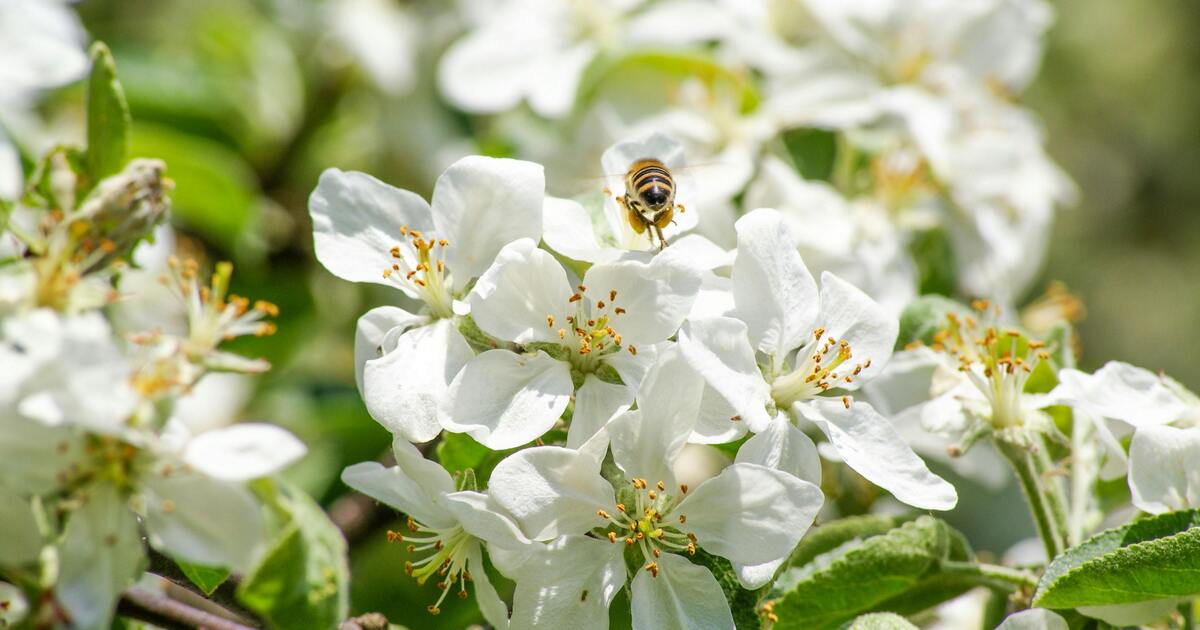
Most people think supporting pollinators means keeping honeybees. It is an understandable assumption: honeybees are the pollinators with the public relations department. They come with hives and veils and smokers and a learning curve steep enough to discourage most gardeners before they start. But the pollinators doing the heaviest work in your spring garden are not honeybees. They are native, solitary, smaller than a dime, and they have been here all along.
Mason bees (Osmia lignaria) are cavity-nesting solitary bees native to the Puget Sound region. They do not form colonies. They do not make honey. They do not sting unless physically pinched. What they do is pollinate, and they do it with an efficiency that makes the honeybee comparison almost unfair: a single female mason bee pollinates roughly 95% of the flowers she visits, compared to about 5% for a honeybee. The difference is structural. Honeybees pack pollen into wet baskets on their hind legs, locking it away from contact with the flower. Mason bees carry pollen dry on a brush of abdominal hairs called a scopa, and it sheds onto every blossom they touch. Research estimates that 250 female mason bees can pollinate an acre of apple orchard, a job requiring 15,000 to 30,000 honeybees.
A 2024 study in Environmental Entomology measured this directly in Washington state cherry and pear orchards. Sites supplemented with Osmia lignaria showed 6 to 25% higher fruit set than honeybee-only blocks, with 65% of introduced bees retained across the season. The researchers described it as “pollination insurance,” and the term fits. If you grow apples, cherries, pears, plums, or blueberries, mason bees are not a novelty. They are a measurable improvement in fruit production.
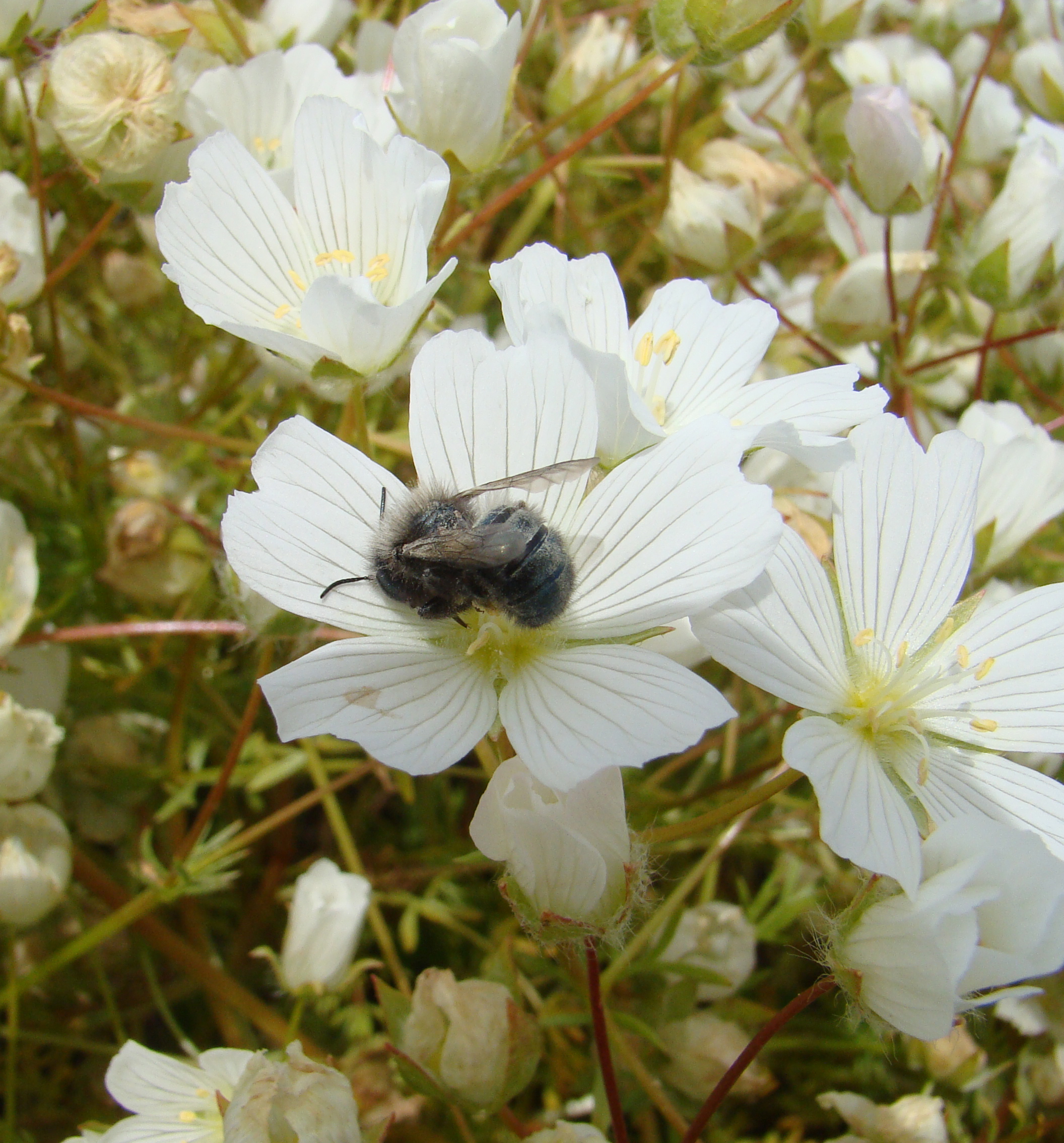 Photo: Ramesh Sagili / Oregon State University, CC BY-SA 2.0
How to Recognize Them
Mason bees are small (9 to 13 mm), stout, and metallic blue-black. They look nothing like honeybees once you know what to watch for. The body is compact and fuzzy, covered in dark hair rather than the banded pattern of a honeybee. Females are larger than males and carry a visible pollen brush (the scopa) on the underside of the abdomen. Males emerge first in spring and are recognizable by a tuft of white facial hair and longer antennae.
The four wings distinguish them from flies (two wings). The fuzzy body and lack of a narrow waist distinguish them from wasps. The abdominal pollen brush, visible as a yellow smear when loaded, distinguishes them from honeybees and bumble bees, which carry pollen on their legs.
You will see mason bees working flowers in the morning, even on cool days when honeybees stay in the hive. They forage at temperatures as low as 55°F, which in the Puget Sound region means they are active on many April mornings that honeybees sit out.
The Three Essentials: Cavities, Flowers, Mud
Mason bees need exactly three things to nest successfully. Providing all three is the difference between occasional visitors and an established population.
Nesting Cavities
Each female mason bee builds her nest inside a pre-existing hole: a beetle gallery in dead wood, a hollow stem, or an artificial tube. The ideal cavity is 5/16 inch in diameter and about 6 inches deep, sealed at the back end. She constructs a series of mud-partitioned cells inside, each provisioned with a pollen and nectar loaf and a single egg.
A bee house is a simple structure: a small wooden box or shelter, open on one front face, holding a bundle of nesting tubes. Commercial versions are widely available at garden centers and nurseries in the region for $15 to $40, or you can build one from scrap wood. The house itself is just a rain shield and mounting platform; the tubes inside are where the bees actually nest.
For artificial nesting, tubes with removable paper liners are the best option. Liners allow you to open the tubes after the season for cocoon harvest and parasite inspection. Drilled wood blocks are a common recommendation but a poor long-term choice: you cannot open them, moisture collects in the holes, and parasites accumulate year over year. Bamboo tubes carry the same problem. If you already have a drilled block, replace it with liner-style tubes after a season or two.
Mount the bee house against a south- or southeast-facing wall, 3 to 5 feet off the ground, protected from rain by an overhang. Orientation matters: morning sun warms the bees and gets them foraging earlier, which is particularly valuable here where spring mornings are often cool.
Continuous Bloom
A female mason bee forages within about 100 yards of her nest for her entire 4- to 8-week adult life. If bloom stalls within that radius, nesting stalls with it. In the Puget Sound region, our cool wet springs make this constraint sharper than national guides acknowledge. Rain days are lost foraging days, and the nesting window is already compressed by our later spring warmup. Continuous bloom through the window is what separates a yard that supports mason bees from one that merely hosts a bee house.
The regional bloom sequence that matters: willows (Salix spp.) and Indian plum (Oemleria cerasiformis) open first, often by mid-March. Red flowering currant (Ribes sanguineum) overlaps in late March through April. Bigleaf maple (Acer macrophyllum) floods the canopy with nectar in April. Then the fruit trees: cherry, apple, pear, and plum carry the bloom into May. Late-spring shrubs like western serviceberry (Amelanchier alnifolia) and Oregon grape (Mahonia aquifolium) close any gap.
If you plant three species from that sequence and already have a fruit tree, you likely have continuous bloom through the nesting window. Mason bees show a strong preference for Rosaceae (the rose family), so fruit trees, serviceberry, and flowering cherry carry more weight than their bloom window alone suggests.
Mud
This is the essential most people forget. Mason bees use moist, clayey soil to build the mud partitions between brood cells and to seal the nest entrance when finished. Without a mud source within foraging range, nesting stops regardless of how many cavities and flowers you provide.
If your property has exposed clay soil (and in the Kent valley and surrounding lowlands, many do), you may already have a mud source. If not, a shallow tray or saucer filled with garden soil, kept moist through the nesting season, works. Avoid sand or potting mix; mason bees need clay particles that bind when wet.
The Annual Cycle
Mason bees are univoltine: one generation per year. The annual cycle runs on a temperature trigger, not accumulated heat (growing degree days). Adults emerge when temperatures reach 50 to 55°F sustained over several consecutive days, typically late March in the Puget Sound lowlands. Bigleaf maple bloom is the visible phenological signal: when the maples flower, mason bees are emerging.
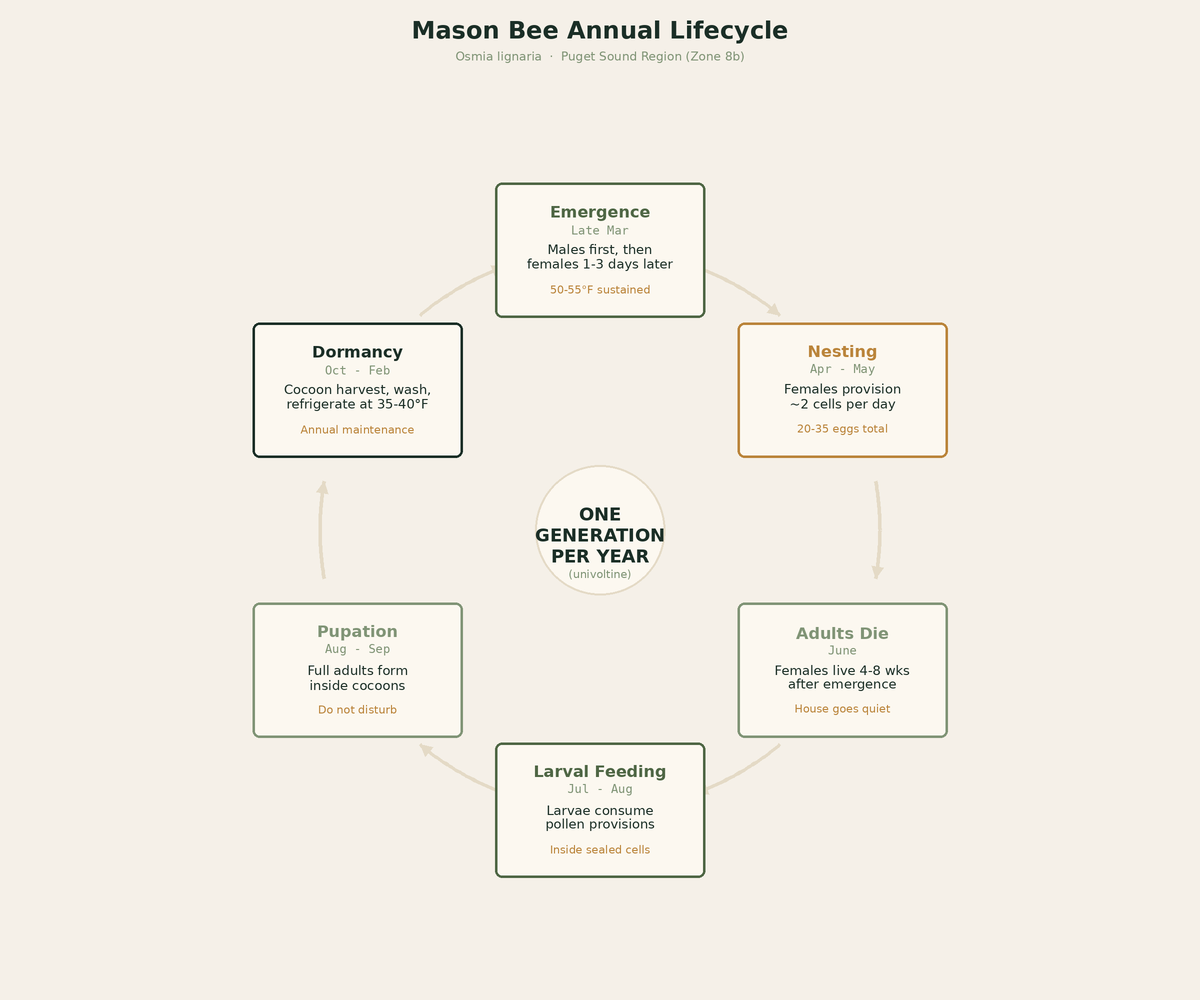
Late February to early March. Set out your bee house and check nesting materials. Replace paper liners from the previous year. Do this before emergence so cavities are available when the bees appear.
Late March (50 to 55°F sustained). Males emerge first, followed by females 1 to 3 days later. If you purchased or harvested cocoons, release them now. Place cocoons inside or next to the bee house in a small container with a protective mesh (to deter birds). Timing the release to coincide with early bloom ensures foraging resources are available immediately.
April through May. Active nesting. Females are provisioning cells at a rate of about 2 per day. Keep the mud source moist. Ensure bloom continuity. This is the critical window to avoid pesticide applications on any flowering plant within 100 yards of the nest. A female mason bee lays only 20 to 35 eggs in her lifetime; every lost foraging day directly reduces the next generation.
June. Activity winds down. The last females die after 4 to 8 weeks of nesting. The house goes quiet.
July through September. Inside the sealed cells, larvae feed on their pollen provisions, pupate, and develop into fully formed adults by late summer. They remain inside the cocoon in a dormant state. Do not disturb the house during this period.
October through November. Cocoon harvest. This is the single most important management action for mason bee health, and the step most casual bee house owners skip. Open the tubes, remove the cocoons, and inspect them. Healthy cocoons are firm, dark brown, and roughly the size of a small raisin. Discard any cocoons that show signs of mold, mite damage (dusty debris), or parasitoid emergence holes.
Wash healthy cocoons in a dilute bleach solution (0.05%, about one teaspoon per gallon of water), rinse, and air dry on a towel. Store them in a breathable container in the refrigerator at 35 to 40°F through winter. Replace all nesting tubes and liners.
Keeping Them Healthy
A bee house is a managed habitat, and like any managed habitat it concentrates organisms in a way that concentrates their parasites. The University of Minnesota Extension makes a point worth repeating: artificial nests tend to support more parasites and non-native bees than natural nesting sites. This does not mean bee houses are counterproductive, but it does mean they require annual maintenance.
Three organisms cause the most trouble in managed mason bee nests:
Pollen mites (Chaetodactylus spp.) are the most common problem. These tiny mites hitch-hike on adult bees, infest brood cells, and consume the pollen provisions meant for larvae. Heavy infestations starve the developing bee. You will notice them as a dusty, grain-like debris inside opened tubes at harvest. The bleach wash removes mites from cocoon surfaces.
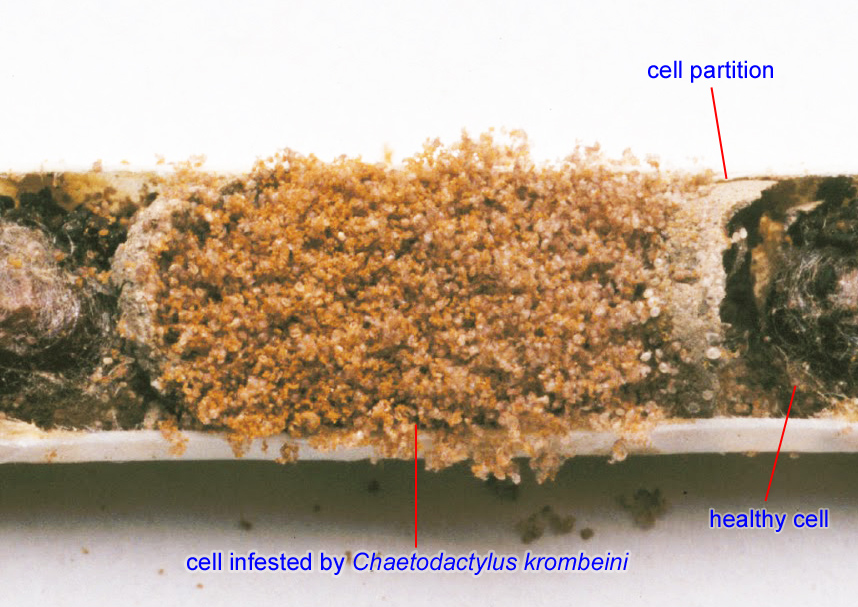 Photo: Pavel Klimov / Bee Mite ID, public domain
Parasitoid wasps (Monodontomerus spp.) lay eggs through the walls of nest cavities. Their larvae consume the mason bee larvae inside. If you find cocoons with small round exit holes, parasitoids have already emerged. Tubes with thicker walls resist penetration better than thin-walled options.
Chalkbrood (Ascophaera spp.) is a fungal disease that kills larvae. Infected cocoons appear chalky gray or white and feel brittle. Spores persist for years, which is why replacing nesting materials annually matters. Discard any chalkbrood-infected cocoons away from the nesting area.
Annual cocoon harvest, bleach wash, and tube replacement break the parasite cycle. If you skip this step, parasite loads build year over year until the nest produces more parasites than bees.
If you harvest cocoons and find mostly parasites or empty cells, the population may have stalled. Common causes: non-native bees (particularly Osmia cornifrons, the hornfaced bee, an introduced Asian species that competes for the same cavities) occupying tubes before mason bees emerge, insufficient early bloom forcing females to forage too far, or a missing mud source. Start fresh with purchased cocoons, confirm all three essentials are in place, and harvest again the following fall to assess whether the population is building.
Natural cavity-nesting habitat (dead wood left standing, old beetle galleries, hollow-stemmed shrubs like elderberry) provides nesting sites without the concentration effect of a bee house. The best approach combines both: a managed house for observation and cocoon harvest, with undisturbed natural habitat nearby.
Beyond Mason Bees
Mason bee season ends in June. The nesting window closes, the adults die, and the next generation sleeps until the following spring. But pollinator support is a year-round practice, not a spring project. Leafcutter bees (Megachile spp.) are the summer chapter of the same story: native, solitary, cavity-nesting, and active from June through September when mason bees are dormant. They use leaf pieces instead of mud for their cell partitions, which is how they get their name.
If you provide continuous bloom from March through September and leave nesting habitat available, you are supporting both guilds with overlapping infrastructure. The bee house works for both species. The mud source matters only for mason bees; the leafcutter bees handle their own construction materials.
Seasonal Action Summary
| When | What | Why |
|---|---|---|
| Late Feb to early Mar | Set out bee house, replace nesting tubes and liners | Ready before emergence; cavities must be available when bees appear |
| Late Mar (50-55°F sustained) | Release stored cocoons when bigleaf maple blooms | Synchronize with emergence trigger and early bloom availability |
| Apr through May | Keep mud source moist, ensure bloom continuity, hold pesticide applications on flowering plants | Active nesting period; every lost foraging day reduces next year’s population |
| June | Activity winds down naturally | Female lifespan ending; house goes quiet |
| Jul through Sep | Leave house undisturbed | Larval development and pupation inside sealed cells |
| Oct through Nov | Harvest cocoons, wash in dilute bleach, air dry, refrigerate at 35-40°F | Annual parasite management; the single most important maintenance action |
| Winter | Store cocoons in fridge; replace all tubes and liners | Prep for next season |
Sources
Oregon State University Extension. Nurturing Mason Bees in Your Backyard in Western Oregon (EM 9130).
Utah State University Extension. Blue Orchard Bee (ENT-162-12).
Hoffman, G.D. et al. (2024). Osmia lignaria increase pollination of Washington sweet cherry and pear crops. Environmental Entomology 53(4):698.
University of Minnesota Extension. Nests for Pollinators.
USDA Agricultural Research Service. Blue Orchard Bee Fact Sheet.
NC State Extension. Bee Hotel Design and Placement.
Utah State University Extension. Best Management Practices to Prevent Spread of Pests.
Pitts-Singer, T.L. et al. (2022). Multiple daily brood cells define the fecundity of Osmia lignaria. Apidologie 53:65.
RHS. Bees in Your Garden.
WSU Kittitas County Extension. Orchard Mason Bees: The Gentle Pollinators (2018).
Mention of commercial products does not imply endorsement. Always read and follow the pesticide label.
Profile: Mason Bees (Osmia lignaria)