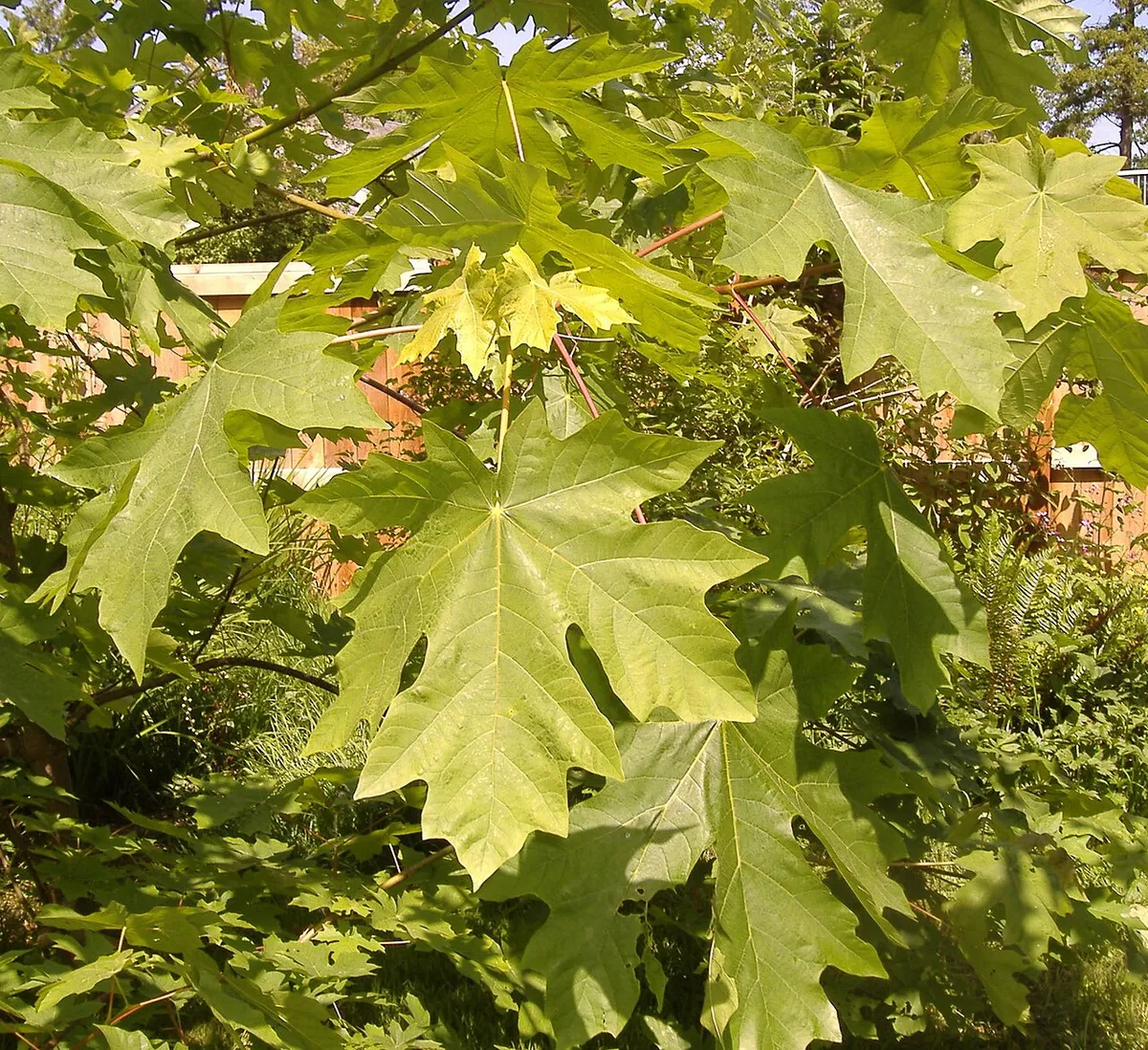
You have walked underneath this tree a thousand times without thinking about it. It is the one that towers over the forest canopy in every second-growth Puget Sound woodland, its enormous leaves catching rain and light like dinner plates. It is the shade tree in the corner of your neighbor’s yard, dropping leaves in October by the bushel. It is the giant emerging from the ravine along the creek trail, its trunk wrapped in so much moss and so many ferns that it looks more like a hillside than a tree.
Bigleaf maple (Acer macrophyllum) is the largest maple in North America, and it is the signature tree of the lowland Pacific Northwest. For most of the last century it was a default choice: native, fast-growing, beautiful, tough, and reliable. You planted one, it grew, your grandchildren played under it. Simple. But over the past fifteen years something has changed. Trees are showing signs of stress they did not show before: smaller leaves, thinning crowns, progressive dieback. Understanding what is happening to bigleaf maple, and what you can do about it, matters now in a way it did not before.
The Tree
Bigleaf maple belongs to Sapindaceae, the same family as Japanese maple and vine maple. But where its relatives are refined and restrained, bigleaf maple is the family giant. The leaves are the largest of any maple species: 20 to 30 centimeters across, heart-shaped at the base, with three to five coarsely-toothed lobes. The petioles, when detached, yield a milky sap that is immediately recognizable. No other native tree in the region produces this.
The tree grows fast: you can expect 30 feet at the twenty-year mark in a typical residential site. At maturity, it reaches 60 feet, with a potential maximum of 100 feet. The form is ascending in youth, becoming rounded and broad in age, with a shallow but vigorous root system that eventually surfaces as the tree matures.
In spring, before the leaves fully emerge or sometimes alongside them, bigleaf maple flowers. The blooms are small, ten millimeters across, greenish-yellow, fragrant enough to notice, arranged in drooping clusters ten to fifteen centimeters long. The flowers appear from April through May in Western Washington, and they attract pollinators. By summer, paired samaras form: the classic maple helicopter fruit, brown at maturity, dispersing by wind in late summer and fall.
The bark, particularly on mature trunks and large branches, retains so much moisture in the Pacific Northwest climate that it becomes a microhabitat in itself. Mosses colonize every inch of north-facing bark. Liverworts and ferns establish on the trunks. The result is a living ecosystem: the tree becomes, functionally, an aerial island of moisture and substrate for epiphytes that would not survive on the ground. This is bigleaf maple’s unique ecological signature in the region.
The species is native throughout the coastal Pacific Northwest, from southwestern British Columbia south to California, occurring from sea level to 1,650 feet elevation. In the wild it colonizes moist woodlands, streambanks, and rich alluvial bottomland. It is relatively shade-tolerant but benefits from disturbance, and frequently dominates second-growth forest alongside red alder and black cottonwood.
One cultivar has gained traction in the nursery trade: ‘Seattle Sentinel’. This cultivar tops out around 40 feet, is distinctly columnar in form, and makes sense when the tree you inherited is too large for the space but you want to preserve the bigleaf maple identity. It is worth noting if you are replacing a specimen.
What It Does Well
Bigleaf maple is a shade tree, and an excellent one. Its dense canopy and horizontal branching pattern provide deep, dappled shade that lets grass grow underneath. Its fast growth rate means you see the benefit within a decade rather than waiting a generation. It establishes readily from container stock and does not require coddling through its first seasons if you understand its water requirements.
For the wildlife-oriented gardener, bigleaf maple delivers. The genus Acer supports Imperial Moth larvae (Eacles imperialis), which have one brood per season from April through October in this region. Deer and elk browse on saplings. The samaras feed birds and small mammals through fall and winter. The epiphyte ecosystem on mature bark is unique: the mosses, liverworts, and ferns create microhabitats for insects, spiders, and other invertebrates that could not establish elsewhere.
Bigleaf maple is also, less commonly known, a maple syrup source. The sap has roughly the same sugar concentration as sugar maple (Acer saccharum), though the flavor profile is distinctly different. If you are interested in exploring sap processing on the home scale, a mature bigleaf maple on your property is a plausible starting point. The trees will not feed a sugarhouse operation, but they are biologically capable of the conversion.
The tree is a significant nitrogen cycler. Like other maples, the dropping leaf litter is relatively high in nitrogen and breaks down readily, enriching the soil. In a managed landscape, this means you do not need to import as much organic matter as you might on other soils, if you allow the leaf drop to remain in place.
Site tolerance is high. Bigleaf maple adapts to soil pH from 4.8 to 7.2, tolerates some soil compaction, and can handle anaerobic soils at medium tolerance levels. It prefers moist, well-drained conditions but is not a picky plant. The precipitation range across Western Washington (22 to 260 inches annually, in extreme cases) is well within its comfort zone.
What Goes Wrong
Bigleaf maple carries a documented list of 19 diseases and 15 pests in the PNW region. Most of these are incidental, cosmetic, or manageable through cultural means. But three problems matter in a Western Washington managed landscape, and one of them is new and serious.
Bigleaf Maple Decline (The Critical Issue)
This is the one you need to understand before you plant, and the one that requires action if you already have one.
Bigleaf maple decline began showing up in 2010. It is now widespread throughout Western Washington and Oregon, and appears to be expanding. The signature is progressive crown thinning and branch dieback, usually accompanied by noticeably smaller leaves on affected branches. Clumps of shrunken foliage in the canopy become visible. The tree sometimes produces unusually heavy seed crops, as if attempting one final reproductive effort. Trees of all ages and sizes are affected.
Unlike most tree diseases, bigleaf maple decline does not have a single causal pathogen. Forest pathologists have been investigating it for over fifteen years. Armillaria, various oomycetes, Nectria cankers, Ganoderma decay fungi, and Verticillium have all been ruled out as primary causes, though some may play secondary roles. Xylella fastidiosa has tested negative. The decline is instead tied to environmental stress factors and a possible insect vector.
The University of Washington and Oregon State University research teams have identified a consistent pattern: decline is worse in trees growing near roads, in urban or suburban development zones, and in areas experiencing hotter summers. The trees are experiencing climate-driven stress. In response to that stress, they become vulnerable to secondary pathogens. The decline accelerates when soils are compacted, when root zones are damaged, or when trees endure extended drought.
There is a compelling hypothesis involving the native leafhopper Empoasca elongata. This insect feeds on bigleaf maple leaves and is a relative of the potato leafhopper (Empoasca fabae), which causes serious damage to field crops in the eastern United States. The potato leafhopper’s saliva mechanically damages the cells that transport water and nutrients, causing a condition called “hopperburn.” Empoasca elongata appears to cause similar injury, and the damage is exacerbated when trees are already water-stressed from drought.
What you see: leaves that are noticeably smaller than you would expect from a mature bigleaf maple. Thinning in the crown, with interior branches dying back. Progressive dieback starting in the branch tips and moving toward the trunk. In some cases, leaves with yellow edges and red-to-brown tips, similar to leaf scorch. Heavy seed production. A generally declining appearance.
What you can do: this is where the news gets a bit better. You cannot cure bigleaf maple decline, but you can reduce the stress that activates it. The single most important action is irrigation during extended droughts. Bigleaf maple did not evolve for the hot, dry summers that are becoming increasingly common. If you have a mature tree, water it during dry spells from June through September. Deep watering, infrequent but thorough, is more effective than frequent sprinkles. Aim for 1 to 2 inches of water per week during extended heat and drought, applied slowly to soak the root zone.
Avoid root zone damage. Do not compact soil around the base of the tree through heavy foot traffic or parking. If you are doing construction near a bigleaf maple, keep equipment away from the drip line and preferably further out.
Keep the tree pruned but not butchered. Remove dead and dying branches annually. This is not about making the tree look perfect; it is about removing the places where secondary pathogens can establish. Prune to improve interior air circulation, which can reduce the likelihood of fungal problems. Avoid making large wounds, and never paint pruning cuts with wound dressing: the tree’s own compartmentalization is more effective.
If your tree shows signs of significant decline, consult a certified arborist. In some cases, if the problem is severe enough, the right decision is removal. Leaving a heavily declining tree standing creates a hazard for anything underneath it. A professional can assess whether your specific tree is stable or at risk.
Sooty Bark Disease
Cryptostroma corticale emerged as a problem in the Pacific Northwest around 2017. It was previously considered a disease of European plane trees in Mediterranean climates, not something you would see in Western Washington. Now we have it.
This is an opportunistic pathogen. The spores are present in the environment, but the fungus only becomes active and causes problems when trees are severely stressed. In the case of bigleaf maple, sooty bark disease shows up in trees that are already struggling with heat or drought stress. The fungus causes cankers on the trunk and large branches. An initial lesion appears, often with bleeding or oozing from the bark. The canker expands, girdling the branch or trunk. The affected wood dies. Spores disperse from the dead tissue, appearing as a dark, sooty coating on the bark surface, hence the name.
What you see: a dark, sooty discoloration on the bark, usually on the trunk or major branches. An area of bleeding or oozing sap. Branch or canopy dieback in that general region. The problem is more likely if your tree is already water-stressed.
What you can do: the primary intervention is stress reduction. Ensure adequate water through dry periods. Improve site conditions if possible. Prune out diseased branches if the canker has not yet girdled the main stem. Once a major canker encircles a branch or trunk, that part of the tree is doomed. Remove it. There is no effective fungicide for sooty bark disease.
Verticillium Wilt
Verticillium dahliae is a soilborne fungus. It enters the tree through the roots and colonizes the vascular system, progressively blocking the movement of water. Symptoms show up as sudden wilting of individual branches or one side of the canopy, often in midsummer heat. Affected leaves turn brown and, notably, stay attached to the tree rather than falling. If you cut into a sick branch, you may see dark streaking in the sapwood.
There is no cure for Verticillium. The fungus persists in soil for decades. If you lose a bigleaf maple to Verticillium, do not plant another maple in that location. Do not plant tomatoes, strawberries, or potatoes there either. The fungus has a broad host range, and these plants are all susceptible.
Verticillium is more common in sites where susceptible plants have grown before, or where soil has been disturbed and moved from other locations. In a new residential planting, test the soil if possible. The disease is not as prevalent in the Puget Sound region as it is in drier climates, but it is present.
Anthracnose and Phyllosticta Leaf Spot
Multiple fungal pathogens cause leaf spotting and blotching on bigleaf maple. Phyllosticta leaf spot and anthracnose are both documented. In a typical Western Washington spring, cool and moist through May, expect some irregular brown spots and blotches to appear on emerging foliage. The damage is cosmetic in most years and the tree grows through it.
If you are seeing severe defoliation, improve air circulation by thinning interior crossing branches during dormancy. Rake and destroy fallen leaves in autumn to reduce overwintering fungal spores. Fungicide is rarely justified on an established tree.
Powdery Mildew and Tar Spots
Late-summer powdery mildew is common on bigleaf maple, especially on plants in sheltered, humid locations with poor air movement. The white powdery coating on leaf surfaces is unmistakable and appears in August and September. It rarely threatens tree health. Site the tree where it gets good air circulation, avoid overhead irrigation, and accept some years will be worse than others.
Tar spots, caused by Rhytisma species, show up as black, raised, tar-like spots on the leaves in late summer and fall. They look dramatic and do essentially nothing to the tree. Rake and compost fallen leaves if the appearance bothers you.
Nectria Canker
Nectria species cause branch cankers and localized dieback on bigleaf maple. The cankers appear on branches and occasionally the trunk, and the affected wood dies back progressively. Prune out diseased branches during dormancy. On major stems, if the canker is expanding, consult an arborist. Most branch cankers are pruning jobs, not emergencies.
Aphids and Cottony Maple Scale
Aphids are the most common insect problem you will notice. Honeydew drips onto whatever sits beneath the canopy, and sooty mold grows on the honeydew deposits. Cottony maple scale produces conspicuous white, cottony egg masses on twigs and branches in spring.
Both are managed by conserving natural predators, particularly ladybugs, lacewings, and parasitic wasps. Avoid broad-spectrum insecticides. If you must treat, dormant oil in late February or early March can suppress scale populations. The critical timing is before bud break. Insecticidal soap works on aphids during the growing season but requires thorough coverage and repeat applications.
Carpenterworm
Carpenterworm larvae bore into the wood of stressed trees. They do not kill healthy trees, but they love wood that is already weakened. Maintain tree vigor through proper watering and you are unlikely to encounter serious carpenterworm damage. If you do see exit holes and sawdust from the trunk, the tree is already seriously stressed. Address the underlying stress.
The Decline Question
Bigleaf maple decline is the conversation you need to have before planting a new tree or accepting one that came with your property. This section is yours to read and think about.
The bottom line: bigleaf maple is still a viable shade tree in Western Washington, but it is no longer a set-it-and-forget-it plant. You need to monitor it, water it during droughts, and be prepared to manage it more actively than you would have needed to even ten years ago.
Is the climate of Western Washington changing in ways that make bigleaf maple less reliable? The data from UW and OSU research teams suggests yes. Hotter summers, more extended droughts, and higher urban heat islands are creating stress conditions that bigleaf maples did not encounter historically. The tree can survive these conditions, but survival and thriving are different things.
Some landscape designers in the region have started looking at alternatives: native alternatives like bigleaf maple’s relative vine maple, or introduced species better adapted to drier conditions. That is a valid choice. If you are replacing a declining bigleaf maple and you do not want to manage a stressed tree, consider other options.
But if you have bigleaf maple already, or if you want one specifically for the ecological value and the mass of the tree, you can keep it healthy. The recipe is straightforward: water it during droughts, avoid damaging the root zone, prune regularly to remove dead wood and improve air circulation, and watch for signs of stress.
What to watch for: leaves that are smaller than expected, starting with specific branches. Progressive thinning of the crown, visible as increased light filtering through the canopy. Branches dying back from the tips inward. New growth that is visibly smaller or paler than the previous year.
When to call an arborist: if the decline appears to be progressing rapidly, if you see cankers on the trunk, if large branches are dieback, or if you simply need help assessing whether the tree is stable or at risk. A certified arborist can do the assessment and tell you whether the tree is worth keeping or whether removal makes sense.
Seasonal Action Summary
| When | What | Why |
|---|---|---|
| Dec - Feb | Dormant pruning to remove dead or dying branches | Improve air circulation and remove substrate for secondary pathogens. Do not make large wounds; prune to the branch collar. Never paint pruning cuts. |
| Late Feb - Early Mar | Apply dormant oil for scale management if needed | Best timing is before bud break. Oil smothers overwintering scale eggs. Cover all twig and branch surfaces. |
| Feb 15 - Mar 15 | Watch for bud break | First green tissue and swelling buds visible. The phenological signal that the growing season is starting. |
| Mar 1 - Apr 1 | Leaf emergence begins | First leaves fully unfurled on new growth. The tree is committing to the season. |
| Apr - May | Bloom period; observe flower clusters | Greenish-yellow flowers in drooping clusters 10-15 cm long. Fragrant. Pollinators active. |
| Apr - Jun | Scout for anthracnose and leaf spot | Irregular brown blotches on emerging foliage. Cosmetic in most years. Prune out severely affected branches only if defoliation is severe. |
| Jun - Sep | Monitor for drought stress and water accordingly | Extended drought creates vulnerability to decline and secondary pathogens. Deep water, infrequent but thorough. Aim for 1-2 inches per week during extended heat and drought. |
| Jul - Aug | Watch for Verticillium wilt symptoms | Sudden branch wilting, often one-sided, during summer heat. Affected leaves brown and remain attached. No cure; remove affected trees and do not replant maples in that soil. |
| Aug - Sep | Expect powdery mildew in sheltered sites with poor air movement | White powdery coating on leaves. Cosmetic. Improve air circulation if possible. |
| Sep - Nov | Samaras mature and disperse | Brown paired fruits dispersing by wind. This is normal. Expect seedlings in nearby gardens and managed areas. |
| Oct - Nov | Rake and destroy fallen leaves | Reduces overwintering inoculum for anthracnose, leaf spot, and tar spots. Do not allow heavy leaf accumulation around the base, which traps moisture and encourages fungal growth. |
| Year 1 | Water 1-2 inches per week through summer | Establishment watering critical. Deep, infrequent watering is more effective than daily sprinkling. Reduce to 1 inch per week by late summer if weather permits. |
| Years 2-3 | Deep water every 2 weeks during hot/dry spells | Taper off irrigation as roots establish, but do not stop completely during droughts even after establishment. |
| Ongoing | Monitor for leaf size reduction, crown thinning, and branch dieback | These are the early signs of stress and decline. Act on water management and pruning if you notice these patterns. |
This article is a reference document in the hortguide.com knowledge base. The bigleaf maple plant profile links to it, and Field Brief advisories reference it when bigleaf maple decline and pest conditions activate. Disease and pest information comes from WSU HortSense, the PNW Plant Disease and Insect Management Handbooks, and the University of Washington Forest Pathology program. The climate stress research is drawn from Betzen et al. (2021), “Bigleaf maple, Acer macrophyllum Pursh, decline in western Washington, USA,” published in Forest Ecology and Management. All recommendations apply specifically to Western Washington, Zones 5b through 8b. Always read and follow pesticide label directions.
Sources: WSU HortSense fact sheets for Ornamental Maple; PNW Plant Disease Management Handbook; PNW Insect Management Handbook; University of Washington Forest Pathology (Betzen, Ramsey, Omdal, Ettl, and Tobin research on bigleaf maple decline, 2021); OSU Landscape Plants Database; USDA Plants Database; North Carolina State Extension Gardener Plant Toolbox.