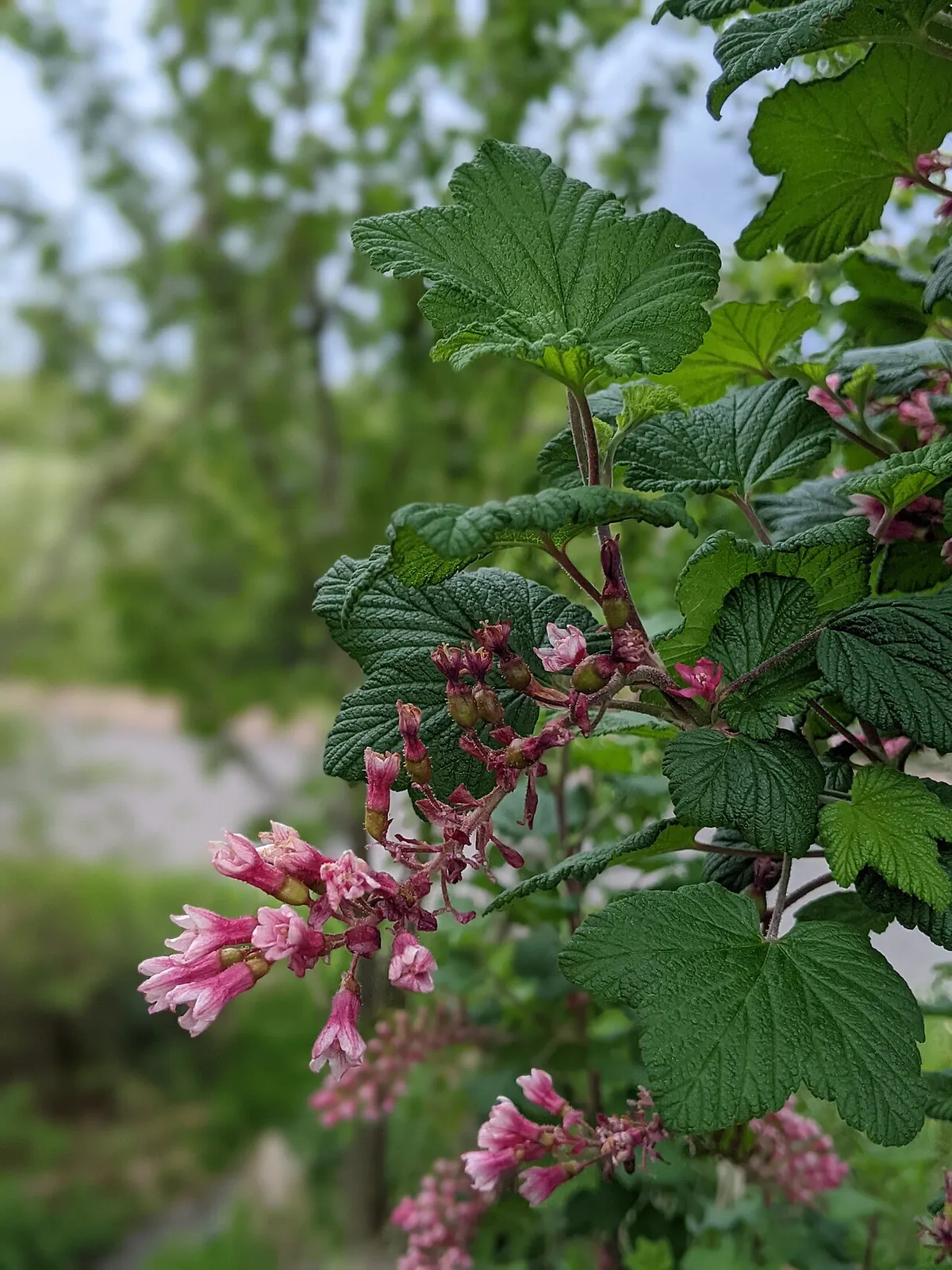
When you see the first crimson flower clusters hanging from bare branches in early March, you know spring is arriving in Western Washington. That’s Ribes sanguineum, the red-flowering currant, and it’s the alarm clock that wakes the entire season in your garden. ‘King Edward VII’ is the cultivar you want if you’re gardening in a typical residential space. It gives you all the beauty and wildlife benefit of this Pacific Northwest native without growing into an unmanageable 10-foot shrub.
Why This Plant Matters in the Puget Sound
The red-flowering currant is native from central British Columbia south to Baja California, but it reaches peak performance in Western Washington and Oregon. David Douglas collected the species in 1826 and sent it to England, where it’s been cultivated ever since. Today it’s considered one of the most important spring bloomers for the region, not because it’s rare or exotic, but because of its ecological role.
This shrub arrives before almost everything else in your garden. While your other perennials are still dormant, rufous hummingbirds returning from Mexico find nectar waiting in those deep crimson flowers. Anna’s hummingbirds, which now overwinter locally in increasing numbers, depend on early bloomers to fuel the energy demands of late winter and early spring breeding season. ‘King Edward VII’ doesn’t just provide food. It signals to the entire insect community that the growing season has begun. Bees visit the flowers. Insects emerge in response. This is keystone plant behavior in a 9-month growing season.
Understanding ‘King Edward VII’ Specifically
The species can reach 12 feet tall and equally wide, which works fine on a forested slope but not in your front yard. ‘King Edward VII’ was selected for compact habit, growing to 5 to 6 feet tall and 4 to 5 feet wide. The flowers are deeper crimson than the species type, more burgundy than red, hanging in dense drooping clusters along the branches. They bloom in March and early April, lasting 3 to 4 weeks. The foliage emerges as the flowers fade, starting red-tinged and maturing to medium green. In fall, the leaves turn shades of orange, red, and purple before dropping. By winter, the bare branches are ready to show next spring’s flower display again.
The plant is deciduous. This matters more than you might think. Unlike an evergreen shrub, ‘King Edward VII’ doesn’t cast shade in winter, so you can position it where it shades your windows in summer without blocking solar gain in the cold months. The bare winter structure is also attractive in its own right, especially on plants with a few years of growth.
Growing ‘King Edward VII’ Successfully
You need well-draining soil with a pH between 6.0 and 7.5. In the Puget Sound region, this usually means you’re working with slightly acidic to neutral native soils. If you’ve already created a garden bed with amended soil, that works fine. Don’t amend heavily with peat or sulfur unless your soil tests below 5.5. This is a shrub that performs best in something closer to its native conditions.
Plant in full sun to part shade. ‘King Edward VII’ blooms most reliably with at least 4 hours of direct sun daily. In Western Washington’s shade-heavy landscape, you can push it to 50 percent shade, but bloom production drops. Morning sun with afternoon shade is ideal if you’re in a dense neighborhood. Don’t crowd it into deep forest shade.
The plant is hardy to USDA zone 7b, which covers the entire Puget Sound region. It also performs in zone 8b, so there’s no concern about winter survival.
Pruning and the Critical Timing Issue
This is where many gardeners make a costly mistake: red-flowering currant blooms on old wood, meaning the flower buds form during the previous growing season. If you prune in late winter or early spring before flowering, you cut off the entire flower show for that year. You might get some secondary bloom, but you’ve sacrificed the main event.
Prune right after flowering through early summer. You have a window from late April through June to remove crossing branches, shape the plant, or reduce size. Hard pruning in summer is acceptable if you need to rejuvenate an overgrown specimen. The plant will flush new growth and have plenty of time to harden it off before winter.
A light deadheading of spent flowers after bloom helps direct energy into foliage rather than berry production, though this isn’t strictly necessary. The berries that follow the flowers are technically edible but nearly inedible. They’re mealy and astringent, useful to wildlife but not to you.
Pest and Disease Reality
The good news: ‘King Edward VII’ has no significant insect pests in Western Washington gardens. The challenging news: five diseases are documented in the Pacific Northwest: anthracnose, cane blight, leaf spot, rust, and powdery mildew. In practice, most of these appear under specific stress conditions.
Leaf spot and rust appear during wet springs and generally resolve as the season dries. Powdery mildew can develop late in the season if the plant is crowded and lacks air circulation. Cane blight affects stressed plants. Anthracnose is regional and occurs most on susceptible species and cultivars, but ‘King Edward VII’ shows good resistance.
Your best prevention is basic: choose a location with reasonable sun and air movement, plant in well-draining soil, and avoid overhead watering. Let the plant dry between waterings once established. No fungicide program is needed for routine garden growing.
Fitting ‘King Edward VII’ Into Your Garden Design
At 5 to 6 feet tall and 4 to 5 feet wide, this cultivar is actually manageable as a specimen shrub or as part of a mixed border. Many gardeners use it as a spring anchor plant that provides structure and early color, then lets other plants take the seasonal spotlight as the year progresses. It pairs well with early-blooming bulbs underneath, hellebores alongside, and spring ephemerals at its base.
In a native plant context, it’s a logical choice for the understory layer on a slope or in a woodland margin. In a standard border, it reads as a bold spring statement without taking up excessive space.
The cultivar ‘Pulborough Scarlet’ grows larger and darker red. ‘Pokey’s Pink’ offers a softer color. ‘White Icicle’ provides neutral tones. But ‘King Edward VII’ gives you the balance: compact enough for residential placement, dramatic enough to announce spring’s arrival, and reliable enough to perform year after year without fussing.
This is a plant that earns its space in a Western Washington garden. It works with your growing season instead of against it. It feeds the wildlife you want to see. And every March, before you’ve even finished your coffee, those crimson flowers are already there.
Sources
- Dirr, Michael A. Manual of Woody Landscape Plants, 6th ed. Stipes Publishing, 2009.
- Pojar, James and MacKinnon, Andy. Plants of the Pacific Northwest Coast. Lone Pine Publishing, 1994.
- Seavey, Mary Ellen. “Native Plants of the Pacific Northwest.” University of Washington Press, 2008.
- USDA Forest Service, Pacific Northwest Region. Native Plant Database.
- Local Puget Sound native plant nurseries and horticultural records.