You have been told to cut to the branch collar. You have been told never to top a tree. You have been told that deep planting kills. Every one of those instructions traces back to anatomy you can see with your own eyes, once you know what you are looking at. A bare twig in January looks like a dead stick. A trunk cross-section looks like simple wood. But both are precisely organized structures, and understanding their organization is what separates pruning by rote from pruning by knowledge.
This guide covers the macroscopic structures you can see and touch: trunks, branches, and twigs. The tissue-level vascular system (cambium, xylem, phloem, sapwood, heartwood, bark layers) is covered in Wood and Bark: The Vascular System.
The Architecture of a Trunk
A trunk is not solid wood all the way through. It is a set of concentric cylinders, each with a different job. From the center outward: pith (the remnant of the original seedling stem), wood (xylem, the structural and water-conducting core), a one-cell-thick layer of vascular cambium that builds all new wood and bark, a thin band of phloem that carries sugars, and bark that protects everything underneath.
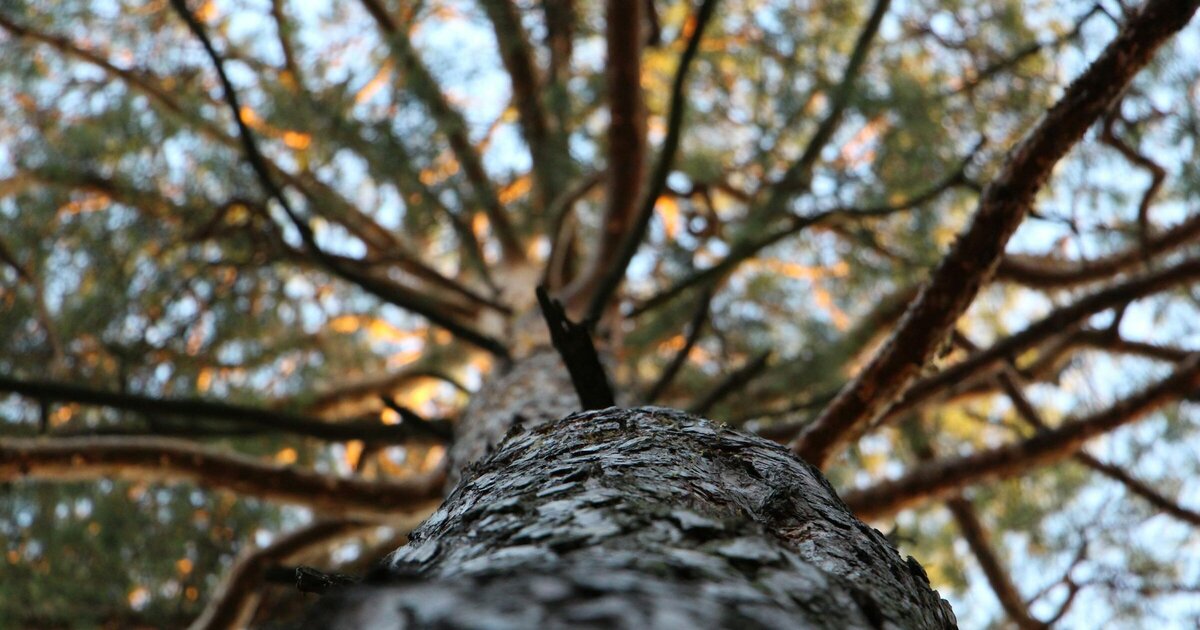
You do not need to memorize those layers yet; Wood and Bark: The Vascular System breaks them down one by one. What matters here is the shape: a trunk tapers from base to crown because each year’s growth ring adds girth, and the base has accumulated the most rings. That taper is not cosmetic. It is structural. A well-tapered trunk flexes under wind load and returns to center. A trunk with poor taper (common in trees that grew too close together or lost their lower branches early) is stiffer and more likely to snap.
You can see taper differences on any residential street in the Puget Sound lowlands. Open-grown Douglas-firs develop pronounced taper with branches nearly to the ground. Forest-grown Douglas-firs, or those hedged tight against a fence line, run straight up like a telephone pole. The structural difference matters when a November atmospheric river pushes 50 mph gusts through a neighborhood. The tapered tree flexes. The pole snaps.
Live crown ratio connects directly to taper. A tree that retains live branches along most of its height (high live crown ratio) builds taper because those branches stimulate cambial growth along the trunk below them. Strip the lower branches and you remove that stimulus. The trunk stops adding proportional girth at the base, taper decreases, and the tree becomes a lever arm with the load concentrated at the top. This is one reason arborists resist over-lifting (removing all lower branches for clearance): every branch you remove changes the structural equation.
Branch Attachment and the Branch Collar
Where a branch meets the trunk, two sets of tissues overlap. The trunk’s annual growth wraps over the base of the branch, and the branch’s annual growth wraps over the trunk surface. That overlapping zone creates a visible bulge called the branch collar. You can see it on most species as a slight swelling where the branch emerges from the trunk.
The branch collar matters because it is the tree’s prepared defense boundary. When a branch dies or is pruned, the collar is where the tree walls off the wound. A pruning cut made just outside the collar preserves this boundary, and the tree seals the wound efficiently with new tissue (woundwood, which is lignified and differentiated, distinct from the undifferentiated callus tissue that forms first). A flush cut that removes the collar destroys the boundary and opens the trunk to decay. This is why every pruning guide tells you to cut to the collar: the anatomy dictates the technique. The structural pruning guide covers cut placement in detail.
Now look at a codominant stem, two leaders of roughly equal diameter emerging from the same point. Instead of one branch subordinate to the trunk, you have two stems competing. The branch collar cannot form properly in a tight V-crotch. Instead, bark gets trapped between the stems: included bark. You can identify it from the ground as a dark line or ridge pressed into the crotch where the two stems meet. Included bark is not simply cosmetic. It means the stems are pushing against each other rather than interlocking, and the union is structurally weak. Included bark is one of the most common structural defects you will encounter in managed landscapes, and recognizing it from the ground is the first step in assessing branch attachment risk.
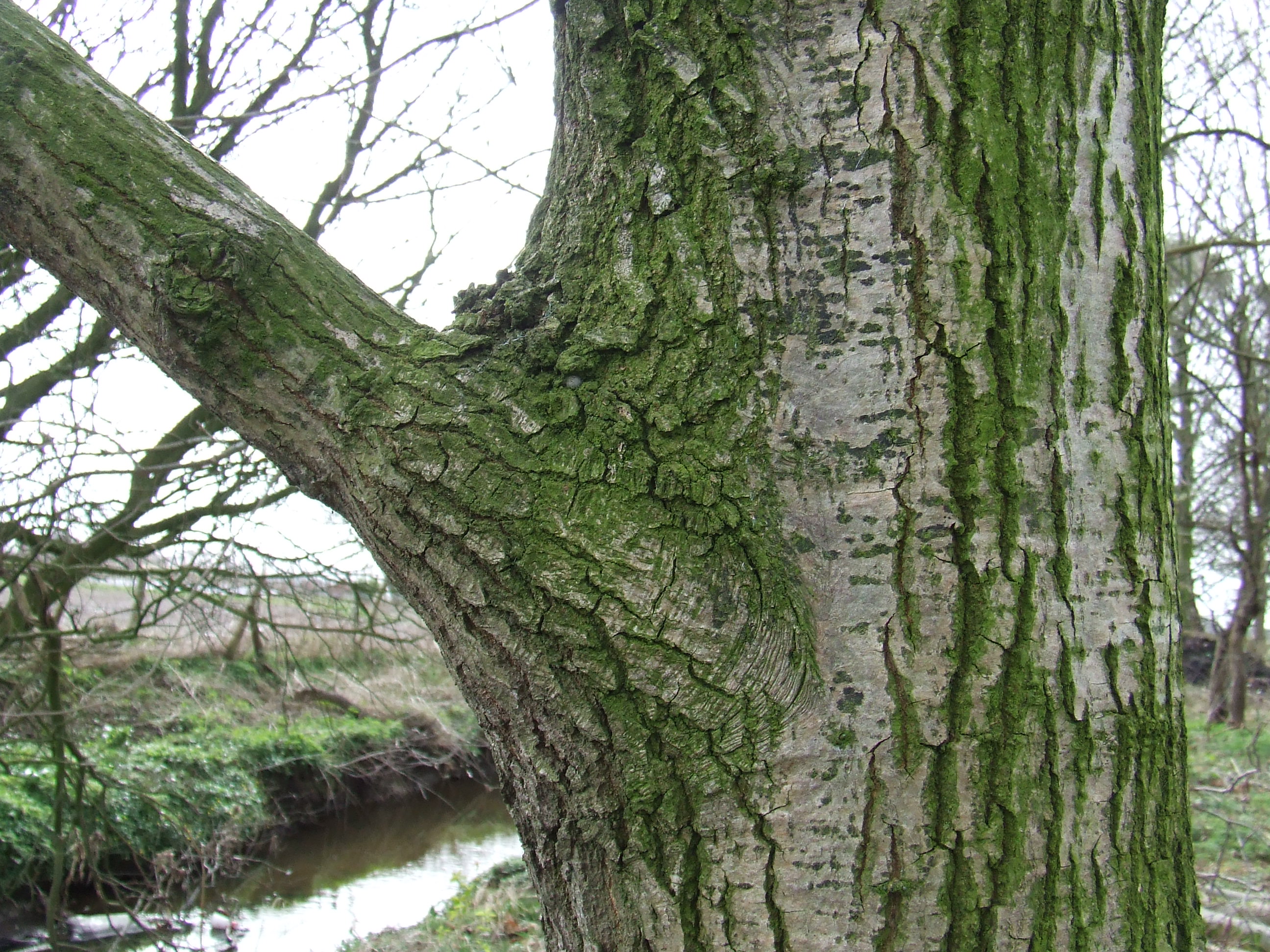 A well-defined branch collar on a common oak (Quercus robur). The collar is the visible swelling of overlapping trunk and branch tissues, and it marks the tree’s prepared defense boundary. Photo: Duncan R Slater, CC BY-SA 4.0.
Oregon white oaks growing in open pastures around the south Puget Sound develop wide branch angles and prominent collars. Bigleaf maples in disturbed sites often throw codominant stems with tight crotches and included bark. The species is not the problem. The geometry is.
Twig Anatomy: Buds, Nodes, and Internodes
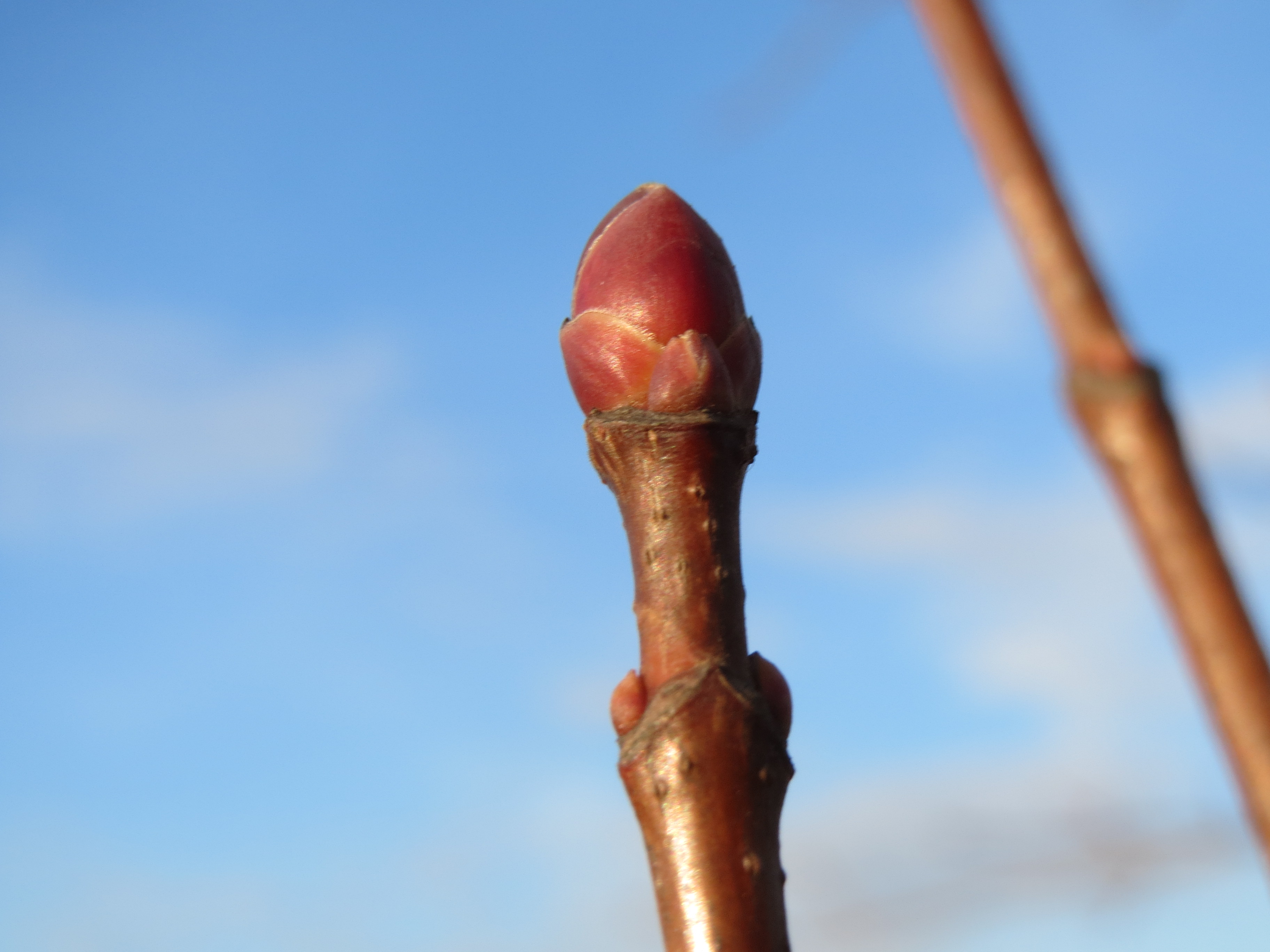 Dormant twig of Norway maple (Acer platanoides) in winter. The terminal bud at the tip is the largest, with visible bud scales protecting the pre-formed shoot. Below it, the node marks where a leaf was attached, and small lenticels dot the bark surface. Photo: AnRo0002, CC0.
Pick up a bare deciduous twig in winter and you are holding next year’s blueprint. At the tip sits the terminal bud, which contains a pre-formed shoot that will extend the branch in spring. The terminal bud is usually the largest bud on the twig, and it produces auxin, a growth hormone that suppresses the buds below it. This is apical dominance: the terminal bud stays in charge as long as it is intact. Remove it (by pruning, breakage, or browsing) and the lateral buds below it activate and produce side shoots. This is the hormonal mechanism behind heading cuts and why topping a tree triggers an explosion of weakly attached watersprouts.
Below the terminal bud, lateral buds sit at nodes, the points where leaves were attached. Between nodes, the smooth stretches of twig are internodes. The length of the internode tells you how vigorous that season’s growth was: long internodes mean rapid extension, short internodes mean the tree was stressed or the growing season was ending.
At each node you can also find a leaf scar (where the petiole detached in autumn) and often tiny bundle scars within it (the broken ends of the vascular traces that fed the leaf). On young bark, look for lenticels: small raised dots or lines that function as gas exchange ports, allowing oxygen and carbon dioxide to move through the bark. Lenticels are especially visible on cherry bark (the horizontal lines that give it its texture) and on young birch stems.
Dormant buds are lateral buds that can persist for years without growing, held in check by apical dominance and environmental cues. When a major branch breaks or a tree is heavily pruned, dormant buds may activate and produce epicormic shoots. These are the tree’s emergency reserves, and they explain how a heavily damaged tree can regrow a crown, though the resulting shoots are typically weakly attached because they originate from surface tissue rather than from deep within the branch.
Winter twig identification is one of the most practical applications of this anatomy. When leaves are gone, buds, bud scales, leaf scars, lenticel patterns, and pith structure become the primary identification characters. In the Puget Sound lowlands, you can separate red alder (stalked buds, no bud scales) from bigleaf maple (large opposite buds with visible scales) from Oregon white oak (clustered terminal buds) just by looking at the twig in your hand. The anatomy you learned on a single twig becomes a diagnostic tool for every dormant tree you encounter.
Sources
- Anatomy of a Tree. USDA Forest Service.
- Management of Tree Root Systems in Urban and Suburban Settings. Arboriculture & Urban Forestry, Vol. 40, No. 4, 2014.
- Silvics of North America. USDA Forest Service.