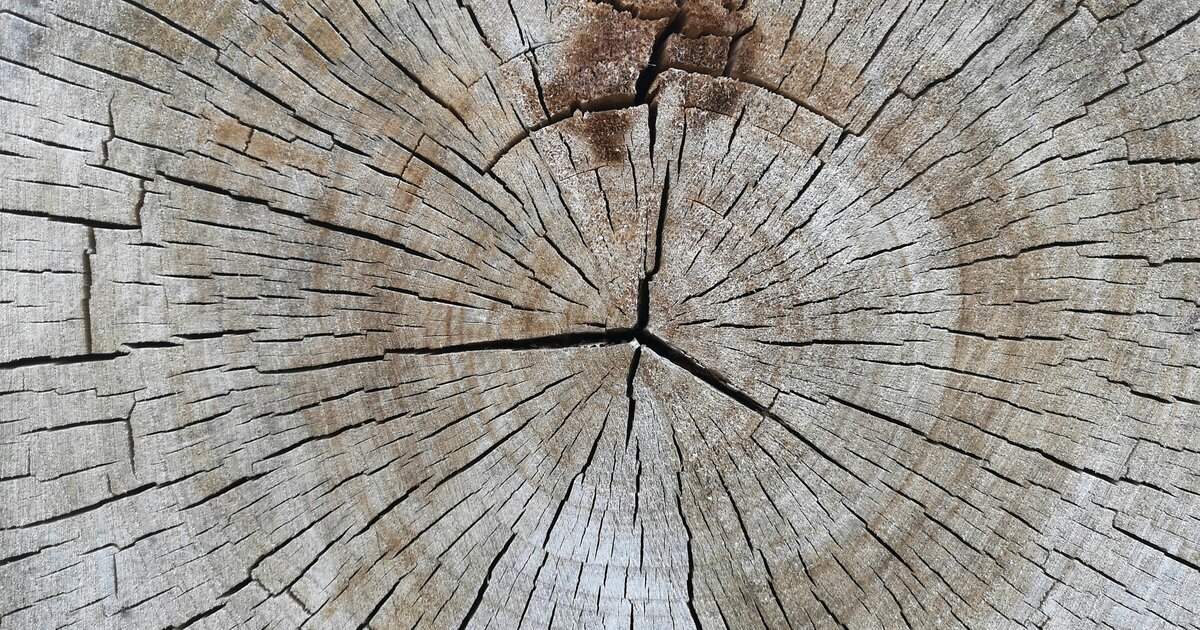
Cut a branch from any tree in your yard and look at the cross-section. You see rings, you see bark, you see a lighter band near the outside and darker wood toward the center. What you do not see is the single layer of cells that built all of it. The vascular cambium is one cell thick, invisible to the naked eye, and it is responsible for every increment of girth your tree has ever added. Understanding what the cambium produces, and how those tissues organize into functioning wood and bark, is what turns “do not damage the trunk” from a vague instruction into a principle you can apply to every pruning cut, every trenching decision, every string trimmer pass.
Tree Trunk, Branch, and Twig Anatomy covered the macroscopic structures: trunks, branches, and twigs. This guide moves inward, to the tissue level: cambium, xylem, phloem, sapwood, heartwood, bark layers, growth rings, rays, and reaction wood.
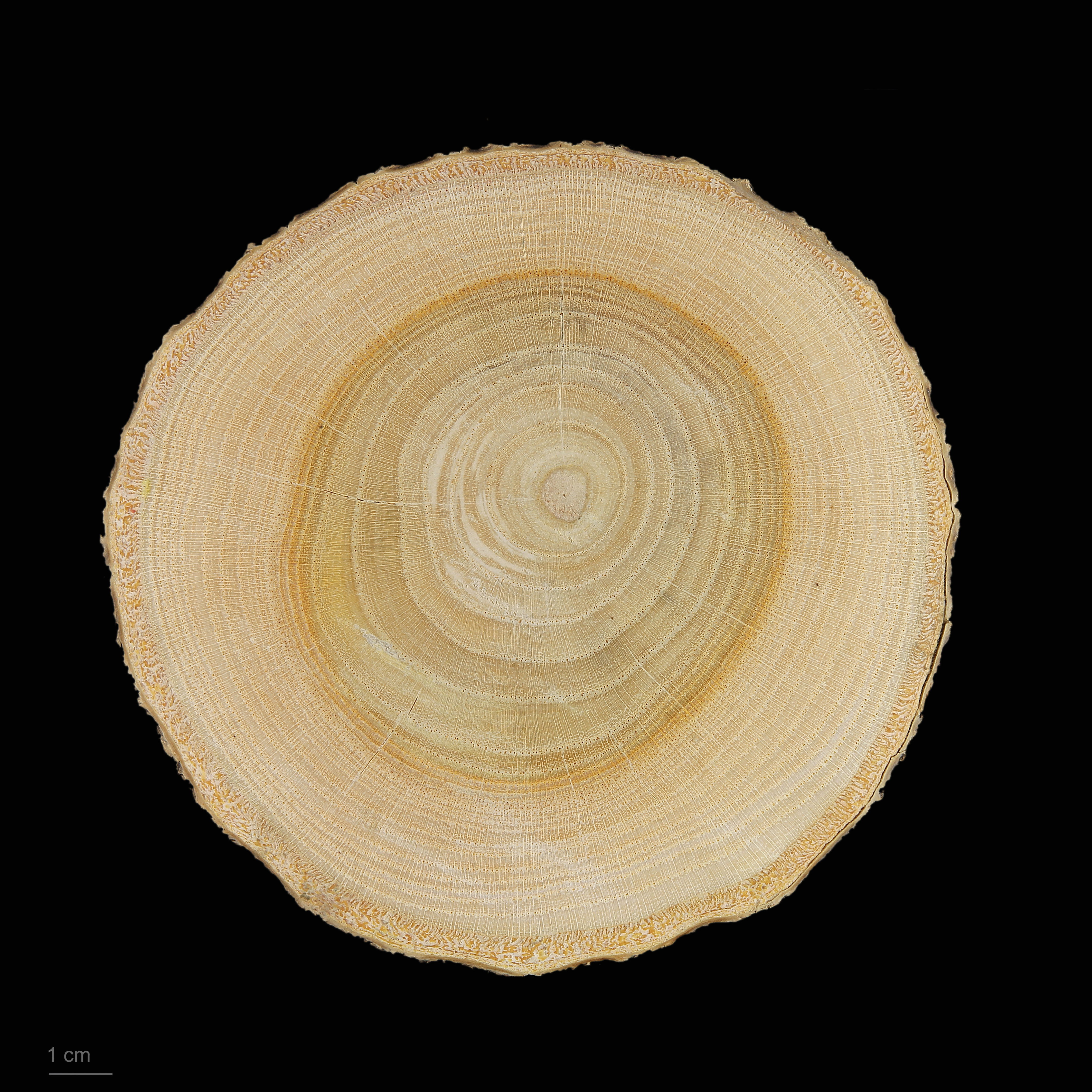 Trunk cross-section of tree-of-heaven (Ailanthus altissima), a museum specimen showing the key structures: pith at center, darker heartwood core, lighter sapwood band, and bark at the outer edge. Growth rings record each season’s xylem production. Photo: Roger Culos, CC BY-SA 4.0, Muséum de Toulouse.
The Vascular Cambium: One Layer That Builds Everything
The vascular cambium is a continuous cylinder of meristematic cells running through every trunk, branch, and root in the tree. It divides in two directions each growing season: inward, it produces new xylem (wood); outward, it produces new phloem (the sugar-conducting tissue). This is secondary growth, the increase in girth that makes a sapling become a timber tree. Primary growth (lengthening from apical meristems at shoot and root tips) is covered in Tree Trunk, Branch, and Twig Anatomy.
The cambium is active only when the tree is actively growing. In the Puget Sound lowlands, cambial activity typically begins in March or April, triggered by auxin flowing down from expanding buds, and slows by late summer. Each season’s division adds one layer of xylem to the inside and one layer of phloem to the outside. Over decades, those xylem layers accumulate into the mass of wood you see in a cross-section. The phloem layers, by contrast, are thin and fragile, compressed against the inside of the bark. At any given time, a tree has only a few years’ worth of functional phloem. This asymmetry matters: wood is a permanent record, phloem is expendable and constantly replaced.
Why girdling kills: the cambium forms a continuous ring. Sever it all the way around the trunk (with a string trimmer, a vole gnawing under snow cover, or a too-tight staking strap) and the tree cannot produce new transport tissue across the gap. The existing phloem above the girdle continues feeding the crown temporarily, but the roots starve. The existing xylem below the girdle continues moving water up for a while, but no new connections form. The tree declines, sometimes within one season, sometimes over several years depending on how much stored energy the root system held.
Xylem: The Water Highway
Xylem moves water and dissolved minerals from roots to canopy. The flow is unidirectional (upward only) and driven by transpiration pull: as leaves lose water vapor through their stomata, negative pressure draws water up through continuous columns in the xylem. A mature Douglas-fir in midsummer can move hundreds of liters per day through this system.
Not all xylem is built the same. Angiosperms (broadleaf trees) have specialized cells called vessels: wide, open tubes stacked end to end, efficient at moving large volumes of water quickly. Gymnosperms (conifers) lack vessels entirely. Their water moves through tracheids, tapered cells that do double duty as both conducting elements and structural support. Tracheids are narrower and less efficient than vessels, but they are also less vulnerable to air embolisms (cavitation events that break the water column). This tradeoff partly explains why conifers dominate cold and drought-prone environments where cavitation risk is high.
You can see the vessel difference in the wood itself. Split a piece of Oregon white oak and look at the end grain: the large pores visible to the naked eye are vessels concentrated in the earlywood (the fast-growing spring portion of each ring). Oak is ring-porous, meaning vessel size changes dramatically between early and late season wood. Now look at a piece of bigleaf maple or red alder: the pores are small and evenly distributed across the entire ring. These species are diffuse-porous. The distinction matters for arborists because ring-porous species like oak are more vulnerable to certain vascular diseases: those wide earlywood vessels are highways for fungal pathogens too.
Sapwood and Heartwood
Not all the xylem in a trunk is still working. The outer band of lighter-colored wood is sapwood: living cells actively conducting water. The darker core is heartwood: xylem cells that have died, been plugged with resins and extractives, and now serve purely as structural support. Heartwood is typically harder and more decay-resistant than sapwood because of those extractive chemicals (this is why western red cedar heartwood resists rot while its sapwood does not).
Tyloses are one mechanism by which sapwood transitions to heartwood. These are balloon-like outgrowths of parenchyma cells that push into and block adjacent vessel lumens. In healthy wood, tyloses gradually plug vessels as they age out of service. In wounded wood, tyloses form rapidly as a defense response, sealing off vessels to limit the spread of fungi and bacteria. This is one of the primary ways a tree compartmentalizes decay: tyloses plug the xylem highways that pathogens would otherwise travel.
Phloem: The Sugar Pipeline
Phloem moves photosynthates (sugars produced in the leaves) and growth regulators throughout the tree. Unlike xylem, phloem transport is bidirectional: sugars flow down to roots for storage and growth, but also up to expanding buds in spring (fueled by starch reserves in ray parenchyma). In angiosperms, phloem consists of sieve tube elements with companion cells that manage loading and unloading. In conifers, sieve cells perform a similar function.
Phloem sits immediately outside the cambium, just inside the bark. This positioning makes it vulnerable. When you strip bark from a branch, the glistening wet layer exposed to air is largely phloem and cambium. Any damage deep enough to reach this layer disrupts sugar transport. A single bark wound may not matter much. A wound that encircles more than about a third of the circumference starts to affect the tree’s ability to feed its roots on that side.
The practical takeaway: bark damage is worse than it looks. A scrape that barely penetrates the outer bark is cosmetic. A gouge that reaches the wet, slippery layer underneath has severed phloem, and the tree must wall off that wound and route transport around it. Construction damage, deer rubbing, and careless mowing account for the majority of phloem injury in residential landscapes here.
Bark: More Than a Shell
Bark looks like armor. It is actually a multi-layered system with its own meristem, living tissue, and gas exchange infrastructure. The formal term for the outer bark system is periderm, and it has three components produced by a second cambium (the cork cambium, or phellogen) distinct from the vascular cambium.
The cork cambium generates two products. Outward, it produces phellem: the dead, corky outer bark you see and touch. Inward, it produces phelloderm: a thin layer of living cells that, in some species, contain chloroplasts and photosynthesize. When you see green tissue under the outer bark of a young bigleaf maple stem, that is phelloderm contributing modest amounts of energy to the branch.
As a tree ages, successive periderms form deeper in the bark, and the older outer layers crack, fissure, and exfoliate. The accumulated dead bark layers are sometimes called rhytidome. The specific pattern depends on species. Douglas-fir develops deeply furrowed, fire-resistant bark several inches thick on mature trees, an adaptation to the fire regimes of its evolutionary range. Pacific madrone sheds its outer bark annually, exposing smooth green to reddish-brown inner bark. Paperbark maple (Acer griseum) exfoliates in thin, cinnamon-colored sheets. These are not just ornamental differences: bark thickness and structure determine how well a tree resists fire, physical impact, desiccation, and pest entry.
Gas exchange happens through lenticels, the small pores or lines visible on young bark. On older trees with thick bark, lenticels may be obscured by fissures, but the function continues through cracks and gaps in the bark surface. The dormant oil sprays guide discusses why lenticel density matters for spray coverage on smooth-barked species.
Growth Rings, Rays, and Reaction Wood
Reading the Rings
Each growth ring in a cross-section represents one season’s xylem production. The ring has two zones: earlywood (large, thin-walled cells produced during the rapid spring growth flush) and latewood (smaller, thick-walled cells produced during slower summer growth). The boundary between one year’s latewood and the next year’s earlywood creates the visible ring line.
Ring width tells you about growing conditions. Wide rings mean good years: adequate water, healthy crown, no competition. Narrow rings mean stress: drought, defoliation, root damage, crown loss. A sudden narrowing in ring width following construction near a tree is diagnostic evidence that root damage occurred, even if the canopy does not show symptoms for several more years. This is one reason arborists take increment cores: the tree has been recording its own health history.
Rays: The Radial Network
Rays are ribbons of parenchyma cells running radially from the center of the trunk outward toward the bark. They perform four functions simultaneously: they transport water and nutrients radially (not just up and down), they store starch and other reserves, they contribute to the structural strength of the wood, and they participate in defense by producing antimicrobial compounds when the tree is wounded.
The defense function is critical. In the CODIT model (Compartmentalization of Decay in Trees), Wall 3, the lateral barrier that limits sideways spread of decay, is formed by ray cells. Trees with dense, abundant rays (oaks, for example) tend to be strong compartmentalizers. Trees with sparse rays tend to be weaker. This directly connects anatomy to arboricultural practice: when assessing decay risk, the species’ inherent compartmentalization ability (partly a function of ray anatomy) shapes your expectations for how far decay will spread from a wound.
Reaction Wood
When a tree leans, it does not simply sag. It actively builds specialized wood to counteract gravity. This is reaction wood, and it takes different forms in conifers and broadleaf trees.
In conifers, reaction wood forms on the underside of the lean and is called compression wood. It pushes the stem back toward vertical. Compression wood has distinctive properties: the tracheids are rounded rather than rectangular in cross-section, the wood is denser, and it shrinks up to six times more than normal wood when dried. Compression wood is visually identifiable in a cross-section as a zone of wider, darker rings on one side. If you see asymmetric rings in a Douglas-fir cookie, with wider, denser growth on one side, you are looking at compression wood responding to a gravitational stimulus: wind exposure, slope, or physical displacement.
In broadleaf trees, the pattern reverses. Reaction wood forms on the upper side of the lean and is called tension wood. It pulls the stem back toward vertical using a unique gelatinous fiber layer (the G-layer) in its cell walls. Tension wood has its own set of problems for arborists: it can release stored tension unpredictably when cut, causing logs to spring or split during removal. In the Puget Sound lowlands, you encounter reaction wood most often in trees growing on slopes, trees with asymmetric crowns from competition or obstruction, and in codominant stems where each leader leans away from the other.
Sources
- Anatomy of a Tree. USDA Forest Service.
- Understanding the Spread of Decay in Trees. Penn State Extension.
- Reaction Wood in Trees. Penn State Extension.
- Silvics of North America. USDA Forest Service.