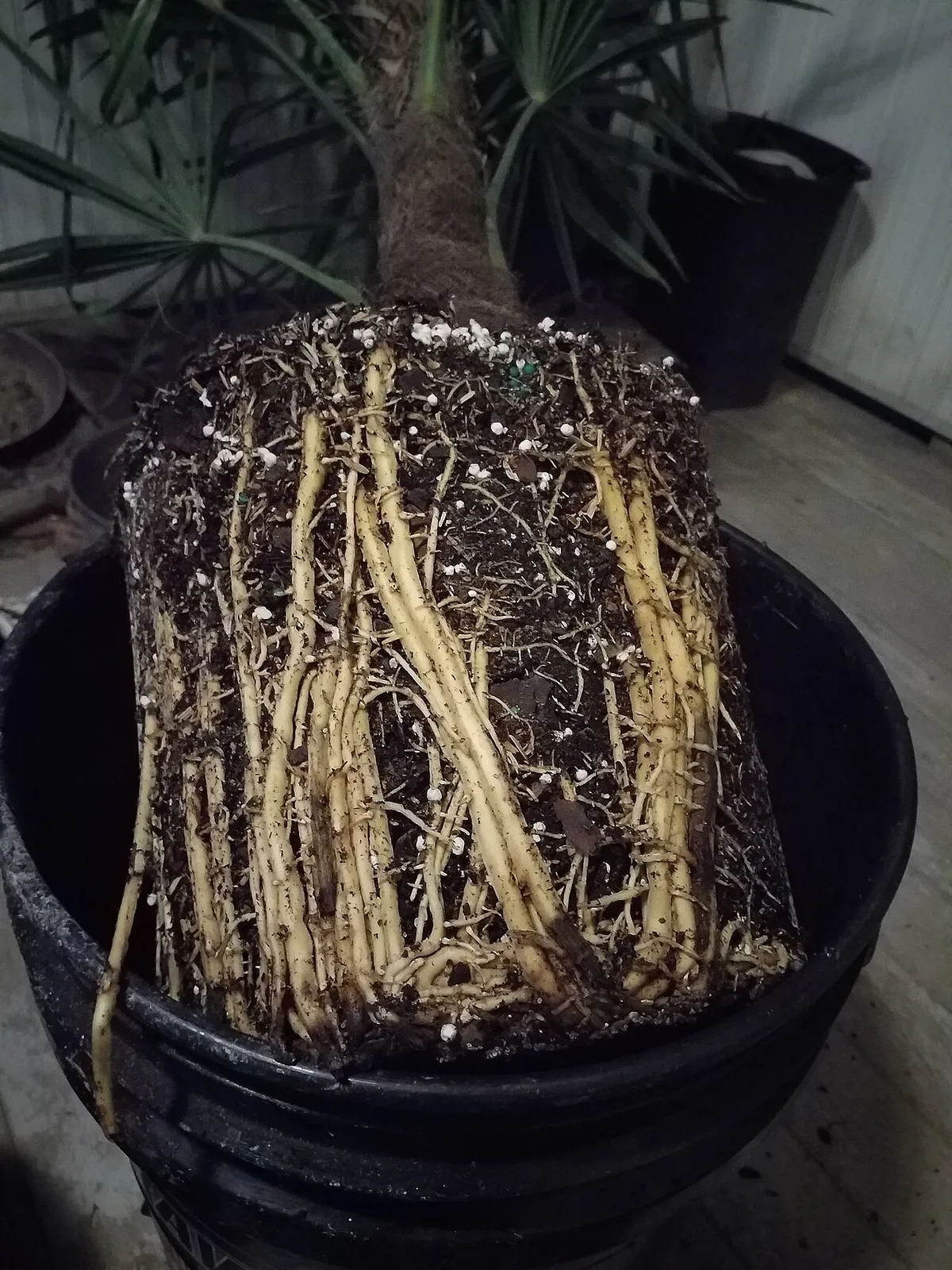
You walk into your local nursery in the Puget Sound region and find a 15-gallon Douglas-fir or Japanese maple. The tag reads “ready to plant.” You load it into your truck, dig a hole in your yard, and drop it in. You water it regularly. The tree seems fine for a few years. Then, at year seven or ten, something shifts. The tree leans without explanation. Its crown thins on one side. Or one winter morning you find it on its side after a wind event that barely bends your other trees. You excavate the base to understand what happened. The roots form a perfect spiral, like they never left the pot. The trunk flare is missing or buried. The roots are girdling the base of the tree, strangling the vascular tissue. You have circling roots, and the damage was locked in the day you planted it.
What Is Happening
When a tree is grown in a container at the nursery, its roots have no choice. They hit the wall of the pot and turn. They circle. In nature, roots can grow outward and downward indefinitely. In a nursery pot, they spiral back on themselves, again and again. Most trees sold in Western Washington, where container-growing dominates the retail nursery business, develop this pattern to some degree. Some are worse than others.
Here is the critical point: these roots do not self-correct once you plant the tree in the ground.
After planting, those circling roots keep growing. But they keep circling. As they increase in diameter, they wrap tighter around the trunk base or around each other, acting like a constrictor. A root the thickness of a pencil can be ignored. A root that has grown to the thickness of a thumb becomes a problem. When that thickening root wraps around the trunk or other structural roots, it girdles them, cutting off the flow of water and nutrients. This is called stem-girdling roots, and it is one of the most common causes of tree decline in the landscape.
The tree weakens. Its crown declines asymmetrically because the girdling has starved one side of the vascular system. Its mechanical strength erodes because the girdling roots no longer brace it properly. The tree leans. The tree fails. The damage is internal, invisible until the day the tree topples or is discovered in decline.
How to Spot Circling Roots
At the nursery: This is your first and best opportunity. Ask the nursery staff to pull the tree from its pot. Look at the root ball. Do the roots form concentric circles around the perimeter? Are they thick and tightly wound? Do they circle the trunk base? Are the roots at the top of the soil ball already wrapping back toward the center? These are red flags. You can reject the tree. Professional nursery stock standards add another check: for balled-and-burlapped trees, the root ball diameter should be at least 10 to 12 times the trunk diameter measured 6 inches above the trunk flare. A root ball smaller than this proportion means a disproportionate root loss during digging.
After planting: Look at the root flare, the place where the trunk widens slightly as it meets the root system. A healthy tree has a visible flare. If you cannot see a flare, the tree may have been planted too deep, or circling roots may have girdled the base. Place your hand at the trunk base. It should feel like a flared cone, wider at the bottom than above. If it feels like a telephone pole, the flare is compromised. Does the tree lean without an obvious wind-break reason? Lean can indicate that girdling roots on one side have weakened the anchor system on that side.
On established trees: Once a tree is mature, the signs are more obvious but the damage is done. Look at the trunk base. Is the bark flattened or indented on one or more sides? Do you see a groove circling the trunk? Is the canopy asymmetrically thin on one side? These all point to stem-girdling roots. The tree may still be alive and stable, but it is compromised and declining.
What to Do at Planting
When you bring a container tree home, intervene before you plant it.
Remove the container. Inspect the root ball carefully. If the roots are circling tightly, score the root ball. Use a sharp knife or a reciprocating saw to make four vertical cuts, spaced around the perimeter, cutting 1 to 2 inches deep into the soil ball. These cuts sever the circling roots and encourage them to branch outward when they encounter the surrounding soil.
If circling is severe, butterfly the root ball. This means cutting the soil ball vertically in half, then cutting each half in half again, creating four quarters. Gently pry the quarters apart slightly. The severed roots at each cut will branch outward into the surrounding soil.
Spread roots radially. Walk the root system with your hands. Any roots that curve back toward the center or wrap around the trunk base should be gently straightened and positioned to radiate outward.
Plant at the root flare, not at the soil line marked on the trunk from the nursery pot. Arboricultural planting standards are emphatic: the trunk flare must be partially visible after planting, and if it is not visible in the nursery container, gently expose it before you plant. The soil line in the pot is often too high, set to fit nursery spacing and watering standards, not to reflect where the tree should sit in the ground. The root flare should be at or slightly above finished grade. Burying it promotes disease and perpetuates the girdling problem.
Remove all burlap, wire baskets, and synthetic growing media from the root ball. These materials slow root escape into the surrounding soil and can themselves girdle roots as the tree grows.
What to Do on Established Trees
If you inherit a tree with mature stem-girdling roots, intervention is possible but more intensive.
Root collar excavation is the standard treatment. Using an air spade or careful hand excavation, expose the root collar and the base of the trunk. The goal is to identify and visualize the girdling roots. Once exposed, a girdling root can be cut with a sharp chisel or a reciprocating saw. The root system will still function because it has branches and alternative pathways; removing one girdling root or even several does not kill the tree. It relieves the strangulation and allows growth to resume.
This work should be done by a certified arborist. A mistake in identifying what is structural root and what is a problem root, or cutting too close to the trunk, can cause other problems. But when done correctly, root collar excavation can literally save a tree’s life.
Prevention: The Better Path
The simplest solution is prevention.
Buy bare-root trees when they are available. Bare-root trees, typically sold dormant in late winter or early spring, come with natural, radial root systems. They have never lived in a pot. Plant them properly, and they grow a normal, balanced root architecture.
If bare-root is not available, inspect root balls before you buy. Reject trees with obvious circling roots, J-rooted taproots, or dense root mats wrapping the trunk base. A nursery may have other specimens, or you can ask them to source one that is better rooted.
Know that in Western Washington, container-growing is the norm. It is not a rare problem. Most trees at retail nurseries are grown in pots, and most have some degree of circling roots. Your job is to identify which ones have too much, and then to intervene at planting time to break the pattern.
Your tree will thank you with decades of stable, healthy growth.
Sources
Gilman, E. F., et al. “Landscape Trees: Root Development, Root Barriers, and Mechanism of Damage to Hardscape.” Journal of Arboriculture 12, no. 9 (1987): 202-207.
Watson, G. W., & Himelick, E. B. “Root Development of Landscape Trees and Its Relation to Tree Stability.” Journal of Arboriculture 23, no. 5 (1997): 211-218.
International Society of Arboriculture. “Best Management Practices: Tree and Shrub Planting.” ISA, 2009.
Chalker-Scott, L. “The Myth of Butterfly Planting: Evidence-Based Soil Preparation.” University of Washington Extension, 2015.
International Society of Arboriculture. (2021). Buying High-Quality Trees. TreesAreGood Series.
International Society of Arboriculture. (2021). New Tree Planting. TreesAreGood Series.