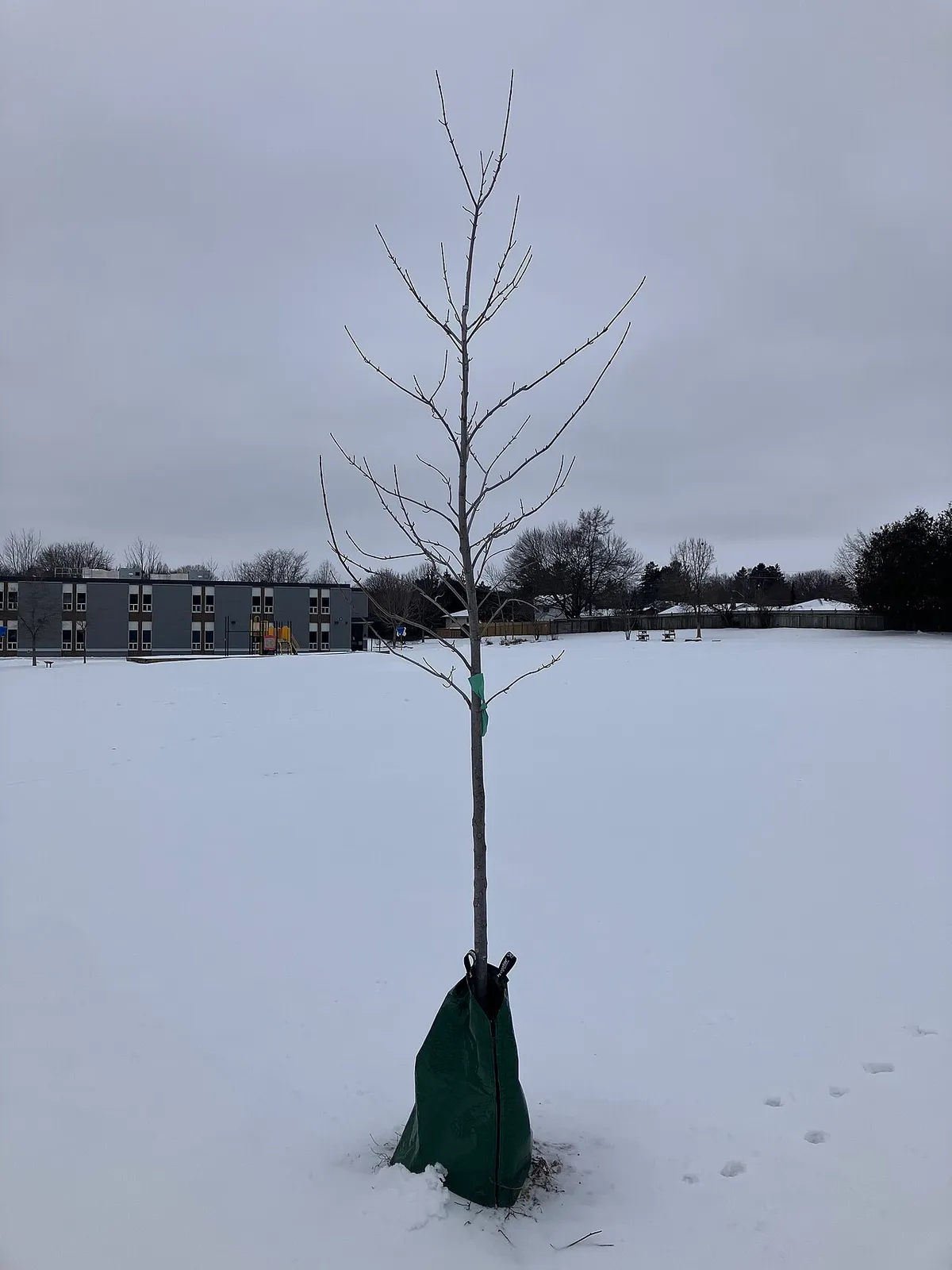
You plant a tree in October. The rain starts in November, and you think you’re done. The soil stays wet through winter and spring. By June, you’ve forgotten about that tree entirely. Then July hits, and you realize your new maple or fir has been gasping for water while you’ve been watching the lawns stay green without a single irrigation turn.
This is the most common mistake in the Puget Sound: assuming that Pacific Northwest rainfall distribution matches what our trees actually need.
The truth is simple. Your newly planted tree has roots in only the top 18-24 inches of soil. Those roots haven’t expanded into the surrounding earth yet. The soil around the root ball can dry out completely in two to three weeks of summer heat, regardless of how much rain fell last April. And when that happens to a tree still learning to survive in Western Washington, you lose the tree or set it back by years.
The first three years after planting are not optional. They are the foundation of everything your tree will be for the next 50 years.
Year One: Establish Weekly Watering
During your tree’s first growing season, water is non-negotiable. From June through September, give your tree 3 to 5 gallons of water per week. Not all at once. Not daily sprinkling. Once per week, apply the water slowly and deeply at the drip line (the area directly below the outer branch tips), not at the trunk.
Why the drip line? Because water needs to move down through the root zone, not pool around the base. And why once a week instead of daily small amounts? Because new root growth happens in moist soil that drains. Shallow, frequent watering creates a false signal that roots don’t need to grow deeper. They stay shallow, and your tree becomes dependent on surface moisture that disappears by August.
The soil you’re watering through matters. If you’re planting in Western Washington clay (and you probably are), understand that clay holds moisture longer than sandy loam does. But here’s the trap: once clay dries out, it shrinks and pulls away from the root ball. When water finally comes, it can’t easily rewet that hard, shrunken soil. Deep, thorough watering is the antidote. Slow application allows clay to absorb water throughout its depth instead of shedding it across the surface.
Apply that weekly water early in the morning or late in the afternoon. You’re not trying to wet the foliage. You’re trying to saturate the root zone down to 12 inches. A soaker hose works well. A drip line works even better. A sprinkler works poorly because much of the water never reaches the tree and evaporates from the soil surface.
During wet periods (late fall through spring), skip watering entirely. Your tree is getting rain. Overwatering in the off-season creates the opposite problem: saturated, anaerobic soil that rots roots.
Year Two: Space Out the Interval
By your tree’s second growing season, its root system has expanded outward. It’s beginning to draw moisture from a wider soil profile. This means you can extend the interval between waterings.
Water every 10 to 14 days during the dry season (June through September). Still 3 to 5 gallons, still at the drip line, still slow and deep.
You might be tempted to skip a watering or two if there’s been a little rain. Resist that impulse. One week of drizzle doesn’t count. You’re watching for the real indicator: soil moisture at 8 to 12 inches below the surface. Dig a small hole with a shovel or probe the soil with a metal rod. If it’s moist at depth, you can wait. If it’s dry, water.
The progression from Year 1 to Year 2 is not about reducing attention. It’s about calibrating that attention to a tree that’s getting stronger but is still not independent.
Year Three: Conditional Watering
Your tree has now been in the ground for two full growing seasons. Its root system has expanded substantially. Most trees can now go longer between waterings without suffering.
Water during extended dry spells only. That means watering when two or more weeks have passed without rain and you see signs of stress (slightly dimmed foliage, a hint of wilting in the afternoon, reduced new growth).
For some tree species, Year 3 is when you’re essentially done. A Douglas fir, a big-leaf maple, a Ponderosa pine: these are adapted to our summers, and by Year 3 they’ve proven they can find water on their own. For smaller or more tender trees (crape myrtles, some Japanese maples, ornamental cherries), continue light monitoring through Year 3 and into Year 4.
After Year Three: Drought Stress Watering Only
Once your tree has passed three growing seasons, you water only when it shows real signs of stress. Premature leaf drop in August, visible wilting, color change: these are your signals to water. A healthy, established tree should not require regular supplemental watering in Western Washington, even during our functionally arid summers.
The exception is extended drought, the kind that comes along every decade or so when July and August deliver nearly nothing. Then, yes, give your older trees occasional deep water. But routine weekly summer watering is no longer your responsibility.
Mulch: The Single Most Important Step
Before you even finish planting, lay down mulch. This single act will do more for your new tree than most other interventions combined.
Apply 2 to 4 inches of arborist wood chip mulch over the entire root zone, extending as far out as the drip line. Pull the mulch back 4 to 6 inches from the trunk itself. Never mulch against the bark. Arboricultural research confirms that mulch piled against the trunk softens bark tissue, making trees more susceptible to insects and disease, and can trigger stem-girdling roots that slowly strangle the tree.
What does mulch do? It moderates soil temperature. It reduces evaporation so your soil stays moist longer between waterings. It eventually breaks down and improves the soil structure, helping both water infiltration and retention. It suppresses weeds that would compete with your tree for water and nutrients. Over time, it becomes part of the soil itself.
In our clay soils, this is especially critical. Mulch is how you prevent the soil from baking hard in July and cracking away from the root ball. Refresh your mulch layer every two to three years as it breaks down.
Why Western Washington Summers Are Deceptive
Our rainy reputation is earned, but it’s entirely a winter and spring story. From June through September, Puget Sound averages less than an inch of rain per month. July and August regularly drop below half an inch each. That’s functionally arid by plant-science standards.
Your newly planted tree didn’t evolve in our weather. Even if it’s a native species like a Doug-fir, it came from a nursery where it was watered regularly. Its root system is small and young. It can’t compete with the established trees around it for what little summer moisture exists. You are the only source of reliable water in those first three years.
The wet winters make people forget. Soil stays saturated through March. By June, new tree owners convince themselves the tree doesn’t need help because it rained in May. Meanwhile, the root ball is drying out in clay that’s rapidly shrinking away from those tender new roots.
This is the invisible failure mode. The tree doesn’t collapse immediately. It just never thrives. It stays small, grows slowly, takes years longer to establish, and becomes more susceptible to disease and pests.
Don’t let that be your tree. Water intentionally. Water deeply. Water on schedule for three full years. Then step back and let your established tree do what it evolved to do.
Sources
Gilman, Edward F. “An Illustrated Guide to Pruning.” University of Florida Environmental Horticulture Department.
Lindsey, Patricia A., and James R. Bassuk. “Specifying Soil Volume to Meet the Water Needs of Mature Urban Trees.” ASCA Technical Paper.
Peper, Paula J., and Shelly E. Mori. “Programs for Calculating the Amount of Water Needed for Tree Irrigation.” University of California Davis, One Tree Planted.
Struve, Donald K., and Steven J. Buhler. “Mulch and Tree Species Affect Establishment.” Journal of Arboriculture 28, no. 5 (2002).
Urban Land Institute. “The Performance of Street Trees in Paved Openings.” Center for Transit-Oriented Development.
Western Regional Climate Center. “Precipitation Climatology: Pacific Northwest.” NOAA, 2024.
International Society of Arboriculture. (2021). New Tree Planting. TreesAreGood Series.
International Society of Arboriculture. (2021). Proper Mulching Techniques. TreesAreGood Series.