You cut into an apple from your backyard tree and find a brown, frass-filled tunnel running straight to the core. Inside, or recently departed, is a pinkish-white caterpillar with a brown head. The fruit looked fine from the outside, maybe a small hole at the blossom end, maybe nothing visible at all. But the inside is ruined.
That is codling moth (Cydia pomonella), and it is the single most damaging insect pest of apples worldwide. If you grow apples or pears in the Puget Sound region without any management, codling moth will find your tree. The larvae bore into the fruit, feed on the seeds and surrounding flesh, and leave you with a harvest that looks fine on the branch but falls apart in your hand.
The good news: codling moth is beatable at backyard scale without a commercial spray program. The critical insight is that everything in codling moth management comes down to roughly one day. The larva hatches on the fruit surface, wanders briefly, and bores inside within about 24 hours. Once inside, it is physically shielded from every control you could apply. Every effective method, whether it is bagging, a virus spray, or a targeted insecticide, works by intercepting that single exposed day. Miss it, and you wait for the next generation or the next year.
What You Are Looking At
If you cut that apple in half, the damage tells the story. A narrow tunnel, often entering through the calyx (the indented blossom end opposite the stem), runs straight toward the core. The tunnel is lined with brown, granular frass and sometimes fine silk webbing. At the core, seeds are partially or fully consumed, and the surrounding flesh is brown and degraded. The larva responsible is pinkish-white to cream-colored, roughly three-quarters of an inch long at maturity, with a clearly visible brown head capsule and true legs behind the head. If you find the entry hole on the outside, it is small and often plugged with reddish-brown frass. On pear, the damage pattern is the same but the entry point shifts: larvae enter through the side of the fruit more often than through the calyx, and the thinner skin may allow faster penetration.
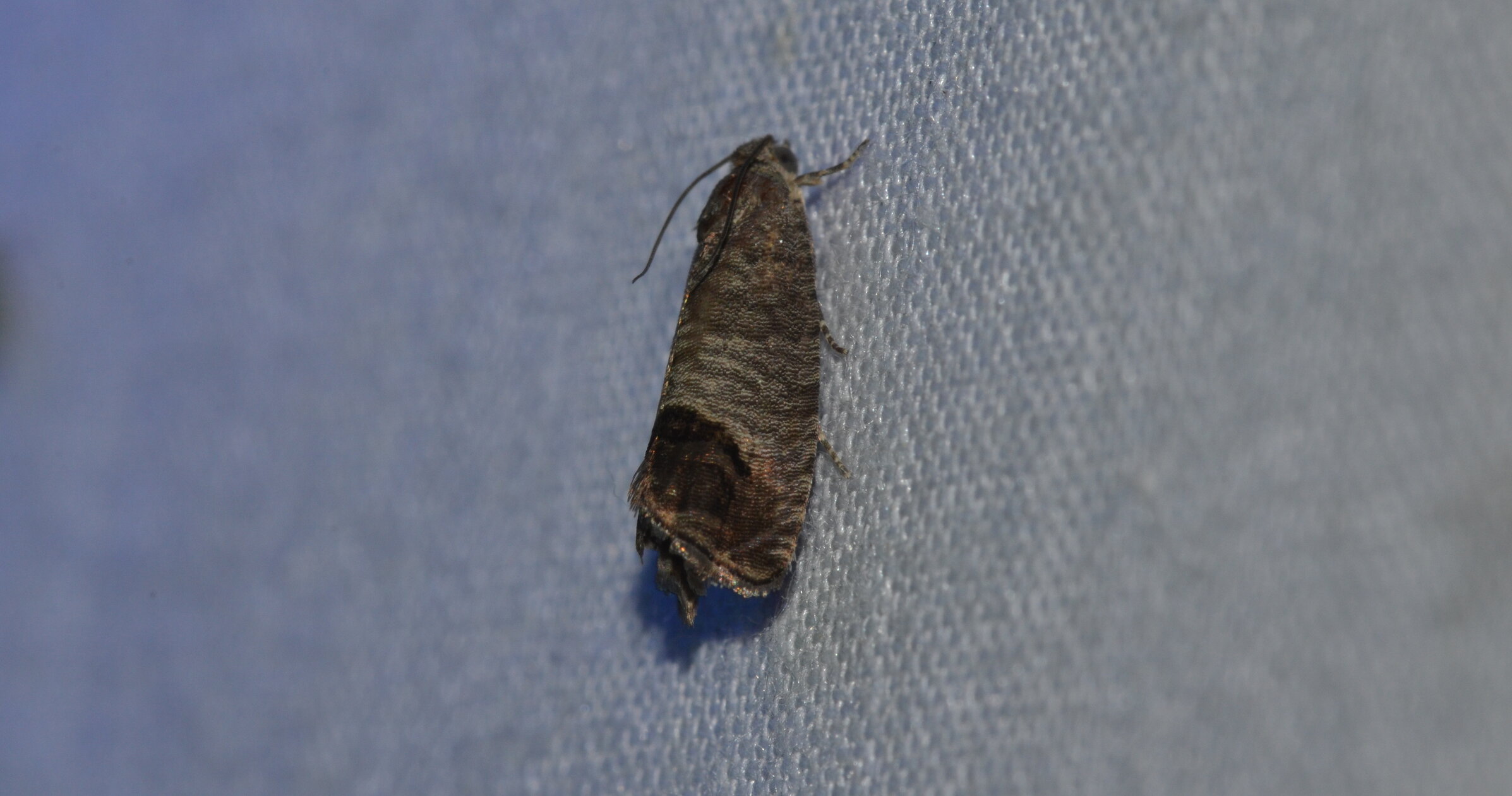
The adult moth is small and easy to overlook. The wingspan is half to three-quarters of an inch. Forewings are gray with alternating lighter and darker crossbands that give a mottled appearance, and a distinctive coppery-brown patch at the wingtip is the field mark. At rest, the wings fold tent-like over the body. Adults fly primarily at dusk and dawn and are rarely seen during the day.
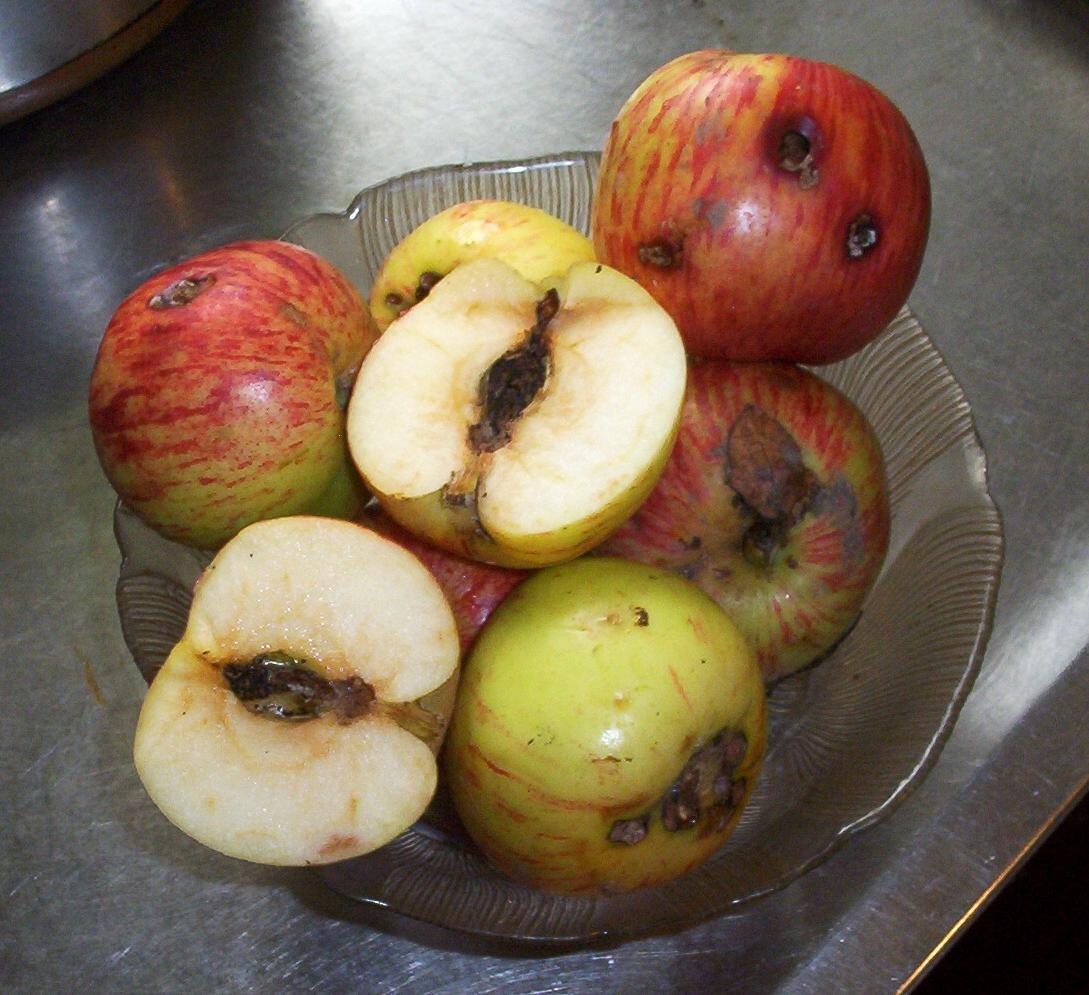 Gravenstein apples showing codling moth damage. Larvae feed on the protein-rich seeds, tunneling straight to the core. Photo by Richard Wilde, public domain via Wikimedia Commons.

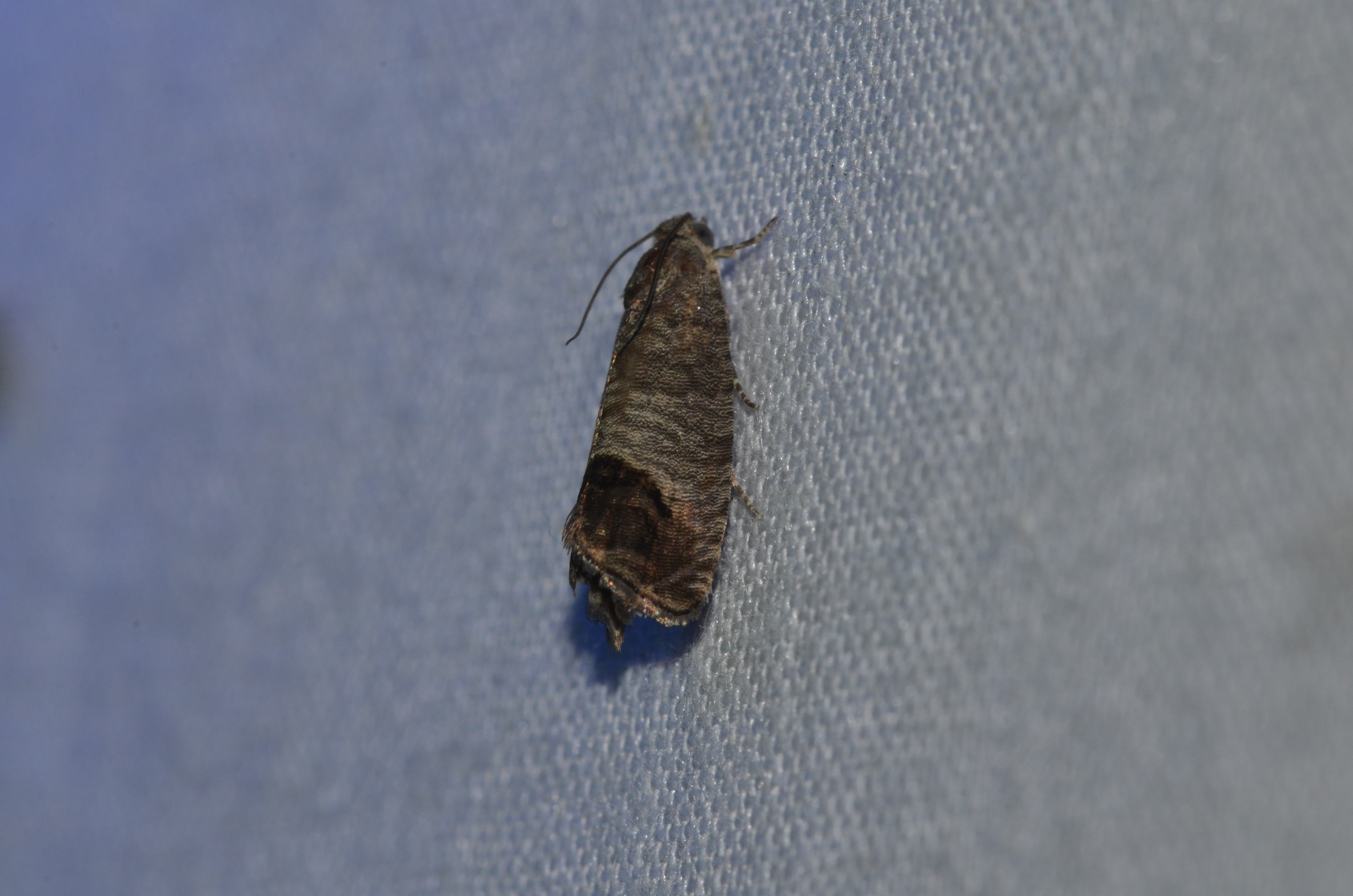 Adult codling moth at rest. The mottled gray-brown forewings and small size (half to three-quarters of an inch wingspan) make this moth easy to overlook. “Cydia pomonella” by Andy Reago & Chrissy McClarren from Wikimedia Commons, licensed under CC BY 2.0.
.jpg)
Codling Moth or Apple Maggot?
Two insects bore into apples in this region, and they require different management at different times of year. If you cannot tell them apart, you end up spraying at the wrong time for the wrong pest.
Codling moth is a spring and summer problem. Larvae enter through the calyx or at points where two fruits touch. The tunnel runs straight to the core, lined with visible frass and webbing. The larva has a brown head capsule, true legs, and fleshy prolegs, growing to about three-quarters of an inch. Damage from the first generation appears in June; second-generation damage shows up at harvest in August.
Apple maggot (Rhagoletis pomonella) is a late-summer and fall problem. The adult is a small fly, not a moth, and it lays eggs just under the fruit skin through a tiny puncture wound. The larva is a legless white maggot with no visible head capsule, much smaller than a codling moth larva, roughly a quarter inch. Instead of tunneling to the core, apple maggot larvae create meandering, wandering trails through the flesh that quickly fill with bacterial rot. The interior looks brown and mushy rather than tunneled and frass-lined.
The practical rule: if you find tunneled, frass-lined damage in June or July, it is codling moth. If you find brown, rotted, trail-laced flesh in September, check for apple maggot. The two pests overlap in August, when both can be active, so cut the fruit open and look at the larva and the damage pattern.
Management differs too. Codling moth overwinters as a larva in cocoons under bark and debris, so winter sanitation targets the tree itself. Apple maggot overwinters as a pupa in the soil beneath fallen fruit, so fall cleanup of every dropped apple is the critical cultural control. Both respond to fruit bagging, but the timing and the reason differ.
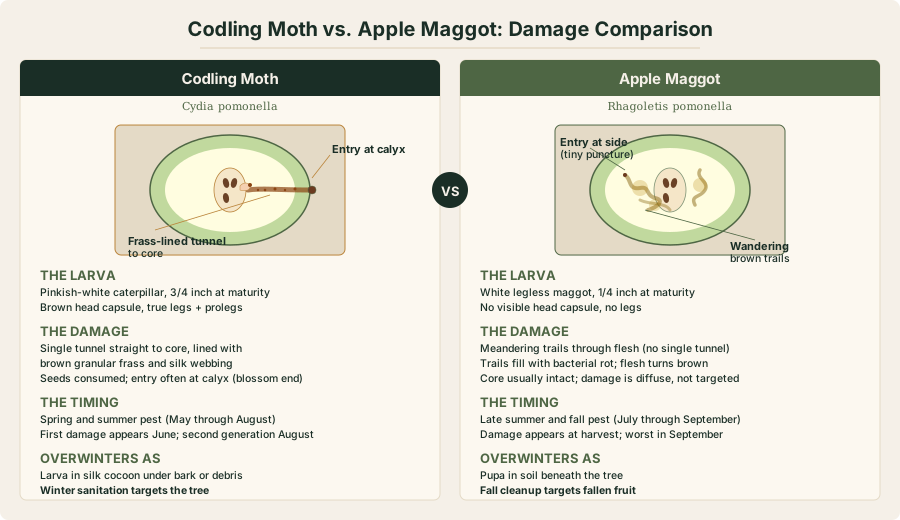 Codling moth larvae tunnel straight to the core through the calyx end; apple maggot larvae create wandering trails through the flesh from a side entry point. The damage pattern tells you which pest you have.
How Much Damage Can You Accept?
Before committing to a management program, it is worth asking what you actually want from your tree. If you grow apples primarily for fresh eating and want clean, unblemished fruit, codling moth requires active management every season. There is no ignoring it the way you can ignore tent caterpillars on an established tree.
But if you use your apples for cooking, cider, or sauce, you can tolerate more damage. A codling moth tunnel runs to the core; if you catch the entry early and cut around the damage, the rest of the apple is fine. Some home orchardists accept 20 to 30% wormy fruit as the cost of avoiding sprays entirely, and that is a legitimate choice. The management approaches below scale to your tolerance. Sanitation alone will reduce the population over years. Adding bagging gets you to clean fruit on the trees you can reach. Adding CpGV or a targeted spray gets you closer to commercial-quality harvests. Pick the level that fits your goals and your time.
The One-Day Window
Understanding codling moth biology is understanding one number: roughly 24 hours. That is how long the newly hatched larva is exposed on the fruit surface before it bores inside and becomes untouchable.
Here is the sequence. Adult moths emerge in late May to early June around the Puget Sound lowlands, coinciding approximately with ‘Red Delicious’ apple bloom. They are crepuscular, flying and mating at dusk when temperatures exceed 62°F. Females lay individual, flat, translucent eggs on leaves near fruit or directly on the fruit surface. Eggs develop for six to fourteen days depending on temperature. When the egg hatches, the tiny larva (about a tenth of an inch) wanders briefly on the fruit surface, finds an entry point, and bores in. That wandering period is the entire management window.
Every effective control method targets this moment. Fruit bags physically block egg-laying. Codling moth granulosis virus (CpGV) must be on the fruit surface when the larva hatches, so it ingests the virus as it bores in. Contact insecticides must be present during the wandering period. Once inside the fruit, the larva feeds for three to four weeks in complete protection, then exits to pupate or spin an overwintering cocoon. You will never reach it.
This is why timing matters more than product choice. A perfectly timed application of any effective material outperforms a poorly timed application of the best material. And timing, for codling moth, is driven by temperature accumulation.
Degree-Day Timing
Research institutions track codling moth development using growing degree days base 50°F (GDD₅₀). Because HFG reports all GDD values in base 32 to capture the biologically relevant heat that accumulates during our mild maritime springs, the conversions below use five years of Kent station data (2021-2025). For more on why base 32 matters here, see the growing degree days guide.
WSU’s no-biofix model, which uses January 1 as the starting point and requires no trapping, is the most practical approach for home orchardists. The key thresholds:
First generation:
- ~2,100 GDD₃₂ (221 GDD₅₀): First adult moth flight. In Kent, this falls between late May and mid-June depending on the year. This is when moths are mating and beginning to lay eggs.
- ~2,650 GDD₃₂ (425 GDD₅₀): First egg hatch begins. This is the critical spray window if you are using CpGV or a contact insecticide. In Kent, typically mid to late June.
- ~3,150 GDD₃₂ (656 GDD₅₀): Peak first-generation larval entry. If you missed the egg hatch window, the larvae are inside the fruit. In Kent, early July.
Second generation:
- ~3,680 GDD₃₂ (920 GDD₅₀): Second-generation moth flight begins. Mid to late July in Kent.
- ~4,640 GDD₃₂ (1400 GDD₅₀): Peak second-generation larval entry. This is when the majority of harvest-time damage occurs. Mid to late August in Kent.
The maritime climate slows degree-day accumulation here compared to the apple-growing regions east of the Cascades or in central Oregon. That typically limits us to two full generations per year, occasionally a partial third in unusually warm summers. OSU notes first flight as early as late April in southern Oregon; here, it runs two to three weeks later.
WSU’s Decision Aid System (decisionaid.systems) integrates the degree-day model with real-time weather data and provides management timing recommendations. It is free and designed for exactly this use case.
Management for the Backyard Orchard
Each step below builds on the one before it, and the order matters. Sanitation is the foundation because it reduces the population you are managing against. Physical barriers (bagging) intercept the next layer. Biological and chemical controls handle what gets through. Skipping straight to sprays without sanitation is like mopping a floor with the faucet running.
One approach you may have seen recommended is mating disruption, which saturates an area with synthetic pheromone to prevent males from finding females. It works well in commercial orchards, but it requires five to ten contiguous acres minimum. It does not work at backyard scale.
Sanitation
This costs nothing, compounds over seasons, and is the foundation everything else builds on.
Remove loose bark from the trunk and scaffold branches. Codling moth larvae spin silken cocoons (hibernacula) in bark crevices, and removing the flaking bark eliminates those overwintering sites. Do this in fall or winter. Clear all fallen fruit throughout the season, not just at harvest. Every infested fruit left on the ground completes a larva’s development and adds to next year’s population. In October, after harvest, collect and destroy every remaining fruit on the tree and on the ground. Do not compost infested fruit; bag it for disposal.
This matters because home orchards with unmanaged apple trees are the primary population source in residential neighborhoods. Your neighbor’s abandoned apple tree may be feeding the moths that find your managed one.
Fruit Bagging
This is labor-intensive but the most effective non-chemical control available to home orchardists. Research at Montana State University’s Western Agricultural Research Center found that bagged fruit sustained 12% damage compared to 35% on unbagged fruit. Paper bags are the standard; Ziploc-style bags reduced damage to 10% in the same trials, though they attracted earwigs.
The technique: thin fruit to one per cluster after June drop, when the fruitlets are roughly dime-sized (four to six weeks after petal fall). Slip each fruit through a slit cut in the bottom fold of a standard No. 2 brown paper bag so the bag seals around the stem. Staple the open end closed. Japanese-style double-layer fruit bags (available from orchard supply companies) are more durable and easier to apply. Remove bags three weeks before your target harvest date to allow color development.
Bagging is practical for trees you keep under ten feet through pruning, and for high-value dessert varieties where cosmetic quality matters. For a tree with 100 to 200 fruits after thinning, expect two to three hours of work. The payoff is a clean harvest with no chemical inputs.
Trunk Banding
Wrap a strip of corrugated cardboard (corrugations facing inward toward the bark) around the trunk in May. Migrating larvae leaving the fruit preferentially crawl into the corrugated channels to spin their cocoons. Every two weeks through September, remove the band, destroy the cocooned larvae, and replace it. This will not eliminate the population, but it reduces it incrementally, and it gives you a visual read on how active the infestation is. More cocoons in the band means more pressure.
Codling Moth Granulosis Virus (CpGV)
CpGV is a naturally occurring baculovirus that infects only codling moth. It is commercially available as Cyd-X and Madex HP, and it is approved for organic production. The virus must be on the fruit surface when the neonate larva hatches and begins boring in; the larva ingests virus particles as it feeds on the treated surface.
You will see a wide range of efficacy numbers for CpGV, and it is worth understanding why. A PNW field study (Lacey et al., J. Econ. Entomol., 2005) achieved 81 to 99% larval kill, while UC Davis IPM characterizes standalone CpGV as “moderate control” at 60 to 80%. The difference is not the product; it is the discipline. The high numbers came from applications timed precisely to egg hatch and reapplied on a tight schedule through the egg-laying period. The lower numbers reflect what happens when someone sprays once at roughly the right time and moves on. CpGV degrades in UV light within a few days, so it needs to be on the fruit surface when each cohort of eggs hatches. One application is not enough. Two to three, spaced per the label through the egg-laying window, is the minimum for reliable results.
CpGV is completely host-specific. It does not affect beneficials, bees, fish, or other wildlife. That specificity is its greatest advantage for home orchards where you want to preserve the predatory insects and parasitoids that control other pests.
One caution: emerging research has documented CpGV-resistant codling moth populations in the United States (Gebhardt et al., Viruses, 2022). Do not rely exclusively on CpGV for multiple consecutive years without rotating in other methods. Pairing CpGV with bagging and sanitation is a more resilient long-term approach than using any single tool alone.
Targeted Chemical Controls
If you spray, the product matters less than the timing. Apply at the egg hatch window (approximately 2,650 GDD₃₂, typically mid to late June in Kent) and reapply per label directions. The conventional shorthand, if you are not tracking degree days, is to apply 10 days after petal fall or 17 to 21 days after bloom.
For organic orchards, spinosad (sold as Captain Jack’s Deadbug Brew or Monterey Garden Insect Spray) is the strongest option. It kills on contact and by ingestion. The catch is bee toxicity: spinosad is lethal to bees while the spray is wet. Apply in the evening after bee activity stops, and never during bloom. If your apple tree is still blooming when codling moth is active, you cannot use spinosad safely. Pyrethrins (Bonide Bug Buster-O) offer rapid knockdown but break down in hours, so the timing has to be nearly perfect.
For conventional programs, acetamiprid (Ortho Flower, Fruit & Vegetable Insect Killer) has contact and some systemic activity with lower bee toxicity than most neonicotinoids, though you should still avoid bloom-period application. Esfenvalerate and malathion are effective but broad-spectrum, meaning they kill the parasitoid wasps, predatory beetles, and other natural enemies that help suppress other pests in your orchard. For a home orchard where you are also relying on beneficial insects for aphid and mite control, that collateral damage matters. Evening application reduces the bee kill but does not eliminate it.
What does not work here: Horticultural oil during the growing season can kill eggs if timed precisely (around 2,550 GDD₃₂), but the window is narrow and oil can cause phytotoxicity on fruit. Dormant oil does not control codling moth because the overwintering stage is a larva in a cocoon, not an exposed egg or crawler. Insecticidal soap has minimal efficacy against codling moth.
Second Generation and Fall Cleanup
The second generation of codling moth causes the majority of harvest-time damage, and it catches people off guard because the fruit is bigger and closer to ripe. Second-generation moths begin flying around 3,680 GDD₃₂ (mid to late July in Kent), and peak larval entry occurs around 4,640 GDD₃₂ (mid to late August). The second generation is worse than the first for two reasons: the population is larger (each first-generation female laid 30 to 70 eggs), and the fruit is now large enough that entry damage is harder to spot before harvest. If you bagged fruit in June, the bags are still protecting against second-generation entry. If you are using CpGV or sprays, you need a second round of applications timed to the second-generation egg hatch.
Fall cleanup is the bridge between this year’s management and next year’s population. Harvest all fruit promptly; do not leave mature fruit hanging. Collect and destroy every dropped apple and pear, because larvae inside fallen fruit will complete their development, exit, and spin overwintering cocoons. Remove trunk bands for the winter. Scrape loose bark from the trunk and major limbs. Every overwintering larva you eliminate now is one fewer moth next May.
Monitoring Without a Spray Program
Even if you choose bagging and sanitation over any spray program, a pheromone trap gives you information you cannot get any other way. Hang one delta trap with a codling moth pheromone lure (codlemone) in the upper canopy of your apple tree by mid-April. Check it weekly. The trap catches male moths, telling you whether adults are active, how heavy the pressure is, and when flight peaks.
What the numbers mean: a count of five or more moths per trap per week indicates significant pressure, enough that some form of active management (bagging, CpGV, or spray) will be necessary if you want clean fruit. Fewer than five suggests the population is low enough that sanitation alone may hold the line. Zero over several consecutive weeks in peak flight season means you either have very low pressure or the lure has expired (replace lures every four to six weeks). If your sanitation and bagging program is working, trap counts should decline over seasons. If counts stay high despite your efforts, there is likely an unmanaged population source nearby, often a neighbor’s abandoned apple tree or unpicked ornamental crabapples.
Combination lures (codlemone plus pear ester) attract both males and females, giving a more complete picture of activity. These are available from orchard supply retailers.
For the do-it-yourself option, a half-gallon milk jug baited with two cups apple cider vinegar and half a cup of molasses will catch codling moths along with other insects. It is less specific than a pheromone trap but costs nothing.
Seasonal Action Summary
| When | What | Why |
|---|---|---|
| November through March | Remove loose bark from trunk and scaffolds. Clean up fallen fruit and debris. Destroy any visible cocoons in bark crevices. | Reduces overwintering larval population. Free, foundational. |
| Mid-April | Deploy one pheromone trap per tree in upper canopy. | Monitors adult emergence and flight intensity. Establishes whether pressure warrants action beyond sanitation. |
| Late May through early June (~2,100 GDD₃₂) | Note first moth catches in trap. Plan management approach. | First adult flight signals egg-laying will begin within days when evening temperatures exceed 62°F. |
| Mid to late June (~2,650 GDD₃₂) | Apply CpGV or targeted spray at egg hatch. OR: bag fruit (4-6 weeks after petal fall, when fruit is dime-sized). | The one-day window. Larvae hatch and bore in within 24 hours. Every method must intercept this moment. |
| July through August | Maintain bagging. Monitor traps for second-generation flight (~3,680 GDD₃₂). Apply second CpGV/spray round if using. | Second generation causes the majority of harvest-time damage. |
| September through October | Harvest promptly. Collect and destroy ALL fallen fruit. Remove trunk bands. Scrape loose bark. | Every overwintering larva removed now is one fewer moth next spring. |
Sources
- WSU Decision Aid System - Real-time codling moth phenology model and management timing
- Codling Moth - WSU Tree Fruit Extension
- Codling Moth Management - UC Davis IPM
- Codling Moth Fact Sheet - Oregon State University Extension
- Lacey et al. (2005). “Codling moth granulosis virus efficacy in PNW apple orchards.” Journal of Economic Entomology 98(4):1217-1225
- Gebhardt et al. (2022). “First evidence of codling moth granulovirus resistance in North American populations.” Viruses 14(2):365
Pesticide labels are the law. Always read and follow the label. Product registration and availability may change. This guide provides educational information and is not a substitute for current label directions.
Get seasonal timing updates for your area: Field Brief →