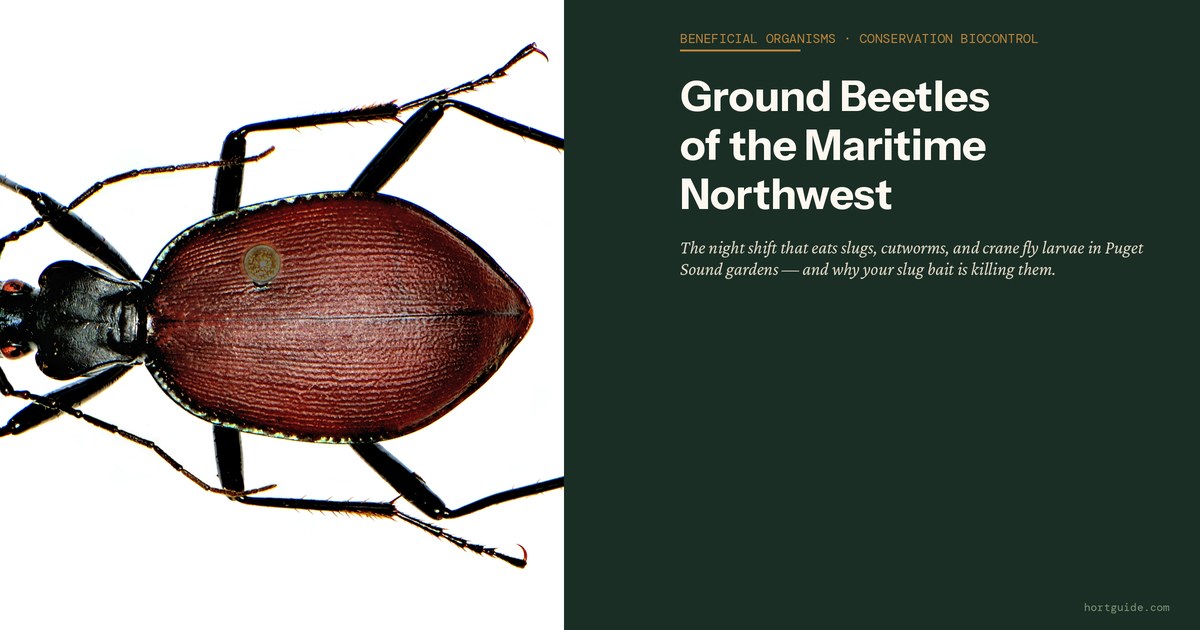
If you have a slug problem in the Puget Sound lowlands, you also have a predator problem. Somewhere under a pot, a flat rock, or a layer of leaf mulch in your yard right now, a beetle is finishing its night shift: ground covered, prey killed, retreating before daylight. Most gardeners never see it. Most slug bait labels never mention it. Most “beneficial insects” articles credit the lady beetles and lacewings and leave this one out.
Ground beetles (family Carabidae) are the largest predator group working your soil surface. They eat slugs and slug eggs, cutworms, crane fly larvae, caterpillars pupating in the leaf litter, and root maggots in the vegetable bed. Here in the Puget Sound lowlands they do it year-round, including in the months national content describes as “winter dormancy.” The problem is not that they are rare. The problem is that metaldehyde slug bait, broad-spectrum lawn treatments, and tidy bare soil are killing them faster than they can reproduce.
What You Are Looking At
Carabids range from 3 to 25 mm. They are usually dark: black, deep brown, bronze, or iridescent green and blue in the light. Most species have long running legs, prominent mandibles, thread-like antennae, and elytra (the hardened wing covers) marked with fine parallel grooves. Most are nocturnal; a few are flightless. You recognize them by what they do when you lift a pot or turn a flat stone: they run, not fly, and they run fast.
Five genera cover most of what you will meet in a Puget Sound garden.
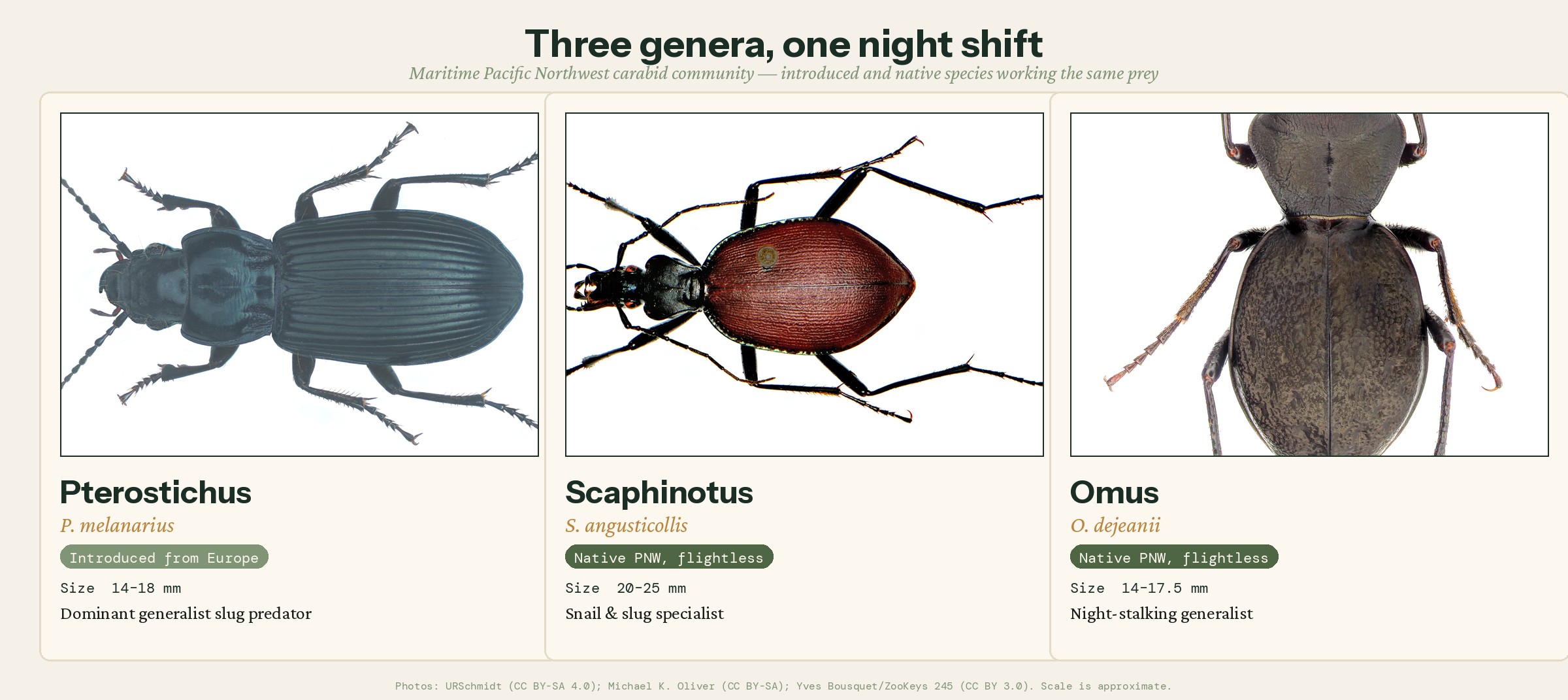
Pterostichus. The big black beetle under every pot. Typically 14 to 18 mm, deep black, glossy, fast. Pterostichus melanarius is a European introduction established here for over a century. Generalist predator, active March through October.
Nebria. Smaller at 10 to 14 mm, dark piceous. Nebria brevicollis is another European species, more recent arrival (documented in Vancouver, Washington by 2010). Active year-round with peaks in April, May, and October. The carabid most responsible for keeping winter predation going in our maritime climate.
Scaphinotus. Narrow-headed, flightless, native to the Pacific Northwest, with four species in Western Washington. Elongated hook-shaped mouthparts extract snails and slugs from their shells. Mann’s mollusk-eating ground beetle (Scaphinotus mannii) is a Washington Department of Fish and Wildlife species of conservation concern.
Omus. Also native and flightless, larger (14 to 17.5 mm), with fused elytra, sickle-shaped mandibles, and large eyes. The night-stalking tiger beetles, Omus dejeanii and Omus audouini, are PNW-endemic generalist predators. Less famous than Scaphinotus but the same category: a large, flightless carabid you cannot replace by importing anything from a catalog.
Poecilus. Iridescent blue-green, 9 to 12 mm, active April through October. Poecilus laetulus is the most common native generalist in this region, and its documented diet includes slugs and caterpillars. National beneficial-insect content defaults to Scaphinotus when it wants a “native carabid,” but Poecilus does most of the actual work.
To distinguish carabids from lookalikes: darkling beetles (Tenebrionidae) are slower, matte, and typically herbivorous; rove beetles (Staphylinidae) have shortened elytra that expose several abdominal segments. Carabids have long grooved elytra, they run rather than walk, and when cornered they face you down with their mandibles rather than hide.
Native Specialists vs. Introduced Generalists
The carabid community in your yard is almost certainly a mix of three groups doing the same job from different directions.
The native specialists are mostly flightless. Scaphinotus cannot leave a site even if pressured. Its habitat is moist, shaded ground cover; its mouthparts are adapted to a specific prey set (snails, slugs); it has been in this ecoregion far longer than any landscape your grandparents’ grandparents built. Omus is the same story at a larger scale. These species are slow-reproducing, habitat-tied, and irreplaceable. Lose a Scaphinotus population from a site and nothing is flying back in to restore it.
The introduced generalists (Pterostichus melanarius, Nebria brevicollis, Harpalus affinis, Anisodactylus binotatus) arrived from Europe on ballast, nursery stock, and soil shipments starting in the 1800s. They fly, they eat almost any soft-bodied ground-dwelling prey they can catch, and they are the dominant biomass in most cultivated landscapes on this continent. They do the same job the natives do: eat slugs, cutworms, and caterpillars at ground level, at night.
Between these poles sit the native generalists nobody mentions. Poecilus laetulus, Calosoma cancellatum, and Loricera foveata are native carabids with important working diets. Poecilus laetulus is the one to know by name: a documented native slug and caterpillar predator, active April through October, common in maritime PNW grasslands and garden edges. When a national article names “the native species” it means this kind of species, but because it rarely gets named, the reader walks away thinking the native carabid community here is just Scaphinotus in the forest duff. It is not.
The conservation math is the same for all three groups. They all need permanent ground cover, undisturbed soil, insecticide-free conditions, and iron phosphate slug bait instead of metaldehyde. You do not have to pick favorites.
What They Actually Eat (And What They Do Not)
This is the section most beneficial-insect content gets wrong, and it is worth the time because the wrong mental model leads to the wrong decisions in the slug aisle at the garden center.
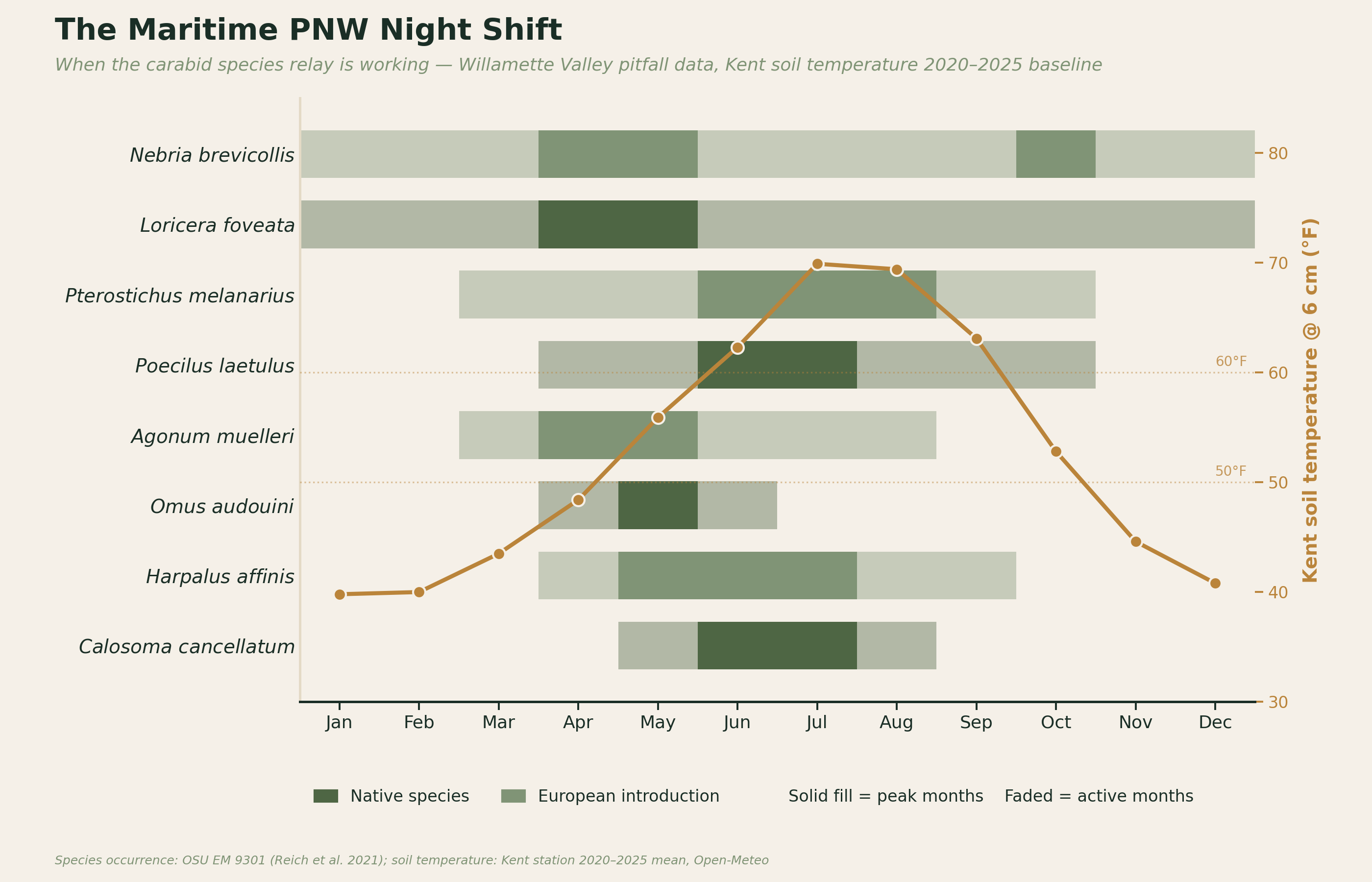
Ground beetles do not primarily eat aphids, thrips, whiteflies, scale insects, or mites. Most carabids do not climb, and almost none spend time in foliage. Extension publications (including WSU HortSense) sometimes list those foliar prey for ground beetles; they should not. The accurate prey list is soil-surface, nocturnal, soft-bodied, and ground-accessible.
Slugs and slug eggs. Pterostichus melanarius, Poecilus laetulus, Anisodactylus binotatus, and Scaphinotus species are all documented slug predators. Scaphinotus is the dedicated specialist, but the generalists do as much work by sheer numbers. A Willamette Valley study using molecular gut-content analysis detected slug DNA in about 9% of Nebria brevicollis specimens and 4% of Poecilus laetulus specimens: active slug predation distributed across multiple species working the same problem simultaneously. Laboratory work on Pterostichus melanarius shows it attacks slugs below roughly 40 mg body weight, which means what you see on your hostas (the big adult Deroceras and Arion) is not what the beetles are eating. The beetles are suppressing the next generation, the eggs and juveniles, underground.
Caterpillars. Especially ground-pupating Lepidoptera: cutworms, armyworms, winter moth, some tent caterpillars. Calosoma cancellatum is a large native caterpillar specialist; Pterostichus melanarius and Poecilus laetulus take caterpillars opportunistically all season.
Crane fly larvae (leatherjackets). Nebria brevicollis, Pterostichus melanarius, and Agonum muelleri all take leatherjackets. If your lawn turns yellow in early summer from European crane fly, your carabid population is working on the problem underground. Reducing the predators will not fix the lawn; it will make next year’s damage worse.
Soil pests and weed seeds. Agonum muelleri takes wireworms. Trechus obtusus takes fly eggs. Several species take root maggot larvae. Amara and Harpalus species are omnivorous and consume significant quantities of annual weed seeds. These are the pests you would otherwise manage with row cover, drenches, or crop rotation.
A ground beetle can eat close to its own body weight in prey in a single night. The population, not any one beetle, is what matters, and the population here is spread across a dozen species working different shifts on different prey.
What they are NOT doing: attacking aphids on your roses, picking thrips off your dahlias, touching your scale insects. Those jobs belong to lady beetles, syrphid flies, lacewings, and parasitoid wasps. If your pest pressure is slugs in spring, crane flies in early summer, and cutworms in fall, you have a carabid conservation opportunity. If your pest pressure is aphids and whiteflies in June, that is a different conversation.
The Maritime Climate Advantage
National beneficial-insect content describes ground beetles as “spring through fall” predators that go dormant in winter. That is correct for the interior of the continent. It is wrong here, and the difference is one of the biggest assets this region’s climate gives local gardeners on the biological control ledger.
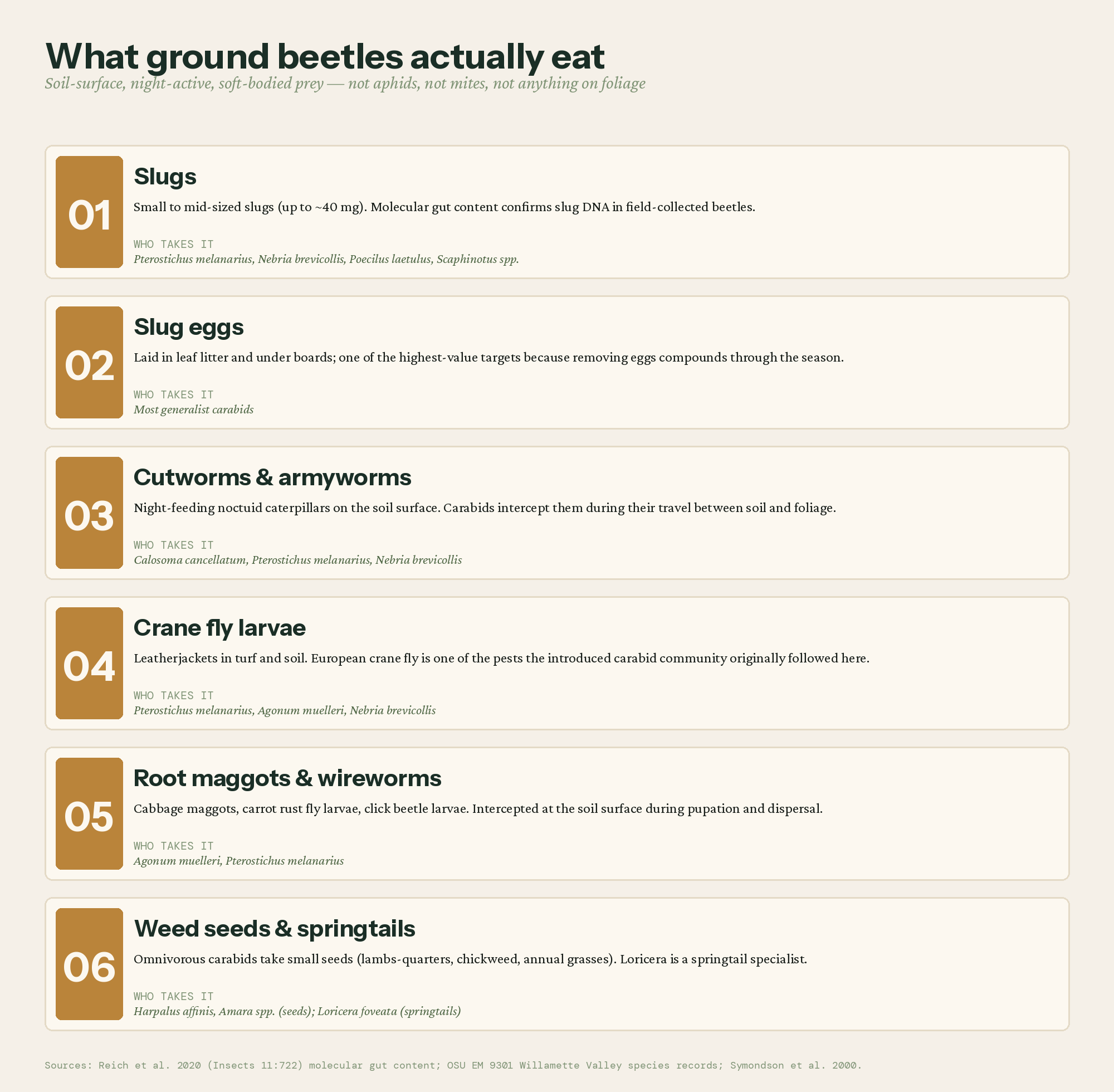
Puget Sound lowland winters are mild. Soil temperatures at ground level stay above freezing most nights even in January, and soils stay moist from October through June. The carabid community is structured as a year-round relay instead of a spring-to-fall peak.
Using the Willamette Valley pitfall-trap record (the closest quantified dataset to this region’s landscape conditions), the relay looks like this:
Year-round with spring and fall peaks. Nebria brevicollis was trapped every month of the year, with activity peaks in April, May, and October. Loricera foveata was very common year-round with a peak in April and May. These species hold the line when continental carabid populations are dormant.
Full growing season, March through October. Pterostichus melanarius (European) and Poecilus laetulus (native) are the two dominant generalist slug predators, active continuously from bud break through autumn leaf drop.
Spring shoulder, March through June. The largest cohort overlaps here: Omus audouini, Agonum muelleri, Harpalus affinis, Anisodactylus binotatus, Platynus brunneomarginatus. Native flightless specialists overlap with the year-round winter species and the incoming summer generalists. Species diversity peaks here, which means prey coverage peaks here too.
Summer specialists, May through August. Calosoma cancellatum (caterpillars and grasshoppers), Amara longula (weed seeds), Anisodactylus californicus (grasshopper nymphs). These are the native warm-season heavyweights.
The practical implication: functional predator coverage exists in every month of the year. When slugs are breeding in mild wet soil in January, Scaphinotus and Nebria are hunting. When cutworms cut vegetable seedlings in May, Pterostichus and Poecilus are taking them at night. When late summer brings crane fly egg-laying, the generalists are eating leatherjackets before next June’s damage surfaces.
Recognizing this starts with accepting that “winter dormancy” is a statement about geography, not biology. One caveat on the source data: the Willamette Valley pitfall records come from agricultural grasslands, not residential landscapes. The species assemblage is the same maritime PNW community at work in Puget Sound gardens, but read abundance rankings as “what you are likely to find in well-kept ground-cover habitat,” not as a prediction of how many beetles any one yard will hold.
Why Your Slug Bait Is Killing Your Solution
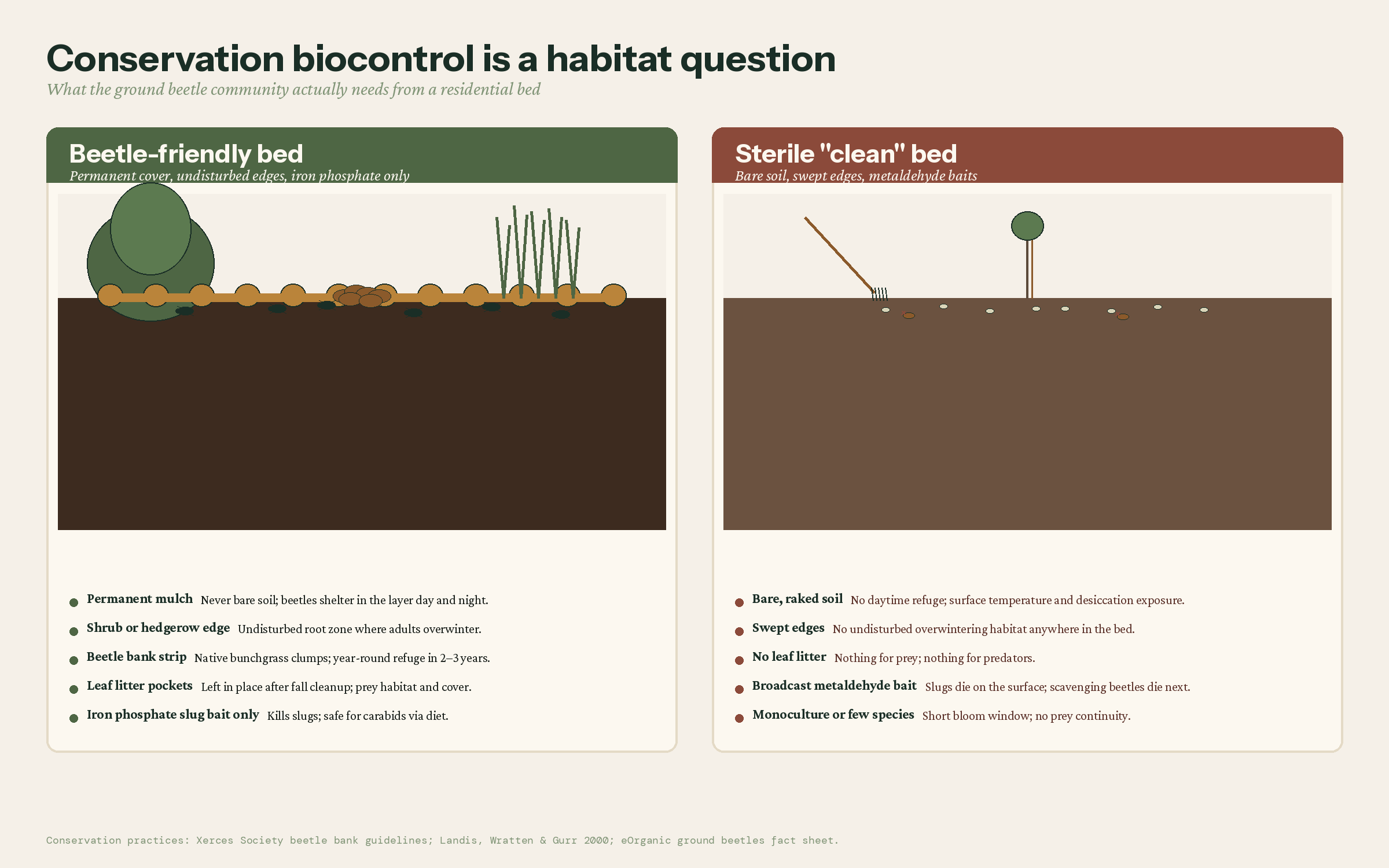
Metaldehyde slug bait (Corry’s Slug & Snail Death, Deadline, Bug-Geta, and most blue pellet products in the garden center) works by poisoning the slug. The slug ingests it, dies on or near the soil surface, and is scavenged by whatever finds it first. In this region, that is very often a ground beetle.
The beetle does not distinguish a dying metaldehyde-poisoned slug from a healthy one. It eats it. The metaldehyde passes up the food chain. The beetle dies. This is secondary poisoning, and it is the reason metaldehyde is rated as highly hazardous to soil-dwelling beneficial insects in every serious integrated pest management reference. Scaphinotus is hardwired to eat the exact prey carrying the toxin, which makes it one of the most vulnerable species. A gardener who reaches for metaldehyde is paying to remove the native predator that would otherwise keep the next generation of slugs in check.
You can keep the slug control and skip the secondary poisoning. Iron phosphate baits (Sluggo, Escar-Go, and several generics) work differently: the slug eats the pellet, stops feeding within hours, retreats to shelter, and dies there. Ground beetles that scavenge the dying slug or residual pellets do not accumulate meaningful toxicity, because iron phosphate is not bioavailable to insects the way it is to mollusks. Iron phosphate costs roughly twice what metaldehyde does per pound, and it is worth every cent if you want a predator community that continues to work after you put the bait away.
Other pesticides to watch for: neonicotinoids (imidacloprid, clothianidin) in soil applications are systemic, contaminate the soil profile, and are lethal to carabids through contact and prey consumption both. Pyrethroids (bifenthrin, permethrin, cyfluthrin) are extremely lethal to beetles and persist on soil and mulch for weeks; a single broad-coverage lawn or perimeter treatment can flatten the carabid population in a yard for a season. Carbaryl (Sevin) is lethal to everything in the soil-surface zone. Horticultural oils and insecticidal soaps are foliar-only and do not meaningfully reach ground beetles.
The short version: every time broad-spectrum insecticide goes into the landscape, the predator community that manages slugs, crane flies, and cutworms gets suppressed with it. You are paying to remove the solution to the problem you are asking the pesticide to solve next month.
Giving Them a Place to Live
Ground beetles are conservation-only beneficials. There is no supplier catalog. You cannot buy a bag of Pterostichus melanarius, and you cannot release Scaphinotus onto a new site and expect them to establish. The only tool you have is habitat.
Here is what that looks like, in descending order of importance.
Permanent mulch and leaf litter, year-round. The single most important thing. Bare soil is hostile habitat. A two-inch layer of wood chip, bark, arborist chips, or shredded leaf mulch provides the humidity, temperature buffering, and physical shelter carabids need to hunt, rest, and lay eggs in. The leaf litter that blows into your beds in November is not a mess to clean up. It is the winter habitat that keeps Nebria active in December.
Reduced disturbance. Do not rototill. Do not rake every leaf off every bed in spring. Do not pull every weed out of the corner behind the shed. Ground beetles live in the top inch of soil and under the mulch; anything that inverts that layer destroys habitat and crushes larvae and pupae. Cultivate only where you must.
Undisturbed edges. Every yard has a fence line, a foundation edge, a corner the mower cannot reach. Leave it alone. Where space allows, plant a two- to five-foot strip of native perennial bunchgrass along it (Festuca roemeri, Deschampsia cespitosa, Elymus glaucus). That strip is a “beetle bank”: a raised, never-tilled, year-round refuge where carabids overwinter and reproduce. It takes two to three years to reach full function and then persists for decades, seeding carabid populations into adjacent beds.
Shelter objects. A flat rock, an upside-down clay saucer, a short piece of landscape timber, a log section decaying in a corner. These are carabid hunting blinds. You will find beetles under them within weeks.
Fewer outdoor lights. Bright landscape lighting disrupts nocturnal predator activity. A single warm-temperature security light on a motion sensor is fine; continuous high-lumen floodlighting is counterproductive.
None of this requires buying anything. That is the point. Conservation biological control means habitat is the tool, and the tool is already free.
How to Know They Are There
You will rarely see a ground beetle during the day and almost never watch one hunt. They retreat to shelter before sunrise and run fast enough to be gone before your eyes catch up. You have to look indirectly.
Turn over shelter objects during the day. Flat rocks, downed wood, potted plant saucers, upturned bricks. Do it in the morning before the soil heats up. Anything dark, fast, and flattened running out from underneath is almost certainly a carabid. Cover the shelter back up gently; the beetles will return within an hour.
Set a pitfall trap for a one-night diagnostic. A yogurt container or plastic cup sunk flush with the soil surface, no bait, empty, checked in the morning. Not for population monitoring and not for pest management; just to see what is there. Collect and count the beetles the following morning, identify them to genus if you can (Pterostichus, Nebria, Poecilus, Scaphinotus, Omus, Loricera), release them at the same spot, and fill the hole back in. A healthy garden here will typically yield three to eight beetles across two or more genera from a single-night trap in late spring. Fewer than that is a habitat problem. None at all is a habitat and pesticide problem.
Watch for larvae in mulch. Carabid larvae are campodeiform: long, segmented, with three pairs of legs, a dark head capsule, and forward-projecting mandibles. They look nothing like white C-shaped beetle grubs. Pull back a handful of damp mulch in April or May and you may see one. If you do, cover it back up. You just met a beneficial.
Watch for what is absent. The most reliable indicator is indirect: fewer adult slugs on daytime surveys, fewer cutworm holes in bedding plants, fewer crane fly damage patches in the lawn in late June. If you have added habitat and reduced pesticide use and are seeing those changes over one to two seasons, you have a functioning carabid community doing the work.
One rule covers all of this. When you find a ground beetle, leave it alone. Put it back exactly where you found it. A single beetle running out from under a rock is not a pest and not a sign of infestation. It is evidence that your habitat is working.
Sources: Reich I, Jessie C, Ahn S, Choi C, Williams M, Gormally M, McDonnell R (2020). Assessment of the biological control potential of common carabid beetle species for autumn- and winter-active pests in annual ryegrass in western Oregon. Insects 11(11):722 (DOI: 10.3390/insects11110722); Reich I, Jessie C, Colton A, Gormally M, McDonnell R (2021). A Guide to Ground Beetles in Grass Seed Crops Grown in the Willamette Valley, Oregon. OSU Extension EM 9301; Ahn SJ, Marshall SA, LaBonte JR (2012). Nebria brevicollis (F.) (Coleoptera, Carabidae) in North America, benign or malign? ZooKeys 147:497-543; Symondson WOC, Glen DM, Erickson ML, Liddell JE, Langdon CJ (2000). Do earthworms help to sustain the slug predator Pterostichus melanarius (Coleoptera: Carabidae) within crops? Molecular interactions revealed by electrophoresis and PCR. Molecular Ecology 9(9):1279-1292; Washington Department of Fish and Wildlife: Scaphinotus mannii species profile; eOrganic: An Introduction to Ground Beetles - Beneficial Predators on Your Farm; Xerces Society: Beetle Banks for Beneficial Insects fact sheet; Penn State Extension: Ground and Tiger Beetles (Coleoptera: Carabidae); Landis DA, Wratten SD, Gurr GM (2000). Habitat management to conserve natural enemies of arthropod pests in agriculture. Annual Review of Entomology 45:175-201; WSU HortSense: Beneficial Insects and Pollinators. Always read and follow pesticide label directions.
Profile: Ground Beetles (Carabidae)