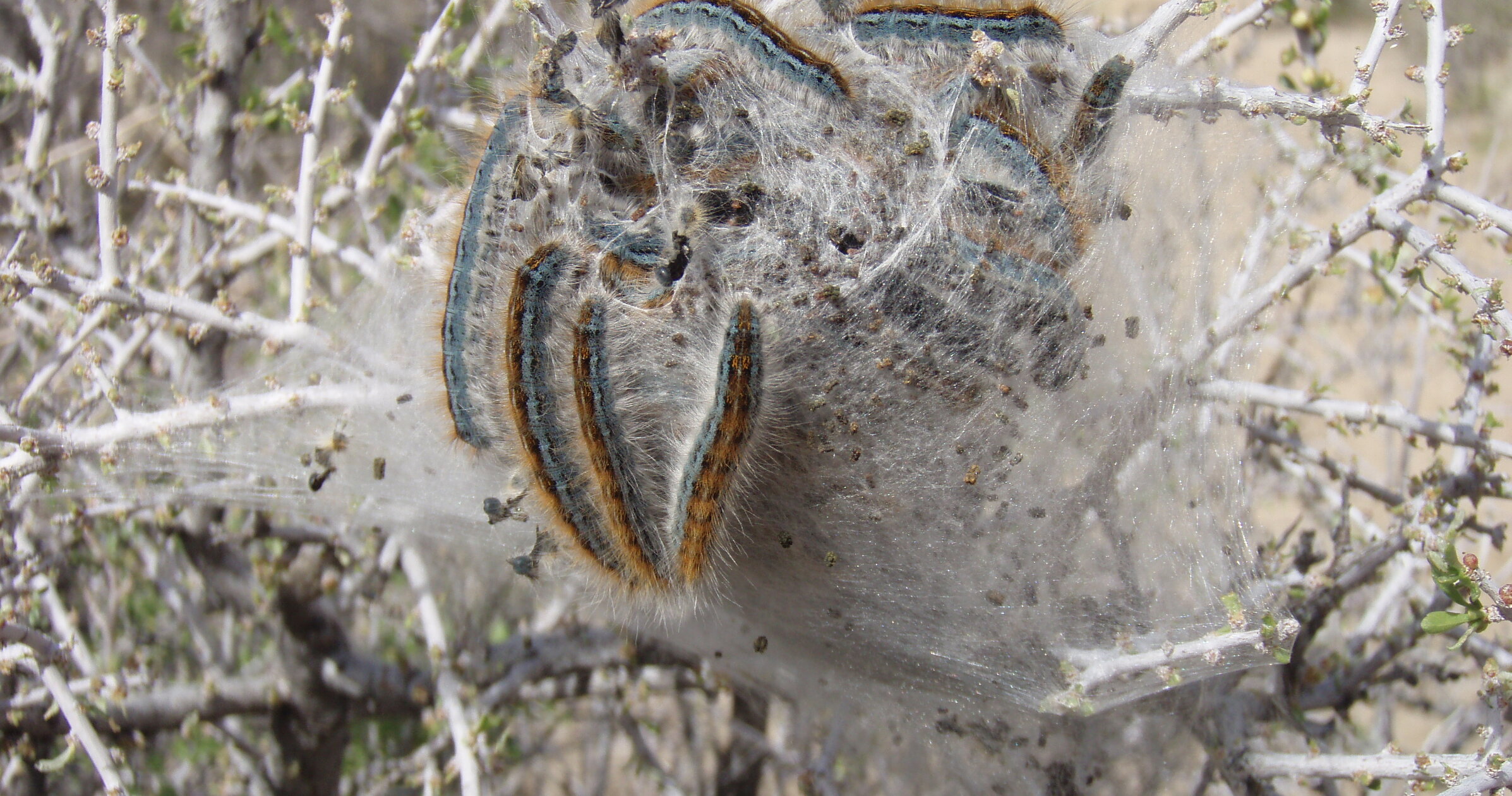
Sometime in late April or early May, you walk outside and notice thick, cottony webs bunched in the branch forks of your cherry tree or crabapple. Inside the web, dozens of hairy caterpillars are clustered together. The tree already has chewed leaves.
This is a tent caterpillar colony. It looks alarming, and if you search online you will find a lot of people telling you to spray immediately. Most of the time, that is the wrong move. Tent caterpillars are one of the most common spring defoliators in the Puget Sound region, and for established trees, the damage is almost always cosmetic. The tree recovers. What matters more than any product you could spray is understanding what you are looking at, whether it is actually a problem, and why outbreaks fix themselves.
What You Are Looking At
Three species of tent caterpillar show up in this region. They belong to the genus Malacosoma, a group of moths whose caterpillars are social feeders, meaning the larvae live and eat together in groups rather than individually.
Western tent caterpillar (Malacosoma californicum) is the one you will see most often. The caterpillars are hairy, up to two inches long at maturity, with orange, blue, and black markings along the body. They spin thick silken tents in branch forks and at branch tips. Host preferences lean toward the rose family: wild cherry, apple, crabapple, and ornamental plum are favorites. But during outbreak years, they will eat almost anything with leaves, including alder, birch, willow, cottonwood, and oak.
Forest tent caterpillar (Malacosoma disstria) is the trickier one to identify because, despite the name, it does not build a tent. Instead of webbing, forest tent caterpillars spin flat silk mats on trunks and branches where they gather to rest. The field mark is a row of white, keyhole-shaped spots running down the back, distinct from the western species’ orange-and-blue pattern. Forest tent caterpillar prefers hardwoods: bigleaf maple, red alder, birch, cottonwood.
Eastern tent caterpillar (Malacosoma americanum) is common across much of North America but rarely the species you encounter here. If you are reading about tent caterpillars on a university extension site and the advice does not quite match what you are seeing, this is probably why. Most national resources describe the eastern species. The western species is what dominates in the Puget Sound lowlands.
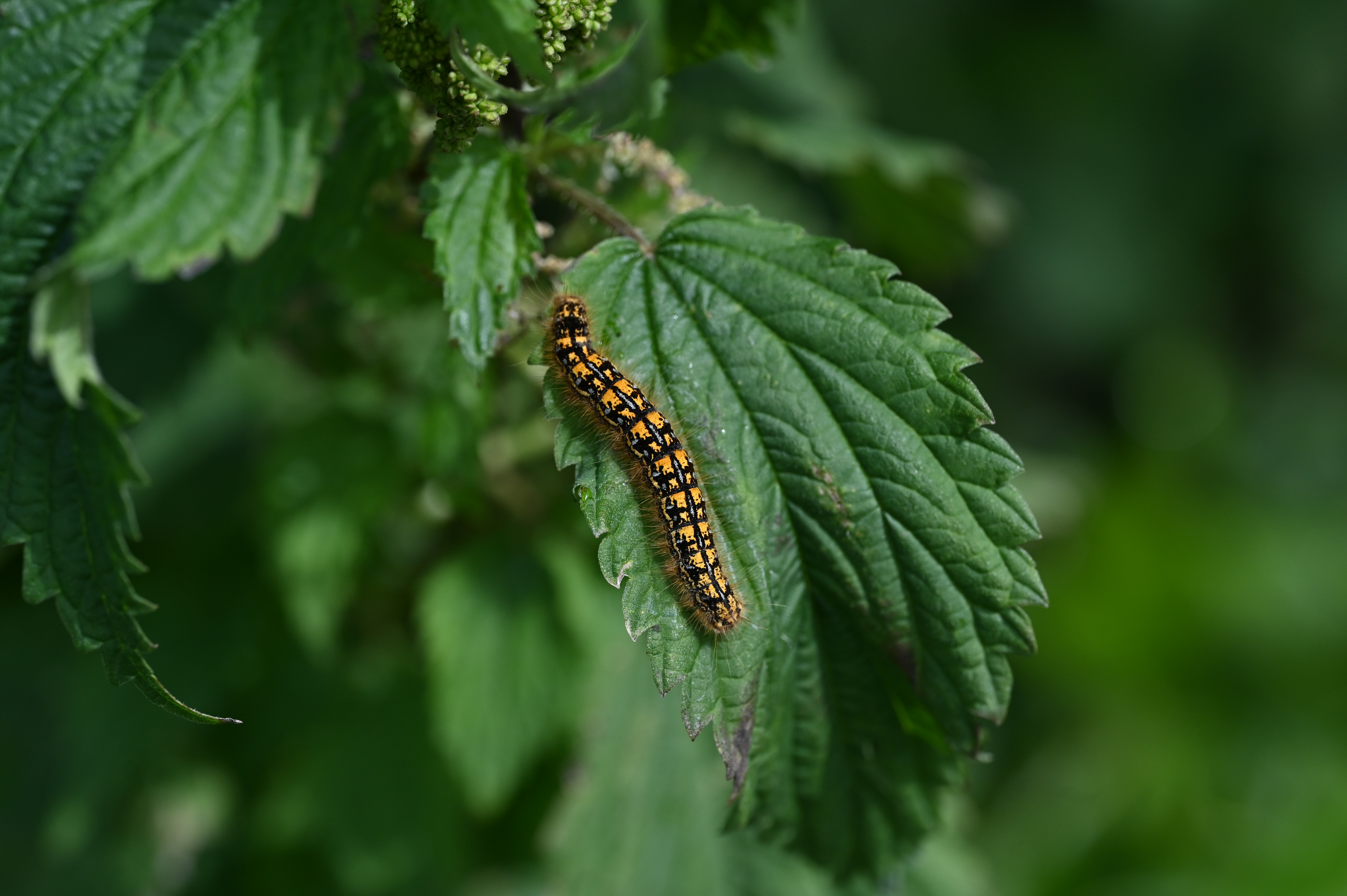 Western tent caterpillar larva showing the orange, blue, and black markings typical of the species. “Malacosoma californicum (Western tent caterpillar)” by MeadowLore from Wikimedia Commons licensed under CC BY-SA 4.0.
.jpg)
When they hatch: Tent caterpillar eggs hatch in sync with host bud break, typically early to mid-May around the Puget Sound lowlands, though warm springs can push it into late April. If you track growing degree days, egg hatch begins around 1,400 to 1,700 GDD₃₂ and the full hatch window extends to roughly 2,200 GDD₃₂. (Published research uses base 50°F, placing hatch at 86 to 190 GDD₅₀, but base 50 misses the mild heat that accumulates through our maritime springs; those conversions come from five years of Kent station data.)
The quick identification: Thick silken tent in a branch fork or at a branch tip, caterpillars clustered inside, chewed leaves nearby, happening in April through early June. That combination is tent caterpillar.
Will My Tree Survive?
Almost certainly, yes. Healthy, established trees tolerate a full defoliation from tent caterpillars and grow new leaves within a few weeks. The tree looks terrible in May and fine again by July. It spent stored energy to push that second set of leaves, so it is mildly stressed, but a single defoliation event on a healthy tree is not a death sentence.
When it does matter:
Young trees and recent transplants are more vulnerable. A tree that has only been in the ground for a year or two does not have the energy reserves of a mature tree. If more than half the canopy gets stripped on a young tree, that is worth intervening.
Consecutive years of heavy defoliation weaken any tree. One bad year is recoverable. Two or three bad years in a row reduce growth, thin the canopy, and make the tree more susceptible to other problems like drought stress or secondary disease. If the same tree has been heavily defoliated for multiple springs running, it deserves more attention.
Trees already under stress from drought, poor soil, root damage, or other problems are less resilient. Drought-stressed trees in urban landscapes are particularly vulnerable because they have fewer carbohydrate reserves to draw on for refoliation. A healthy crabapple shrugs off tent caterpillars. A crabapple that has been fighting apple scab all season and sits in compacted clay with no supplemental water is a different situation.
For most established landscape trees, the answer is: leave it alone and let the natural cycle do its work. The population will crash.
This Is Not Fall Webworm
If you see webbing in your trees, the first question is when. Tent caterpillars are a spring pest. Fall webworm (Hyphantria cunea) shows up in late summer, July through September. If you are seeing webs in August, it is not tent caterpillar.
The second question is where on the tree. Tent caterpillars build their webs at branch forks and crotches. Fall webworms enclose the tips of branches, wrapping foliage and all inside a loose, thin web. A tent caterpillar web is dense and opaque, like a cotton ball stuffed into a branch crotch. A fall webworm web is thin and gauzy, stretched over the ends of branches.
The third question is behavior. Tent caterpillars leave their tent to feed on nearby leaves, then return to the tent to rest. The tent is home base. Fall webworms feed inside their web and expand it as they eat, engulfing more branch tips as they go.
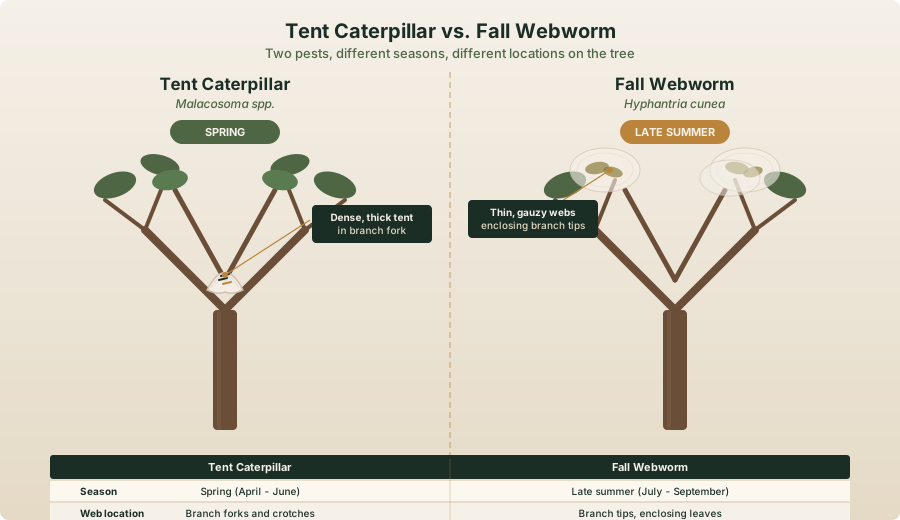 Tent caterpillars build dense webs at branch forks in spring. Fall webworms enclose branch tips in thin webs in late summer. Different pests, different seasons, different locations on the tree.
These differences matter because the timing for any intervention is completely different. Treating for tent caterpillars in August makes no sense; they pupated months ago. Treating for fall webworm in April is equally pointless.
Why Outbreaks End on Their Own
Here is the single most useful thing to know about tent caterpillars: their populations rise and crash in predictable cycles, roughly every eight to eleven years. You may go a decade seeing only a few scattered tents in the neighborhood. Then one spring, every cherry and crabapple on your street is draped with silk. Two or three years later, they are nearly gone again.
The main driver of these crashes is a virus. Tent caterpillar populations carry a naturally occurring pathogen called nucleopolyhedrovirus, or NPV. Think of it as a caterpillar-specific disease that spreads through the colony. When populations are low, the virus circulates at low levels. As the population grows and caterpillars crowd together in those communal tents, the virus transmission rate accelerates. By the time you are seeing tents everywhere, the viral infection rate is climbing fast. A long-term study of western tent caterpillar populations in British Columbia found that viral infection was the main factor driving the population crashes, more significant than any predator or parasitic wasp.
The other part of the crash is that female moths start producing fewer eggs several years before the population visibly peaks. So by the time the outbreak looks worst to you, the decline has actually already started. The year you are most alarmed is often the year it is already turning around.
This matters for management because it means broad-spectrum insecticide sprays (products that kill everything, not just caterpillars) are working against you. The parasitic wasps, predatory beetles, and other natural enemies that help keep tent caterpillar populations low between outbreaks are also killed by those sprays. Removing the natural enemies extends the outbreak cycle instead of shortening it.
When and How to Act
If you do decide to intervene, timing and method both matter. Working from highest impact to lowest:
Winter: Remove Egg Masses (November Through March)
This is the most effective single action you can take, and it requires no products at all. Female tent caterpillar moths lay their eggs in late summer as dark, shiny bands cemented around twigs, with a varnish-like coating that protects them through the winter. Each egg mass contains 150 to 350 eggs.
Walk your susceptible trees after the leaves drop. Look for those dark, slightly glossy bands encircling small twigs, roughly half an inch long. They feel hard and smooth, not soft or papery. Snap or prune the twig section off and drop it in a bag for the trash. Do not leave removed egg masses on the ground; the eggs can still hatch. Every mass you remove in January is 150 to 350 caterpillars you will not see in April.
Focus on crabapple, ornamental cherry, ornamental plum, apple, and hawthorn. Those are the preferred hosts.
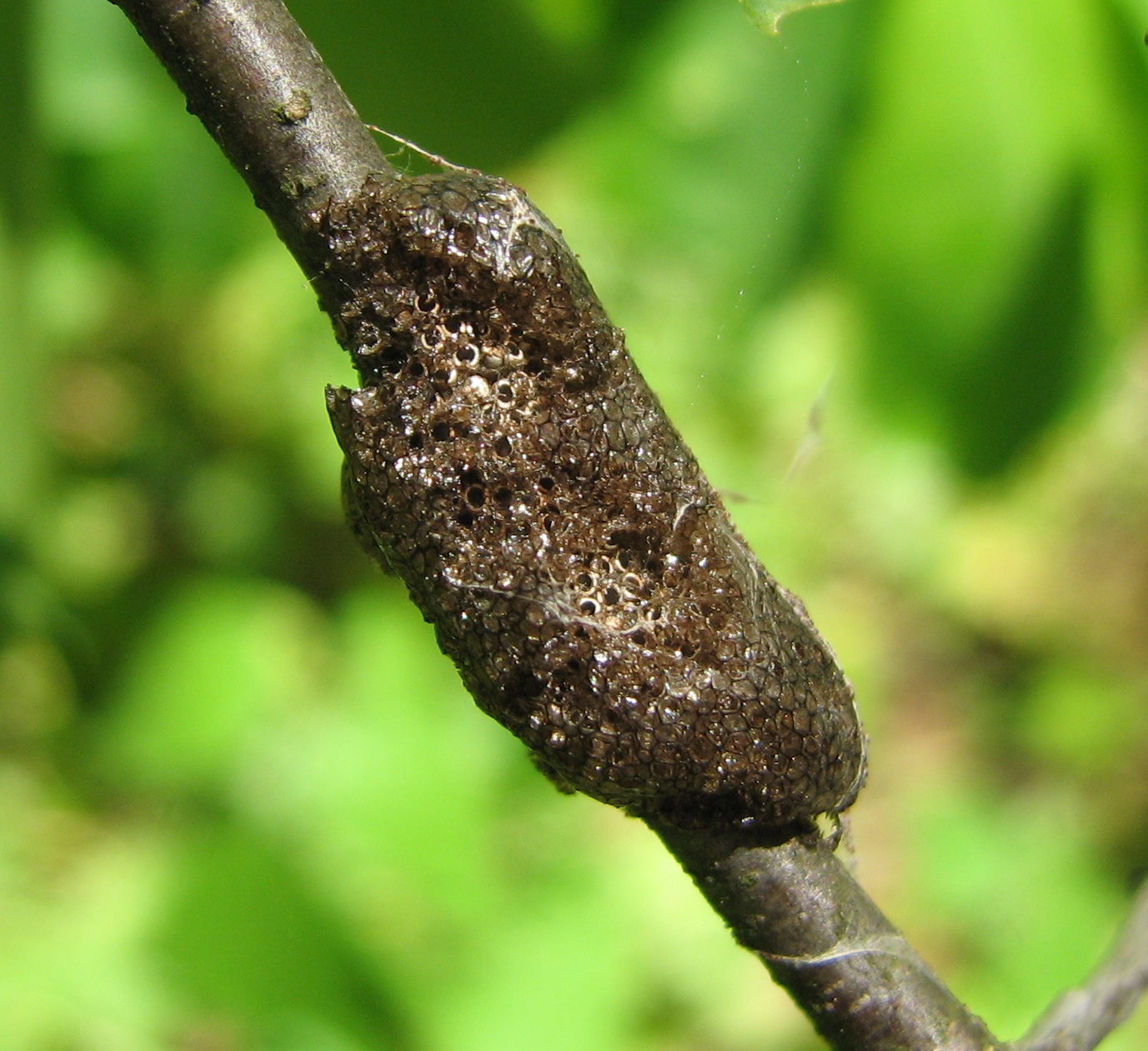 Tent caterpillar egg mass on wild cherry. The dark, glossy band encircling the twig is what to scout for after leaf drop. “Malacosoma americanum egg mass” by Beatriz Moisset from Wikimedia Commons licensed under CC BY-SA 4.0.

A note on dormant oil: If you spray dormant oil for other pests like scale insects, be aware that it does not control tent caterpillar eggs. The varnish-like coating on the egg mass protects them. Dormant oil works by suffocating exposed overwintering insects; tent caterpillar eggs are sealed too well for the oil to penetrate.
Early Spring: Prune Out Small Tents (April Through Early May)
When caterpillars first hatch and start building their tent, the colony is small and concentrated. Prune the branch section containing the tent, drop it into a bucket of soapy water to kill the caterpillars, then bag and trash it. Best done early in the morning or in the evening when the caterpillars are gathered inside the tent rather than out feeding.
Do not burn the tents. This is advice you will hear from neighbors, and it does more damage to the tree than the caterpillars do. You are scorching bark, killing cambium (the living layer under the bark that produces new wood), and potentially setting nearby structures on fire. Pruning is safer and more effective.
If Spraying Is Warranted: Target Small Caterpillars
For situations where egg mass removal and tent pruning are not practical (large trees, severe infestations on young trees, commercial orchards), a targeted spray can help. The key word is targeted.
Btk (Bacillus thuringiensis var. kurstaki) is the first choice. This is a naturally occurring soil bacterium that produces a protein toxic specifically to caterpillars when they eat it. It does not harm bees, birds, beneficial insects, or mammals. The caterpillar has to be actively feeding on treated foliage for it to work.
The critical constraint: Btk is effective on young caterpillars, under about an inch long. Once the larvae are bigger than that, the toxin has much less effect. In this region, that means your spray window opens when you first see tents forming, around 1,400 to 1,700 GDD₃₂ (typically early to mid-May at Kent), and closes roughly two weeks later as larvae grow past the vulnerable size. Plan two applications about seven to ten days apart to catch caterpillars as they continue hatching.
Use a spreader-sticker additive with liquid Btk formulations to help it adhere to foliage. Btk breaks down quickly in sunlight, so coverage matters more than volume.
Spinosad (sold as Monterey Garden Insect Spray and similar products) is also effective but comes with an important restriction: it is toxic to bees. Do not apply spinosad to any tree that is blooming or being visited by pollinators. Here is the practical problem: the trees most targeted by tent caterpillars (cherry, apple, crabapple) are blooming during peak caterpillar season. That means spinosad effectively has no safe application window on the hosts that need it most. Use Btk instead on any tree in or near bloom.
Neem oil (azadirachtin) is a softer option that disrupts caterpillar feeding and development rather than killing on contact. It works as a growth regulator and feeding deterrent, so treated caterpillars eat less and may fail to molt successfully. Neem is slower and less effective than Btk for active infestations, but it breaks down gently in the environment and is a reasonable choice when Btk is unavailable or as a complement to it.
What not to spray: Broad-spectrum insecticides like carbaryl, malathion, or synthetic pyrethroids kill tent caterpillar predators and parasites far more effectively than they kill tent caterpillars. Using them creates a worse problem next year. For the same reason, do not spray trees taller than about ten feet with homeowner application equipment; you cannot get adequate coverage, and the drift (spray that misses the target and lands on other plants, soil, or nearby water) hits everything else.
Doing Nothing Is a Legitimate Strategy
For established landscape trees during a typical outbreak year, no intervention is the strongest long-term play. Every tent caterpillar colony in your yard is also a food source for parasitic wasps, predatory beetles, and lacewing larvae that are building their populations right now. Those natural enemy populations are what keeps the next outbreak eight to eleven years away instead of three. Spraying removes the food source and resets the predator-prey clock. Tolerating the tents this spring is an investment in fewer tents five springs from now.
The Natural Enemies Doing the Real Work
Tent caterpillars are food for a long list of predators and parasites. Understanding who is already on your side helps explain why “do nothing” is not lazy; it is strategic.
Parasitic wasps and flies are the most significant group. Tiny wasps in the ichneumonid and braconid families lay eggs on or inside tent caterpillar larvae. The wasp larvae develop inside the caterpillar and kill it. Tachinid flies do the same. UC Davis documents over 100 species of parasitic flies and wasps that attack tent caterpillar eggs, larvae, and pupae. If you see small, dark wasps hovering around a tent, they are not a second problem; they are the solution.
Predators include assassin bugs, damsel bugs, lacewing larvae, spiders (especially orb-weavers near the tents), earwigs, and birds. Cuckoos, orioles, and grosbeaks all eat tent caterpillars.
The virus (NPV) is the population-level control that no individual predator can provide. It cycles through the caterpillar population over years, building in prevalence as populations grow, then causing the dramatic crashes that end outbreaks.
Every broad-spectrum insecticide application kills some of these natural enemies. In plant health care programs, the standard practice is to leave a pest remnant specifically so natural enemies have a food source to sustain their populations between outbreaks. In a bad outbreak year, the instinct to spray is understandable. But the parasitic wasps and flies rebuilding their populations between outbreaks are your best insurance against the next one.
Host Plants: Who Gets Hit
Tent caterpillars are not picky eaters during outbreak years, but they have clear preferences:
High preference: Wild cherry, ornamental cherry (Prunus spp.), apple, crabapple (Malus spp.), hawthorn (Crataegus spp.), ornamental plum. The western tent caterpillar’s strong preference for rose-family plants means your flowering cherry and crabapple are the first to be targeted.
Moderate preference: Red alder, bigleaf maple, birch, cottonwood, willow, mountain ash, rose. Forest tent caterpillar shows a stronger preference for these hardwoods than the western species does.
Occasional hosts: Oregon white oak, poplar, hazelnut, elm. During severe outbreaks, populations spill onto almost any deciduous tree.
If you have red alder on your property, expect forest tent caterpillar to be part of the picture during outbreak years. The red alder guide covers the specific management approach for native trees, which boils down to: the alder will be fine.
Seasonal Action Summary
| When | What | Why |
|---|---|---|
| Nov - Mar | Scout for and remove egg masses on twigs of susceptible trees | Each mass destroyed eliminates 150-350 caterpillars. Most effective single action. |
| Apr - early May | Watch for first tents forming at bud break (~1,400-1,700 GDD₃₂). Prune out small tents early morning or evening. | Colonies are concentrated and easy to remove when tents are new and small. |
| Mid-Apr - early May | Apply Btk if spraying is warranted. Two applications, 7-10 days apart. Target before ~2,200 GDD₃₂. | Effective only on young caterpillars under 1 inch. The treatment window closes fast. |
| May - Jun | Tolerate defoliation on established trees. Monitor young or stressed trees. | Healthy trees releaf within weeks. Intervene only for vulnerable trees losing >50% canopy. |
| Jul - Aug | Note moth activity near outdoor lights. | Heavy moth flights indicate a larger population next spring. |
| Following Nov | Begin winter egg mass scouting on trees that had heavy tents | The cycle continues. Winter removal remains the best management tool. |
Sources: UC Davis IPM: Tent Caterpillars (ipm.ucanr.edu); UMN Extension: Eastern Tent Caterpillars, Forest Tent Caterpillars; UNH Extension: Fall Webworm & Eastern Tent Caterpillar Fact Sheet; Rutgers Plant & Pest Advisory: Eastern Tent Caterpillar: The Landscape Harbinger of Spring; WSU Tree Fruit: Tent Caterpillar; Myers & Cory 2025, Journal of Animal Ecology 94(10):1922-1934 (DOI: 10.1111/1365-2656.70104); Cory & Myers 2009, Journal of Animal Ecology 78(2):453-462 (DOI: 10.1111/j.1365-2656.2008.01519.x); Miller F, “An Introduction to Biological Control Agents,” Arborist News 30(3):34-40 (June 2021); Raupp MJ, “Does a Droughty World Mean More Insect Outbreaks?” Arborist News 24(4):36-41 (August 2015); WSU HortSense; PNW Insect Management Handbook. Always read and follow pesticide label directions.