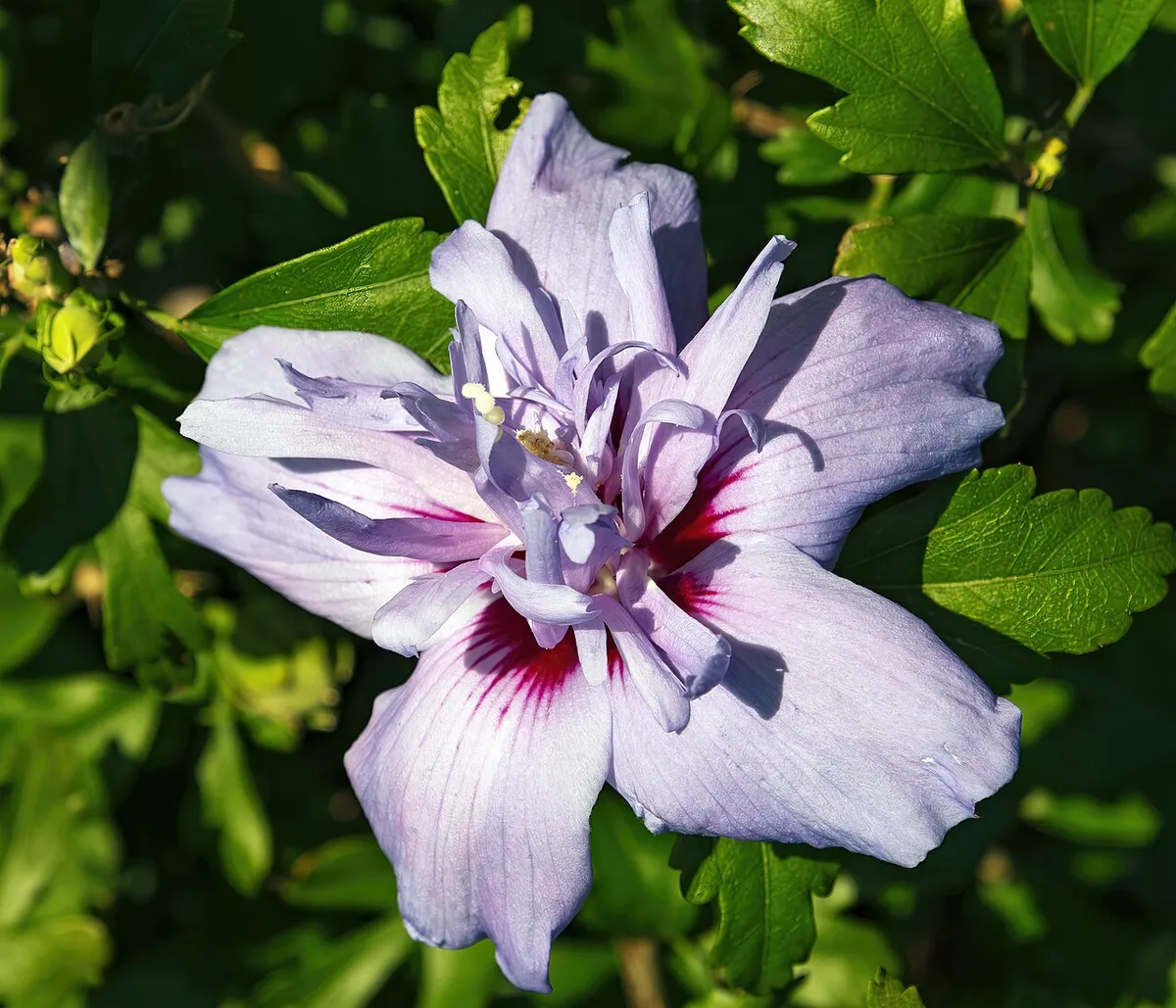
When you’re standing in your garden in late August and the spring bloomers have faded, the early perennials are looking tired, and the hydrangeas are reaching the end of their show, Rose of Sharon (Hibiscus syriacus) arrives with a burst of color. This deciduous shrub is one of the few plants in the Puget Sound region that reliably delivers substantial flowers deep into the summer season, right when the garden needs them most.
Despite its name, Rose of Sharon isn’t Syrian at all. It’s native to China and India, and it belongs to the Malvaceae family alongside hibiscus, mallow, and cacao. The misnomer has stuck for centuries and isn’t worth correcting at the nursery. What matters is understanding what this plant does for your landscape and what you need to know to grow it well in Western Washington.
Why Rose of Sharon Works Here
You might be surprised to learn that Rose of Sharon thrives in Western Washington. It’s rated for USDA zones 5a through 8b, and our maritime climate, even on the shadier west side of the Cascades, sits comfortably within that range. The real value is the bloom window. Rose of Sharon flowers in August and September, when the shrub layer in a typical Puget Sound garden is essentially dormant. This two-month flush of blooms can anchor your late-season design in a way few other landscape plants can match.
The flowers are showy, typically 2-3 inches across, and come in white, pink, purple, and blue depending on the cultivar. The blooms appear continuously through the season, so you’re not getting a one-week spectacle followed by green leaves. You’re getting consistent color for months.
The Pruning Principle
Here’s the insight that changes how most people approach this plant: Rose of Sharon blooms on new wood. This means the flowers develop on stems that grew during the current growing season. This matters for pruning, and it’s the opposite of what many gardeners assume.
If you’re afraid to prune, you’re wrong. If you prune hard in late February or early March, before the buds break, you don’t reduce flowering. You increase it. Remove up to a third of the plant’s bulk. Cut back the previous year’s growth. The shrub will respond by sending up vigorous new shoots, and those new shoots will carry more flowers than unpruned wood would have. Heavy pruning also keeps the plant more compact and shapely, which most homeowners prefer.
In Western Washington, prune in late winter. Don’t wait until spring is well underway. By March, the plant is ready to push growth, and you want those cuts to happen before that energy mobilizes.
The Spring Surprise (and Why You Shouldn’t Panic)
Rose of Sharon is the last deciduous plant in the Pacific Northwest to leaf out. While everything else in your garden is green by mid-April, your Rose of Sharon will still be completely bare. This sends new owners into a panic. They assume it died over winter. They dig it up. They throw it away.
Don’t do this. Patience is the only remedy. The plant usually doesn’t show leaves until late May or even early June, depending on the year and your microclimate. This isn’t a weakness. It’s a characteristic. The late leafing is actually an adaptation that allows the plant to avoid spring frosts, which is useful at the margins of its hardiness range. In Western Washington, it’s just something you accommodate by noting the location in your design notes and reminding yourself in April that yes, it’s still alive.
Cultivar Selection and Seeding
Three cultivars are commonly available in the trade: ‘Aphrodite’, ‘Minerva’, and ‘Diana’. Each has its own color, pink, purple, and white respectively, but they share a critical trait: they are sterile or nearly sterile. They don’t produce viable seed.
This matters because standard Rose of Sharon plants self-seed aggressively. If you’re in Western Washington and you plant an unnamed seedling or a cultivar selected for flower color rather than sterility, you will eventually have many, many Rose of Sharon seedlings in your garden and your neighbors’ gardens. You’ll find them in mulch beds, between driveway cracks, and in the gravel pathway. Stewarding the landscape means choosing sterile or near-sterile cultivars. It’s not optional if you respect your property boundaries.
Pests and Diseases in the PNW
The national literature on Rose of Sharon makes it sound like a magnet for disaster. There are 11 documented diseases and 27 documented pests associated with the species. This alarming list is worth context. Most of these pests and diseases are shared across the broader Malvaceae family and are not severe in managed landscapes in Western Washington. Rose of Sharon growing in healthy, well-draining soil with adequate air circulation rarely succumbs to disease here.
Japanese beetles are the biggest pest concern in the eastern United States. They can completely defoliate Rose of Sharon. Fortunately, Japanese beetles are not established in Western Washington. This removes the single most significant pest problem from the equation entirely. Other common issues like spider mites, whiteflies, and aphids occur occasionally but rarely require intervention beyond basic cultural practices.
Growing Rose of Sharon in Puget Sound
Plant Rose of Sharon in full sun. It needs six hours of direct light daily for reliable flowering. In shade, it will grow but flower production drops significantly. Place it where afternoon sun is available, and it will reward you with dense, consistent blooming.
Rose of Sharon is not fussy about soil. It prefers well-draining earth and doesn’t want to be waterlogged, but our region’s rainfall and soil texture usually accommodate this plant without amendment. Once established, it’s drought-tolerant, which is increasingly relevant during our drier summers.
This is a resilient plant for Western Washington. The combination of late-season bloom, reliable hardiness, low pest pressure, and responsiveness to thoughtful pruning makes Rose of Sharon a genuinely useful shrub in the maritime Pacific Northwest. Plant the right cultivar, note the late spring leafing in your mental map, prune it in February, and you’ll have color in the garden when you need it most.
Sources
- Dirr, Michael A. (2009). Manual of Woody Landscape Plants. 6th ed. Stipes Publishing.
- U.S. Department of Agriculture. USDA Plant Hardiness Zone Map.
- Pacific Northwest Plant Disease Management Handbook. Oregon State University Extension.
- U.S. National Arboretum. Hibiscus syriacus cultivar evaluation records.