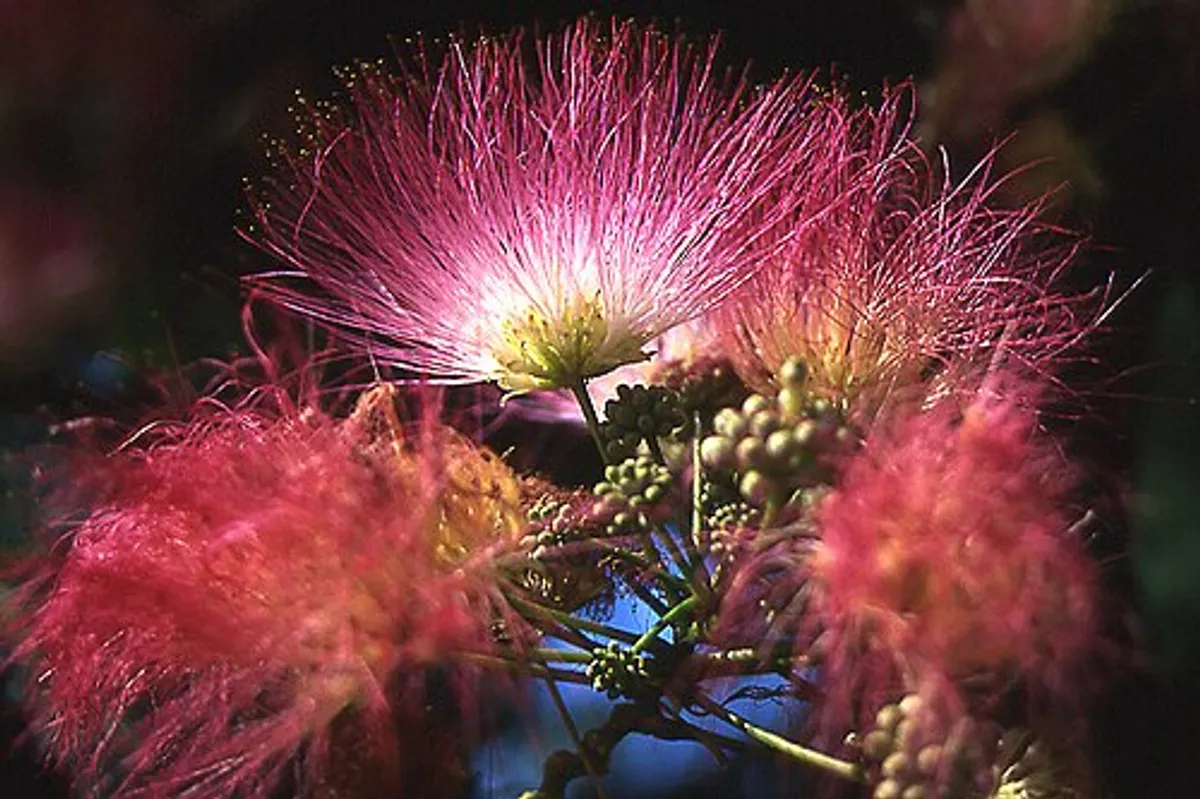
If you have seen a tree with feathery, fern-like leaves topped with fluffy pink flower puffs blooming in midsummer, you have encountered a silk tree. This Asian native shows up in gardens, parking lots, and along disturbed roadsides across Western Washington, and the reactions it generates are passionate and divided. Some gardeners plant them deliberately for their tropical charm and reliable July-August bloom. Others spend years cutting them down, only to watch seedlings emerge the following spring. Understanding what silk tree is, what it does well, and what problems come with it will help you decide whether it belongs in your landscape.
What You Are Looking At
Silk tree is a small, deciduous tree native to southwestern and eastern Asia. It typically grows 20 to 30 feet tall with a spreading, often vase-shaped crown. What makes it instantly recognizable is its foliage: the leaves are bipinnately compound, meaning they are divided twice along the central stem, creating a delicate, fern-like texture. This is the source of its appeal. Even before flowers appear, the airy canopy casts dappled shade and gives a landscape an almost subtropical feel.
The flowers are the main event. Appearing in July and August when most landscape trees have finished blooming, silk tree produces dense pink or rose-colored flower clusters that look like powder puffs. These flowers are fragrant and attract butterflies. The botanical feature that explains the flower form is that what you see is actually not a flower but a showy cluster of many tiny stamens (the male parts) from many small flowers fused together. It is genuinely striking against the fine-textured foliage.
After flowering comes seedpod production. The tree generates hundreds of flat, papery legume pods (technically called loments) that mature from green to tan or light brown, then split open to release small seeds. These pods persist on the tree well into fall and winter. Drop rates vary year to year, but in good seed years, the ground beneath and around the tree becomes thickly carpeted with both whole and broken pods.
Hardiness and Growing Conditions
Silk tree is rated for USDA zones 6a through 8b. In Western Washington, this means it grows reliably in the warmer sections of the Puget Sound region and more marginally in cooler pockets. Especially cold winters or late-spring frosts can kill back young trees or damage established specimens. However, it recovers quickly if the root system survives.
The tree prefers full sun and well-drained soil but is not particularly fussy. It tolerates poor, compacted soil reasonably well and is notably drought-tolerant once established. As a member of the Fabaceae family (legumes), it forms nitrogen-fixing relationships with soil microbes, which is why it often thrives in degraded sites where many other trees struggle.
There is one cultivar in common cultivation: ‘Summer Chocolate’, which features deep purple foliage in spring and early summer, shifting to green as the season progresses. The flowers are the same pink, but the foliage contrast can be striking in the right setting.
The Propagation Problem
In Western Washington’s milder microclimates, silk tree produces copious viable seed. Those seeds germinate readily in warm soil in spring, especially in disturbed areas. If you walk along roadsides, through parking lots, or through gardens in areas with established seed trees, you will find seedlings. They pop up in foundation beds, in the cracks between pavement and landscape fabric, in gravel, and in any spot where soil is bare and summer moisture is adequate.
This is why silk tree is classified as invasive in several southeastern US states where it poses genuine ecological problems in natural areas. In Western Washington, it has not reached that regulatory threshold, and it has not invaded wild lands the way it has elsewhere. But the seed production is undeniable, and if you prefer not to have volunteer seedlings in your garden or neighborhood, a single mature silk tree nearby will keep you pulling them out every year.
The Structural Liabilities
Here is where the honest assessment becomes important. Silk tree has notoriously weak wood. The branches are brittle and prone to splitting, especially under the weight of snow or ice or during windstorms. In areas that experience heavy wet snow or winter storms, limb failure is common. You will see silk trees with major branches gone, cleft trunks, or crowns broken open after a winter event.
This weakness becomes more pronounced as the tree ages, and this brings us to the second structural issue: silk trees are relatively short-lived. Unlike oaks or Douglas-firs or even most landscape maples, which can live a century or more, a healthy silk tree typically lives 30 to 50 years before decline sets in. Some live longer, but you should not plant a silk tree thinking you are creating a permanent landscape feature.
If you plant one, know that it will eventually need to be removed, and in the meantime it will require attention. Trees with major branch damage should be pruned to remove broken or rubbing limbs. Trees showing signs of decline (thin canopy, sunken areas of bark, lack of growth) are better removed before they become hazards.
The Maintenance Reality
Even in good years, a mature silk tree is a generator of plant debris. The leaflets drop throughout the season (not all at once like a typical deciduous tree), spent flower clusters litter the ground in July and August, and seed pods rain down from late summer through fall. If you place one where its dropped material lands on a deck, a roof, a driveway, or a sidewalk, you will be cleaning regularly. Some gardeners enjoy this. Many find it tiresome.
When and Where Silk Tree Works
Silk tree is best suited to situations where its weaknesses matter less and its strengths have room to shine. In a large, open area where there is nothing below the canopy to be buried in debris, where the tree is not shading a roof or deck, and where occasional storm damage is acceptable, it can be a fine choice. It is excellent in xeriscaping or low-water design in full sun. The flowers are genuinely useful for sites that need mid-to-late summer color when the garden is typically quiet. Its nitrogen-fixing habit makes it valuable in remediation or poor-soil situations.
It is poorest suited to tight urban spaces, to areas with heavy winter snow loads, and to neighborhoods where self-seeding is unwelcome. It is also not a good choice as a parking lot shade tree, where falling limbs present a liability.
The Bottom Line
Silk tree is neither a villain nor a savior. It is a tree with genuine beauty, useful properties, real limitations, and predictable problems. If you choose to plant one, do so with eyes open to the maintenance commitment, the weak wood, the short lifespan, and the annual cleanup. If you already have one, assess whether you can live with its characteristics, or whether removal and replacement with a more durable species serves your landscape better. The choice is yours, but make it based on honest information rather than wishful thinking or prohibition.
Sources
USDA Plant Hardiness Zone Map. United States Department of Agriculture. https://planthardiness.ars.usda.gov
Dirr, Michael A. Manual of Woody Landscape Plants. Stipes Publishing, 6th ed., 2009.
Pacific Northwest Invasive Species Council. Invasive Plant Database. https://www.pnwisa.org
International Society of Arboriculture. Wood Strength and Tree Risk Assessment. ISA, 2014.