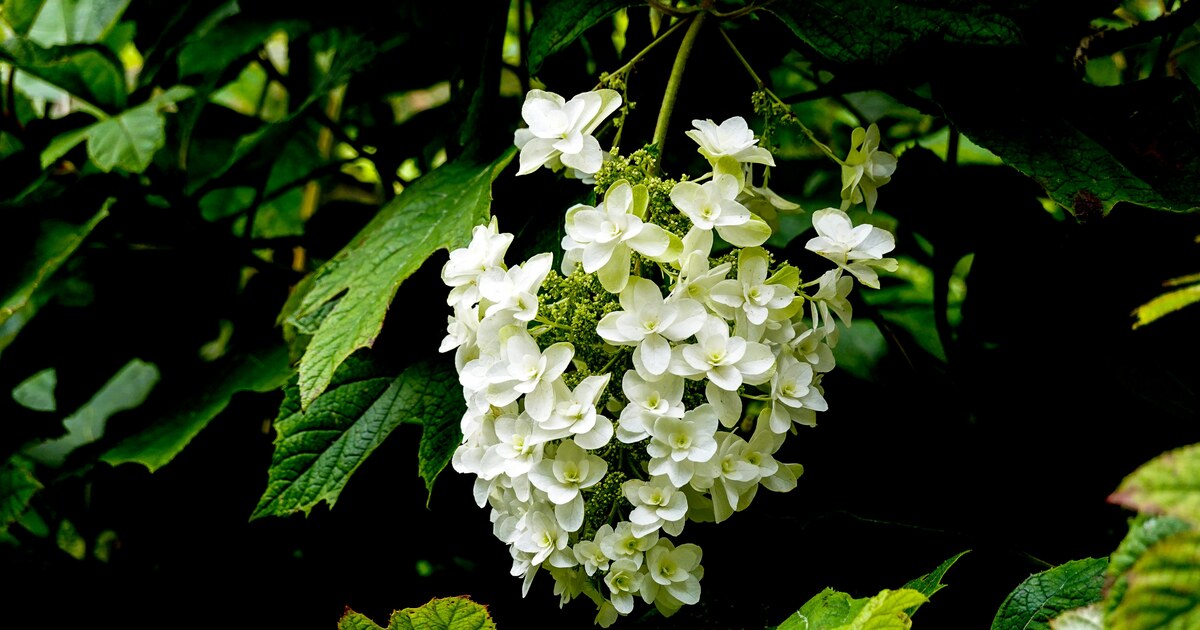
Your hydrangea will not bloom. It is leafy, healthy, maybe four feet across, and every summer it throws out exactly three sad flower heads while the one down the street is covered in mopheads the size of cantaloupes. Or your hydrangea bloomed beautifully last July, and then the week of 108°F heat came through and the edges of every leaf turned brown and crispy. Or you are standing at the nursery in April looking at a bench of blooming bigleafs and a bench of panicles and you want to plant the right one, but the tags all say “full sun to part shade” which is true of nothing.
All three of these problems have the same root cause: hydrangeas get matched to yards based on flower color, and they should be matched based on site. Light, summer soil moisture, and whether next year’s flower buds can survive your winter are the three variables that decide whether any hydrangea blooms reliably here. Species and cultivar flow from that. This guide organizes by the site you have, not the plant you want.
The One Thing to Know First
Hydrangeas bloom on one of two types of wood, and this one biological fact explains most of what goes wrong with them in the Puget Sound lowlands.
Old-wood bloomers set next year’s flower buds on this year’s branches by late summer. Those buds sit exposed on the plant all winter. If a late spring frost hits them after they break dormancy, or a hard pruning removes them, the plant cannot bloom until the following year. Hydrangea macrophylla (bigleaf), H. quercifolia (oakleaf), H. serrata (mountain), and H. anomala var. petiolaris (climbing) are all old-wood bloomers.
New-wood bloomers make their flower buds on current-season growth in late spring and summer. Nothing about winter matters to them, because the shoots that will carry flowers have not grown yet. You can prune them to the ground in February and they still bloom in July. Hydrangea paniculata (panicle) and H. arborescens (smooth) are the new-wood group.
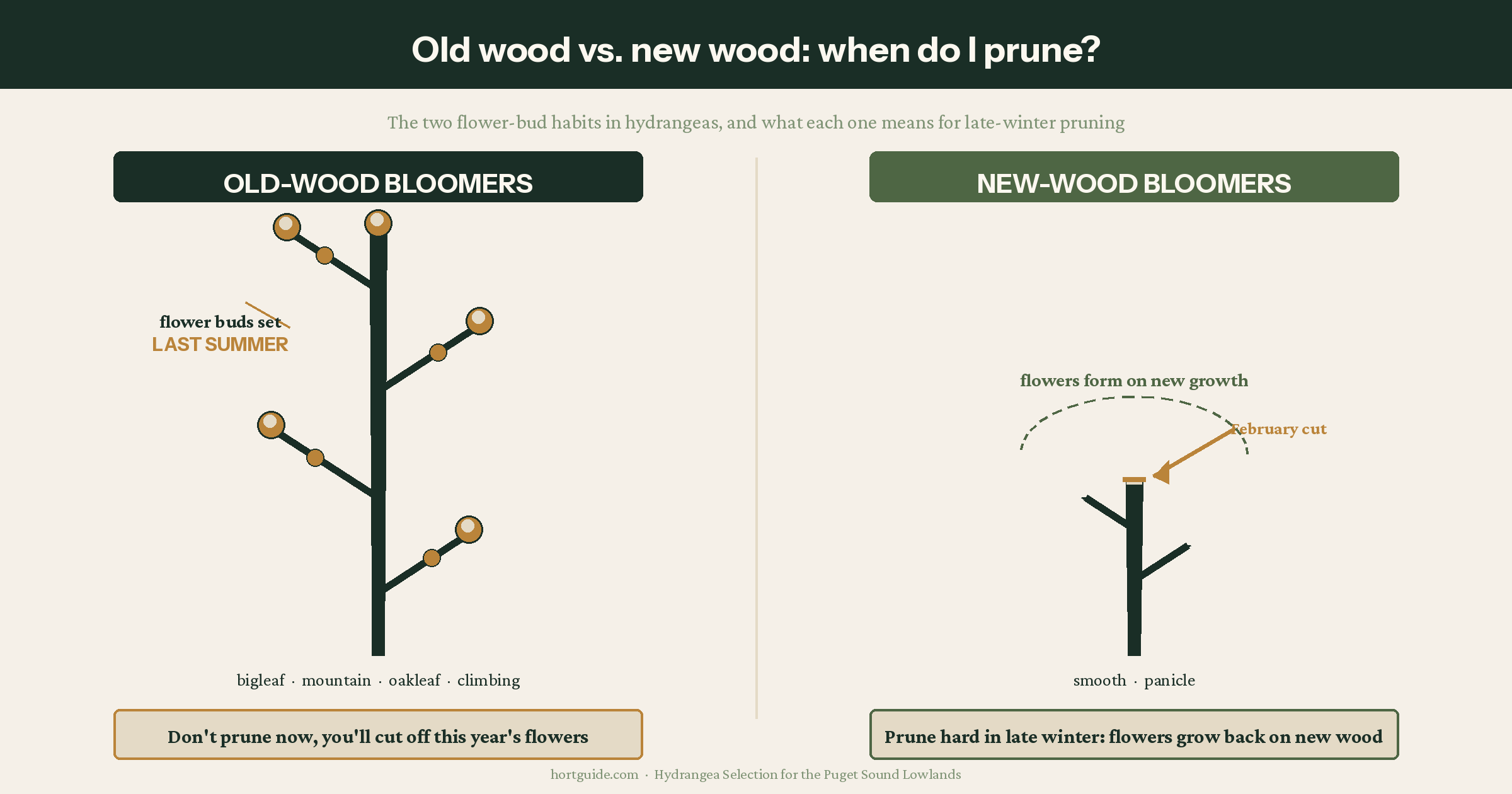 The two bloom habits and what each one means for late-winter pruning. Illustration: hortguide.com.
That is the entire diagnostic tree. Every hydrangea decision this guide makes flows from which group the plant belongs to. Old-wood bloomers are the fussy ones that fail spectacularly when winter or the gardener goes wrong. New-wood bloomers are bulletproof and forgiving. That does not mean one group is better. It means the two groups solve different site problems, and the site decides which one you should plant.
The Five Hydrangeas Worth Knowing Here
Before matching plants to sites, a quick reference on what actually grows in the region. The native landscape has no hydrangeas at all, so every one you see here is a deliberate planting, and most of what’s worth considering comes down to five species plus a climbing specialist.
Panicle hydrangea (Hydrangea paniculata) is the one that thrives in full sun in this region, and the only hydrangea that can take an afternoon in the Green River valley without wilting. New wood. Cold-hardy to Zone 3. Cone-shaped flower panicles open white or green and age to pink or red. Mature size runs from 4 feet (‘Little Lime’) to 15 feet (‘Limelight’) depending on cultivar. This is the region’s most reliable hydrangea by a wide margin.
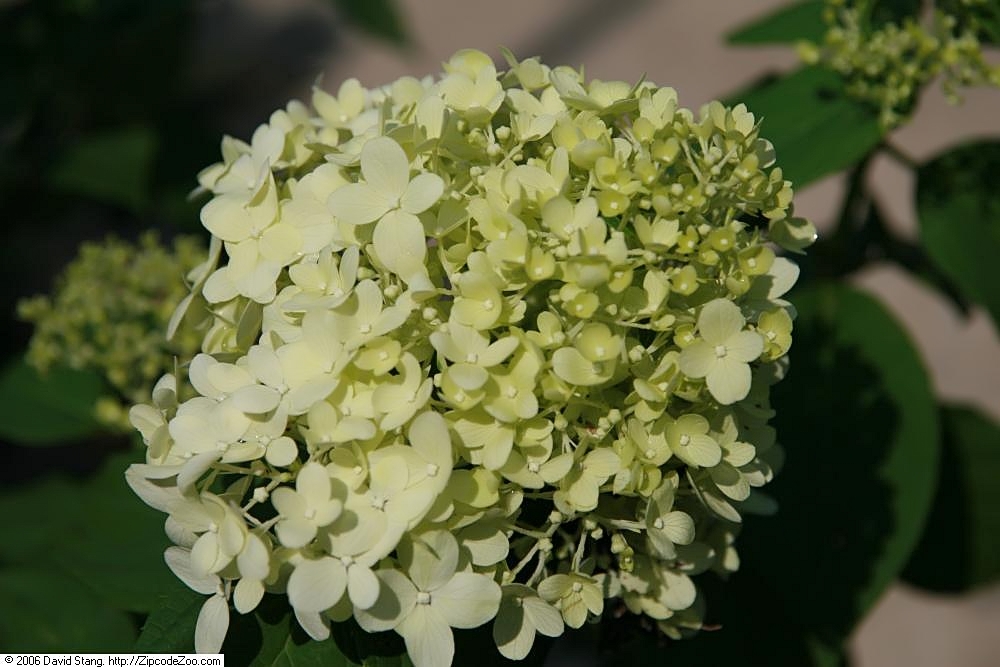 Panicle hydrangea ‘Limelight’. Photo: David J. Stang via Wikimedia Commons, CC BY-SA 4.0.
Bigleaf hydrangea (Hydrangea macrophylla) is the one everyone pictures: cantaloupe-sized mophead flower clusters in blue or pink, with the flatter lacecap form as a quieter alternative. Old wood. Needs afternoon shade in all but the coolest lowland sites, and reliable summer water. This is also the one with the powdery mildew problem on the wrong cultivars. Mature size typically 4 to 6 feet.
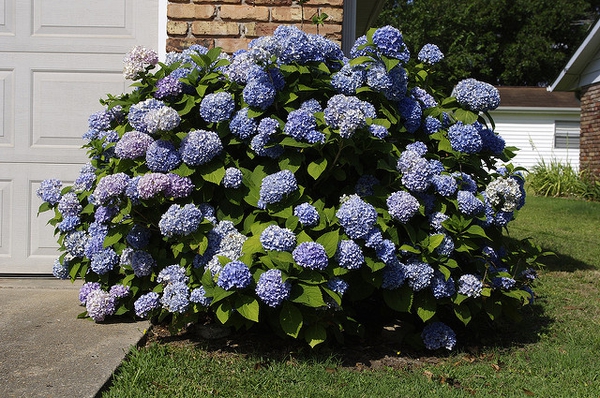 Bigleaf hydrangea in the classic blue mophead form. Photo via Wikimedia Commons, CC BY-SA 4.0.
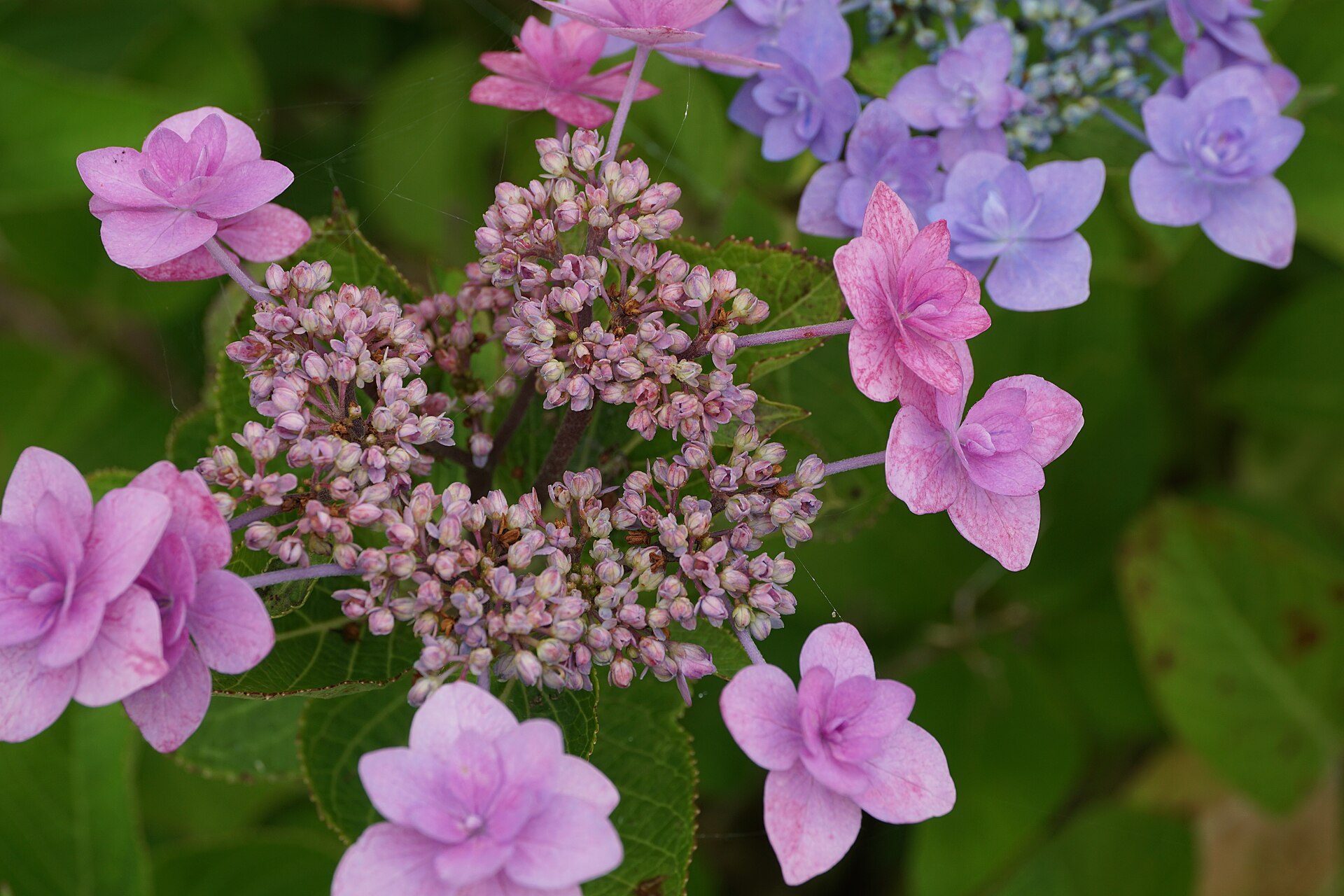 Bigleaf hydrangea in lacecap form: a ring of showy sterile florets around a central disk of smaller fertile flowers. Photo via Wikimedia Commons, CC BY-SA 4.0.
Smooth hydrangea (Hydrangea arborescens) is ‘Annabelle’ and its descendants. Large round white flower heads on a 4 to 6 foot shrub, blooms on new wood, takes hard shade. The one catch is drought intolerance. Repeated summer wilting degrades it over years, so it only works where the soil stays moist through August. Newer selections like ‘Incrediball’ have stronger stems than the original and do not flop after summer rain.
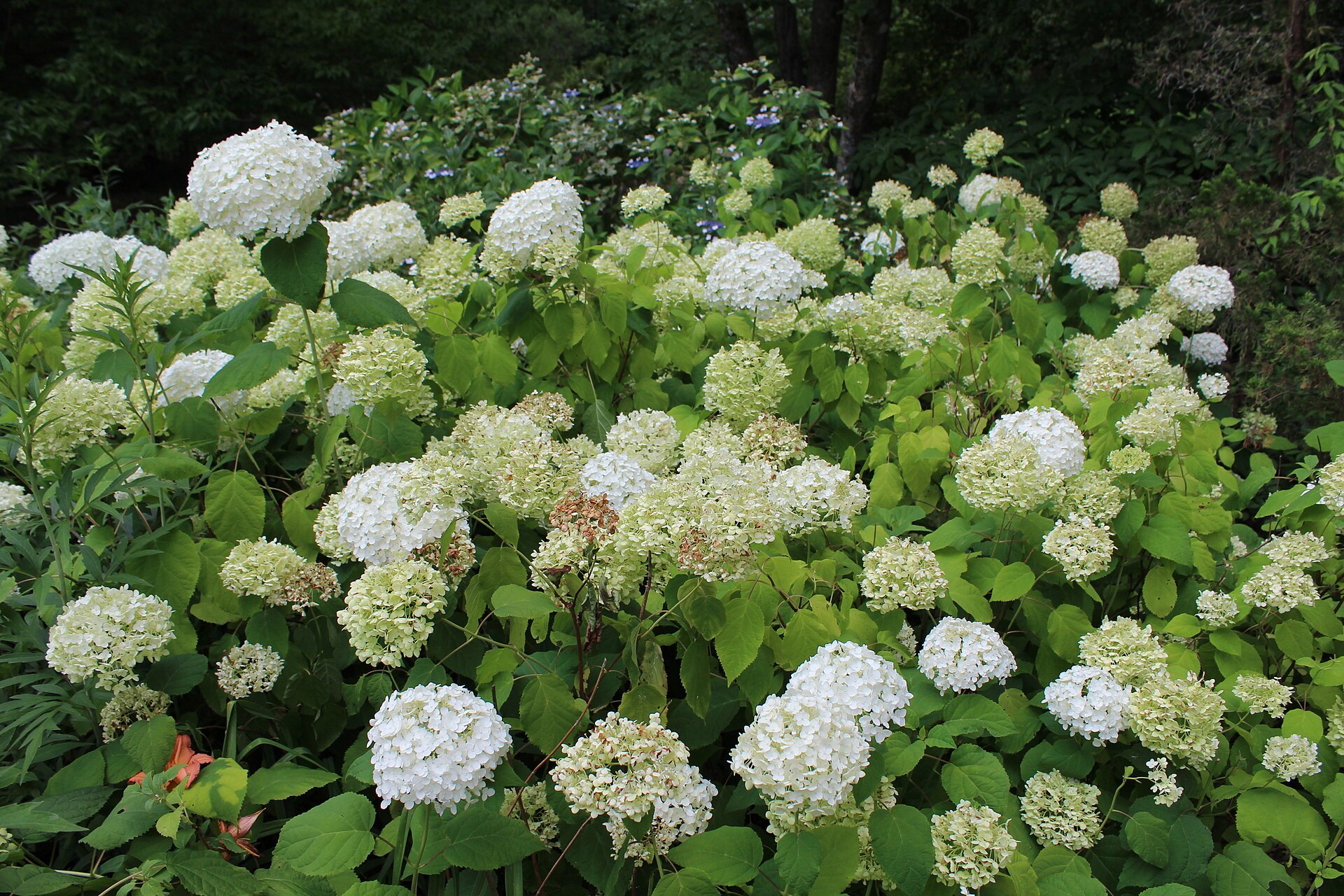 Smooth hydrangea ‘Annabelle’ at Coker Arboretum. Photo via Wikimedia Commons, CC BY-SA 4.0.
Oakleaf hydrangea (Hydrangea quercifolia) is the Southeast native that performs surprisingly well here, and if I had to keep exactly one hydrangea in a yard this would be it. Cone-shaped white flower panicles in June and July that age to dusty pink, oak-lobed foliage that turns burgundy and wine-red through October, cinnamon-colored peeling bark that holds the bones of the plant together all winter. That is three seasons of payoff from one shrub, which is more than any other hydrangea in the genus offers. Old wood bloomer, so pruning is a late-winter light touch only. More drought-tolerant than other hydrangeas once established, which matters on our summer-dry sites. Slower to establish than panicle or smooth (expect two to three years before it settles in and bulks up), and it needs decent light for the fall color to develop. The payoff is worth the patience.
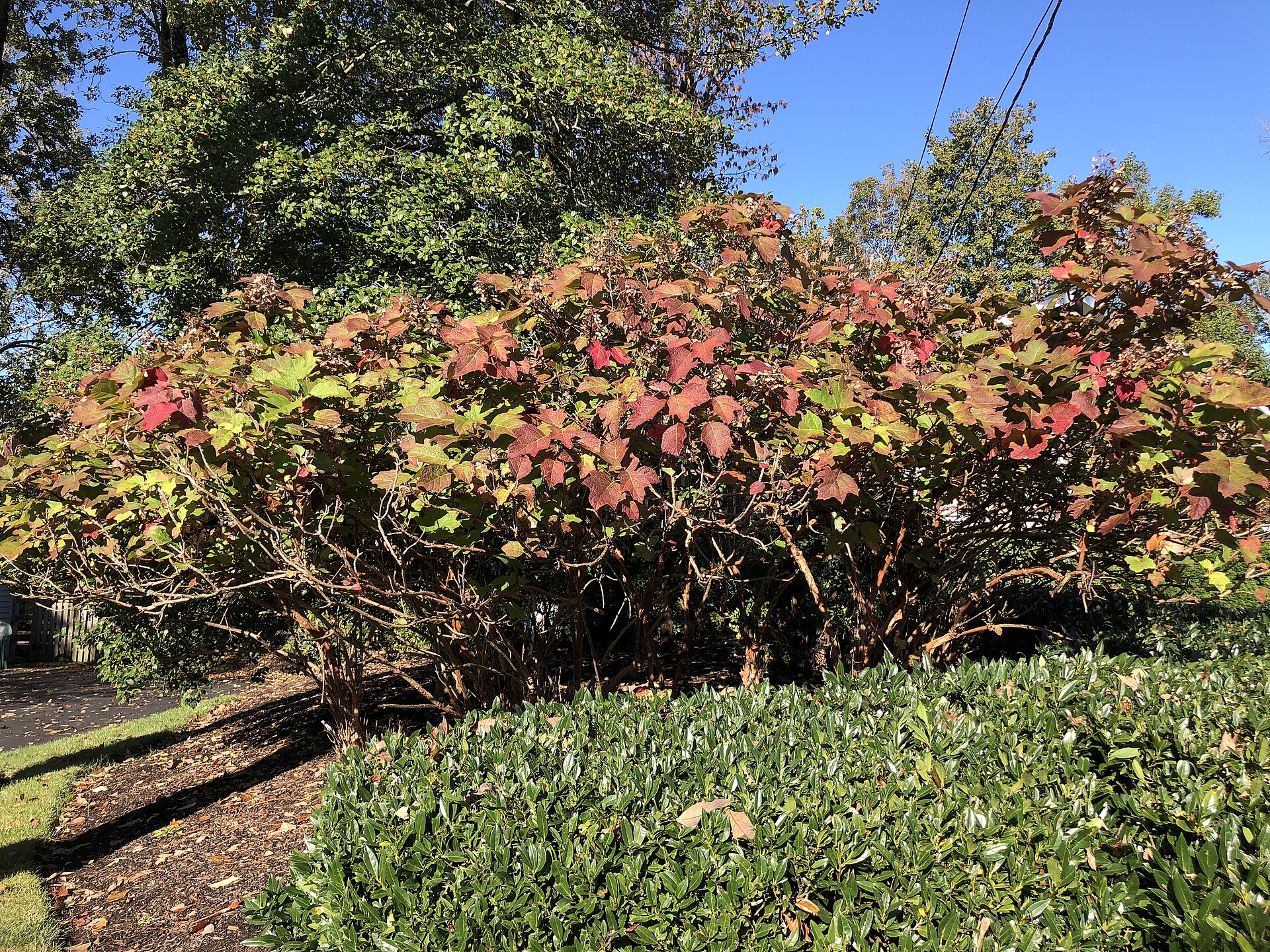 Oakleaf hydrangea in autumn: the fall-color payoff that no other hydrangea in the genus delivers. Photo via Wikimedia Commons, CC BY-SA 4.0.
Mountain hydrangea (Hydrangea serrata) is the underused macrophylla alternative. It looks and acts like a compact bigleaf with lacecap flowers, but its flower buds harden faster in fall and tolerate cold better, so it blooms more reliably in late-frost microclimates where macrophylla fails. Old wood, part shade, 2 to 4 feet tall. If you have a site where bigleaf never quite performs, this is the species to try next.
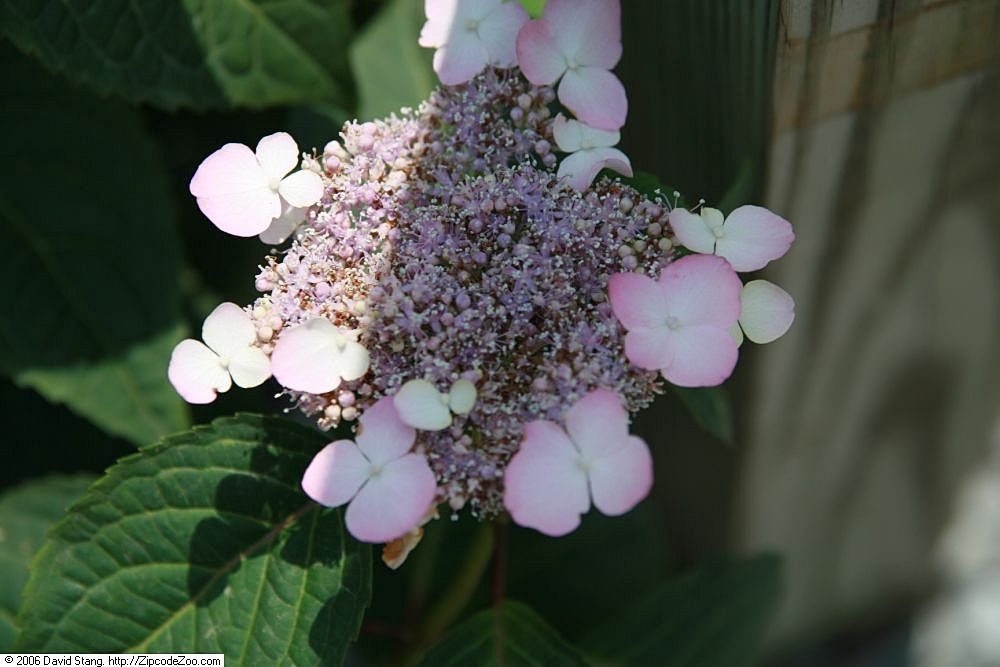 Mountain hydrangea in lacecap bloom. Photo: David J. Stang via Wikimedia Commons, CC BY-SA 4.0.
Climbing hydrangea (Hydrangea anomala var. petiolaris) is the one vine in this list. It clings to walls or large tree trunks with aerial rootlets, reaches 30 to 60 feet over time, and produces flat lacecap flower heads in June. Tolerates deep shade. Slow to establish (three to five years before it starts climbing with purpose) but long-lived. For dry shade on a north wall or the trunk of a mature Douglas-fir, there is almost nothing else that works.
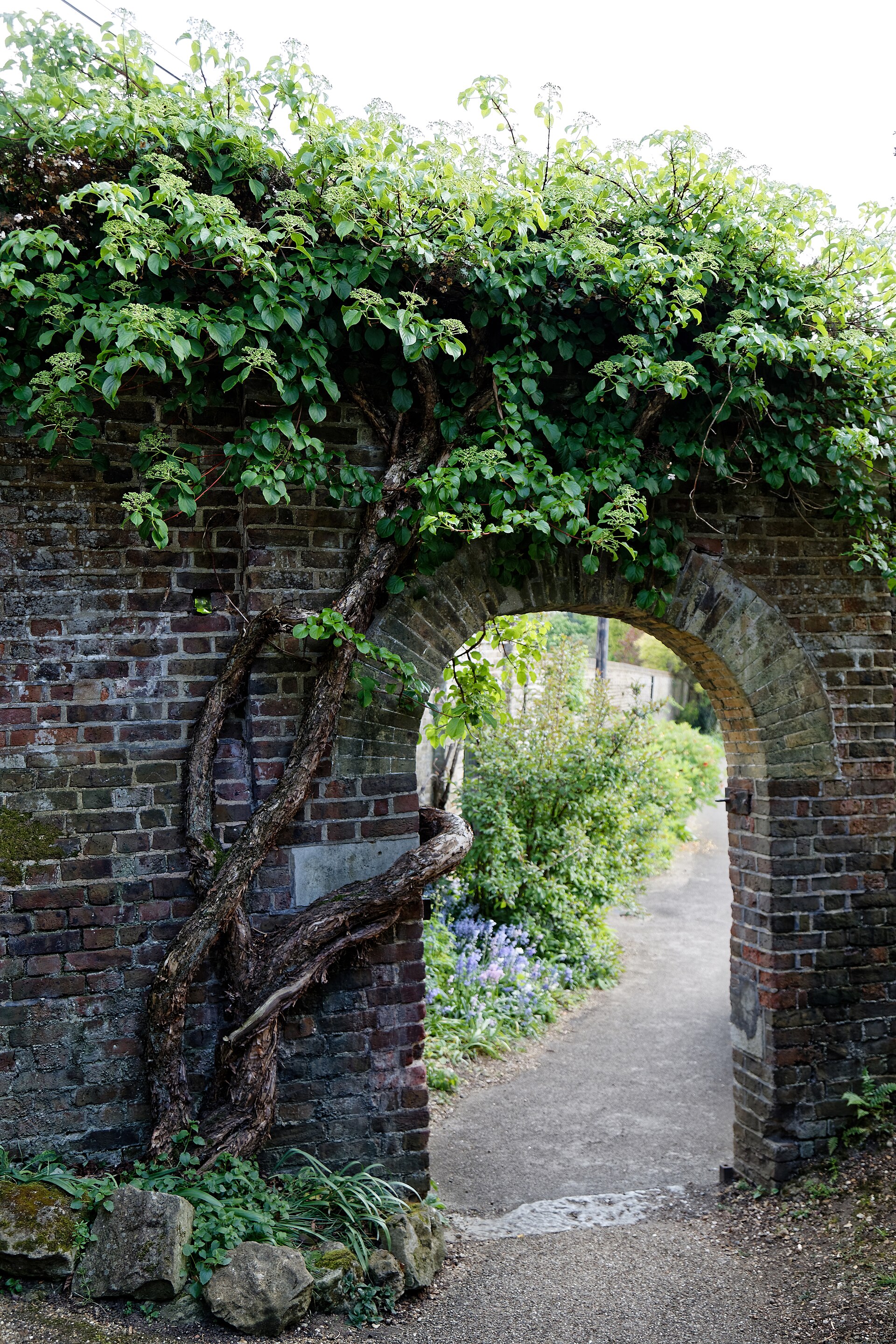 Climbing hydrangea engulfing a brick archway at Myddelton House Gardens. Photo via Wikimedia Commons, CC BY-SA 4.0.
Matching the Hydrangea to the Site
This is the part of the guide to read. Find the site you actually have, not the one you wish you had, and the right hydrangea will be sitting there.
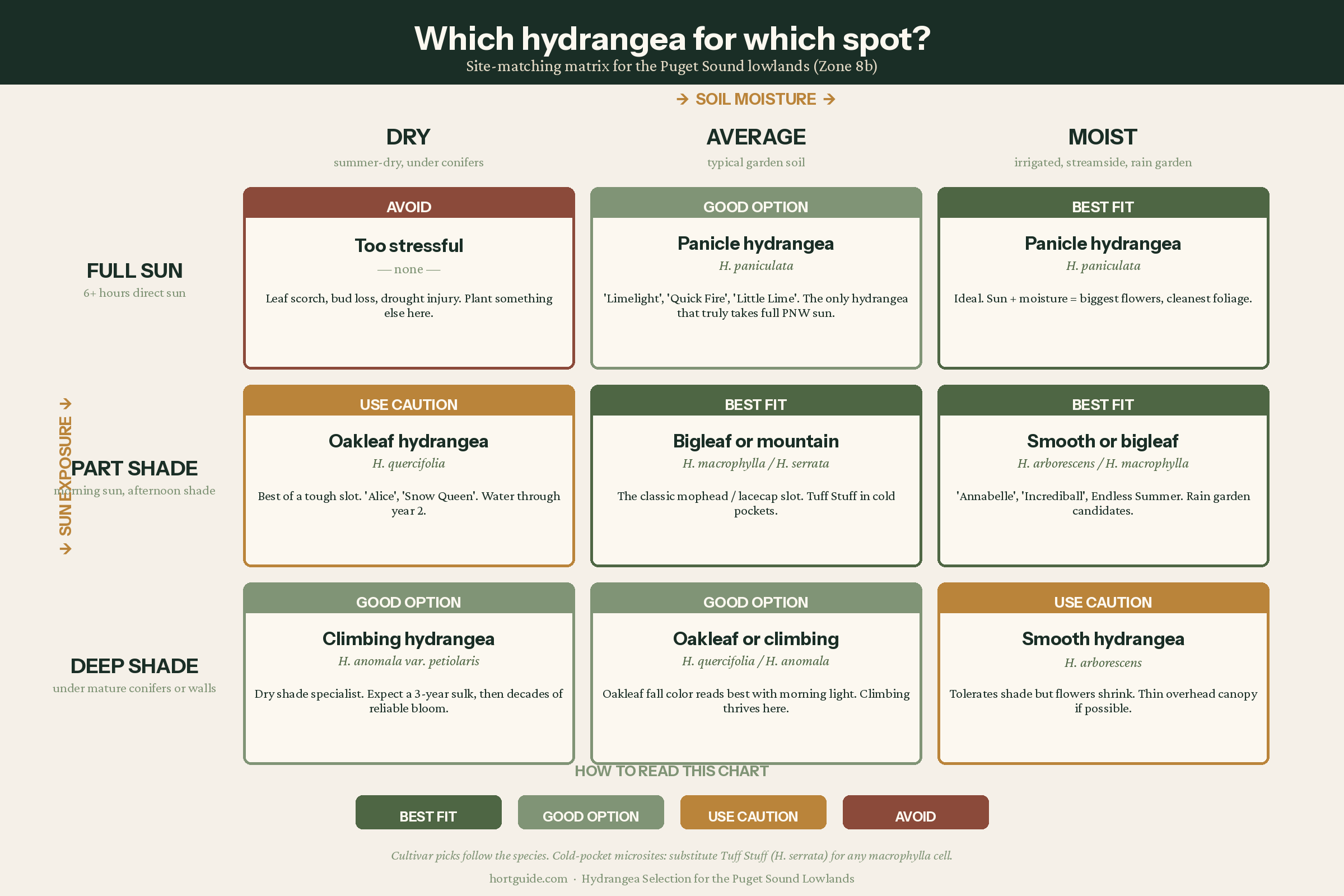 Site-matching matrix for the Puget Sound lowlands. Find the sun + moisture combination that matches your yard, then follow the species and cultivar recommendations below. Illustration: hortguide.com.
Full sun, clay soil, irrigation available in summer
This is the standard suburban front-yard site: south or west exposure, heavy native soil, a drip line or occasional hose watering in July and August. Most of this region’s new construction lands here.
Plant panicle hydrangea. This is the one hydrangea that actually earns a full-sun spot in the Puget Sound lowlands. It blooms on new wood, so late pruning or a cold snap cannot kill the flower buds. It handles heat better than any other hydrangea in the genus. Powdery mildew is possible but uncommon locally, and root weevil is the one pest to watch for on the lower stems. Flowers open white or green in July and age to rose or red through fall, often holding color into November.
Cultivars worth buying: ‘Limelight’ (Proven Winners, 2001) is the benchmark for cool-toned panicle hydrangeas, with chartreuse-green flowers aging to pink. ‘Little Lime’ is the 3 to 5 foot dwarf version for tight spaces. ‘Pink Diamond’ opens white and ages to a deep rose, holding two-tone flowers for weeks. ‘Quick Fire’ blooms a month earlier than the rest of the species and turns red first. ‘Phantom’ produces some of the largest flower heads in the group. ‘Vanilla Strawberry’ goes white to pink to red across one flower head, progressing up the panicle.
The substitution to avoid: planting a bigleaf hydrangea in this site. Bigleafs in full sun on clay will wilt dramatically every afternoon in July, scorch in the first heat wave, and crack out in powdery mildew by August. Everything the tag says about “full sun to part shade” assumes a cooler, moister climate than the Green River valley at 2 PM.
Part shade with morning sun, moisture-retentive soil
The ideal bigleaf spot. Woodland edges, the east side of the house, a spot where a tall tree filters afternoon light. Soil that has been amended or is naturally moist through summer.
Plant bigleaf hydrangea, and if you have historically had trouble with late frost killing the flower buds, plant a remontant (reblooming) cultivar that sets buds on both old and new wood as insurance. These are the varieties in the Endless Summer line that the marketing department invented to solve a problem most PNW yards do not have, but in our occasional April return-frost years they blow past straight macrophylla.
Cultivars worth buying: ‘Endless Summer’ (introduced 2003 via Bailey Nurseries from a Hans van der Toorn selection) and ‘BloomStruck’ for remontant insurance. ‘Nikko Blue’ as the reliable blue-mophead classic if you accept the powdery mildew risk. ‘Mariesii’ for a large lacecap with flat flower heads. ‘Madame Emile Mouillère’ for the best white mophead. In drier soil, ‘Lady in Red’ handles moderate drought better than most.
Cultivars to approach with caution: the WSU HortSense cultivar list for powdery mildew susceptibility includes Forever Pink, Holstein, Lilacina, Madame Emile Mouillère (the irony is hers), Nikko Blue, and Veitchii. That does not mean do not plant them. It means expect white, fuzzy leaf coverage by late August and plan for airflow. If you have a history of powdery mildew on any shrub in your yard, skip these and go to a newer mildew-tolerant selection.
Also consider oakleaf. If the site has morning sun and afternoon shade with reasonable soil, oakleaf hydrangea is the sleeper pick for this exposure. You give up some of the big flower payoff that bigleafs deliver, but you gain fall foliage, winter bark, and a drought tolerance that bigleaf cannot match when the July hose schedule slips. This is the spot where oakleaf quietly outperforms every other option over a ten-year horizon.
The substitution to avoid: planting ‘Annabelle’ here. It will perform, but ‘Annabelle’ belongs in deeper shade and will not bring anything to the space that a bigleaf cannot do better.
Dry shade under conifers
The hardest hydrangea site in the region. Mature Douglas-fir or hemlock roots have already claimed the water in the top two feet of soil, and whatever falls as rain in October gets intercepted before it hits the ground. Most flowering shrubs simply give up on this site.
Plant climbing hydrangea if you have a vertical surface (north wall, tree trunk, shed). It roots shallowly, tolerates dry shade better than any other hydrangea, and once established it covers large vertical surfaces with June lacecap flowers that glow in low light.
Plant oakleaf hydrangea if you have horizontal space. Oakleafs are Southeast natives (Hydrangea quercifolia is a Georgia and Alabama plant), but they tolerate dry shade in this region better than any other shrubby hydrangea. The Skagit County Master Gardeners put it plainly: “oakleaf hydrangeas do exceptionally well in the PNW.” Give it morning light, keep the soil mulched, and water in the first two summers to establish. After that, it largely handles itself.
Cultivars worth buying: ‘Snow Queen’ for upright flower panicles and strong red fall color. ‘Ruby Slippers’ for a 3 to 4 foot compact form with pink-aging flowers. ‘Alice’ for larger flower heads on a 6 to 8 foot shrub.
The substitution to avoid: planting ‘Annabelle’ in this site. Smooth hydrangea has the shallowest roots of any hydrangea on this list and cannot compete with conifer root systems for summer water. It will wilt to the point of collapse by mid-July, and repeated wilting will break the plant down year over year.
Moist shade with reliable summer water
Shade from a deciduous canopy, soil that stays damp through August, maybe a low spot that collects runoff or sits above a water table. The site that ‘Annabelle’ was built for.
Plant smooth hydrangea. In the right spot, smooth hydrangea performs better here than almost anywhere else in the country. The cool, moist shade is exactly what ‘Annabelle’ and her relatives evolved to use, and the plant rewards the placement with huge round white flower heads that age to green and persist into fall.
Cultivars worth buying: ‘Incrediball’ for stronger stems that hold the flower heads upright after summer rain (the original ‘Annabelle’ is notorious for flopping when the flowers get wet). ‘Invincibelle Spirit’ for pink coloration on the same habit. ‘Haas’ Halo’ for a lacecap form that opens to large white sterile florets around a green fertile center.
The substitution to avoid: planting bigleaf hydrangea where it looks like the site should fit but afternoon sun actually sneaks through. Bigleafs in that in-between exposure get the worst of both conditions: enough sun to trigger wilting, enough shade to reduce bloom, and perfect humidity for powdery mildew. Smooth hydrangea handles the same spot without complaint.
Cold pocket with late-frost exposure
The microsite where last year’s bigleaf “just never bloomed.” Low ground that collects cold air overnight, a frost pocket at the bottom of a slope, an exposed site where morning sun hits frozen buds on an April return-cold night. These microclimates exist throughout the Puget Sound region even though the overall climate is mild.
Plant mountain hydrangea (Hydrangea serrata) or a remontant bigleaf. Mountain hydrangea is native to colder, higher-elevation mountain forests in Japan and Korea than bigleaf, and its flower buds harden earlier in fall and tolerate cold-snaps better in spring. NC State’s Extension Gardener Plant Toolbox positions it as the “smarter” macrophylla for zones where late frost damages old wood, and that framing transfers directly to our frost-pocket microsites. Cultivars bred from serrata are increasingly available at local nurseries and solve this problem without the maintenance anxiety of straight macrophylla.
Cultivars worth buying: ‘Tuff Stuff’ and ‘Tuff Stuff Ah-Ha’ (Proven Winners) for reliable cold-bud hardiness and reblooming. ‘Bluebird’ for a classic lacecap form. ‘Preziosa’ (technically a macrophylla × serrata cross) for flowers that shift from green to pink to wine-red over the season. If you prefer a mophead look, ‘Endless Summer’ or ‘BloomStruck’ from the bigleaf side give you the same insurance through the remontant mechanism rather than bud hardiness.
The substitution to avoid: straight Hydrangea macrophylla without remontant genetics. This is the plant that produces lots of green leaves and three sad flower heads. The flower buds are there; the spring frost killed them.
A Note on Flower Color
Because it will come up. Bigleaf and mountain hydrangea flower color responds to soil chemistry: acidic soil with aluminum available produces blue flowers, and higher-pH soil with aluminum locked up produces pink. Most soils in this region are naturally acidic, clay holds aluminum, and most bigleafs in Puget Sound yards come out blue by default without any intervention. That is the good news.
The bad news is that trying to force the color in the other direction rarely works cleanly in ground. Aluminum sulfate lowers pH temporarily; it also builds up in the soil over years and can reach toxic levels for the plant. Lime raises pH temporarily but washes out with our winter rainfall. Most of the gardeners who get reliable pink flowers from a bigleaf are either growing it in a container (where you control the soil chemistry) or picked a pH-stable cultivar like ‘Invincibelle Spirit’ that holds its color regardless. This guide will not solve color for you in soil. A dedicated hydrangea color chemistry guide is coming; until then, plant for the color your soil will give you and stop fighting it.
A Brief Note on Pruning
The one timing issue that breaks more hydrangeas in this region than any other: prune bigleaf and oakleaf hydrangeas in early March, not August. Every national guide tells you to prune after flowering. In a climate where the flower buds are cold-hardy and winter is the threat, that is correct. In the Puget Sound lowlands, winter is mild enough that the old flower heads actually insulate next year’s buds through the occasional freezing week, and pruning them off in August just exposes those buds to whatever frost shows up in April. The late-winter window here runs from mid-February through the first week of March, before bud break. That is the one published PNW timing that matters.
Panicle and smooth hydrangea are new-wood bloomers and can be pruned any time from fall through early March without affecting bloom. A full pruning guide for hydrangeas by pruning group is coming as a spin-off guide; until then, if you must prune something this week, prune panicle and smooth; leave bigleaf, oakleaf, mountain, and climbing alone until the buds break.
What the 2021 Heat Dome Changed
In late June 2021, Puget Sound lowland temperatures reached 108°F over three days. Every hydrangea on a clay site without afternoon shade scorched, and many of them collapsed entirely. The PNW Plant Disease Management Handbook documented the event as a leaf scorch entry, which is the first time the regional pathology literature had to deal with a hydrangea heat failure this widespread.
The event changed siting recommendations going forward. The old advice (“bigleaf hydrangeas tolerate full sun if kept watered”) assumed historical maritime climate. The new advice assumes at least one event like 2021 per decade, and probably more. Afternoon shade is no longer optional for bigleaf hydrangea in this region. Water deeply before a forecast hot stretch (not during it, when the plant cannot move water fast enough to keep up with transpiration). Mulch 3 inches deep to moderate soil temperature. If the site cannot provide afternoon shade, plant panicle hydrangea and skip the bigleaf altogether.
Common Mistakes
-
Buying for the bloom color. The blue flowers on the nursery bench tell you this cultivar can be blue, not that it will be blue in your yard. Soil chemistry and aluminum availability decide color in the ground. Pick for site and let the color happen.
-
Pruning old-wood bloomers in August. You are removing next year’s flowers along with this year’s spent ones. Wait until March.
-
Planting bigleaf in full afternoon sun on clay. The standard suburban front-yard site. Plant panicle hydrangea instead.
-
Crowding the plant against a wall or another shrub. Hydrangeas need airflow or powdery mildew and Cercospora leaf spot set in by August. Leave the mature width (not the nursery pot width) of clear space on all sides.
-
Asking “will it survive” instead of “will it bloom.” Most hydrangeas will survive in most PNW sites. The question is whether the plant will carry flowers reliably. Site for reliable bloom, not marginal survival.
The Reference Table
| Site | Plant | Top cultivars | Avoid |
|---|---|---|---|
| Full sun, clay, some summer water | Panicle | ’Limelight’, ‘Pink Diamond’, ‘Quick Fire’, ‘Little Lime’, ‘Phantom’ | Bigleaf, smooth |
| Part shade, morning sun, moist soil | Bigleaf or oakleaf | Bigleaf: ‘Endless Summer’, ‘Nikko Blue’, ‘Mariesii’. Oakleaf: ‘Snow Queen’, ‘Alice’ | Smooth |
| Dry shade under conifers (vertical) | Climbing | H. anomala var. petiolaris | Anything else |
| Dry shade under conifers (horizontal) | Oakleaf | ’Snow Queen’, ‘Ruby Slippers’, ‘Alice’ | Smooth |
| Moist shade with reliable water | Smooth | ’Incrediball’, ‘Invincibelle Spirit’, ‘Haas’ Halo’ | Bigleaf |
| Cold pocket, late-frost exposure | Mountain | ’Tuff Stuff’, ‘Bluebird’, ‘Preziosa’ | Straight macrophylla |
| If you only plant one | Oakleaf | ’Snow Queen’ for structure, ‘Alice’ for size, ‘Ruby Slippers’ for small yards | - |
If the site and the table agree on two plants (for example, part shade with both moist soil and late-frost exposure), pick the cultivar list that is more forgiving of the dominant stress. Cold pockets beat soil moisture; go with mountain hydrangea.
Seasonal Action Summary
| When | What | Why |
|---|---|---|
| February to early March | Prune panicle and smooth hydrangeas | New-wood bloomers tolerate hard pruning in the dormant window |
| Early to mid March | Light cleanup on bigleaf, oakleaf, mountain (remove dead wood only) | Wait until bud swell reveals what winter damaged |
| Late March to April | Watch for late frost events on old-wood bloomers | Drape covered row fabric if hard frost is forecast after bud break |
| April to May | Plant new hydrangeas from nursery stock | Cool soil, warm days, rain is doing the watering |
| June | Begin summer watering schedule, especially for smooth hydrangea | Dry stretch begins; shallow-rooted species wilt first |
| Late June to August | Monitor for powdery mildew on bigleaf in crowded spots | Treat with horticultural oil or thin for airflow before spread |
| July to August | Peak bloom across all species; cut for drying if desired | Panicle flowers dry well; cut just as color begins to shift |
| September to October | Transplant window opens (fall planting is ideal here) | Cool soil, fall rains, root establishment ahead of winter |
| November to February | Leave old flower heads on bigleaf, oakleaf, mountain | Spent flowers insulate next year’s buds through winter |
Related Profiles
- Panicle hydrangea (Hydrangea paniculata)
- Bigleaf hydrangea (Hydrangea macrophylla)
- Smooth hydrangea (Hydrangea arborescens)
- Oakleaf hydrangea (Hydrangea quercifolia)
- Mountain hydrangea (Hydrangea serrata)
- Climbing hydrangea (Hydrangea anomala var. petiolaris)
Sources
- Ohio State University Extension, “Selecting Hydrangeas for the Home Landscape,” HYG-1263 (Eric Barrett, 2018)
- WSU HortSense, “Hydrangea: Failure to Bloom,” “Hydrangea: Powdery Mildew,” and “Hydrangea: Leaf Scorch” fact sheets
- PNW Plant Disease Management Handbook, “Hydrangea: Leaf Scorch” (Jay W. Pscheidt, 2021 heat dome entry)
- NC State Extension Gardener Plant Toolbox, entries for Hydrangea macrophylla, H. paniculata, H. quercifolia, H. serrata, H. arborescens, H. anomala var. petiolaris
- Missouri Botanical Garden, Hydrangea species profiles and cultivar registry
- University of Washington Botanic Gardens, Miller Library Plant Answer Line, “Hydrangea Pruning”
- Skagit County Master Gardener Foundation, “Pruning Hydrangeas in the PNW”
- Royal Horticultural Society, “Hydrangeas: Pruning,” and “Hydrangea Color: The Aluminum Question”
- Fine Gardening magazine, “Serrata Versus Macrophylla”
- Swansons Nursery (Seattle), “Hydrangea Care” species and cultivar recommendations
- Dirr, Michael A., Manual of Woody Landscape Plants
Regional observations in this guide draw from the author’s field experience in landscape and urban horticulture across the Puget Sound lowlands. Any product recommendations should be cross-checked against current WA state pesticide registration before application.