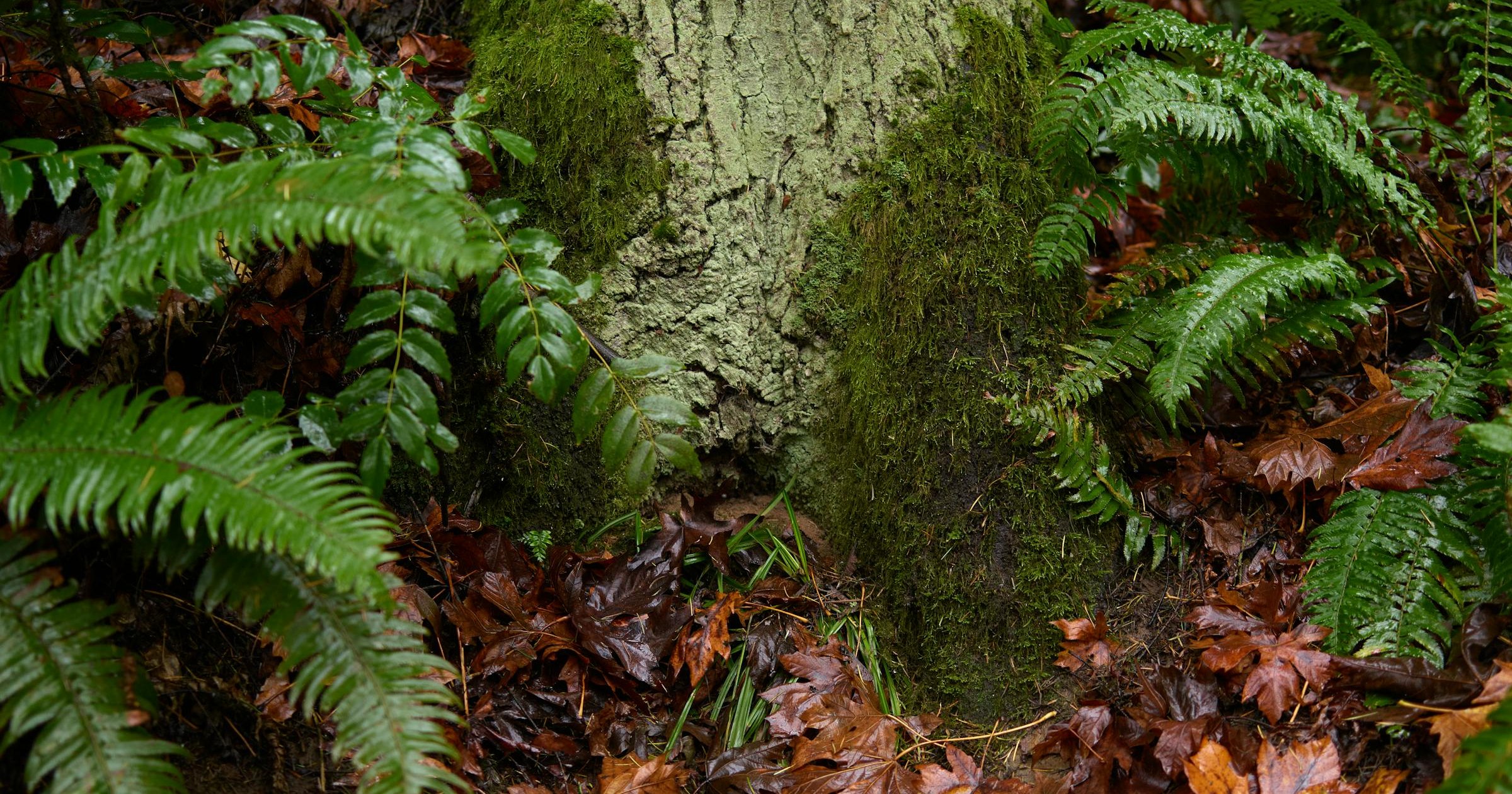
You have been staring at the patch under your Douglas-fir where lawn gave up three years ago. Bare soil, a few moss colonies, some invasive creeping buttercup working its way in from the neighbor’s side. You want something native. You have read that kinnikinnick is the answer. So you buy a flat of starts, plant them in October, water through the first summer, and watch them rot out by the following January. The problem was not the plant. The problem was your soil.
Most national native groundcover guides frame these plants as drought alternatives to lawn. That framing is backwards here. The Puget Sound lowlands get 37 to 55 inches of rain a year. The primary challenge in most yards is not drought but seasonal saturation: clay soils and glacial till that hold water from October through April, then bake hard in July and August. The question that actually determines which groundcover survives is not “how much sun does this spot get?” It is “does this spot drain?”
The Drainage Question
Before you choose a single plant, do the drainage test. Dig a hole 12 inches deep and 12 inches wide. Fill it with water. Time how long it takes to empty. If the water drains within an hour or two, you have a well-drained site: sand, gravel, or amended soil over a permeable layer. If water stands for four hours or more, you have a moisture-retentive site: clay, glacial till, valley-floor alluvium, or the heavy soils that characterize most developed lots in this region.
This one observation sorts every native groundcover recommendation that follows. The soil texture and drainage guide covers the full picture, but for groundcover selection, it comes down to two tracks. Well-drained sites get one set of plants. Moisture-retentive sites get a different set. Plant the wrong track and you are fighting your soil instead of working with it.
Light matters too, but it is the secondary filter. A shade-loving groundcover in well-drained sandy soil (wild ginger under a mature Douglas-fir on a slope) behaves differently from the same plant in waterlogged clay (wild ginger in a north-facing lot in the Green River valley). Drainage first. Light second.
For Well-Drained Sites
If your drainage test empties in under two hours, you are working with the conditions that suit our most familiar native groundcovers.
Kinnikinnick (Arctostaphylos uva-ursi)
This is the one native groundcover where cultivar selection changes what you get. Six cultivars move through the nursery trade, and they are not interchangeable.
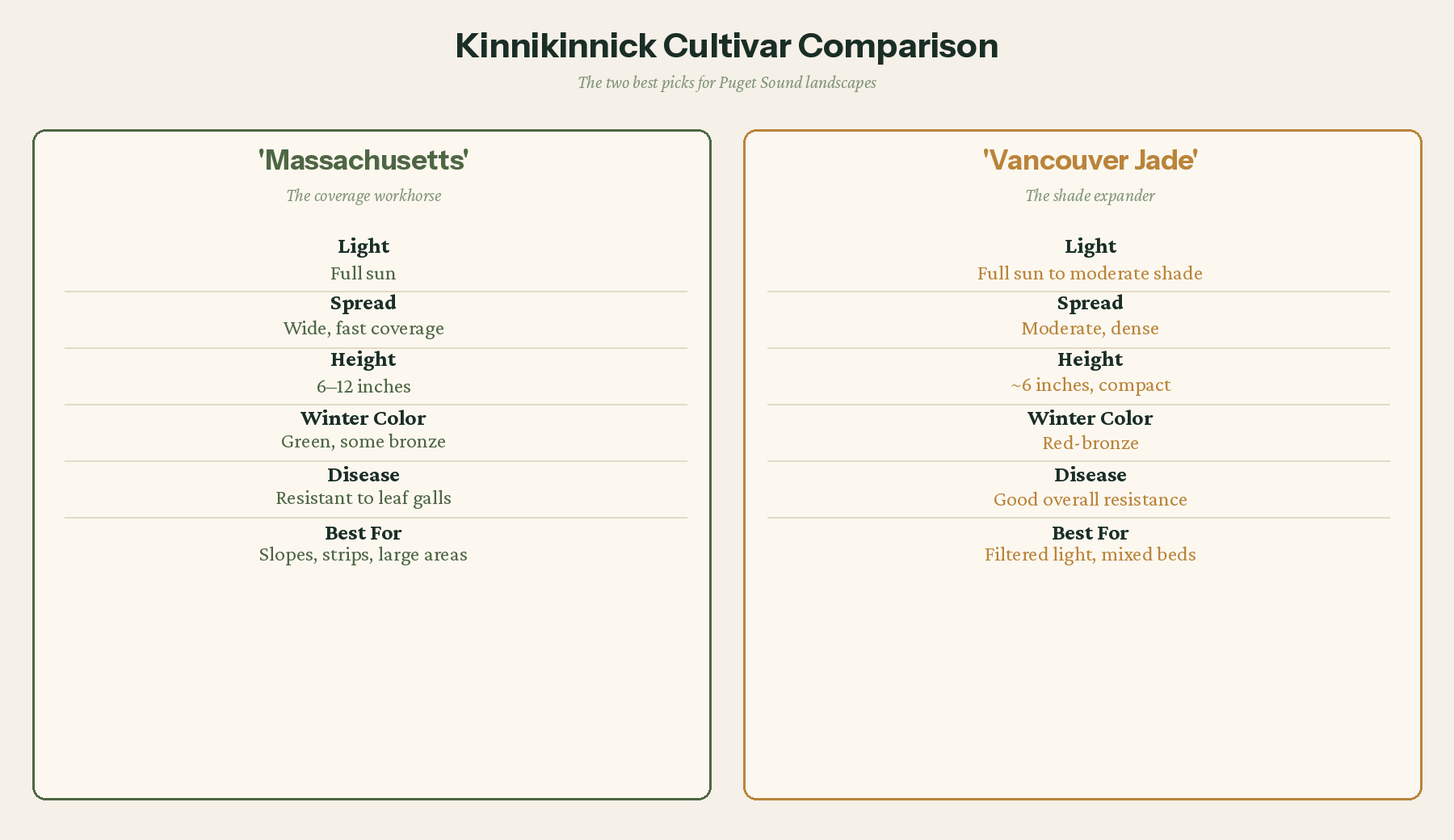
‘Massachusetts’ is the workhorse. Vigorous, flat-growing, reliable in full sun, resistant to leaf burn. Robert Tichnor developed this selection at Oregon State University, and it remains the most widely available cultivar for a reason: it covers ground fast and tolerates the widest range of well-drained conditions. If you are planting a slope, a parking strip, or any area larger than 50 square feet, this is the default choice. Use the ‘Massachusetts’ cultivar specifically to avoid the insect-caused leaf galls that plague some other selections.
‘Vancouver Jade’ is the cultivar that expands where you can use kinnikinnick. It tolerates a wider range of light conditions than ‘Massachusetts’, performing in both full sun and moderate shade. The foliage is dense and jade-green through summer, turning red-bronze in winter. It also carries better disease resistance than the straight species. Lower growing at about 6 inches, but not as wide-spreading as ‘Massachusetts’.
‘Point Reyes’ was selected from coastal populations in Marin County, California. Large, glossy leaves, a wide spreading habit (6 to 10 feet), and strong drought tolerance. It produces fewer berries than ‘Massachusetts’. Best for dry, exposed sites where you want the most aggressive horizontal coverage.
‘Emerald Carpet’ is actually a hybrid between A. nummularia and A. uva-ursi, found in the mid-1960s in Mendocino County. Darker green foliage than the straight species, and it accepts more shade than ‘Massachusetts’. Tops out around a foot tall with 3 to 4 feet of spread.
‘Wood’s Compact’ stays tighter and smaller than any other selection. The right choice for containers, narrow borders, or anywhere you need the kinnikinnick effect in a confined space.
The full kinnikinnick guide covers site requirements, problems, and establishment in detail. The short version for this guide: full sun to part shade, excellent drainage, and patience through two full growing seasons of supplemental watering before you can call it established.
Beach Strawberry (Fragaria chiloensis)
Beach strawberry is the stoloniferous option: it sends runners across the surface, rooting at each node, building a glossy dark-green mat up to a foot tall. It tolerates light foot traffic, which is unusual among native groundcovers. White flowers in spring, small fruit in summer, evergreen foliage through winter. Plant it in full sun with good drainage. It evolved on coastal bluffs and dune edges, so sandy or gravelly soil suits it best.
Beach strawberry has no named cultivars in the ornamental trade. What you buy is the wild species, and source matters. A population collected from a coastal site will have different vigor than one from a forest margin. Ask your nursery where the stock originated.
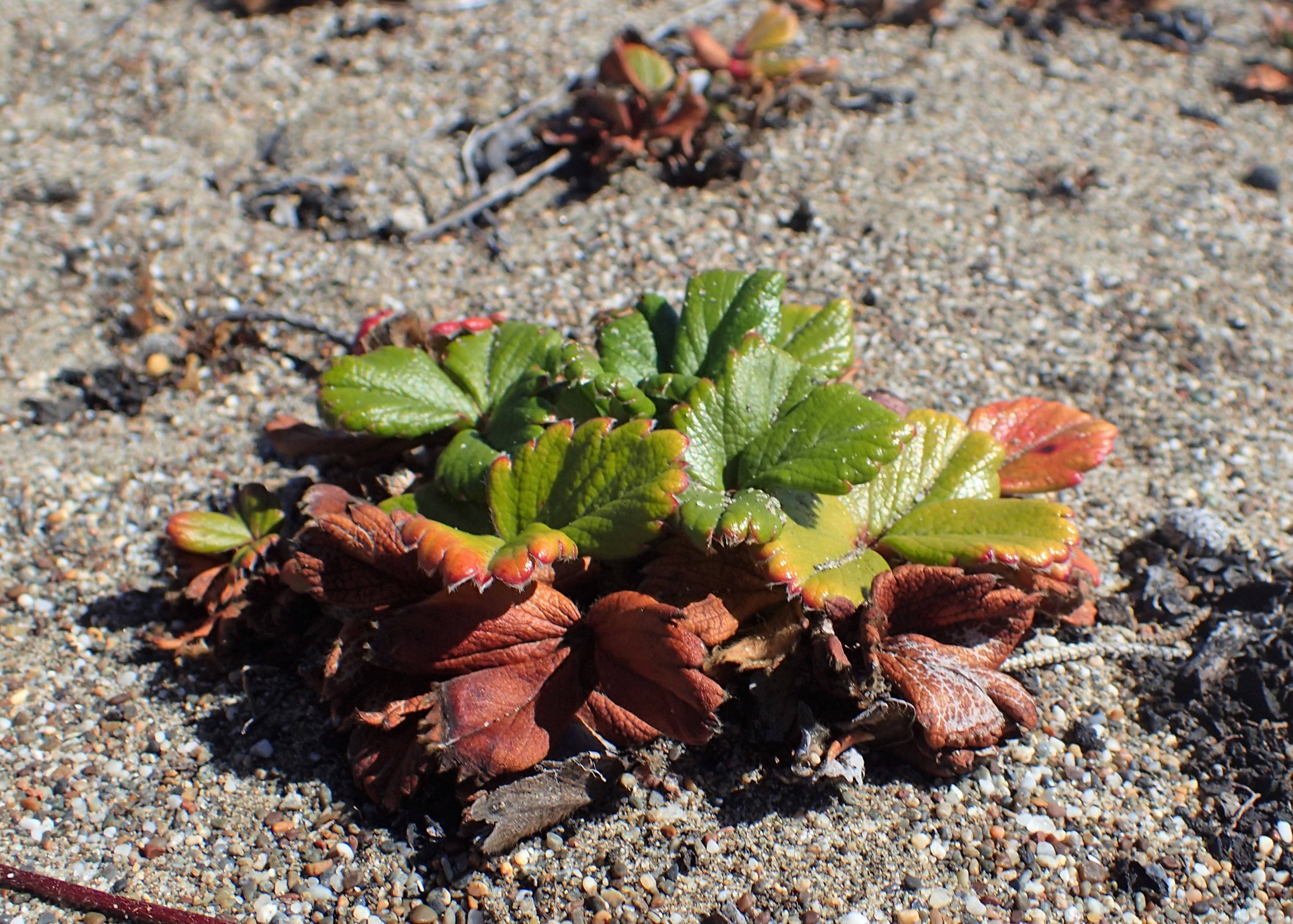 Beach strawberry in its native coastal habitat. Photo by Krzysztof Ziarnek, Kenraiz, CC BY-SA 4.0, via Wikimedia Commons.
Creeping Oregon Grape (Berberis repens)
If your well-drained site is in shade, creeping Oregon grape is the answer kinnikinnick cannot be. It stays one to two feet tall, spreads by rhizomes, and thrives in the dry shade under conifers and roof eaves where almost nothing else will grow. Holly-like evergreen leaves turn purple-bronze in winter. Bright yellow flowers in early spring. Blue-purple berries by summer.
The creeping Oregon grape guide covers this plant in full, including the renovation pruning technique that makes it one of the most forgiving groundcovers in the region: cut it to the ground in late winter and it comes back dense from the rhizome system. No other native groundcover recovers from that kind of hard reset.
For Moisture-Retentive Sites
If water stands in your drainage test for four hours or more, you need plants that evolved in the forest floor conditions typical of this region: consistent moisture, organic-rich soil, and shade from an overhead canopy.
Salal (Gaultheria shallon)
Salal is the Puget Sound understory. It carpets hundreds of thousands of acres of forest floor from the coast to the Cascade foothills, and it has been doing so since before your neighborhood was platted. Learning to use it as a groundcover means working with its vigor, not against it.
In full sun, salal stays low: one to two feet, dense and manageable, exactly the height you want in a groundcover. In shade, on moist soil, it will reach four to six feet if you let it. The key to keeping salal at groundcover scale is site selection and occasional pruning. Full sun or dry shade constrains its height naturally. If you plant it in moist shade and rich soil, plan on cutting it back.
Salal is the only native groundcover in this list with active cultivar development. ‘Cascade Sunrise’ (PP34625) is a sport discovered at Sidhu & Sons Nursery in British Columbia. It has orange-red new growth, narrower and more tapered leaves than the species, and it reaches about three feet in sun. This is the first named cultivar to enter the nursery trade, and a second patented selection is also being commercialized. For now, the straight species remains the standard purchase, but watch this space.
The floral industry harvests salal foliage commercially throughout this region, which tells you something about its reliability: it grows here with no help at all.
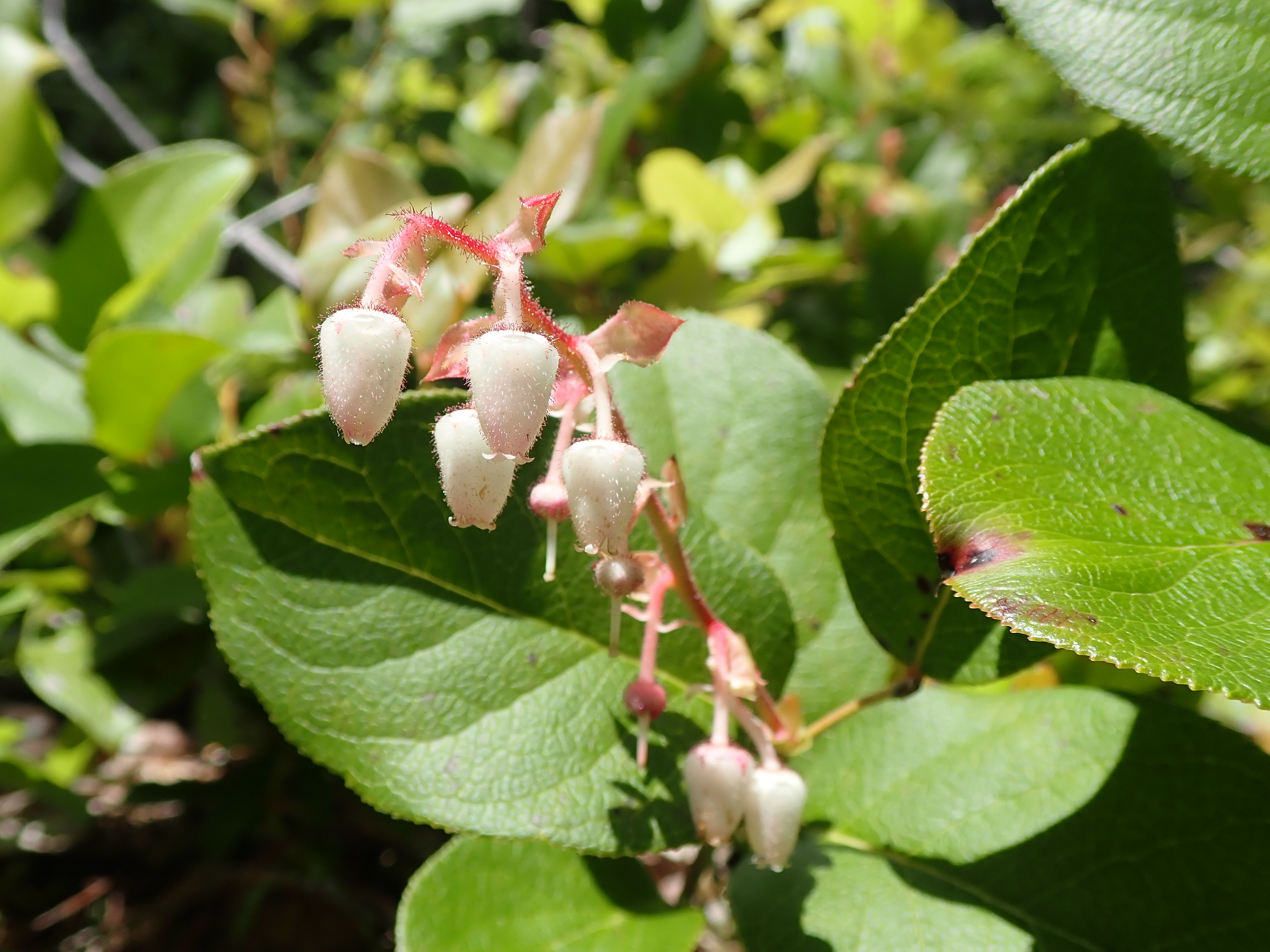 Salal at Mount Rainier National Park. Photo by NPS, public domain.
Wild Ginger (Asarum caudatum)
Wild ginger is an elegant ground cover with bold, deep-green, heart-shaped leaves that overlap to form a dense, low mat. It stays under six inches tall and spreads slowly by rhizomes through shaded areas. The flowers are hidden beneath the foliage: small, thimble-shaped, maroon to brown, blooming in spring at ground level where they attract ground-crawling pollinators rather than bees.
It handles heavy soil better than most native groundcovers, but pure clay benefits from organic matter amendment at planting time. Part to full shade. Consistent moisture. Evergreen through mild winters, which in the Puget Sound lowlands means most years. Space plants 12 inches apart for a filled look within two to three years.
Wild ginger is commonly found in moist woodlands from the Cascades west to the coast, so you are planting it back into the conditions it evolved in. There are no cultivars in the trade. What you buy is the species.
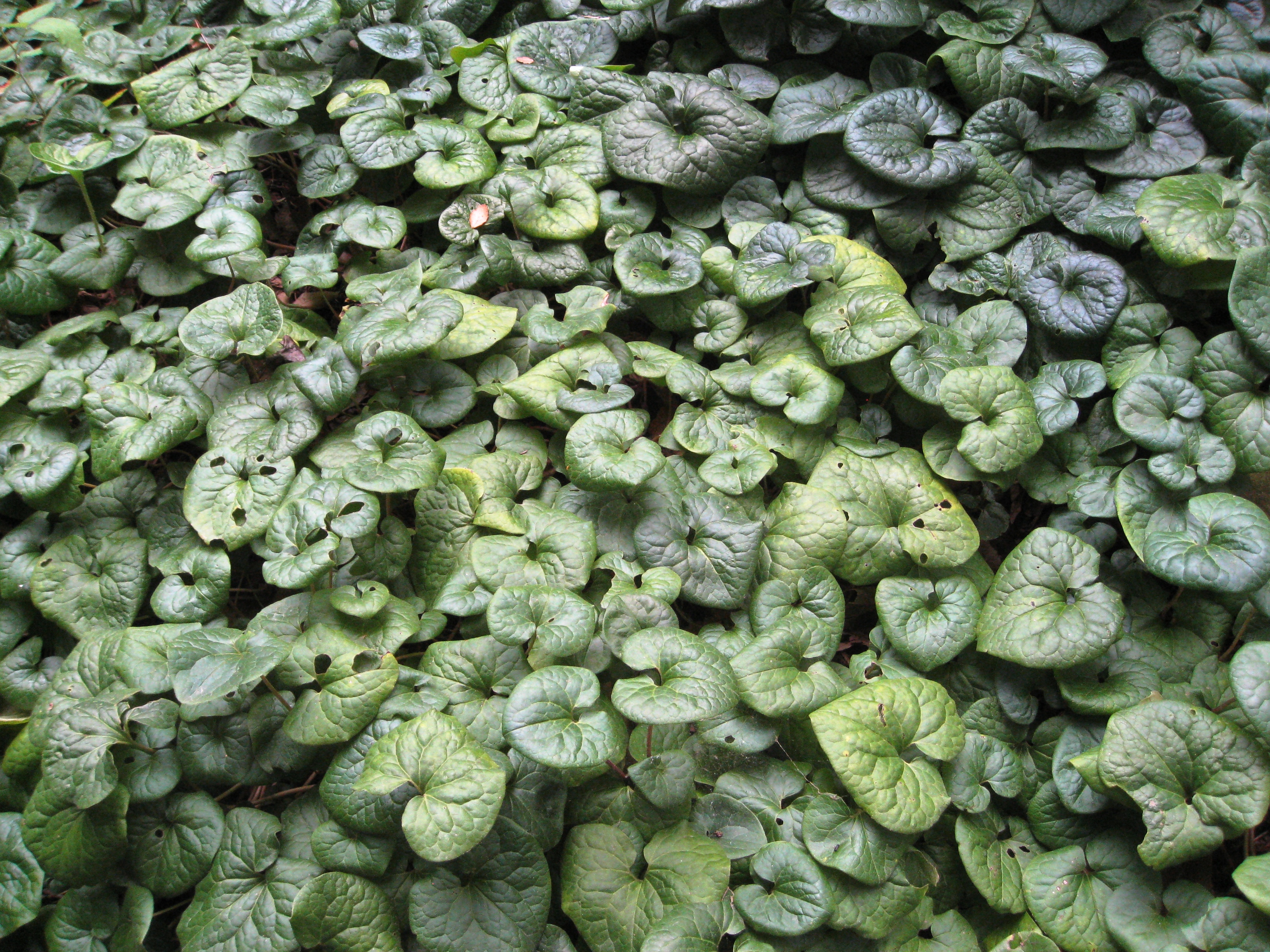 Wild ginger carpet near Seattle. Photo by brewbooks, CC BY-SA 2.0, via Wikimedia Commons.
Inside-out Flower (Vancouveria hexandra)
Inside-out flower builds a light but cohesive carpet about eight inches tall during the growing season. The name comes from the tiny white flowers whose petals reflex backward, looking like they were blown inside out by a gust of wind. The foliage is delicate, compound, and airy, quite different from the heavy, glossy look of salal or kinnikinnick.
The catch: it is deciduous. The carpet disappears in winter, leaving bare ground until new growth returns in spring. If year-round coverage matters to you, pair inside-out flower with an evergreen companion like sword fern or wild ginger. In the forest it colonizes the deep shade of Douglas-fir and western hemlock canopies, spreading by rhizomes. It asks for moist, acid, woodland soil and no direct sun.
No cultivars exist. No significant disease or pest issues are documented. It is a species plant that does one thing well: fill the forest floor in deep shade where other groundcovers refuse to go.
Redwood Sorrel (Oxalis oregana)
Redwood sorrel carpets the floor of moist forests throughout southwestern Washington and the Olympic Peninsula. Bright green, clover-shaped leaves. White or pinkish flowers throughout the growing season. It tolerates deep shade and dry shade, and once established, it is drought-tolerant. It also spreads aggressively via rhizomes.
That last point deserves emphasis. If you plant redwood sorrel, you should be sure you want it. It will colonize every shaded, moist area it can reach. It can substitute for English ivy as a shade groundcover, but it shares some of ivy’s enthusiasm for expansion. In the right spot (under established trees, in beds you want fully carpeted, as an intentional replacement for invasive groundcovers) that vigor is an asset. In a mixed border with delicate perennials, it will overwhelm its neighbors.
No cultivars. Two to four inches tall. Rhizomatous. Fire resistant, if that matters for your site. The species is native to the counties west of the Cascades, primarily the Olympic Peninsula and the southwestern coast.
Piggyback Plant (Tolmiea menziesii)
Piggyback plant gets its common name from the plantlets that form at the base of mature leaves, tiny copies of the parent riding piggyback on the older foliage. It forms dense mounds six to eight inches tall and builds extensive stands under shrubs and in shaded garden beds. In sheltered locations, it stays green year-round.
It thrives in partial to full shade with consistent moisture. The foliage is hairy, maple-shaped, and lighter green than most forest-floor natives. It fills a niche between the dense carpet of wild ginger and the airy texture of inside-out flower. Like redwood sorrel, it requires no summer irrigation once established.
No cultivars. No significant pest or disease issues. Piggyback plant is one of the most reliable shade groundcovers for this region, and it deserves more use than it gets.
Building a Community, Not a Monoculture
The strongest native groundcover plantings use three functional layers rather than a single species. The spreading carpet (kinnikinnick, wild ginger, redwood sorrel) forms the continuous coverage. Emergent structural plants rise above the carpet to add depth: sword fern at two to four feet, Cascade mahonia at two feet. Dynamic fillers self-seed into gaps: candy flower (Claytonia sibirica) for shade, yarrow (Achillea millefolium) for sun.
This three-layer approach mimics the native plant communities you see on forest floors and prairie edges throughout the region. Monocultures of any groundcover, native or not, are vulnerable to disease outbreaks and visual monotony. A mixed planting is more resilient, requires less maintenance, and looks like the landscape is supposed to look.
Cultivar vs. Ecotype: When Selection Matters
For kinnikinnick, cultivar selection is a real decision with real consequences. Choosing ‘Massachusetts’ over ‘Vancouver Jade’ changes how the planting performs in shade, how quickly it fills, and what winter color you get. The six named cultivars represent decades of selection and evaluation.
For salal, cultivar development is just beginning. Cascade Sunrise is the first selection to enter the trade. Buy the species for now unless you specifically want the orange-red new growth of the named cultivar. More selections will follow.
For every other native groundcover in this guide, there are no cultivars. What you buy is the species. But ecotype matters. A beach strawberry collected from a coastal dune population will establish differently than one propagated from a forest-edge population. A wild ginger grown from Cascade foothill stock may handle slightly drier conditions than one from a coastal forest.
When sourcing, ask where the nursery’s stock originated. Local genotypes establish better and carry adaptations to regional soils and rainfall patterns that imported stock may lack. Sound Native Plants, Plantas Nativa, Woodbrook Native Plant Nursery, and Fourth Corner Nurseries all propagate from regional ecotypes.
What Not to Plant
Three invasive groundcovers dominate the “alternative to lawn” market in this region. All three escape cultivation and damage native ecosystems. The invasive plants guide covers them in detail. The short version:
English ivy (Hedera helix): already banned in some jurisdictions, climbs and kills trees, smothers native understory. Every native groundcover in this guide does the job ivy does without the ecological damage.
Greater periwinkle (Vinca major): evergreen, aggressive, displaces native plants in riparian areas. A Washington Noxious Weed Control Board concern.
Yellow archangel (Lamiastrum galeobdolon): the variegated cultivar sold in nurseries as a shade groundcover escapes into forests and is nearly impossible to eradicate once established.
Bugleweed (Ajuga reptans): not officially listed as invasive here, but aggressive enough that it escapes garden beds and competes with native groundcovers in adjacent natural areas. Six cultivars in the nursery trade, all of them vigorous spreaders. If you want a dense, low, colorful mat in shade, wild ginger and piggyback plant fill the same niche without the risk.
If you are open to non-native plants for dry shade and nothing native fits your site, barrenwort (Epimedium) is the honest alternative. The Elisabeth C. Miller Botanical Garden has validated several species as tough, drought-tolerant shade groundcovers that do not escape into natural areas. ‘Sulphureum’, E. × rubrum, and E. × perralchicum are the proven performers here.
Getting Them Established
Fall planting is optimal. Put plants in the ground between September and October, before the heavy rain starts, and winter does the watering work for you. You can plant through May, but spring-planted natives need more supplemental irrigation through their first summer.
Water new plantings well for two full growing seasons. Once established, most native groundcovers need no supplemental irrigation in this climate. That two-year investment is non-negotiable. Skipping summer watering in the first or second year is the single most common cause of failure with native groundcovers.
Soil preparation depends on your drainage track. Well-drained sites need minimal amendment: kinnikinnick and beach strawberry prefer lean, mineral soil. Moisture-retentive sites benefit from working compost into the planting area. Forest-floor species (wild ginger, inside-out flower, piggyback plant) evolved in soil rich in organic matter, and amending heavy clay with compost improves both drainage and the biological activity these plants depend on.
Spacing varies by species. Kinnikinnick: 18 to 24 inches. Salal: 3 to 4 feet (it fills faster than you expect). Wild ginger: 12 inches. Beach strawberry: 12 to 18 inches. Inside-out flower: 12 inches. Mulch between plants with arborist wood chips or leaf mold, but keep mulch away from crowns.
One honest limitation: native shade groundcovers do not tolerate foot traffic. If you need a walkable surface, you need stepping stones, a path, or moss. Kinnikinnick and beach strawberry handle light traffic in sun, but nothing native and shade-loving survives being stepped on regularly. Plan your paths before you plant, not after.
The patience test is real. Most native groundcovers take two to three full growing seasons to fill in and look like the coverage you imagined. The temptation is to plant too densely, which wastes money, or to give up after one year when the planting still has gaps. Trust the rhizomes. Trust the stolons. They are working underground before you see the result.
Source plants from nurseries that propagate from regional stock. Wild collection damages native populations and is unnecessary when good nursery-grown material is available.
Seasonal Planting Guide
| When | What | Why |
|---|---|---|
| September - October | Plant native groundcovers | Fall planting lets winter rain establish roots. Optimal window. |
| October - March | Leave plantings alone | Winter moisture does the work. No fertilizer, no amendment, no fussing. |
| April - May | Spring planting (if you missed fall) | Viable but requires more summer watering. |
| May - September (Year 1 and 2) | Water weekly in dry periods | Two-year establishment watering is non-negotiable. Deep soak, not sprinkle. |
| March - April (Year 2+) | Light cleanup | Remove dead foliage from deciduous species. Cut back salal if height exceeds target. |
| June - August (Year 3+) | Nothing | Established native groundcovers need no summer care. This is the payoff. |
Sources
- Oregon State University Landscape Plants Database: Arctostaphylos uva-ursi cultivar descriptions and growing requirements
- Briggs Nursery: Gaultheria shallon ‘Cascade Sunrise’ (PP34625) cultivar specifications
- Washington Noxious Weed Control Board: Groundcover Alternatives for Pacific Northwest Regions
- University of Washington Elisabeth C. Miller Library: Native groundcover walkability limitations
- Elisabeth C. Miller Botanical Garden: Epimedium species validation for Pacific Northwest shade gardens
- Pacific Horticulture: “Blanket the Ground: Native Groundcover Communities for Biodiversity, Habitat, and Beauty”
Pesticide recommendations are based on current Washington State labels. Always read and follow the label.
Get seasonal timing updates for the Puget Sound lowlands: subscribe to the Field Brief.