At Soos Creek Botanical Garden in Auburn, along the woodland trails past the rhododendron collection, you walk past something that stops you if you are paying attention. A western hemlock is growing out of a decaying western red cedar stump. The stump is hollow. Its wood, bark, and root flare have broken apart into chunks, and between them you can see the hemlock’s new wood threading down through the decaying stump to the ground below.
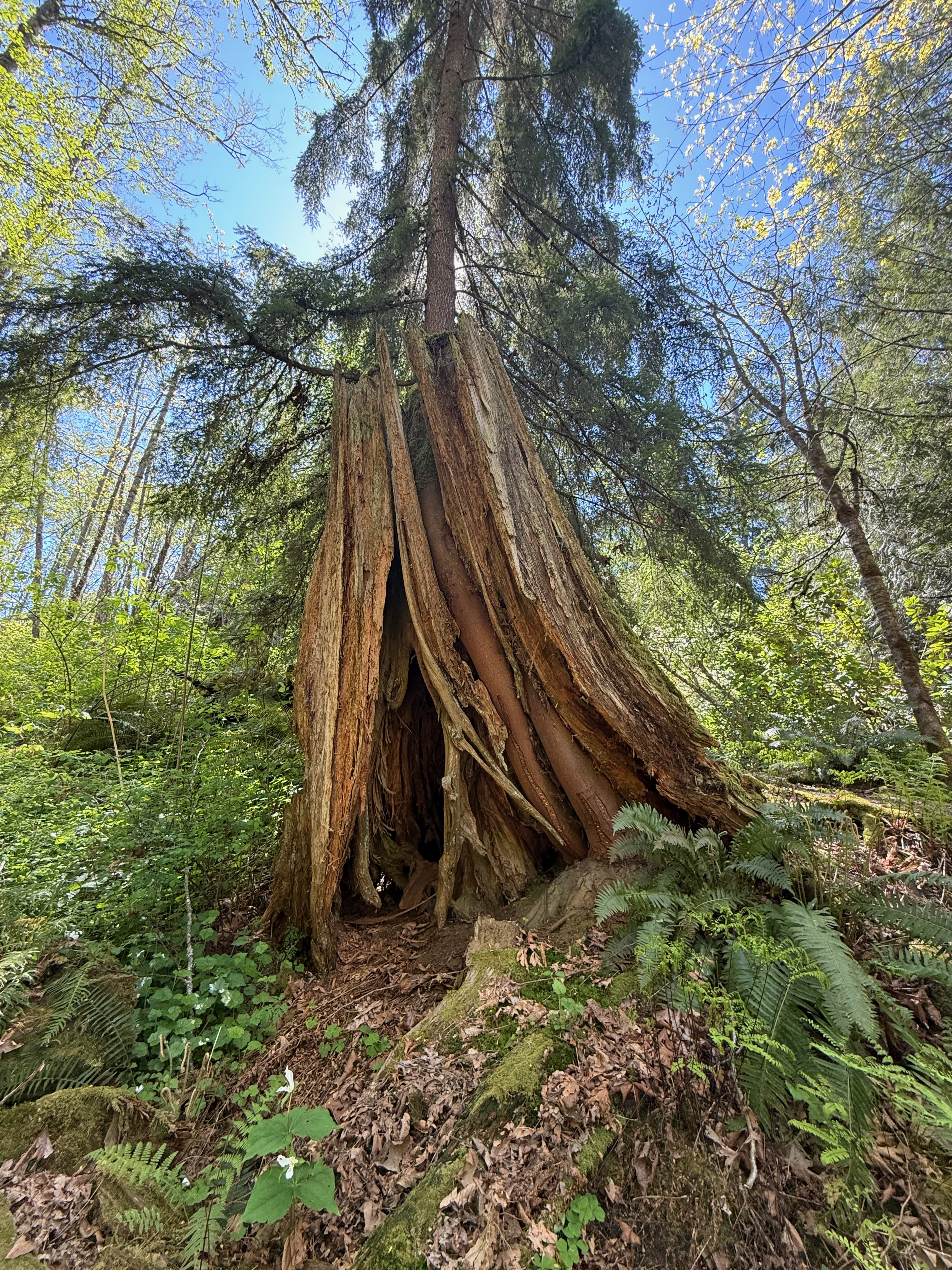 Western hemlock growing from a hollow western red cedar nurse stump at Soos Creek Botanical Garden in Auburn, WA. The hemlock’s new wood is visible threading between the old cedar’s decaying wood, bark, and root flare. Photo: Chris Welch, hortguide.com.
Look closely at the wood. The old cedar stump is breaking apart, its wood, bark, and root flare slowly giving way to decay. The hemlock’s new wood running through it is smoother, lighter, clearly living tissue. You are looking at two species in one structure: the dead tree that became the nursery, and the living tree it grew. That contrast, old wood intermixed with new, is the easiest way to read a nurse stump in the field.
Walk further along the trail and you find another: a western red cedar growing from a cedar stump beside the path, its flared base the only evidence that it started life on top of something else.
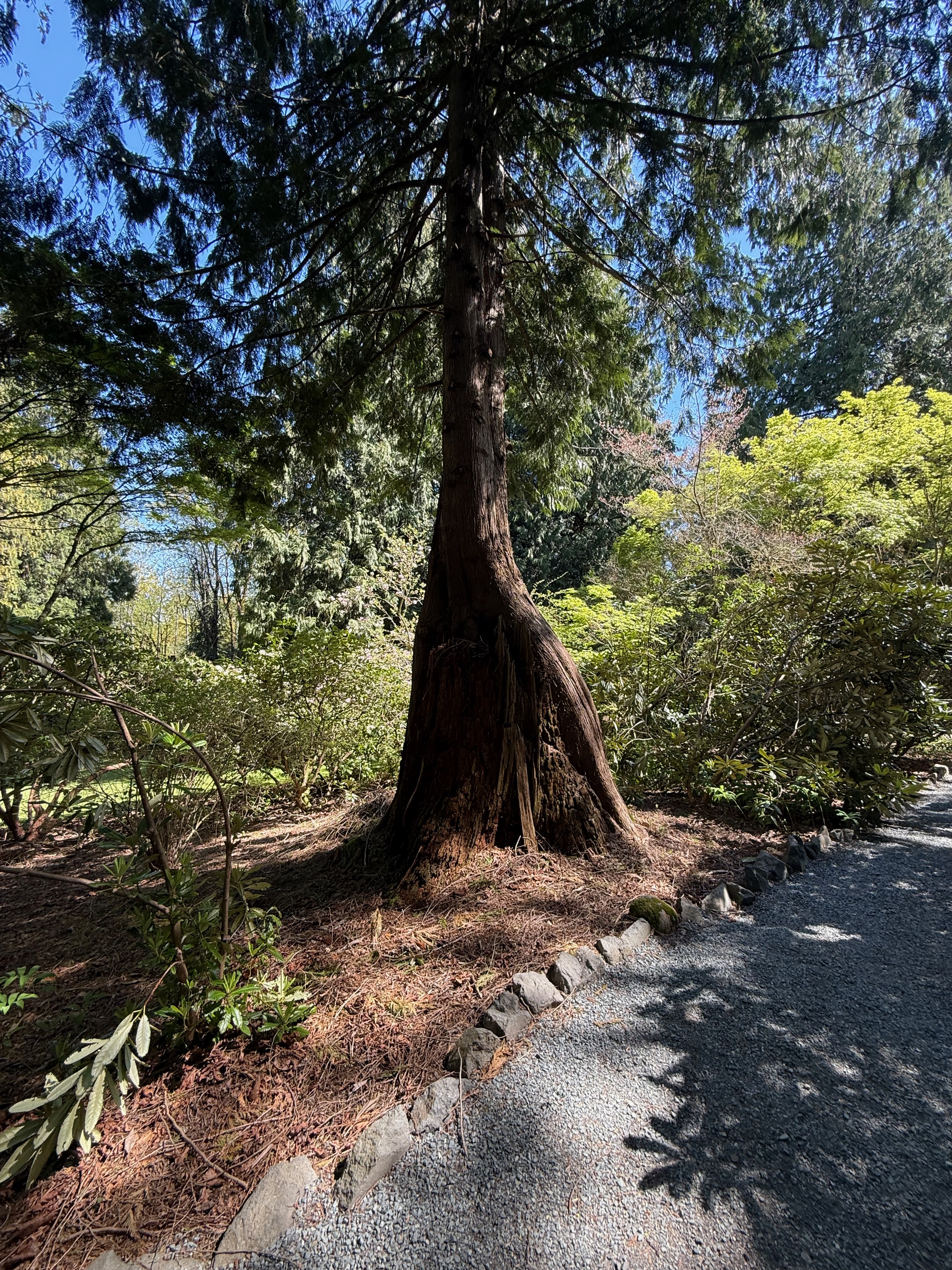 Western red cedar that established on a nurse stump beside the trail at Soos Creek Botanical Garden. The stump has nearly disappeared; the flared, buttressed base is the only remaining evidence. Photo: Chris Welch, hortguide.com.
Then a third example, at a different stage entirely. Each tells the same story: a large tree died, its stump stood and rotted, seeds landed on the moist decomposing wood and germinated, and now new trees are growing from the old one’s remains. If you have spent any time on forest trails in this region, you have seen this before without necessarily knowing what you were looking at or why it works.
What you are looking at is a nurse stump. Its horizontal cousin, the nurse log, is the same thing on its side: a fallen trunk slowly decomposing while seedlings colonize its surface. Together, nurse stumps and nurse logs are responsible for the majority of new conifer establishment in the old-growth forests of this region. In the coastal rainforests of the Olympic Peninsula, as much as 90 percent of new western hemlock and Sitka spruce seedlings establish on decomposing wood rather than on bare soil. This is not a botanical curiosity. It is the primary mechanism by which these forests renew themselves.
How Dead Wood Becomes a Nursery
A tree falls or is cut. For the first few years, nothing much happens on the surface. The wood is too hard, too dry in summer, and too nutrient-poor to support germination. Below the bark, though, saprotrophic fungi are already at work, the same wood-decay organisms described in the wood and bark guide. These fungi break down cellulose and lignin over decades, softening the wood and unlocking nutrients that were locked in the tree’s structural tissue.
Ecologists classify decomposing wood on a five-point scale. Class I is freshly fallen, structurally sound. Class V is so far gone it crumbles in your hand and is barely distinguishable from soil. The sweet spot for seedling establishment is Class III and IV: soft enough to hold moisture and support root penetration, intact enough to maintain structure above the forest floor. In the maritime climate here, reaching that stage takes roughly 50 to 100 years for a large conifer log. Complete decomposition takes 200 to 500 years or more.
The moisture dynamics are the key. Decomposing wood acts as a sponge. It absorbs rain through the wet season and releases it slowly through summer, staying damp long after the surrounding mineral soil has dried out. For a tiny conifer seedling with roots measured in millimeters, that moisture buffer is the difference between surviving August and desiccating.
There is also a seed-trapping mechanism. Research in Sitka spruce and western hemlock forests along the Oregon and Washington coast found that moss-covered and litter-covered log surfaces retained 48 to 98 percent of the seeds that landed on them. Bare wood and bark retained almost none. The moss that colonizes decomposing wood in our wet forests is not just decoration; it is the seedbed that catches and holds the next generation of trees.
The Tree That Can Wait
Not every conifer uses nurse logs. The species that do share one trait: extreme shade tolerance.
Western hemlock is the classic example. It is the most shade-tolerant tree-sized conifer in the region, capable of germinating and surviving for decades in deep forest shade. A hemlock seedling does not need open sky. It needs moisture, a stable substrate, and time. A nurse log in the understory of a mature forest provides all three. Hemlock seeds are tiny, roughly the size of a sesame seed, and they germinate readily on the organic surface of decomposing wood.
Western red cedar does the same thing. Its shade tolerance is not quite as extreme as hemlock’s, but it is substantial, and its tolerance for saturated substrates gives it an additional advantage on waterlogged nurse logs in low-lying areas.
The tree that does not use nurse logs is the one that dominates the regional landscape: Douglas-fir. It is shade-intolerant. Douglas-fir seeds need exposed mineral soil and direct sunlight to establish. A Douglas-fir seedling in the understory of a closed-canopy forest will die. This is why Douglas-fir is a pioneer species, the first large conifer to colonize after a disturbance like fire, windthrow, or logging, and why it does not regenerate under its own canopy.
This distinction is the ecological engine behind forest succession in the Puget Sound lowlands. Douglas-fir colonizes open ground and grows fast. Over a century or two, it builds a closed canopy. Under that canopy, on the nurse logs and nurse stumps created by fallen trees, hemlock and cedar seedlings establish and slowly grow. Given enough time without major disturbance, hemlock and cedar replace Douglas-fir as the dominant canopy species. The nurse log selects for the trees that can wait.
This is why old-growth forests look different from second-growth forests. Second-growth is Douglas-fir plantations: even-aged, uniform, the product of a single disturbance event. Old-growth is multi-species, multi-aged, and structurally complex because nurse log regeneration has been operating for centuries, continuously introducing shade-tolerant species into the understory.
Stilt Roots and Colonnades
The nurse stumps at Soos Creek show you the middle of this process. The original stump is decaying. The new tree’s roots have grown down around and through the stump, finding soil beneath it. But the stump has not yet disappeared. You can still see the architecture: the root system draped over decomposing wood like a hand gripping a crumbling post.
Give it another century. The stump rots away entirely. What remains is a tree standing on exposed aerial roots, raised above the ground on what foresters call stilt roots. The space where the stump used to be is now an open cavity beneath the trunk. You see this frequently in mature lowland forests: a large hemlock or cedar whose base flares out into root buttresses with gaps between them, a hollow space at ground level that looks structural but is actually historical. That tree started its life on top of something that is no longer there.
Nurse logs produce an even more dramatic signature. When a large trunk falls in an old-growth forest, multiple seedlings germinate along its length. They grow in a line, spaced by the accident of where seeds landed. Over centuries, the log decomposes and vanishes, leaving a row of mature trees in a straight line, each standing on stilt roots, each marking where the nurse log once lay. These rows are called colonnades, and they are one of the most recognizable visual features of Pacific Northwest old-growth. In the Hoh Rainforest, you can find colonnades of Sitka spruce stretching a hundred feet or more, the trees so precisely aligned that the forest floor between their stilt roots looks like an arcade.
If you know what to look for, you can read a forest’s history by its colonnades. The orientation of the row tells you which direction the nurse log fell. The spacing of the trees tells you something about how many seeds germinated and survived. The diameter of the stilt roots hints at how long ago the nurse log disappeared.
Two Fungal Guilds in One Piece of Wood
Two completely different groups of fungi are working in a nurse log at the same time, doing different jobs.
The first group is the saprotrophic fungi, the decomposers. They are breaking down the wood itself: digesting cellulose, hemicellulose, and lignin, recycling the carbon and nutrients locked in the dead tree’s structure back into forms that living organisms can use. Without them, dead wood would accumulate indefinitely. They are the reason the nurse log softens, holds water, and eventually disappears.
The second group is the mycorrhizal fungi that partner with the living trees surrounding the nurse log. These fungi form networks connecting the roots of established trees, and those networks extend into and across the decomposing wood. When a seedling germinates on a nurse log, its young roots can tap into the existing mycorrhizal network, gaining access to nutrients and water through fungal connections to mature trees before its own root system is developed enough to forage independently. Research has shown that seedlings connected to these common mycorrhizal networks have significantly higher survival rates than seedlings growing in isolation.
There is even evidence that the type of wood decay affects which seedlings succeed. A 2024 study found that seedlings partnering with ectomycorrhizal fungi (the type that serves conifers, oaks, and birch) regenerate more successfully on white-rot logs, where fungi have broken down lignin and left the cellulose. Seedlings partnering with arbuscular mycorrhizal fungi (the type serving maples, fruit trees, and most shrubs) do better on brown-rot logs, where the cellulose is consumed but the lignin framework remains. The chemistry of the decomposition shapes which trees inherit the site.
From Forest to Garden
Everything that makes nurse logs work in the forest also works in a garden. Decomposing wood holds moisture. It supports fungal networks. It provides habitat for insects, amphibians, and soil organisms. It recycles nutrients slowly over years. And it creates the microsite conditions that shade-tolerant plants need to establish.
The Victorians figured this out in the 1850s, though they would not have described it in ecological terms. They built stumperies, garden features constructed from tree stumps and roots arranged upside down or on their sides, and planted them with ferns. The craze for fern gardening (pteridomania, as it was called) drove the fashion, but the ecology was sound: the decomposing wood created exactly the conditions that woodland ferns require. The Royal Horticultural Society maintains a stumpery at their Rosemoor garden, completed in 2017, as a demonstration of the form.
In the Puget Sound lowlands, you have a natural advantage. The maritime climate that drives nurse log ecology in the forest, cool temperatures, consistent rainfall, slow steady decomposition, operates in your garden too. A log pile or stumpery in a shaded corner of a residential property here decomposes at roughly the same rate as a nurse log on a forest trail a few miles away. You are not mimicking a foreign ecosystem. You are working with the one you already live in.
If you have a tree removed from your property, consider keeping the stump rather than grinding it. Consider stacking the trunk sections in a shaded area rather than hauling them to the transfer station. Over a few years, moss will colonize the surfaces. Sword fern (Polystichum munitum) will root into the crevices. Licorice fern (Polypodium glycyrrhiza) will appear on the upper surfaces, the same species you see growing on bigleaf maple branches overhead. Deer fern (Blechnum spicant), salal (Gaultheria shallon), and red huckleberry (Vaccinium parvifolium) all establish readily on decomposing wood. Trailing yellow violet (Viola sempervirens) and wood sorrel (Oxalis oregana) fill in at ground level. Within a few seasons, what started as yard waste becomes a functioning ecological feature.
There is also the wildlife case. A log pile in a shaded garden corner provides habitat for salamanders, ground beetles, centipedes, and the fungal networks that connect your garden’s root systems. Removing all dead wood from a landscape removes the structural component that roughly a quarter of forest-dwelling species depend on at some point in their life cycle.
Reading the Forest
Once you know what nurse stumps and nurse logs look like, you start seeing them everywhere. The next time you walk through Seward Park, Schmitz Preserve, the Carbon River corridor, or any of the lowland forest remnants scattered through the Puget Sound region, look for the signs: a tree with a flared, hollow base standing on root buttresses. A row of hemlocks in a suspiciously straight line. A stump with ferns and seedlings growing from its top. A cedar whose trunk starts three feet above the ground on a lattice of exposed roots.
Each one records a transaction that took centuries to complete. A tree grew, fell or was cut, decayed, caught seeds, and grew the next generation from its own remains. The forest ecologist Jerry Franklin, whose 1981 USDA report established the framework for understanding old-growth Douglas-fir forests, identified four structural components that define old-growth: large live trees, large snags, large logs on land, and large logs in streams. Nurse logs connect three of those four. They are the mechanism that converts dead structure into living structure, the handoff that keeps the forest replacing itself.
The stumps at Soos Creek are doing exactly this. The trees growing from them are not remarkable specimens. They are ordinary hemlocks and cedars doing what hemlocks and cedars have always done here: waiting for the right substrate, rooting into decomposing wood, and growing slowly toward the canopy. The remarkable part is the patience of the system, and how much of it you can bring home.
Sources
- Nurse Logs - Washington Native Plant Society
- Ecology of Coarse Woody Debris in Temperate Ecosystems - Harmon et al., Advances in Ecological Research, 1986
- Retention of needles and seeds on logs in Picea sitchensis-Tsuga heterophylla forests of coastal Oregon and Washington - Harmon, Canadian Journal of Botany, 1989
- Ecological characteristics of old-growth Douglas-fir forests - Franklin et al., USDA General Technical Report PNW-118, 1981
- Nurse Logs Provide New Habitat - AskNature, Biomimicry Institute
- Factors associated with seedling establishment on logs of different fungal decay types - Ecology and Evolution, 2024
- Ectomycorrhizal networks and seedling establishment during early primary succession - Nara, New Phytologist, 2006
- The Stumpery at RHS Garden Rosemoor - Royal Horticultural Society
- Keeping Dead Wood and Creating Wildlife Habitat Piles - Northwest Natural Resource Group