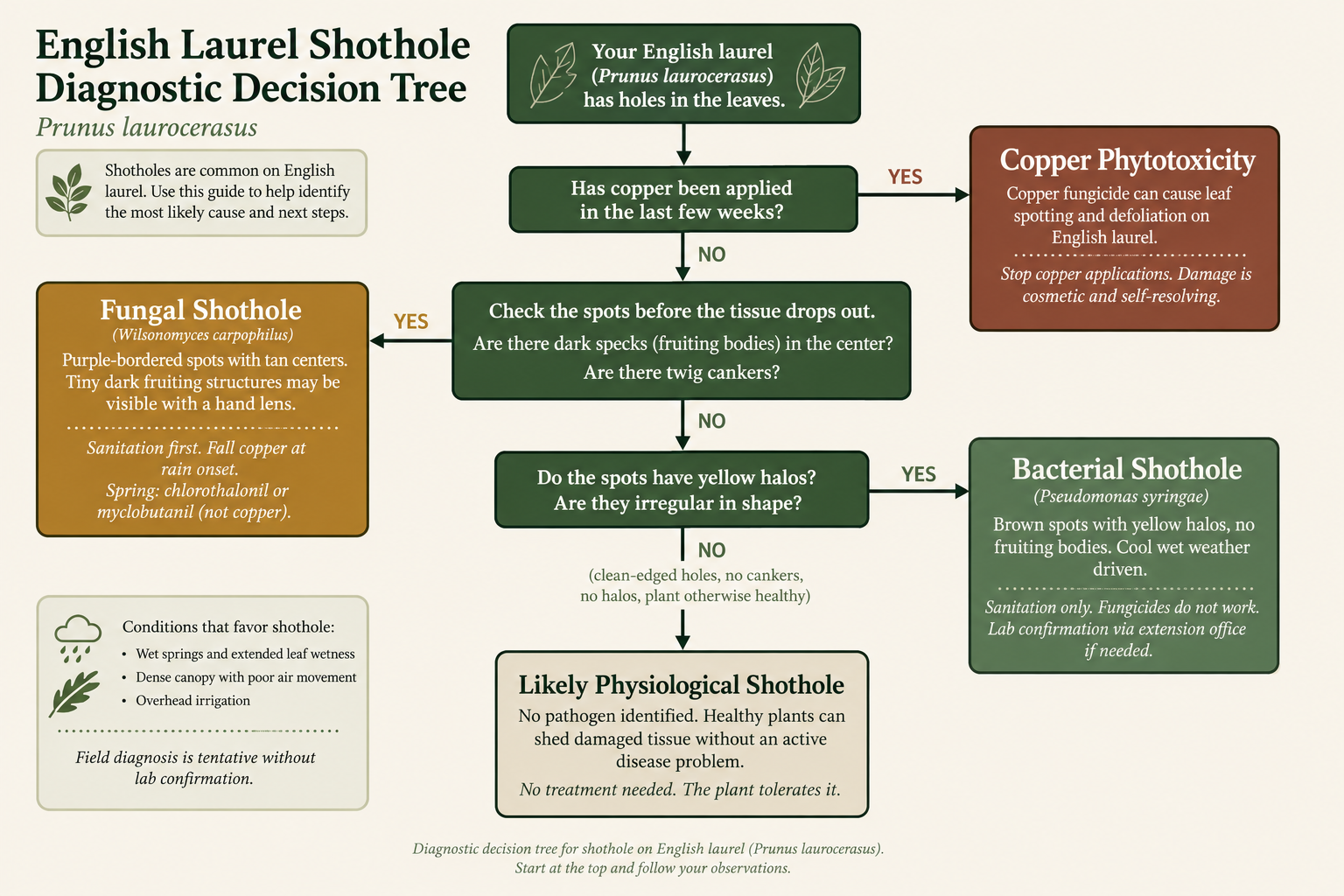
It starts showing up in May. You walk past your English laurel hedge and notice the leaves look like someone took a pellet gun to them: dozens of small, round holes punched through otherwise green foliage. By June it looks worse. By July you are wondering whether the hedge is dying.
It is not dying. In almost every case, on established English laurel in the Puget Sound region, shothole is cosmetic damage that the plant outgrows by late summer. But here is the part that most online advice skips: what you are looking at might not be a disease at all. Shothole on English laurel has four distinct causes, and only one of them responds to fungicide. Spraying before you diagnose is a waste of product at best, and at worst, the spray itself creates more holes.
English laurel (Prunus laurocerasus, also called cherry laurel nationally) is the most common hedge species in this region. You see it as a 15-to-20-foot property-line screen (the straight species), a compact foundation shrub (‘Otto Luyken’), or a narrow columnar hedge (‘Schipkaensis’). All three forms get shothole. The straight species is designated as a weed of concern in King County because birds spread its seed into forest understory; the compact cultivars do not pose the same invasive risk. If you already have one, here is how to keep it healthy. If you are planting the straight species new, consider native screening alternatives.
Four Causes, One Symptom
The holes all look similar, but the causes are different, and so is the response.
Fungal: Wilsonomyces carpophilus
This is the classic Coryneum blight, the shothole that extension publications describe. Look for small purple-bordered spots, roughly the size of a pencil eraser, with light tan or brown centers. As the tissue dies, the plant forms an abscission layer and drops the dead center out, leaving the hole. That abscission response is the mechanism behind the symptom: the plant is actively shedding damaged tissue rather than letting rot spread.
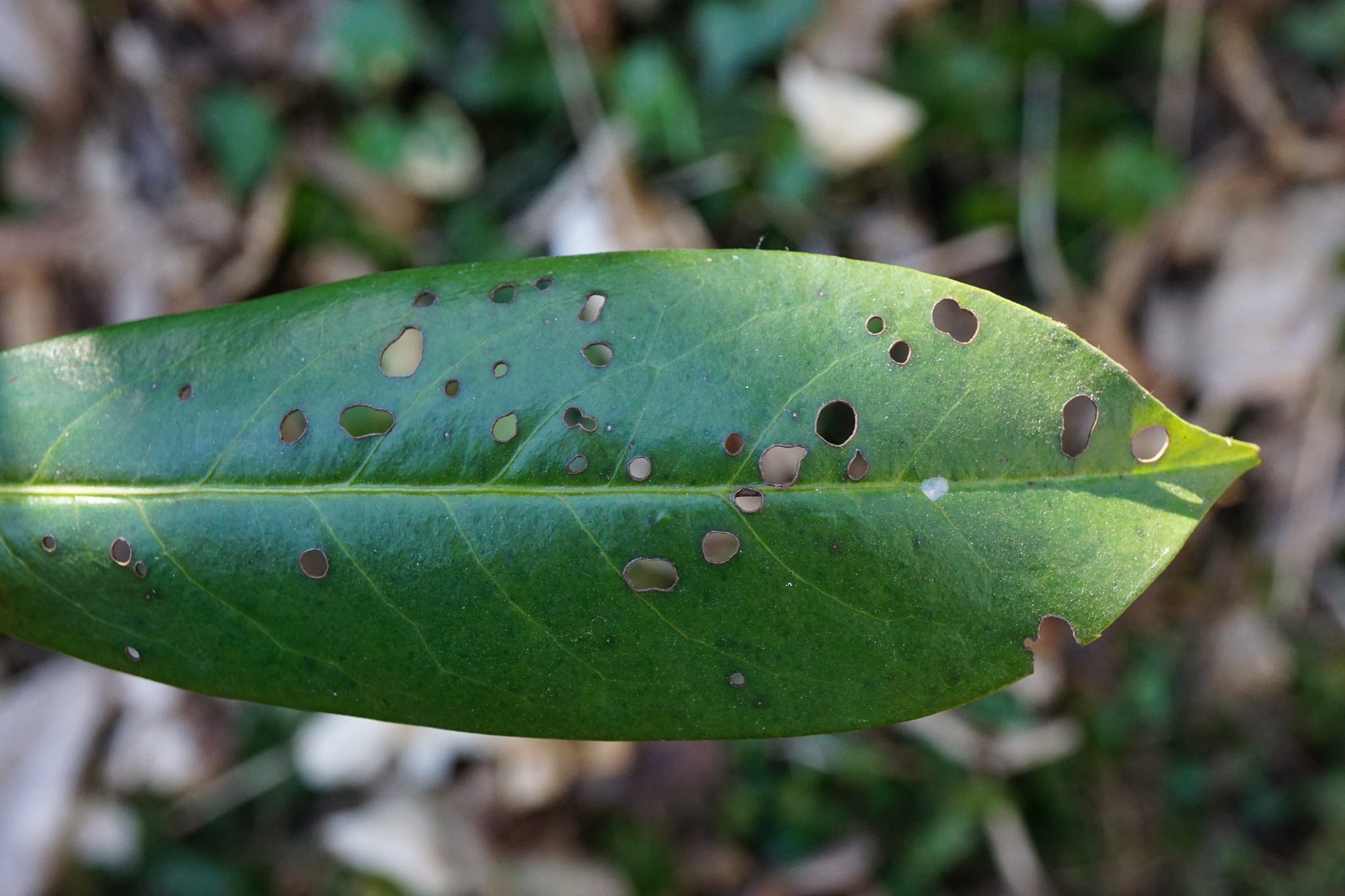 Cherry leaf showing the full progression: intact purple-bordered lesions, tissue dying, and holes where the dead center dropped out. Photo: Patrick Hacker, Wikimedia Commons, CC BY 4.0.
Two field clues confirm the fungal form. First, look at the twigs: if you see small raised cankers, dark and slightly sunken lesions on one-year wood, the fungus has been there since last fall. Second, check the centers of brown spots with a hand lens before the tissue drops out. Dark specks in the center are sporodochium, the fruiting bodies where the fungus produces spores. No other cause produces this sign.
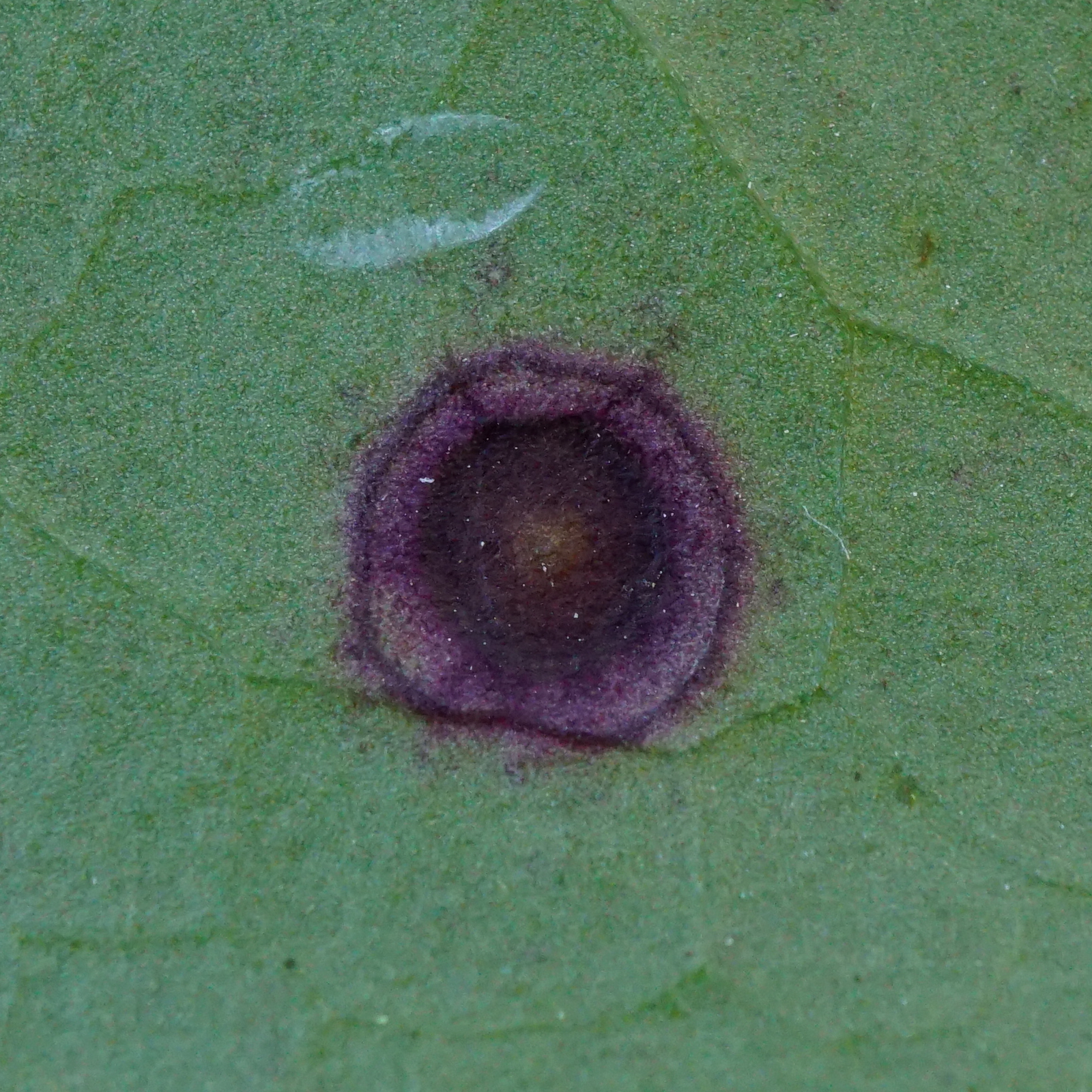 Macro view of a single lesion showing concentric rings and dark specks (sporodochium) in the center. These fruiting bodies confirm the fungal form. Photo: Patrick Hacker, Wikimedia Commons, CC BY 4.0.
The fungus overwinters in infected buds and twig cankers. Fall rains splash spores onto healthy tissue, and the pathogen enters through leaf scars where old leaves dropped. In spring, rising temperatures and moisture trigger a new round of spore release. Infection requires roughly 24 hours of leaf wetness above 41°F. Severity scales with temperature: lesion density peaks at 68°F after 24 hours of wetness, and at 77°F infection can establish in as little as 6 hours.
Bacterial: Pseudomonas syringae and others
Bacterial shothole produces brown spots with yellow halos rather than the purple-bordered lesions of the fungal form. The spots tend to be more irregular in shape, and they lack the fruiting bodies you can find with a hand lens in fungal lesions. Cool, wet weather drives this form, which is why maritime climates like ours see it regularly.
Distinguishing bacterial from fungal shothole in the field is difficult. The PNW Plant Disease Management Handbook attributes shothole on English laurel to Pseudomonas syringae, Cercospora sp., Blumeriella sp., and Wilsonomyces carpophilum, plus copper spray injury and boron toxicity. That multi-causal attribution is unique to English laurel. On deciduous stone fruit, shothole is almost always fungal.
The practical difference: fungicides do not work on bacterial infections. If you spray for shothole and see no improvement, bacterial involvement is a likely explanation. Lab confirmation through your county extension office is the only way to be certain.
Physiological: No Pathogen, No Treatment
This is the one WSU HortSense calls out specifically for English laurel: shothole symptoms with no identified pathogen. The holes are clean-edged, the foliage is otherwise healthy, no fruiting bodies are visible, and no spray history explains the damage. Research has not identified what specific stress triggers this response.
In my experience, physiological shothole is the most frequent cosmetic complaint on established English laurel hedges in this region. Healthy, vigorous plants do this. It looks alarming and it means nothing. There is no effective treatment because there is nothing to treat.
If your hedge has holes but no cankers, no halos, and no spray history, you are probably looking at this form. The plant tolerates it.
Copper Phytotoxicity: The Treatment That Backfires
Here is the irony that no competing guide mentions: copper fungicide, the standard recommendation for fungal shothole, can itself cause leaf spotting and defoliation on English laurel. The PNW Plant Disease Management Handbook warns specifically that fixed coppers “can cause leaf injury and defoliation” on this species.
The resulting damage looks like shothole. A homeowner reads “spray copper for shothole,” sprays copper, and creates more shothole-like symptoms. If you have been treating shothole with copper sprays and the problem keeps getting worse, the treatment may be the cause.
This does not mean copper is useless. A single fall dormant application as rains begin in October, before the fungus establishes in new bud tissue, remains the most effective preventive tool. The risk comes from repeated applications during the growing season on actively growing foliage. If you need a spring fungicide, chlorothalonil or myclobutanil are safer choices on English laurel than copper.
Diagnosing What You Have
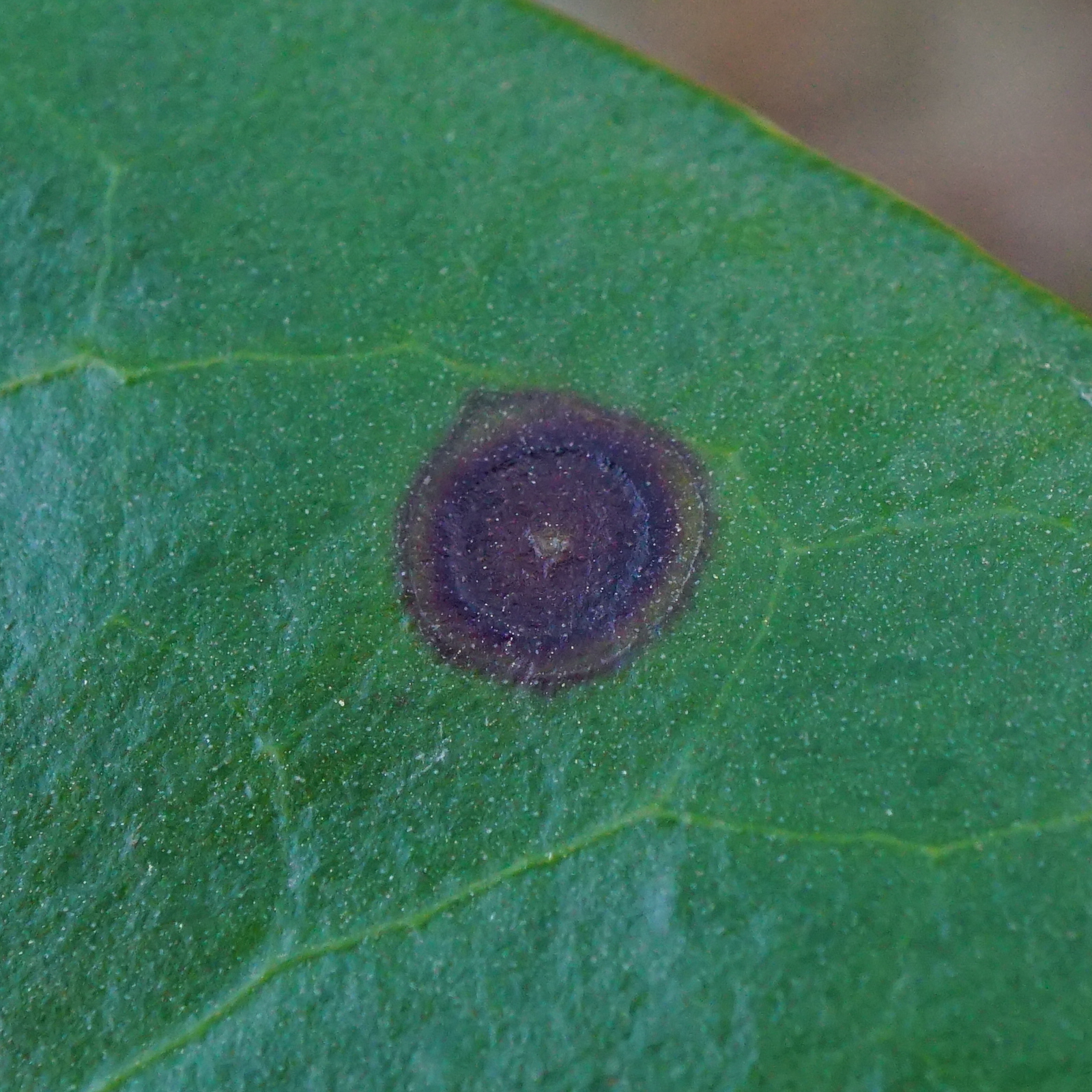 A single fungal lesion before the center drops out: purple border, tan center, roughly pencil-eraser size. This color pattern distinguishes fungal shothole from bacterial (yellow halos) and physiological (no discoloration). Photo: Patrick Hacker, Wikimedia Commons, CC BY 4.0.
The four causes overlap in timing and appearance, but three observations narrow it down.
Timing. Fungal shothole appears in late spring (May through June) as overwintered infections produce new spores. Bacterial shothole often shows up earlier, driven by cool wet conditions in March and April. Physiological shothole has no consistent timing. Copper injury follows 7 to 14 days after a copper application.
Associated signs. Twig cankers point to fungal. Yellow halos suggest bacterial. Clean-edged holes with no other symptoms suggest physiological. Marginal leaf burn or bronzing after a recent spray application points to copper injury.
Response history. If you have been spraying fungicide and the problem persists or worsens, consider copper phytotoxicity or bacterial involvement. If you have never sprayed and the plant is otherwise vigorous, physiological shothole is the most likely explanation.
When in doubt, start with the management approach that works for all four causes: sanitation.
Why This Is an Annual Certainty Here
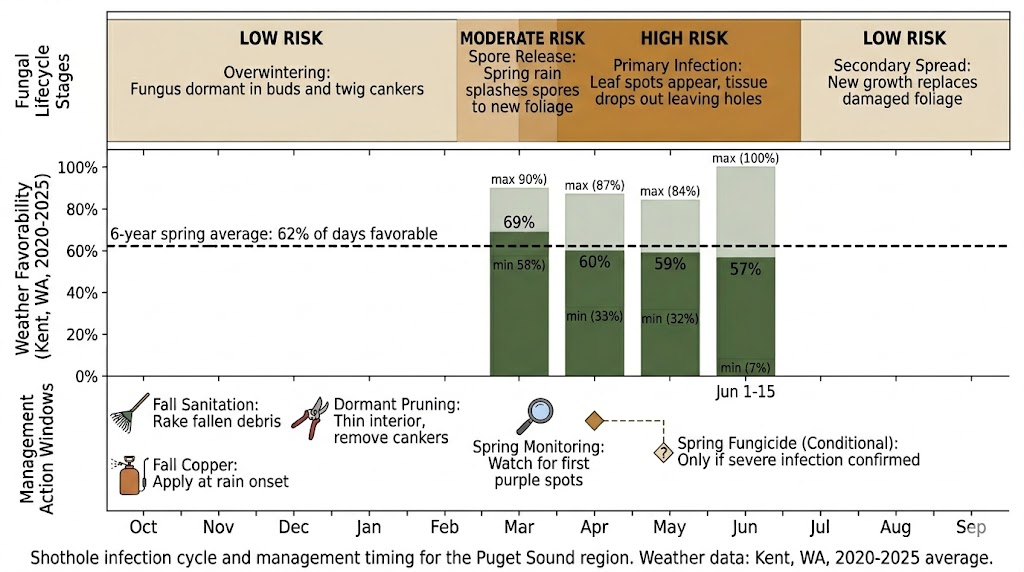
In regions with dry summers and episodic spring rain, shothole is an occasional problem on susceptible Prunus. Here, it is a guarantee. Kent weather data from 2020 through 2025 tells the story: 62 percent of spring days (March 1 through June 15) meet the fungal infection threshold, with an average of 66 favorable days per spring season. Extended wetness events lasting six or more hours averaged 49 per spring. The wettest spring in that window (2022) saw 85 percent of days favorable for infection.
This is the opposite of fire blight, where conditions align for perhaps one or two risk days per year. Shothole activation conditions are endemic to our climate. The question is never “will I get shothole?” but “how bad will it be this year?” The wettest springs produce the worst infections. The driest springs, like 2021 at 53 percent, produce the mildest. Year-to-year variability determines severity, but some degree of shothole on susceptible Prunus is essentially guaranteed. Current-season weather data is available at the weather dashboard.
These six years are a limited sample, and daily precipitation hours underestimate actual leaf wetness because humidity, dew, and fog contribute moisture without registering as rainfall. The real favorable-day count is likely higher than shown.
When to Act (and When Not To)
On established English laurel, the answer is usually “do not act.” The plant tolerates shothole better than almost anything else you could put in its place. New growth replaces damaged foliage through the summer. By August, most of the holey leaves have been covered or dropped, and the hedge looks presentable again.
Intervention makes sense in three situations: young plants that have not yet filled in their canopy, newly planted hedges where every leaf matters for establishment, and severe recurrent infections where the plant visibly declines rather than growing through the damage. If none of those apply, sanitation alone is likely sufficient.
Sanitation First
Rake and destroy fallen leaves and debris beneath the hedge in October, before the wet season starts. This single step removes overwintering inoculum and reduces next year’s infection load. It costs nothing and works regardless of which cause you are dealing with.
Pruning for Air Circulation
Thin dense interior growth during dormancy, December through January. Remove crossing branches, dead wood, and anything that blocks light and airflow into the canopy. Better air circulation means foliage dries faster after rain, which shortens the moisture window the fungus needs. Do not prune during the wet season (February through April); wounds created during wet weather invite exactly the infections you are trying to prevent.
Fall Copper Application
If last season’s infection was significant and you want to reduce next year’s disease pressure, apply copper fungicide (copper octanoate or basic copper sulfate) as fall rains begin, typically October. On English laurel, time this to rain onset, not to leaf fall: the plant is evergreen and has no leaf-fall event to anchor your timing. This single fall application protects new bud tissue as the fungus is trying to establish overwintering sites.
Do not repeat copper applications through the winter or into spring on English laurel. That is where phytotoxicity risk climbs.
Spring Fungicide (Severe Cases Only)
If the previous season was severe enough that you are planning a spring spray, use chlorothalonil or myclobutanil instead of copper. Apply when new spring growth is expanding, typically March through April. English laurel has no petal fall stage to anchor timing the way deciduous stone fruit does, so watch the plant: when new leaves are unfurling, that is your spray window.
The PNW Plant Disease Management Handbook advises that chemical control on English laurel “should only be used if a bacterial or fungal cause has been identified.” Spraying physiological shothole accomplishes nothing. Spraying copper for bacterial shothole also accomplishes nothing. Identify the cause first.
If You Also Grow Stone Fruit
On deciduous Prunus (peach, apricot, cherry, plum), shothole is almost always fungal, and the four-cause diagnostic complexity described above largely does not apply. The management framework for stone fruit is simpler: spray timing keys to clear phenological stages that English laurel lacks.
Apply copper at 50 percent leaf fall in autumn. In spring, apply chlorothalonil or myclobutanil at petal fall or shuck split. Do not apply copper in spring on peach or nectarine; the phytotoxicity risk on those species is well documented by WSU. Fruit damage matters on edibles in a way it does not on a hedge plant, so the tolerance threshold is lower: act earlier and spray more consistently than you would on ornamental English laurel.
WSU HortSense maintains host-specific fact sheets for apricot, cherry, peach, and plum with full product lists and timing for each crop.
Seasonal Action Summary
| When | What | Why |
|---|---|---|
| October | Rake and destroy fallen leaves and debris beneath the hedge | Removes overwintering fungal inoculum. The single most effective cultural practice. |
| October | Apply copper fungicide as fall rains begin (if previous season was severe) | Protects new bud tissue from fungal colonization before winter. Time to rain onset, not leaf fall. |
| Dec - Jan | Dormant pruning: thin interior, remove cankered twigs, improve air circulation | Reduces canopy density and moisture retention. Removes overwintering canker sites. Safe pruning window. |
| March - April | Monitor new spring growth for first purple spots | Early detection. First symptoms appear 5-14 days after infection during warm wet periods. |
| April - June | Diagnose cause before treating: check for cankers, halos, fruiting bodies, spray history | The four causes require different responses. Spraying fungicide for physiological shothole wastes product. |
| April - June | Apply chlorothalonil or myclobutanil (not copper) if fungal cause is confirmed and previous year was severe | Spring fungicide on English laurel only when justified. Copper on actively growing foliage risks phytotoxicity. |
| June - July | Remove fallen infected material during peak symptom visibility | Reduces secondary spread and next year’s inoculum load. |
| August | Assess season severity; new growth is covering damage | Determines whether fall copper application is warranted for next season. |
The cherry laurel plant selection guide covers the full landscape profile of this species, including siting, cultivar selection, and the invasiveness question. The copper fungicide guide covers application technique and phytotoxicity risk across susceptible species. The dormant season spraying guide covers fall and winter spray timing for the full spray program. All disease and pest management recommendations are based on regional extension research and horticultural practice. Always read and follow pesticide label directions.
Sources
- PNW Plant Disease Management Handbook: Prunus laurocerasus - Leaf Spots and Shothole
- UC IPM: Shot Hole, or Coryneum Blight
- WSU HortSense: Laurel - Physiological Shothole
- AHDB: Bacterial Shot-Hole of Cherry Laurels
- Adaskaveg, J.E. 1990. Latent Infection and Postharvest Decay. Phytopathology 80:749-756.
- NC State Extension: Prunus laurocerasus
- OSU Extension: Do My Laurels Have Shothole?