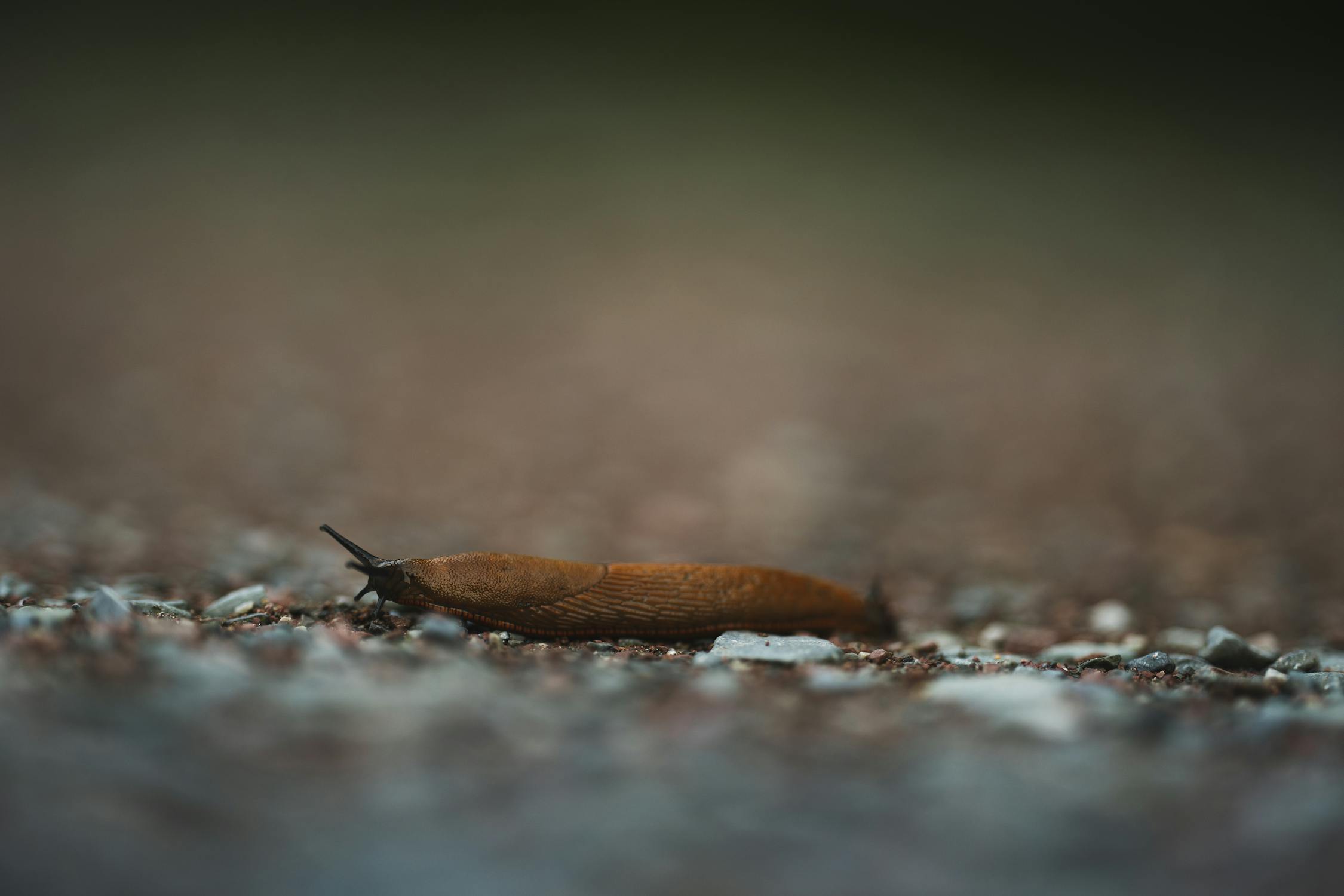
You walk out to your vegetable starts on an April morning and find ragged holes in every transplant. The lettuce is laced. The hosta crowns you watched for two weeks are shredded overnight. There are no insects on the leaves, no caterpillars under the rims, nothing visible at all. But there are slime trails on the soil surface, drying to silver in the first hour of sun, and small pretzel-shaped droppings at the base of the stems. You have a slug problem. In this region, you have always had a slug problem. The question is whether your response makes it better or worse.
What You Are Looking At
The Puget Sound lowlands are slug country, not snail country. If you moved here from California or the Southeast, adjust your expectations: the brown garden snail (Cornu aspersum) is present but secondary. The damage in your beds is almost certainly from slugs, and almost certainly from one of three groups.
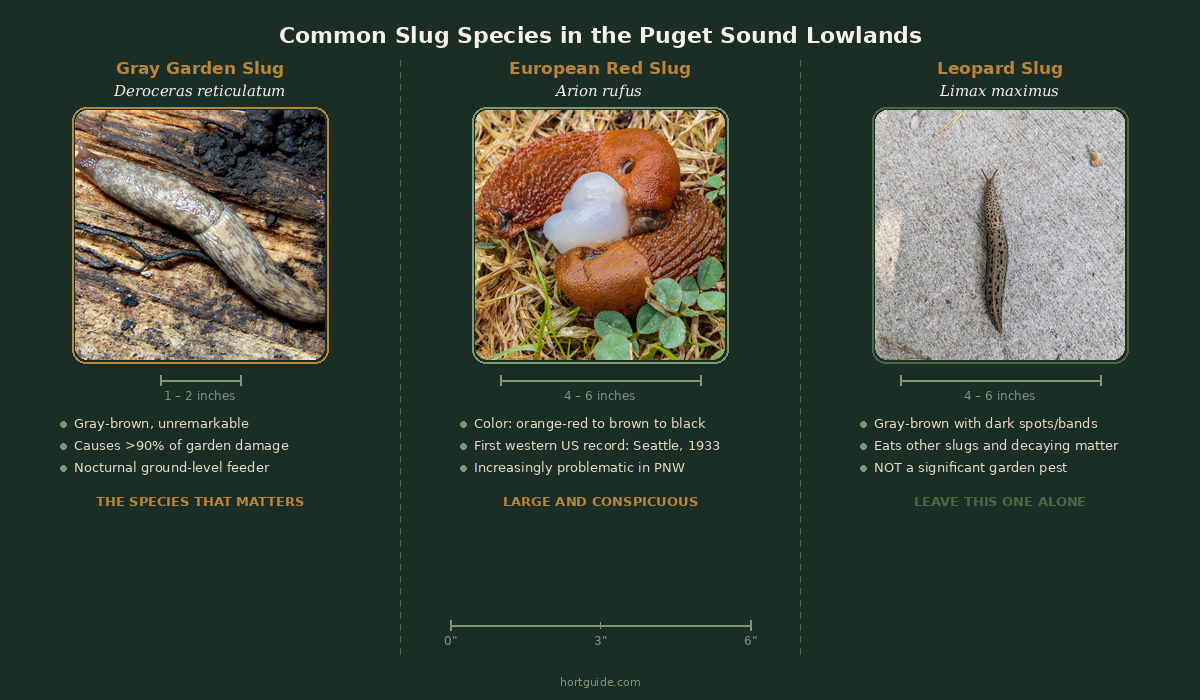
Gray garden slug (Deroceras reticulatum). Small, 1 to 2 inches, gray-brown, unremarkable. This is the species that matters. It causes over 90% of garden and crop damage in the Pacific Northwest. You will not notice it because it does not look like much. It feeds at ground level, at night, on anything soft and green.
European red slug (Arion rufus). Large, 4 to 6 inches, color variable from orange-red to brown to solid black. The first western US specimen was collected in Seattle’s Laurelhurst neighborhood in 1933; the species has been expanding through the region since. Increasingly problematic in gardens and natural areas. The slug most people photograph and post online asking “what is this.”
Smaller Arion species. A. hortensis (garden slug), A. circumscriptus (hedgehog slug), A. intermedius (white-soled slug). These contribute to the overall damage load but are rarely identified individually.
One large slug you should learn to leave alone: the leopard slug (Limax maximus), spotted, 4 to 6 inches, moves fast for a slug. It is primarily a predator of other slugs and a decomposer of decaying organic matter. It is not your garden pest. Killing it on sight removes an ally.
Two common names that cause confusion: “pear slugs” and “roseslugs” are not slugs at all. They are sawfly larvae (Hymenoptera: Tenthredinidae) that happen to be slimy. Different organisms, different management.
Diagnostic clues. Slug damage produces irregular holes with smooth edges (the radula, a rasping tongue-like feeding organ, scrapes rather than tears). Slime trails dry to a silvery sheen visible in morning light. The pretzel-shaped fecal droppings noted by WSU HortSense are a useful field confirmation when trails have dried or been rained away.
Why It Is Worse Here
National slug content assumes a spring-to-fall problem with winter dormancy. That framing is wrong for this region by about four months.
Slugs are surface-active whenever overnight lows exceed 38°F, relative humidity is near 100%, and wind speed is below 5 mph. That describes most nights here from October through May. The maritime climate gives slugs what amounts to a 9-month active season, suppressed only during the dry weeks of July and August. The PNW Insect Management Handbook calls slug control “often a year-round necessity” in western Washington and Oregon. That is not hyperbole.
The soils compound the problem. The Woodinville Series silt loam that underlies much of the Green River valley (commonly mistaken for clay, but technically silt loam) retains moisture at the surface and provides ideal egg-laying substrate. Every major pest slug species in the region is a European introduction, thriving in a climate that mirrors its native maritime range.
The other piece of national advice that falls apart here is “water in the morning, not the evening.” From October through May, the sky waters your garden around the clock. Irrigation timing is irrelevant during those months. The cultural controls that actually matter in the Puget Sound lowlands are habitat modification and drainage, not sprinkler schedules.
What They Eat (and What They Avoid)
The host range is nearly everything soft-leaved. Hostas, delphiniums, dahlias, marigolds, lettuce, basil, beans, cabbage, and strawberries are the highest-damage hosts. Seedlings of almost anything are vulnerable regardless of species; a six-week-old transplant that will be slug-resistant at maturity can be destroyed overnight as a start.
Plants slugs consistently avoid: lavender, rosemary, sage, ferns, ornamental grasses, cyclamen, geraniums, sedum, and most thick-leaved or waxy-cuticle species. If your garden is heavily slug-pressured, interplanting resistant species around vulnerable ones does not create a barrier, but it does reduce the total acreage of food.
Strawberry damage is distinctive: holes chewed under the cap where the fruit contacts soil. Ground-ripening tomatoes get the same treatment. Raising fruit off the ground with straw mulch reduces contact but does not eliminate feeding.
Cultural Controls: The Habitat Tension
Remove hiding spots. Boards, flat stones, dense ground cover at bed edges, stacked pots, and debris piles are daytime refugia for slugs. Clearing them reduces the population that emerges each night.
Here is the tension: ground beetle habitat and slug habitat overlap significantly. Ground beetles need permanent mulch, undisturbed soil, and ground cover to survive and reproduce. Stripping your garden bare to deny slugs cover also evicts the predators that eat slug eggs and juveniles.
The resolution is not “choose one.” It is spatial. Keep permanent plantings and mulch under shrubs and in established beds (that is predator habitat). Manage the edges and transitions: clear the bed borders where slugs travel between daytime hiding spots and nighttime feeding zones. Remove spent annuals in autumn. Pull leaf litter away from the crowns of vulnerable perennials, but leave it under woody shrubs where ground beetles overwinter.
Transplant sturdy starts rather than direct-seeding in slug-prone beds. A 6-inch transplant survives a night of slug feeding. A cotyledon does not. Raised beds elevate vulnerable crops above the worst ground-level slug highways.
Trapping and Hand-Picking
Board traps are the simplest monitoring tool. A 12-by-15-inch board elevated about an inch off the soil (two small sticks underneath) creates an irresistible daytime shelter. Place traps near vulnerable beds in late afternoon. Check each morning. Scrape slugs into a container of soapy water.
Beer traps work but require maintenance. Bury a container to ground level and fill with an inch of beer or a yeast-water mixture (one inch of water plus one teaspoon of dry yeast). Slugs are attracted to the fermentation, fall in, and drown. Replenish every few days; stale traps stop working. The PNW Insect Management Handbook documents a bread-dough attractant (500g flour, 500mL water, half an ounce of yeast) that produces the same fermentation effect at lower cost.
Hand-picking on damp evenings with a flashlight is tedious and effective. Target the first two hours after dark, when surface activity peaks. Consistent hand-picking reduces the local population measurably over 2 to 3 weeks.
Barriers: What Works and What Does Not
This section is short because the evidence is short.
The Royal Horticultural Society tested copper tape, bark mulch, eggshells, sharp grit, and wool pellets under garden-realistic conditions and found no reduction in slug damage from any of them. These are the five most commonly recommended slug barriers on the internet, and none performed.
Copper strips may work on the rims of raised beds and containers, where a slug must cross a continuous band of 4 to 6 inches (the metal reacts with slug mucus). UC Davis IPM supports this limited application. But copper tape on the ground, around individual plants, or in short strips does not produce measurable results.
Diatomaceous earth loses all effectiveness when wet. In a region where slug season and rain season are the same season, it is not a practical tool.
Biological Controls
The most effective biological slug control in the Puget Sound lowlands is already in your soil, if you have not killed it.
Ground beetles (family Carabidae) are documented slug predators across multiple species. Pterostichus melanarius attacks slugs and slug eggs below roughly 40 mg body weight, meaning beetles suppress the next generation (eggs and juveniles), not the large adults you see on your hostas. A Willamette Valley study using molecular gut-content analysis detected slug DNA in about 9% of Nebria brevicollis specimens and 4% of Poecilus laetulus specimens. Scaphinotus species are specialist mollusk predators with elongated mouthparts adapted to extracting snails and slugs from shells and crevices. The ground beetles guide covers the full predator community and how to conserve it.
Birds (song thrushes, starlings, robins), garter snakes, frogs, toads, and salamanders all contribute to slug predation. Ducks are effective but incompatible with most garden layouts.
One biological control you will encounter in UK and European sources: the parasitic nematode Phasmarhabditis hermaphrodita, sold commercially as Nemaslug. It is not approved for sale in the United States, and there is a specific regional reason. Research published in 2024 demonstrated that P. hermaphrodita kills Monadenia fidelis, an endemic Pacific Northwest snail. The EPA has not approved the product due to these non-target effects. This is the biological tool we cannot use, and given the native species it threatens, may not want to.
The practical biological strategy here is conservation, not augmentation. Protect the predators you already have. That means iron phosphate bait instead of metaldehyde, no broad-spectrum insecticides in garden beds, and permanent ground cover for beetle habitat.
The Bait Aisle Decision
This is the choice the guide is built around. Two chemistries dominate the retail slug bait shelf. Both kill slugs. One of them also kills the predators that eat slugs.
Iron phosphate (Sluggo, Escar-Go!, Slug Magic). A stomach poison: slugs that ingest the bait stop feeding and die within 3 to 7 days. Safe around pets, children, and wildlife at labeled application rates. OMRI-listed for organic production. The critical thing to understand: you will not see dead slugs. Iron phosphate causes slugs to stop feeding and crawl away to die in the soil or under cover. The perceived absence of dead slugs is the number one reason gardeners think iron phosphate does not work, and the number one reason they switch to metaldehyde. It works. You just do not see the evidence.
One nuance worth noting. Edwards et al. (2009) found that iron phosphate formulations containing EDTA chelating agents (which includes Sluggo) were significantly more toxic to earthworms in laboratory conditions (LD50 of 72.2 mg/kg versus over 10,000 mg/kg for iron phosphate alone). However, NPIC testing at twice the labeled rate showed no adverse effects on beetles or earthworms. The discrepancy likely reflects dose. Apply at labeled rates and reapply on schedule rather than over-applying.
Metaldehyde (Deadline, Slug-Fest, Metarex). Damages the mucus-producing cells of slugs, causing rapid dehydration and visible death. Fast-acting. Also toxic to dogs (a meaningful concern in a region where dogs and gardens share space), and documented to cause secondary poisoning of ground beetles that consume poisoned slugs. The United Kingdom banned metaldehyde slug pellets for garden use effective March 2022, citing environmental contamination and pet toxicity. The UK maritime climate is the closest European analog to the Puget Sound lowlands.
Sodium ferric EDTA (Corry’s, Ferroxx). A newer formulation that kills faster than iron phosphate (3 days versus 7) but is not organic-approved. A middle option if speed matters and organic certification does not.
The recommendation is iron phosphate as the default choice. Metaldehyde solves one pest while undermining the predator community that suppresses the pest long-term. The UK reached the same conclusion and legislated accordingly.
Application technique. Scatter bait lightly in the late afternoon or evening when slugs become active. Never pile bait in mounds; scatter it across the area. Light irrigation before application brings slugs to the surface and improves contact. Reapply every 10 to 14 days during active season.
Seasonal Action Summary
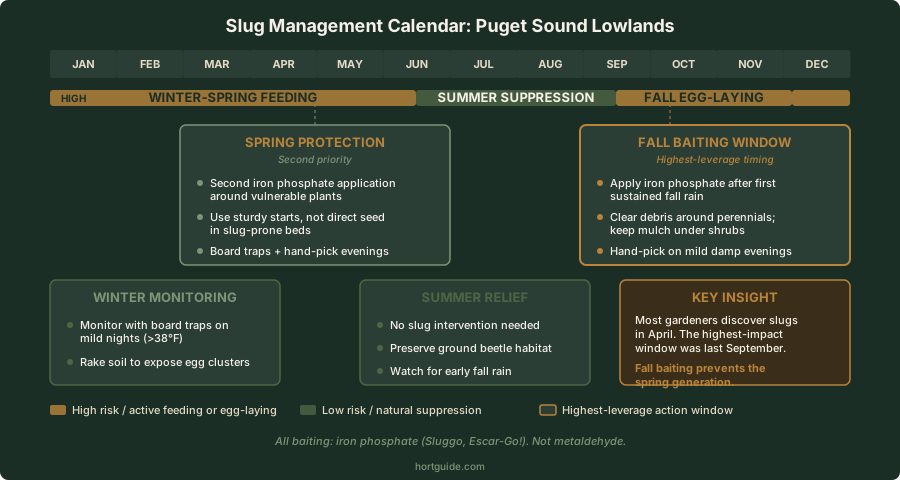
The single highest-leverage action most gardeners miss: fall baiting. The conventional instinct is to reach for slug bait in April when damage appears. By then, the spring generation has already hatched from eggs laid the previous autumn. The adults that laid those eggs were surface-active after the first September rains, mating and depositing clusters of 20 to 50 translucent eggs in soil crevices and under mulch. Each adult lays 300 to 500 eggs over a season. Fall baiting removes those reproductive adults before egg deposition is complete. Spring baiting is the second priority: protect vulnerable new growth from the generation fall baiting missed.
| Season | Timing | Action |
|---|---|---|
| Fall | After first sustained rain (Sep-Oct) | Apply iron phosphate bait across garden beds. Target egg-laying adults. Clear summer debris from around vulnerable perennials; keep mulch under shrubs. |
| Winter | Mild nights above 38°F (Nov-Feb) | Monitor with board traps. Hand-pick on active nights. Rake soil to expose egg clusters. |
| Spring | March through May | Second iron phosphate application around emerging hostas, seedlings, and transplants. Use sturdy starts instead of direct-seeding in slug-prone beds. Hand-pick on damp evenings. |
| Summer | June through August | No slug intervention needed. Dry conditions suppress activity naturally. Preserve ground beetle habitat. Monitor for early fall rain to trigger next baiting cycle. |
Sources
- UC Davis Integrated Pest Management Program. Snails and Slugs Pest Note 7427. ipm.ucanr.edu
- Cornell Integrated Pest Management. Slug and Snail Control Fact Sheet. cals.cornell.edu
- University of Minnesota Extension. Slugs in Home Gardens. extension.umn.edu
- Royal Horticultural Society. Slugs and Snails: Biodiversity. rhs.org.uk
- PNW Insect Management Handbook. Slug Control. pnwhandbooks.org
- Oregon State University Extension. How to Control Slugs in Your Garden (EM-9155). extension.oregonstate.edu
- Oregon State University Extension. Fall and Spring Are Prime Times to Battle Garden Slugs. extension.oregonstate.edu
- National Pesticide Information Center. Iron Phosphate General Fact Sheet. npic.orst.edu
- Edwards, C.A. et al. (2009). Relative toxicity of metaldehyde and iron phosphate molluscicides to earthworms. Crop Protection 28(4): 289-294.
- Rae, R. et al. (2023). Thirty years of slug control using Phasmarhabditis hermaphrodita and beyond. Pest Management Science 79(12). DOI: 10.1002/ps.7636.
- McKemey, A.R. et al. (2003). Predation and prey size choice by Pterostichus melanarius. Bulletin of Entomological Research 93(4): 299-307. DOI: 10.1079/BER2003240.
- OSU Slug Portal. Common Slug Species. agsci.oregonstate.edu
- WSU HortSense. Slug Fact Sheets (Strawberry, Cucurbits, Common Insects and Mites).
Always read and follow pesticide label directions. The label is the law.