Persian Ironwood
Leaf emergenceParrotia persica
Hamamelidaceae · broadleaf deciduous tree · introduced
Last updated
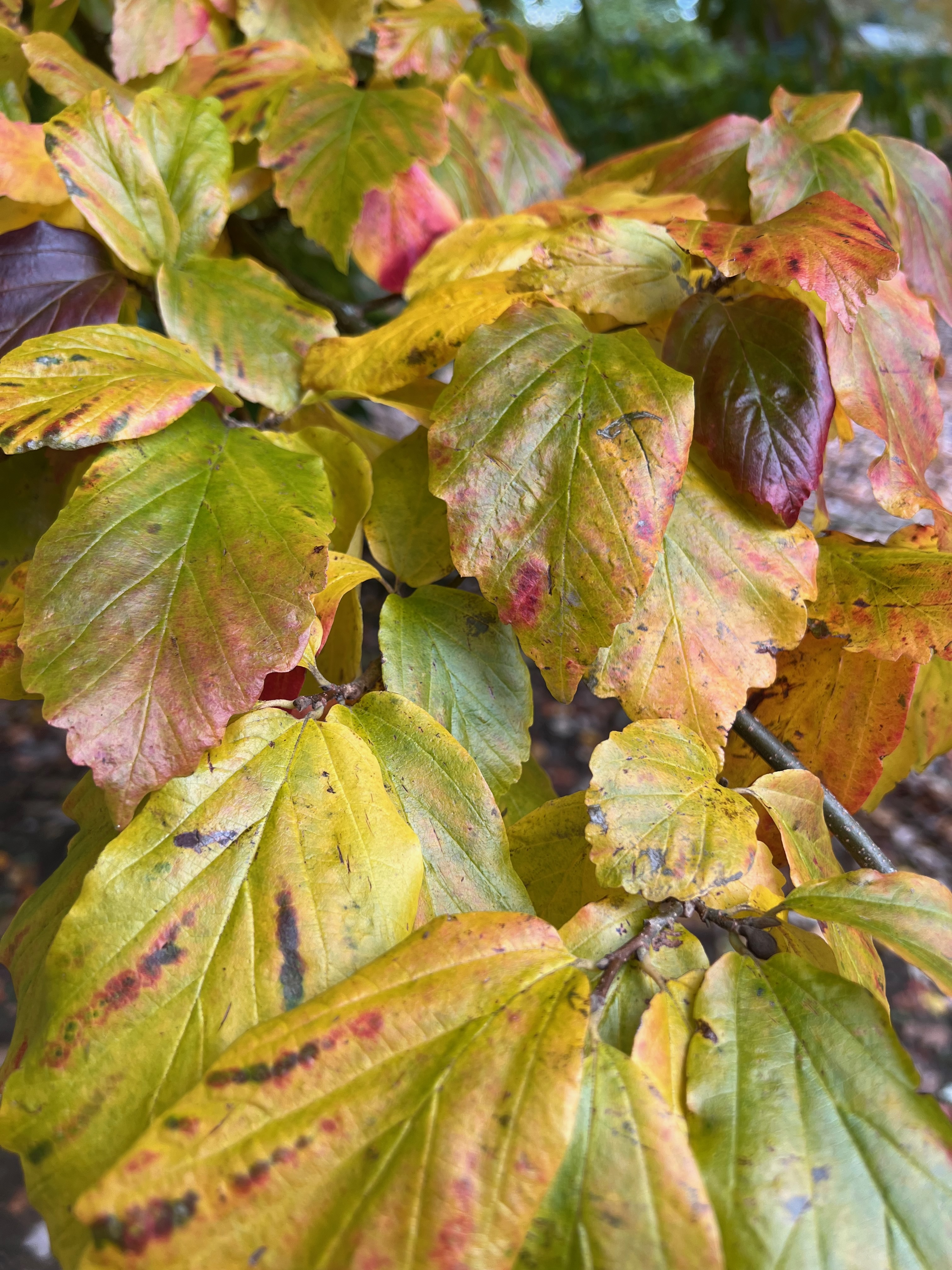
Parrotia persica (Hamamelidaceae) is a deciduous tree or large shrub native to northern Iran and Azerbaijan. It grows 20 to 40 feet tall with a rounded, spreading crown and exfoliating bark that reveals a mosaic of gray, green, white, and brown. Dark red flowers consisting mostly of stamens appear on bare branches in late winter to early spring before the foliage emerges. Fall color is exceptional, ranging through yellow, orange, red, and purple, often with multiple colors on a single tree.
Persian ironwood thrives in full sun to part shade on well-drained soil across a range of soil types. It is notably pest- and disease-free, with no significant problems documented. The species tolerates moderate drought once established. Growth rate is moderate. It is valued as a four-season specimen tree for its winter flowers, summer foliage, fall color, and winter bark display. Hardy in Zones 5a to 8b.
Quick Facts
Root Colonization Period
Growing Season Stress Expression
Field Observations
Phenological Calendar
As of May 18, 2026, Puget Sound stations range from 2022.7 to 2224.5 GDD₃₂. Persian Ironwood has passed leaf emergence (958 GDD₃₂).
Regional Season Tracker
GDD₃₂ accumulation across 7 Puget Sound stations · as of May 18, 2026| Station | GDD₃₂ | Current Stage | Next | To Go |
|---|---|---|---|---|
| Issaquah / East King | 2,225 | Leaf emergence | — | — |
| Kent / Auburn | 2,194 | Leaf emergence | — | — |
| Seattle / UW | 2,164 | Leaf emergence | — | — |
| Olympia / Tumwater | 2,128 | Leaf emergence | — | — |
| Bellingham / Whatcom | 2,098 | Leaf emergence | — | — |
| Tacoma / Puyallup | 2,092 | Leaf emergence | — | — |
| Sequim / Rain Shadow | 2,023 | Leaf emergence | — | — |
| Stage | GDD32 | Typical Window |
|---|---|---|
| Dormancy break / bud swell BBCH 01-03 | — | Jan 15 - Feb 28 |
| Bloom start BBCH 61 | — | Feb 15 - Mar 10 |
| Full bloom BBCH 65 | — | Feb 25 - Mar 20 |
| Bloom end BBCH 69 | — | Mar 10 - Mar 30 |
| ● Leaf emergence BBCH 10 NOW | 958 | Mar 15 - Mar 30 |
| Leaf expansion BBCH 12 | — | Mar 25 - Apr 10 |
| Fruit set BBCH 71 | — | May - Jun |
| Leaf senescence / fall color BBCH 93 | — | Oct 15 - Nov 15 |
| Dormancy BBCH 97 | — | Nov - Jan |
Source: Field observation, Issaquah WA. Cultivar: 'Vanessa'. First phenological observation for this species. About GDD₃₂ →
Season tracker for Kent / Auburn as of May 18, 2026. Predicted dates use 16-day weather forecast through Jun 3, 2026, then climate normals.
Diseases: Other Associations (2)
Cultivars (4)
Parrotia performs reliably across the Puget Sound lowlands as a small to medium landscape tree. It remains underused relative to its merits: exceptionally pest- and disease-free; deep root system that handles maritime clay once established; bark exfoliation that develops on mature specimens and provides four-season interest; and a long fall color window (yellow through orange and red to burgundy, often persisting into early November) that aligns with the region's cool wet autumn. The precocious bloom is subtle (small crimson-stamen clusters on bare branches in February-March) and easy to miss from a distance, but rewards close observation. Mature specimens are uncommon in residential landscapes; older institutional plantings can be found at UW Washington Park Arboretum, Bellevue Botanical Garden, and the Seattle Trees for Neighborhoods plantings (which feature ‘Inge's Ruby Vase’ for street use). The Society of Municipal Arborists named ‘Vanessa’ Urban Tree of the Year in 2014. Performance is consistent on Kent clay sites with no irrigation past establishment.
— Chris Welch, ISA Certified Arborist