You find white, cottony spots on the bark of your grand fir and assume it is lichen. It is not. Or you notice the crown thinning over a couple of summers and attribute it to drought stress, maybe a bad year. It is not that either. By the time the top of the tree bends sideways and branches start dying back, the pest responsible has been feeding for years, restructuring the wood from the inside in ways you could not see from the ground.
Balsam woolly adelgid (Adelges piceae) has been in the Pacific Northwest since 1930, first detected in the Willamette Valley on grand fir. It caused extensive mortality across Washington and Oregon during the 1950s and 1960s, killing subalpine fir, Pacific silver fir, and grand fir through coastal and Cascade forests. It is still here, still feeding, still removing grand fir from lowland areas of the Puget Sound trough. Most gardeners in this region have never heard of it. If you have a true fir in your landscape, you should know what it is and what to look for.
What You Are Looking For
The diagnostic sign is the white woolly wax. Adelgids produce a dense, cottony covering that appears as small white dots on bark, roughly the size of a pinhead. These are not the flat, crusty patches of lichen that grow on most conifer bark in this climate. Adelgid wool is raised, soft, and cottony. Press it with your fingertip and it compresses. On a heavily infested tree, the woolly masses can cover the entire trunk.
Underneath each wool mass is the insect itself: a tiny, purple-black, roughly spherical animal less than a millimeter long. You will not see it without pulling the wool aside. One reliable field test: prick a woolly mass with a pin. If you get purple-black liquid, the adelgid is alive. A dried husk means it is already dead, possibly from predators.
The second diagnostic feature is gouting. Balsam woolly adelgid feeding at branch nodes and terminal buds stimulates abnormal cell growth, producing swollen, knob-like deformations at the joints. Normal branch nodes are smooth and proportional. Gouted nodes are bulbous and stiff. This symptom is specific to balsam woolly adelgid; no other pest on firs produces it.
In winter and early spring, before the white wool appears, you can find overwintering nymphs on bark. They are black, tent-shaped, and tiny, visible with a hand lens tucked into bark crevices. If you know to look for them, you can catch an infestation before it becomes obvious.
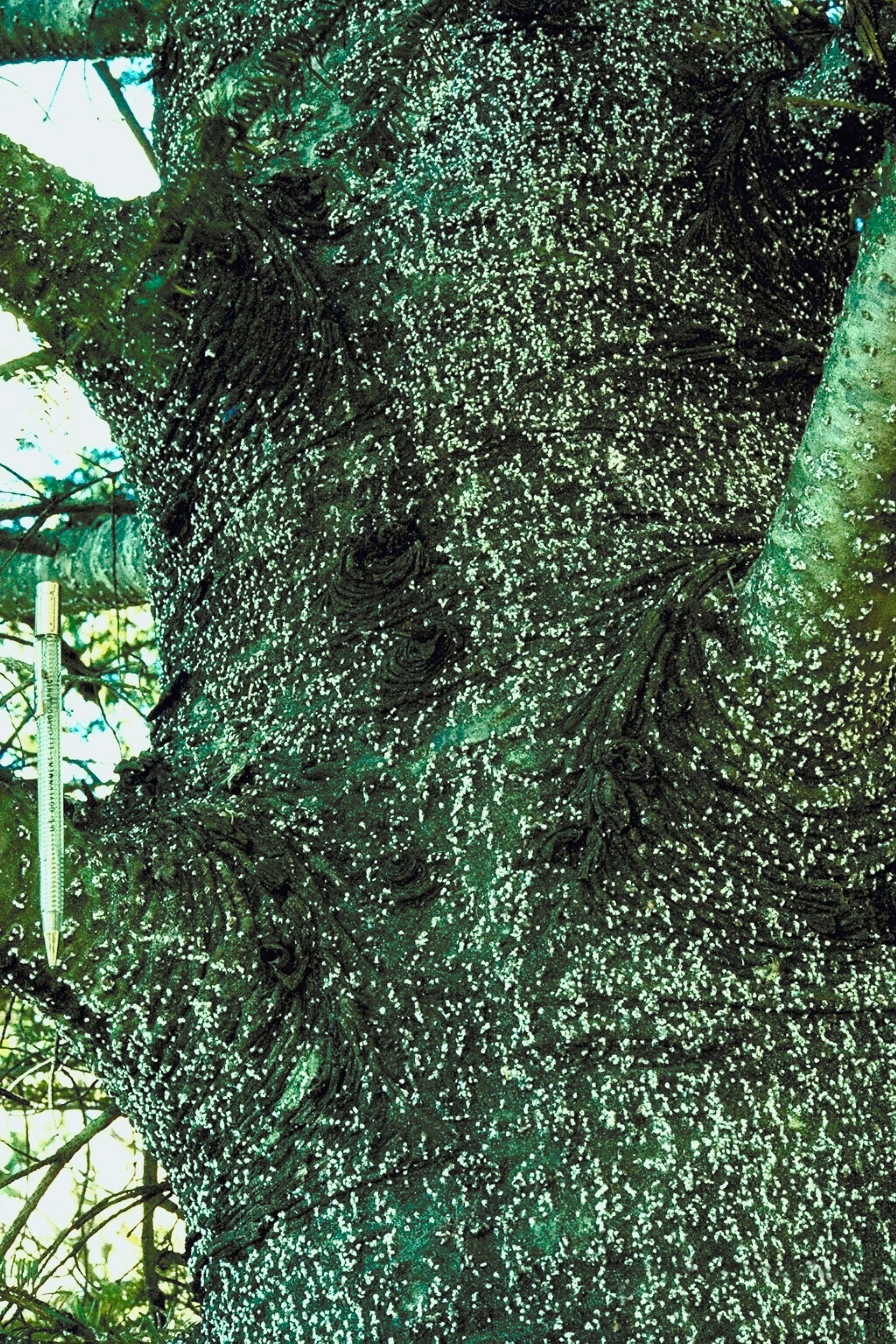 White woolly masses of balsam woolly adelgid covering fir bark. Photo: USDA Forest Service, Asheville Archive, CC-BY-3.0-US.
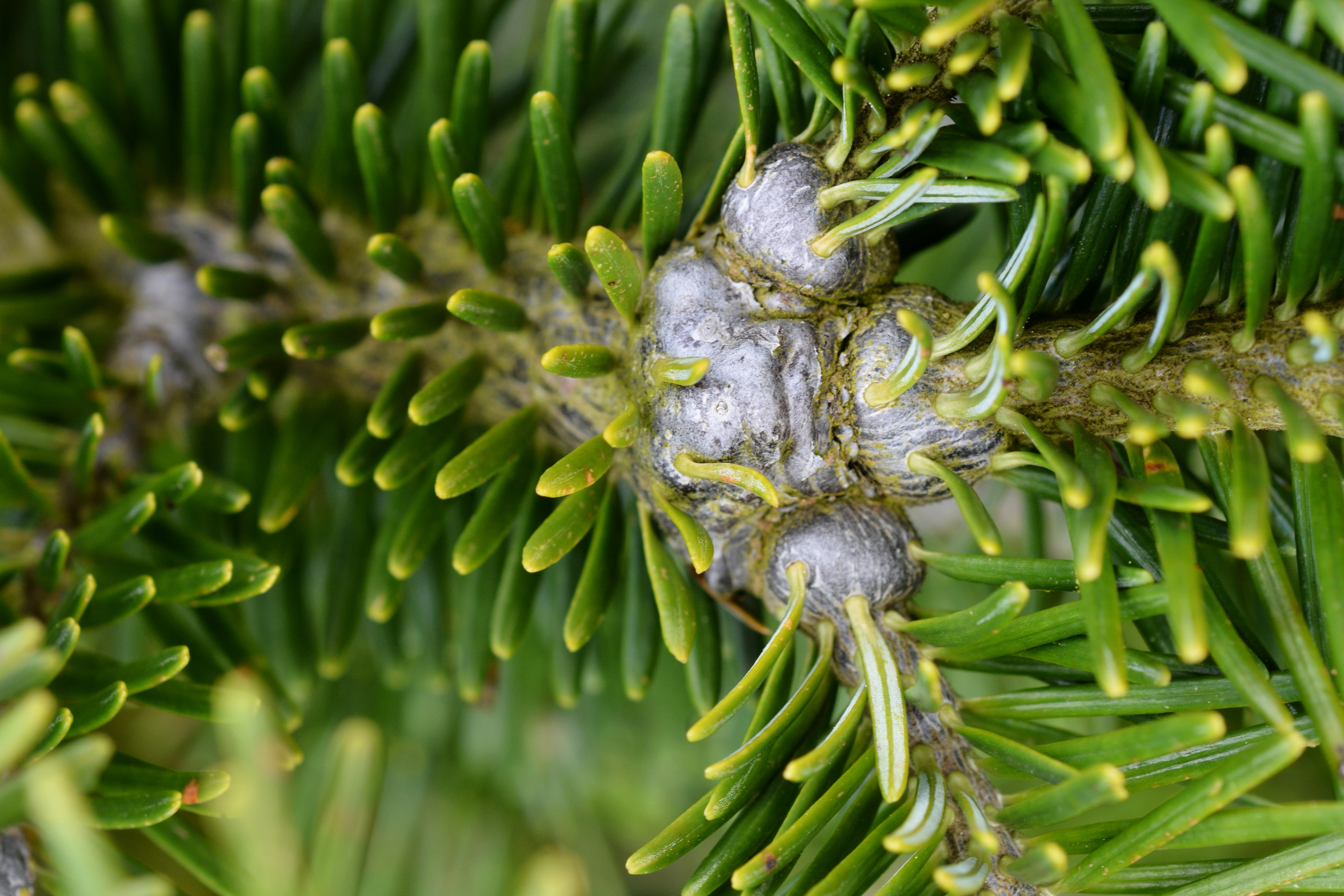 Gouting at branch nodes on fir caused by balsam woolly adelgid feeding. The swollen, knob-like growths are unique to this pest. Photo: Gilles San Martin, Flickr, CC-BY-SA-2.0.
Which Firs Are at Risk
Balsam woolly adelgid feeds exclusively on true firs (Abies). It does not attack Douglas fir, hemlock, spruce, pine, or any other conifer. If the tree is not an Abies, this pest is not your problem.
Among the firs native to this region, susceptibility follows a clear ranking. Subalpine fir (Abies lasiocarpa) is the most vulnerable, followed by Pacific silver fir (Abies amabilis), then grand fir (Abies grandis). Noble fir (Abies procera) shows moderate susceptibility, and white fir (Abies concolor) is generally less severely affected.
For homeowners and landscape professionals in the Puget Sound lowlands, grand fir is the species that matters most. It is the only native fir that naturally occurs at low elevations here, growing in floodplains and valley bottoms on the glacial till and alluvial soils typical of our lowlands. Subalpine fir and Pacific silver fir are mountain species you rarely encounter in residential landscapes. Noble fir is a montane species not well suited to lowland conditions. If you have a native fir in your yard in the lowlands, it is almost certainly a grand fir.
White fir and concolor fir are occasionally planted as ornamentals. They are susceptible but generally less severely affected. Some Asian fir species, including Nikko fir (Abies homolepis), Veitch’s fir (Abies veitchii), and Momi fir (Abies firma), show greater resistance and may be worth considering if you are replacing a fir lost to adelgid damage.
How the Damage Works
Most sap-feeding insects remove nutrients. Adelgids do something worse. When balsam woolly adelgid inserts its stylet into bark and begins feeding, its saliva injects toxins that trigger the tree to produce abnormal wood called rotholz. This compression wood is harder and denser than normal sapwood, and it progressively restricts water and nutrient transport through the trunk.
The result is internal water stress in a tree that may be receiving adequate soil moisture. The tree is functionally drought-stressed from the inside out, and no amount of irrigation fully compensates once the rotholz accumulation is severe. If you cut a cross-section of an infested trunk, you can see the rotholz as reddish bands in the wood. Count the bands and you know how many years the tree has been infested.
This mechanism explains why the damage sneaks up on you. External symptoms lag the internal damage by months to years. The progression runs roughly like this: the terminal leader weakens and may bend to one side. Crown density drops. Branch tips show stunted growth. Needles thin. Secondary attackers move in (bark beetles, root diseases, defoliators exploit the weakened tree). Eventually, major branches die back and the tree enters irreversible decline. From initial infestation to death, the timeline is typically two to seven years, though a healthy, well-watered tree can hold on longer.
Lifecycle and When to Act
Every balsam woolly adelgid in North America is female. There are no males on this continent. Each female reproduces parthenogenetically, laying roughly 100 eggs without mating. A single colonizing insect can found an entire infestation.
The lifecycle has five stages relevant to management:
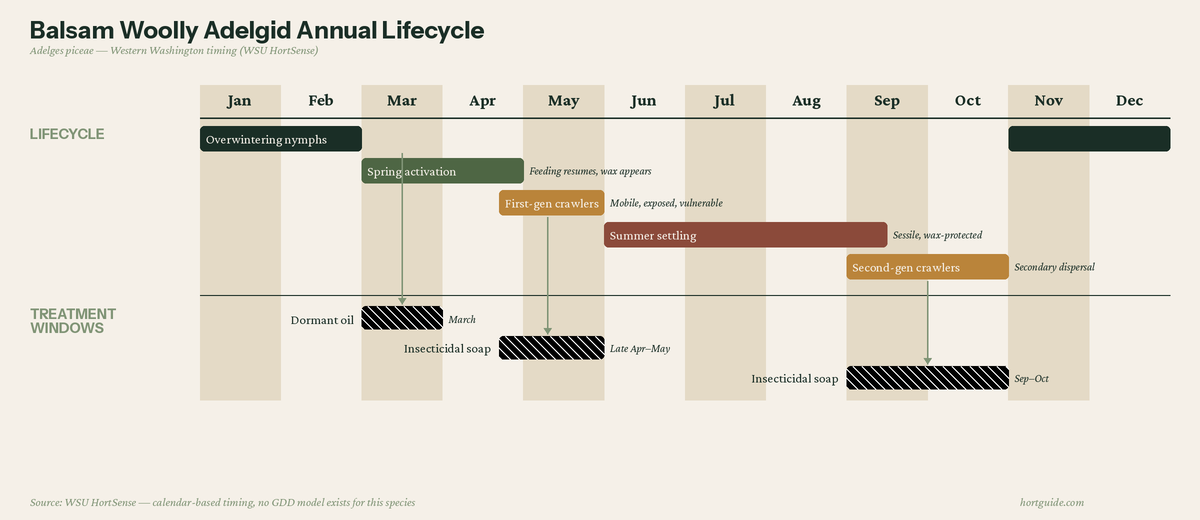
Overwintering nymphs (November through February). First-instar nymphs sit dormant in bark crevices. They are not feeding, not producing visible wax. This is the dormant oil window: horticultural oil applied in March can suffocate them before they resume activity.
Spring activation (March through April). As temperatures warm, nymphs resume feeding, begin producing white woolly wax, and mature to egg-laying adults. The woolly masses become visible on bark. Gouting starts or worsens at branch nodes.
First generation crawlers (late April through May). WSU HortSense identifies the end of April to early May as the crawler treatment window in western Washington. Crawlers are the only mobile life stage, tiny dark specks that disperse by wind or crawl short distances to new feeding sites. They are also the most vulnerable: exposed, unprotected by wax, and susceptible to contact treatments like insecticidal soap. A crawler that does not find a suitable feeding site within a day or two dies. This is the most effective treatment window of the year.
Summer settling and feeding (July through mid-September). Crawlers that successfully settle insert their stylets into bark, become permanently fixed in place, and begin producing protective wax. Contact treatments are no longer effective against settled individuals. Damage accumulates internally through the summer.
Second generation (September through October). A second cycle of eggs and crawlers provides a secondary treatment window. These crawlers settle before winter and enter dormancy as first-instar nymphs, restarting the cycle.
No published growing degree day model exists for this species. The timing guidance above comes from WSU’s direct observations for this region rather than a temperature-accumulation model.
Managing the Pest on Landscape Trees
Chemical control of balsam woolly adelgid is not feasible in forest settings. But a landscape tree, one you can reach, water, and monitor, is a different situation. The management approach has three layers, and the cultural foundation matters more than any spray.
Cultural controls (year-round). Maintain tree vigor through adequate irrigation. Grand fir on clay soils in summer needs supplemental water. A vigorous tree tolerates adelgid feeding far better than a stressed one. Prune heavily infested branches during winter dormancy (November through February) and destroy the prunings. For minor infestations, hand-wipe woolly masses from accessible bark, or dislodge them with a strong stream of water from a hose.
Dormant oil (March). Apply horticultural oil at dormant or delayed-dormant rates before bud break. The oil suffocates overwintering nymphs before they produce the thick wax covering that protects them during the growing season. This is the same dormant oil approach used for scale insects and mite eggs, applied to the trunk and scaffold branches rather than the canopy. Timing matters: too early and rain washes it off, too late and the nymphs are already wax-protected.
Insecticidal soap (late April through early May, repeat September through October). This is the crawler treatment, timed to WSU’s western Washington window. Insecticidal soap (potassium salts of fatty acids) must contact crawlers directly before they settle and produce wax. Apply with enough pressure to saturate bark on the trunk and major branches. For trees over 10 feet tall, WSU recommends engaging a commercial applicator rather than attempting foliar sprays from the ground. The same application can be repeated in September and October when second-generation crawlers are active.
A note on systemics. Systemic insecticides like dinotefuran can be applied as a soil drench for large trees. However, balsam woolly adelgid feeds on bark and cambium tissue, not on foliage. Xylem-transported systemics move upward to leaves effectively, but their concentration in bark tissue where this pest feeds is less certain. If you are considering systemic treatment, discuss the delivery pathway with your applicator specifically in the context of a bark-feeding pest.
Protect the predators. Lady beetles and syrphid fly larvae feed on adelgid eggs and nymphs. Broad-spectrum insecticides (pyrethroids like permethrin and bifenthrin) kill these natural enemies and can trigger pest population rebounds. If you use contact sprays, stay with insecticidal soap or horticultural oil, both of which break down quickly and spare predators that arrive after the spray dries.
When to Save and When to Replace
The management thesis for balsam woolly adelgid on landscape firs is simple: healthy, well-watered trees resist it. A grand fir with a strong root system, adequate summer irrigation, and early-stage adelgid pressure can be managed indefinitely with the cultural and chemical tools above. The key is catching it early and maintaining vigor.
Assess your tree with clear eyes. If the crown retains most of its density and the terminal is still growing upright, you have time. Start cultural controls, plan a dormant oil application for next March, and monitor through the season.
If more than half the crown is thin or dead, the terminal has collapsed, trunk bark shows extensive roughening from years of rotholz formation, and gouting is widespread on remaining branches, the tree is likely in irreversible decline. At that point, continued treatment extends the decline without reversing it. Replacing the tree gives you a head start on the next generation.
Replacement options include resistant Asian fir species like Nikko fir or Momi fir, or stepping outside the genus entirely to conifers that balsam woolly adelgid cannot attack: Douglas fir, western red cedar, incense cedar, or western hemlock (keeping in mind that hemlock woolly adelgid, a related but distinct pest, is approaching this region from the south and east).
Large landscape conifers take decades to replace. The difference between catching an infestation in year one and discovering it in year five is the difference between saving the tree and losing it. Walk your firs every March. Look for the white dots on the bark. Press one with your finger. If it is soft and cottony, not flat and crusty, you know what you are dealing with.
Seasonal Action Summary
| When | What | Why |
|---|---|---|
| March | Apply dormant horticultural oil to trunk and scaffold branches | Suffocates overwintering nymphs before wax thickens |
| March-April | Scout trunks for expanding white woolly masses and gouting | Early detection drives management success |
| Late April-May | Apply insecticidal soap targeting first-generation crawlers | Crawlers are exposed and vulnerable before settling |
| Summer | Maintain supplemental irrigation on landscape firs | Tree vigor is the primary defense against adelgid damage |
| September-October | Apply insecticidal soap targeting second-generation crawlers | Secondary treatment window before winter dormancy |
| November-February | Prune and destroy heavily infested branches | Removes overwintering population; reduces spring emergence |
Sources
- WSU HortSense: True Fir - Balsam Woolly Adelgid
- PNW Insect Management Handbook: Fir - Balsam Woolly Adelgid
- NC State Extension: Balsam Woolly Adelgid
- USDA Forest Service DecAID: Balsam Woolly Adelgid
- UC IPM: Adelgids
- UMass Extension: Adelges piceae
Pesticide recommendations are provided for informational purposes only. Always read and follow the product label. Mention of a product does not constitute endorsement. Check Washington State registration status before purchasing any pesticide product.
Field Brief subscribers receive threshold-based timing alerts for this and other landscape pests throughout the growing season. Subscribe to the Field Brief.