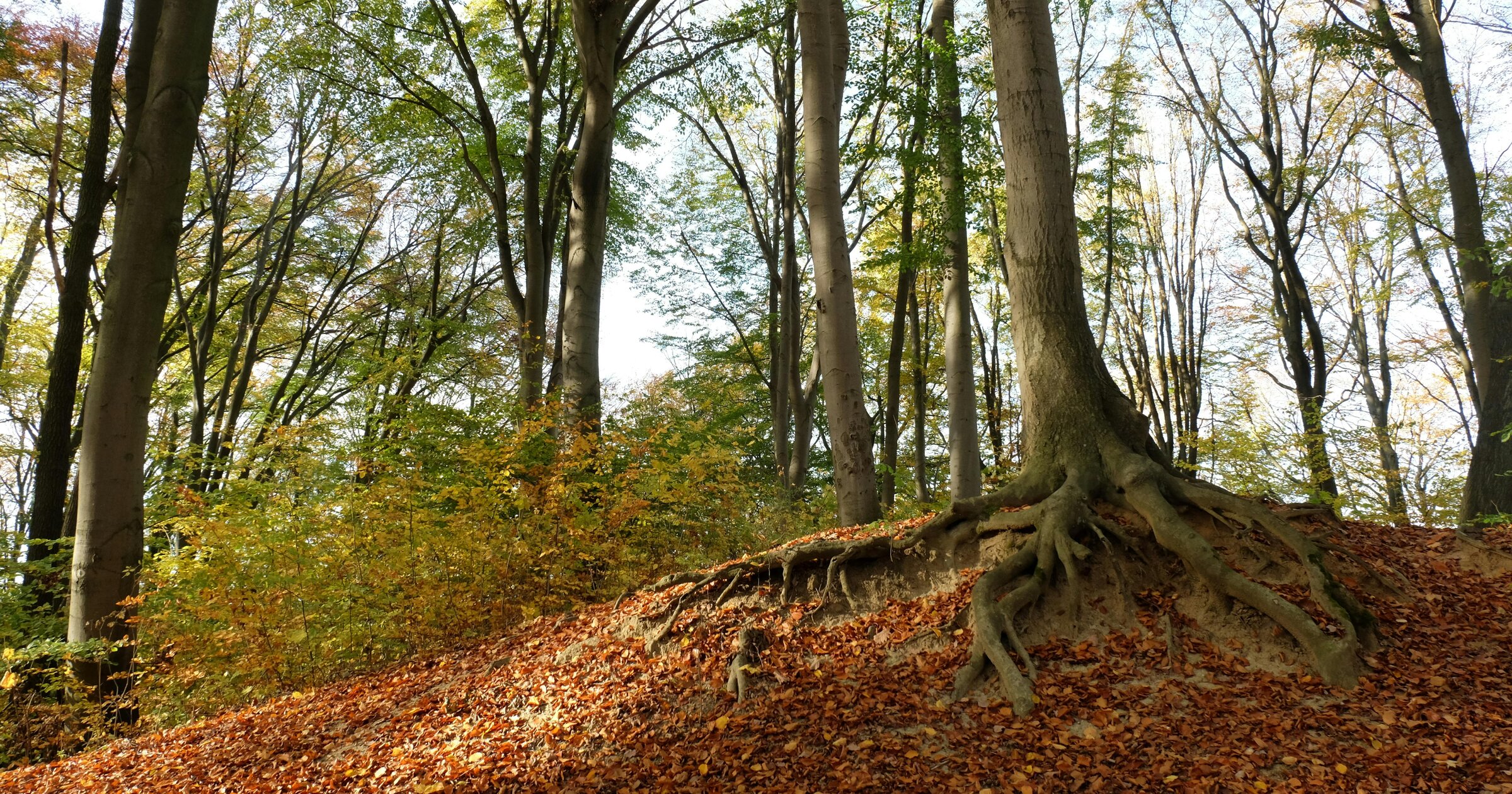
You have been told to protect the root zone during construction. You have been told that planting too deep kills trees. You have been told to mulch but never to volcano-mulch. Every one of those instructions traces back to root anatomy that is invisible for most of the tree’s life, buried under soil, and routinely misunderstood. Most people picture roots as a mirror image of the crown: a deep taproot anchoring the center, with branching roots radiating downward. The reality is almost the opposite, and understanding what roots actually look like, where they actually grow, and how they respond to damage is what separates informed tree care from guesswork.
Tree Trunk, Branch, and Twig Anatomy covered the above-ground macroscopic structures. Wood and Bark: The Vascular System moved inward to the tissue level. This guide moves underground, to the root system that feeds and anchors everything above it. The fungal partnerships that extend root function are covered separately in Mycorrhizal Relationships: The Root-Fungal Partnership (forthcoming).
Two Kinds of Roots, Two Different Jobs
A tree’s root system has two functional classes working at completely different scales. Woody structural roots (also called transport roots) radiate outward from the trunk, thicken with secondary growth each year just as branches do, and provide both anchorage and long-distance transport of water and minerals. They contain the same vascular cambium, xylem, and phloem described in the vascular system guide. On a mature tree, structural roots may extend well beyond the canopy edge.
Fine absorbing roots are a different story. These are small, short-lived, and concentrated near their growing tips. At the very tip of each absorbing root sits the root cap, a thimble of expendable cells that protects the apical meristem (the actively dividing growing point) as it pushes through soil. Just behind the meristem, in the zone of elongation, cells stretch and lengthen, driving the root tip forward. And just behind that, root hairs emerge: single-celled extensions of the root epidermis that are nearly invisible to the naked eye and may only persist for days or weeks before being replaced by new ones further along the advancing tip.
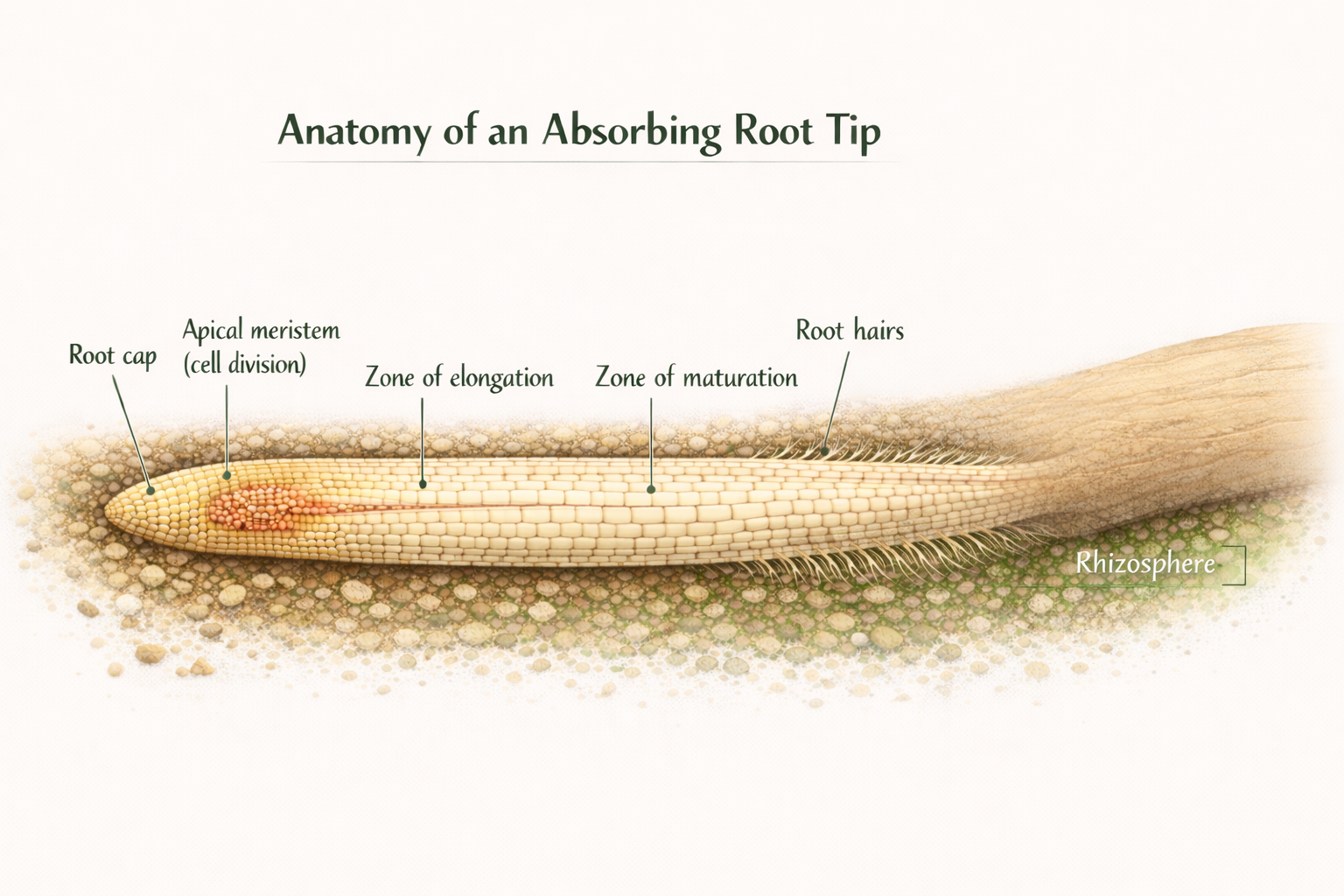 Longitudinal section of a fine absorbing root showing the root cap, apical meristem, zones of elongation and maturation, root hairs, and the rhizosphere.
Root hairs are where the majority of water and mineral absorption happens. They dramatically increase the surface area of each root tip in contact with soil particles. The soil zone immediately surrounding and influenced by these fine roots is the rhizosphere, a narrow sleeve of intense microbial activity where fungi, bacteria, and root exudates interact. The mycorrhizal fungi that colonize absorbing roots (covered in the forthcoming companion guide) further extend this absorption zone, sometimes by orders of magnitude.
Here is the part that surprises people: most of this absorbing root mass sits in the top 12 to 18 inches of soil. In the clay soils common across the Puget Sound lowlands, where drainage is poor and oxygen availability drops sharply with depth, feeder roots concentrate even shallower, often in the top 6 to 12 inches. The deep taproot model holds for some species in sandy, well-drained soils (notably oaks in their first years), but in the heavy, seasonally saturated soils typical of residential sites here, root systems spread wide and stay shallow. Dig around the base of a mature Douglas-fir in a Puget Sound lowland yard and you will find structural roots radiating outward just below the surface, not plunging downward. Bigleaf maples in wet sites are the same: wide, shallow plates of root that explain why they tip over in saturated soil during windstorms rather than snapping. A mature tree’s root zone commonly extends 2 to 3 times the radius of the canopy, and the critical absorbing roots are closer to the surface than most people assume when they decide to trench, regrade, or pour a patio.
How Roots Grow Back
Roots get cut. Transplanting severs them. Trenching severs them. Construction excavation severs them. What happens next is one of the more remarkable aspects of root biology, and it is directly tested on the BCMA certification exam.
When a root is severed, the cut end does not simply heal over. Instead, multiple new roots regenerate from the severed end, initially growing in the same direction the original root was growing. Over time, these replacement roots may redirect in response to soil conditions (toward moisture and oxygen, away from compaction and toxicity), but the initial regeneration pattern is outward from the cut, not random. This means that if you sever roots on one side of a tree during construction, the new roots replacing them will attempt to recolonize the same direction, provided the soil conditions in that direction still support growth. If you then compact that soil, pave it, or raise the grade over it, you have eliminated both the original roots and their replacements’ ability to re-establish.
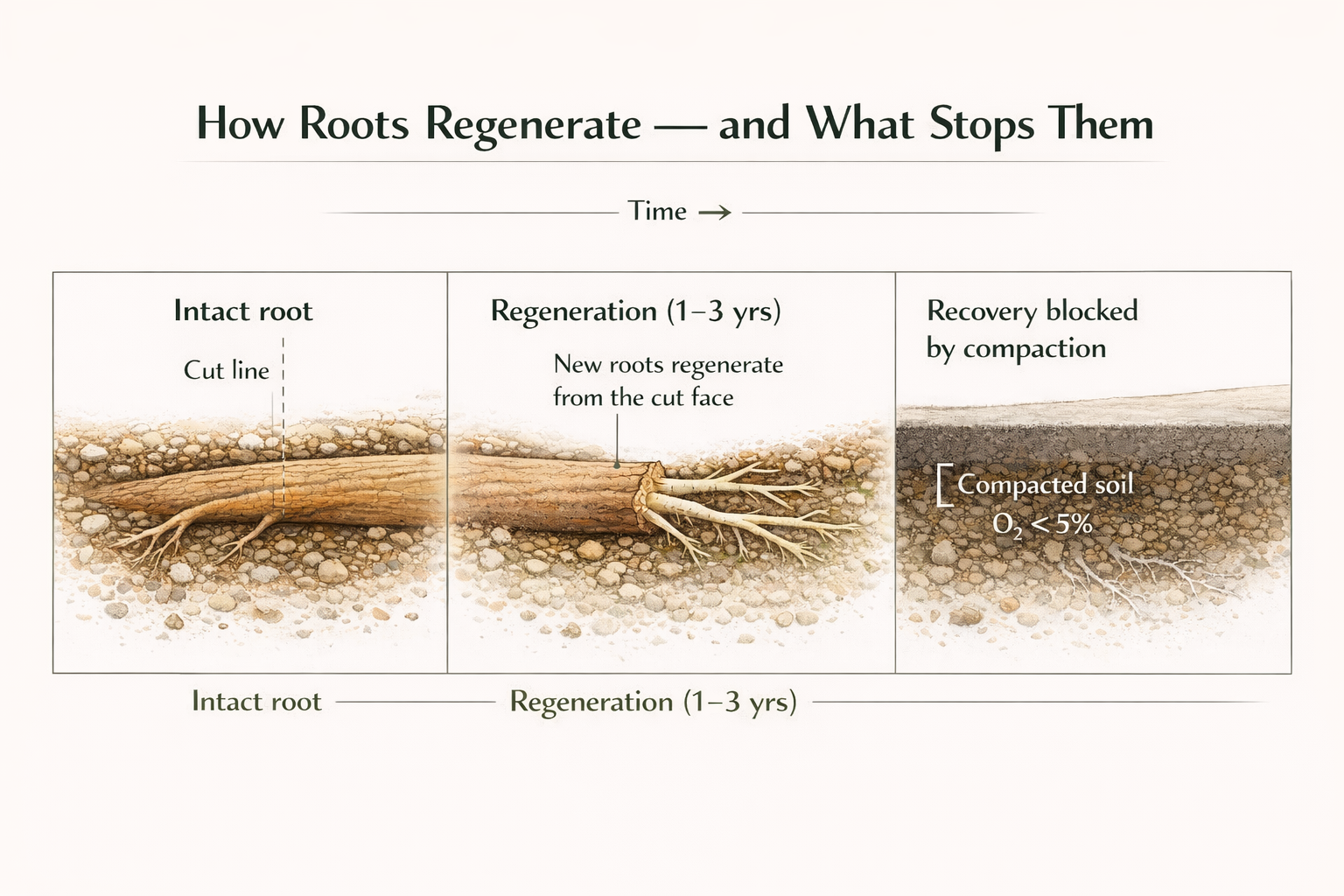 Three stages of root response to damage: intact root with cut line marked, new roots regenerating from the severed end (1-3 years), and recovery blocked when compacted soil eliminates the oxygen roots need to regrow.
Root regeneration takes time. A tree can survive the loss of a significant portion of its root system using stored energy reserves (primarily starch in ray parenchyma cells throughout the woody structure), but rebuilding absorbing root capacity to pre-damage levels may take years. This is why construction damage often shows no above-ground symptoms for 3 to 5 years: the tree is drawing down reserves while its reduced root system struggles to keep pace with the crown’s water demand. By the time the canopy thins visibly, the root damage may be half a decade old.
Adventitious roots add another dimension to root development. These are roots that arise from positions where roots would not normally form: along buried trunk tissue, from stem cuttings, or from other above-ground parts. The BCMA key terms define adventitious as “arising peripherally from parts of the root or stem having no connection to meristems or existing buds.” Adventitious roots are how cuttings develop root systems, how willows dropped into wet soil take hold, and how too-deep planting creates problems. When a tree is planted with the root flare buried under excess soil or mulch, the trunk tissue below the soil line may produce adventitious roots. These roots grow in the fill material rather than in the native soil profile, they often circle or girdle the trunk (because the fill is where conditions are best), and they lack the structural attachment strength of the original root system. Years later, the tree declines, and the cause traces back to an invisible anatomy problem created at planting. The circling roots guide covers diagnosis and intervention in detail.
Protecting What You Cannot See
Eighty percent of urban tree problems trace to soil and root conditions. That statistic reframes every tree management decision. Crown problems are often root problems expressing themselves above ground.
Root zone protection starts with understanding how little disturbance roots can tolerate. Soil compaction is the most pervasive threat in managed landscapes. When soil is compacted (by foot traffic, equipment, or construction staging), the pore spaces that hold air and water collapse. Roots need a minimum soil oxygen concentration of 10 to 12 percent to grow; below about 5 percent, root growth ceases entirely. Compacted soils in residential developments routinely fall below these thresholds. The critical soil resistance threshold is around 2.5 megapascals: above that, root penetration becomes physically impossible regardless of species.
Mulch is the single most effective tool for protecting existing root zones. A 2- to 4-inch layer of coarse organic mulch (arborist wood chips are ideal) insulates soil temperature, retains moisture, reduces compaction from rain impact and foot traffic, and feeds the microbial community in the rhizosphere. Research shows mulching increases fine-root development by 30 to 300 percent compared to bare or turf-covered soil. The key is keeping mulch away from the trunk (mulch volcanoes promote the adventitious root and bark decay problems described above) and spreading it outward toward the canopy edge, where the absorbing roots actually are.
Grade changes, trenching, and root severance during construction are the acute threats, but they get the most attention precisely because the damage is visible. The chronic threat, the one that degrades more root systems over time, is the combination of compacted soil and turfgrass competing for the same shallow soil layer where tree feeder roots live. If you understand root architecture (shallow, spreading, concentrated in the top foot of soil) and root physiology (oxygen-dependent, moisture-dependent, regenerating slowly from damage), every site management decision becomes clearer. Mulch rings, not volcanoes. Root zone fencing during construction. Planting at the correct depth so the root flare sits at grade. These are not arbitrary rules. They are direct consequences of root anatomy.
The construction and tree damage guide covers protection specifications for active jobsites.
Sources
- Management of Tree Root Systems in Urban and Suburban Settings. Arboriculture & Urban Forestry, Vol. 40, No. 4, 2014.
- Anatomy of a Tree. USDA Forest Service.
- Silvics of North America. USDA Forest Service.