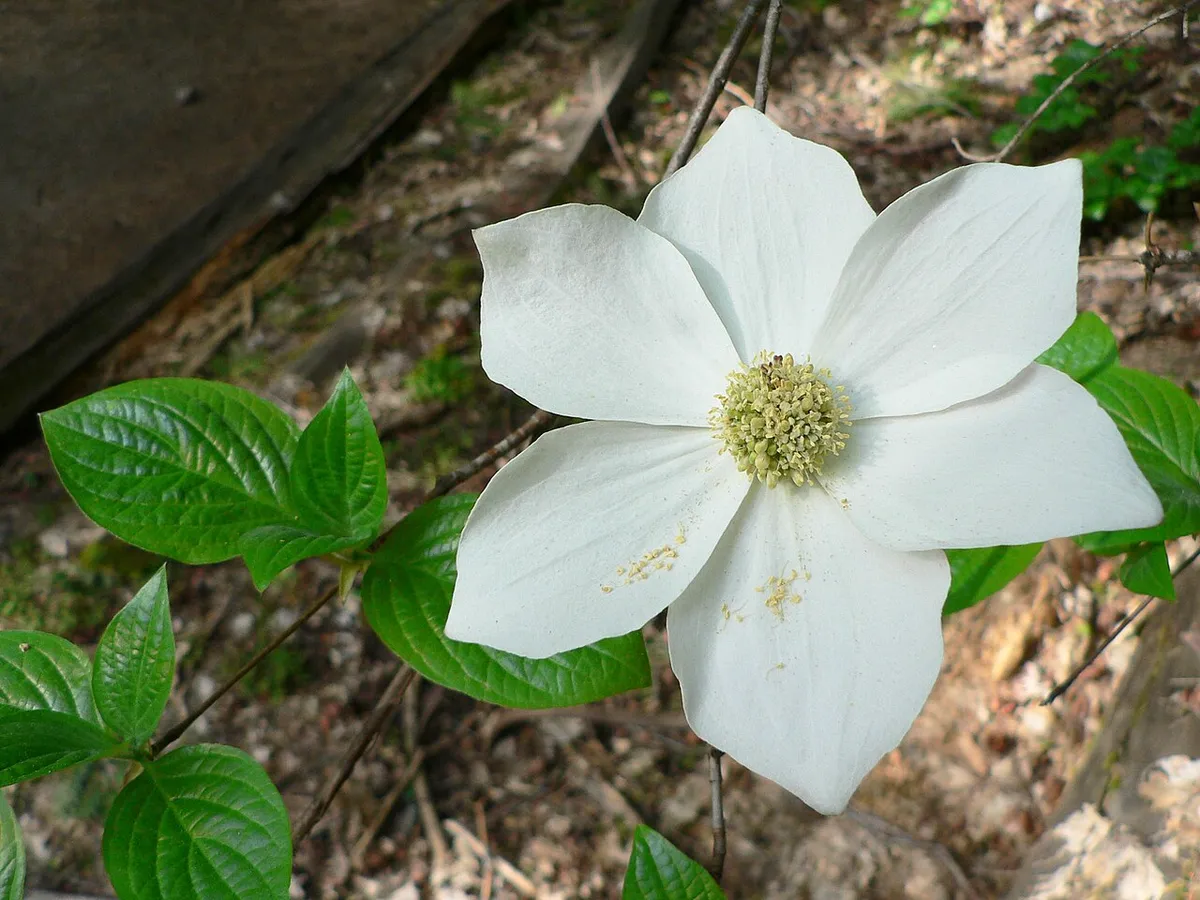
The White Bracts in the Forest
You have seen this tree, even if you did not know its name. In April, walking through a second-growth Douglas-fir forest, white stars appear against the dark conifers. Four large bracts (modified leaves, not petals) surround a tight cluster of small green flowers, and the effect is unmistakable: the understory glowing white while everything else is still waking up.
Pacific Dogwood is the tree that British Columbia chose as its provincial flower. It is native from southern BC to southern California, living in the space between the conifer canopy and the forest floor, rarely exceeding 40 feet. The species was named by John James Audubon for his friend Thomas Nuttall, an English-American botanist who explored these forests in the early 1800s. For most of the twentieth century, it was the reliable native understory tree: spring bracts, red-purple fall color, bright red drupes for the birds, a second bloom in late summer that surprised you every year.
Then, beginning in the 1990s, a fungal pathogen arrived that started killing them. Not slowly. Systematically.
A Climate Built for the Pathogen
Dogwood anthracnose, caused by Discula destructiva, is not the cosmetic leaf-spot anthracnose that hits sycamores and maples every wet spring. That form is annoying but harmless. Dogwood anthracnose is lethal. It progresses from purple leaf blotches to twig cankers to branch dieback to trunk girdling, and the trajectory is almost always one-directional. An infected tree does not recover. It declines over 3 to 10 years.
The pathogen is exotic. Microsatellite analysis of 93 isolates across 47 loci confirmed that D. destructiva was independently introduced on both the east and west coasts of North America, likely through imported plant material arriving at ports. The east coast introduction devastated Cornus florida populations beginning in the 1970s. The west coast introduction reached Pacific Dogwood in the 1990s.
What makes this region particularly dangerous for Pacific Dogwood is not the pathogen itself. It is the climate. Anthracnose infection requires cool temperatures during leaf expansion combined with prolonged moisture on foliage surfaces. Six years of Kent station weather data (2020 through 2025) show what that means in practice: across the March through May window when new leaves are expanding, an average of 51 out of 92 days (55 percent) have both measurable precipitation and maximum temperatures below 65°F. The worst year, 2022, hit 66 cool-wet days out of 92, with an average daily high of just 54.6°F. You can check current conditions on the weather dashboard.
For comparison, fire blight infection conditions (warm plus wet) align here roughly one day per spring. Anthracnose conditions are not episodic. They are the baseline.
Forest Dogwood vs. Garden Dogwood
This is the distinction that determines whether Pacific Dogwood thrives or dies in your landscape. In the wild, the tree lives in shade, in still air, under a closed conifer canopy where humidity lingers and leaf surfaces stay wet for hours. Those are exactly the conditions Discula destructiva needs. Forest populations of Pacific Dogwood in the Puget Sound lowlands have declined significantly since the pathogen arrived, and they continue to decline.
But the same species, planted in a landscape with good air circulation, adequate light, proper drainage, and no overhead irrigation, can perform well for decades. The difference is microclimate. A garden dogwood in an open setting dries faster after rain, receives more direct sunlight (which inhibits spore germination), and benefits from pruning and sanitation that forest trees never receive.
This is not a doomed tree. It is a tree that needs the right setting.
Siting for Success
Choose a location with moving air. A spot where afternoon breezes pass through the canopy is less favorable to the fungus than a sheltered corner where humidity pools. Avoid the bottom of a slope or a walled garden where cold, moist air settles.
Sun to part shade works, with afternoon shade preferred during the hottest weeks of summer. Pacific Dogwood evolved under partial canopy cover, but the anthracnose calculus has changed. More sun means faster leaf drying, which means fewer infection hours per rain event. A slightly sunnier site than the textbooks suggest is a reasonable trade-off in the age of anthracnose.
Drainage matters. While the tree tolerates seasonally moist soils (flood tolerance is documented), standing water stresses roots and creates secondary entry points for Phytophthora and Armillaria. Well-drained soil with consistent moisture through summer is the target.
Never irrigate from overhead. Water at the base only. Every sprinkler session that wets the canopy extends the infection window.
Sanitation as Defense
If anthracnose conditions are the default spring weather, then reducing the amount of fungal inoculum available each spring is the lever you can pull. Remove infected twigs promptly, cutting back to healthy wood. Rake and destroy fallen dogwood leaves through the growing season and again in fall; the fungus overwinters in debris on the ground and in twig cankers still attached to the tree. Do not compost diseased material.
Keep the canopy open. Thin crowded branches during dormancy to improve airflow. Fewer branch intersections means faster drying after rain, and faster drying means fewer hours for spore germination.
Chemical Management: Realistic Expectations
Fungicide applications can slow disease progression but do not cure infection. WSU HortSense recommends chlorothalonil applied at bud break and continued at 10 to 14 day intervals until dry weather arrives, typically by late June. This is a commitment: six to eight applications per season, every season, with no guarantee of complete protection.
For homeowners, the practical reality is that chemical management makes sense only for a high-value specimen tree where the investment is justified. For a tree in a naturalized landscape or woodland edge, cultural practices (siting, sanitation, canopy management) are the foundation. If the tree is already showing branch dieback and trunk cankers, fungicides will not reverse the decline.
When to Choose a Hybrid Instead
Pacific Dogwood is worth growing when you can provide the right site and are willing to manage the anthracnose risk. But if you want the white bracts of a native dogwood without the full anthracnose burden, several hybrids with C. nuttallii parentage deserve consideration.
Eddie’s White Wonder (C. nuttallii × C. florida) is the safest choice for this region. Developed in Vancouver, BC in 1955, it carries native dogwood genetics, produces large white bracts, reaches about 25 feet, and shows strong anthracnose resistance. It is a Great Plant Picks award winner and the City of Seattle has used it in their Trees for Neighborhoods planting program. If you want the look of Pacific Dogwood with substantially less disease risk, this is the tree.
Venus (C. kousa × C. nuttallii) produces the largest bracts of any dogwood, up to 6 inches across, on a 25-foot tree with excellent disease resistance. The kousa parentage gives it later bloom timing (June rather than April) and a different texture, so it does not replicate the spring forest moment, but the floral display is spectacular.
Starlight (C. kousa × C. nuttallii) reaches 30 feet with white flowers and strong resistance to both anthracnose and borers. Like Venus, it blooms later than the straight species.
The Rutgers Stellar series (Aurora, Constellation, Stellar Pink, Celestial) crosses C. kousa with C. florida rather than C. nuttallii, so the native parentage connection is absent. They are excellent landscape trees with anthracnose and borer resistance, but they belong in the kousa hybrid conversation, not the Pacific Dogwood one.
The decision comes down to three questions. If you want the native species, the April forest-moment timing, and the wildlife value of the straight species, plant C. nuttallii and commit to the siting and sanitation practices above. If you want native genetics with less risk, plant Eddie’s White Wonder. If you want maximum disease resistance and do not need the native connection, plant Venus, Starlight, or a kousa cultivar. WSU HortSense lists 24 dogwood cultivars and species with documented anthracnose resistance; pure C. kousa selections (Milky Way, China Girl, Satomi, and others) are consistently rated as showing very good resistance.
What Else Goes Wrong
Dogwood anthracnose is the existential threat. Everything else on the susceptibility list is secondary, but worth knowing.
Powdery mildew appears most years on lower-canopy foliage during summer, presenting as a white coating on leaves. It is cosmetic and rarely warrants treatment. Improving air circulation helps.
Leaf scorch shows up as brown margins during hot, dry periods, particularly on the south side of the canopy. This is an environmental stress response, not a pathogen. Water deeply during summer dry spells; Pacific Dogwood evolved with consistent forest-floor moisture and does not tolerate prolonged drought.
Scale insects (lecanium, oystershell, brown soft scale) occasionally colonize branches. Natural predators, particularly ladybird beetles and parasitic wasps, usually keep populations below damaging levels. If you see heavy encrustation, prune out the worst branches and apply horticultural oil during dormancy.
Collar rot and Armillaria root rot target trees in poorly drained or wounded sites. Both are prevented by proper siting rather than treated after the fact. Avoid wounding the trunk, and do not let soil or mulch contact the bark above the root flare.
The Infected Tree: When to Remove
If your Pacific Dogwood shows anthracnose symptoms, the first step is a severity assessment. Leaf blight alone (purple blotches on foliage, premature leaf drop) without twig or branch cankers is early-stage. Aggressive sanitation and improved cultural conditions may slow progression. A tree showing branch dieback and trunk cankers is in mid to late decline, and the trajectory is unlikely to reverse.
The harder question is whether to remove an infected tree. Every infected dogwood is a spore source. If you are near other dogwoods, in your yard or in adjacent natural areas, maintaining a heavily infected tree spreads the pathogen. But a tree that has been part of the landscape for decades is difficult to lose.
If the tree is in early decline and isolated from other dogwoods, management may be worthwhile. If it is heavily infected and adjacent to wild dogwood populations or neighborhood specimens, removal is the responsible choice. A certified arborist can help assess severity and trajectory.
Seasonal Action Summary
| When | What | Why |
|---|---|---|
| Late February through March | Remove overwintering twig cankers; rake any remaining fallen leaves | Reduces spring inoculum before spore release begins |
| March through April (bud break) | Begin chlorothalonil applications if using chemical management | Protection must be in place before new leaves expand; 10-14 day intervals |
| April through May (bloom, ~1,260 GDD₃₂) | Monitor expanding leaves for purple blotches | Early detection allows prompt removal of infected shoots |
| May through July | Prune infected twigs back to healthy wood; thin canopy for airflow | Limits secondary spore production during successive wet periods |
| July through September | Reduce overhead moisture; watch for powdery mildew; enjoy the second bloom | Mature foliage becomes resistant; fungal pressure declines with dry weather |
| October through November | Remove ALL fallen dogwood leaves from ground and crown | The single most important sanitation step for the following spring |
| December through February | Structural pruning; inspect for branch and trunk cankers | Dormant-season visibility makes canker detection easier |
Sources
- Dogwood (Cornus spp.)-Anthracnose - PNW Plant Disease Management Handbook
- Dogwood: Anthracnose - WSU HortSense
- Confirmation of Independent Introductions of Discula destructiva - Milgroom et al., PLOS One, 2017
- Resistance to Dogwood Anthracnose Among Cornus Species - Journal of Arboriculture, 1996
- Cornus nuttallii - OSU Landscape Plants
- Pacific Dogwood - USDA Forest Service
- Dogwood Anthracnose - National Invasive Species Information Center
- Eddie’s White Wonder Dogwood - City of Seattle Trees for Neighborhoods