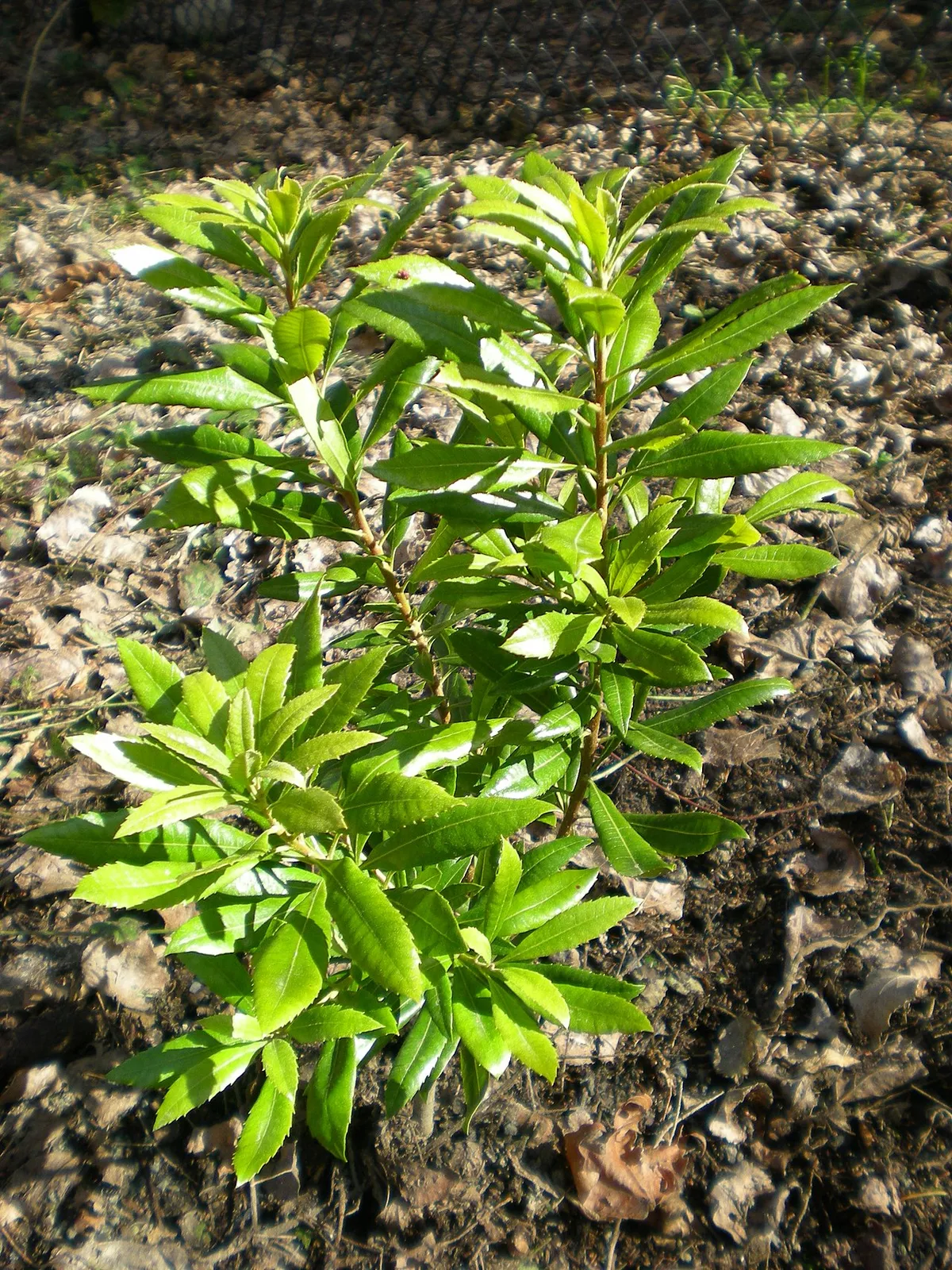
Pacific Wax Myrtle (Morella californica, formerly Myrica californica) is a native evergreen that solves several problems at once: privacy, wind protection, and nitrogen fixation in a fast-growing package. You see it screening highway corridors and stabilizing coastal slopes across the Puget Sound region. It performs just as well in residential gardens.
Native to the Pacific coast from British Columbia south to southern California, it grows as a large shrub or small tree reaching 10 to 30 feet tall, with a dense, upright habit and fine-textured foliage. Hardy in Zones 7a through 8b.
The first thing you’ll notice in the field is the aroma. Brush the leaves and your fingers release a sharp, pleasant fragrance. That’s your clearest ID feature. The foliage is narrow and lance-shaped, bright to dark green, and it stays on the plant year-round. In late summer, female plants produce small waxy purple berries that persist into winter. Birds love them. Males produce inconspicuous catkins and no berries, so if you’re planting for wildlife value, ask your nursery about plant sex.
What separates Pacific Wax Myrtle from ordinary screening shrubs: it fixes its own nitrogen. The roots form nodules that house Frankia bacteria, which pull nitrogen from the air and convert it to usable plant nutrients. You do not fertilize it. In soil-poor sites or newly graded areas, the plant establishes without chemical inputs and improves the soil for nearby plants.
Pacific Wax Myrtle tolerates wet soils and seasonal flooding better than most native shrubs, handles coastal salt spray, and grows well in sandy, loamy, or clay soils. Full sun produces the densest form; dappled shade works. Once established (by year two), it requires minimal water beyond normal rainfall.
Pest and disease pressure is remarkably low. Only one disease has been documented in PNW records for this species. You will not battle spider mites, scale, or fungal leaf spots the way you might with imported ornamentals. The aromatic oils in the foliage likely contribute to this resilience.
Use it where you need screening or a windbreak; it is dense enough to block views and wind within two to three growing seasons. It works as a single specimen, a foundation planting on north- or west-facing walls, a property-line hedge, or a restoration species on difficult slopes.
The taxonomy note: you may find Pacific Wax Myrtle sold under either Morella californica or the older name Myrica californica. Both are correct. The genus was reclassified in the early 2000s, and many nurseries still use the old name on labels. When shopping, verify with the botanical name rather than relying on common names alone.
Spacing depends on your goal. For a dense privacy hedge, plant on 4-to-6-foot centers. For a more natural grouping, 8 to 12 feet apart allows individual character to show. It responds well to pruning if you need to maintain a specific height or shape, though in time it will reach 15 to 30 feet without intervention. The form is naturally upright and tidy, so heavy maintenance pruning is optional.
Native, hardy, pest-resistant, and a soil improver. Few screening plants offer that combination.
Sources
Dirr, M. A. (2009). Manual of Woody Landscape Plants: Their Identification, Ornamental Characteristics, Culture, Propagation and Uses. Stipes Publishing.
Hitchcock, C. L., & Cronquist, A. (1973). Flora of the Pacific Northwest: An Illustrated Manual. University of Washington Press.
Pojar, J., & MacKinnon, A. (1994). Plants of the Pacific Northwest Coast: Washington, Oregon, California & British Columbia. Lone Pine Publishing.
U.S. Department of Agriculture, Natural Resources Conservation Service. Pacific Coast Plant Guide: Morella californica. PLANTS Database.