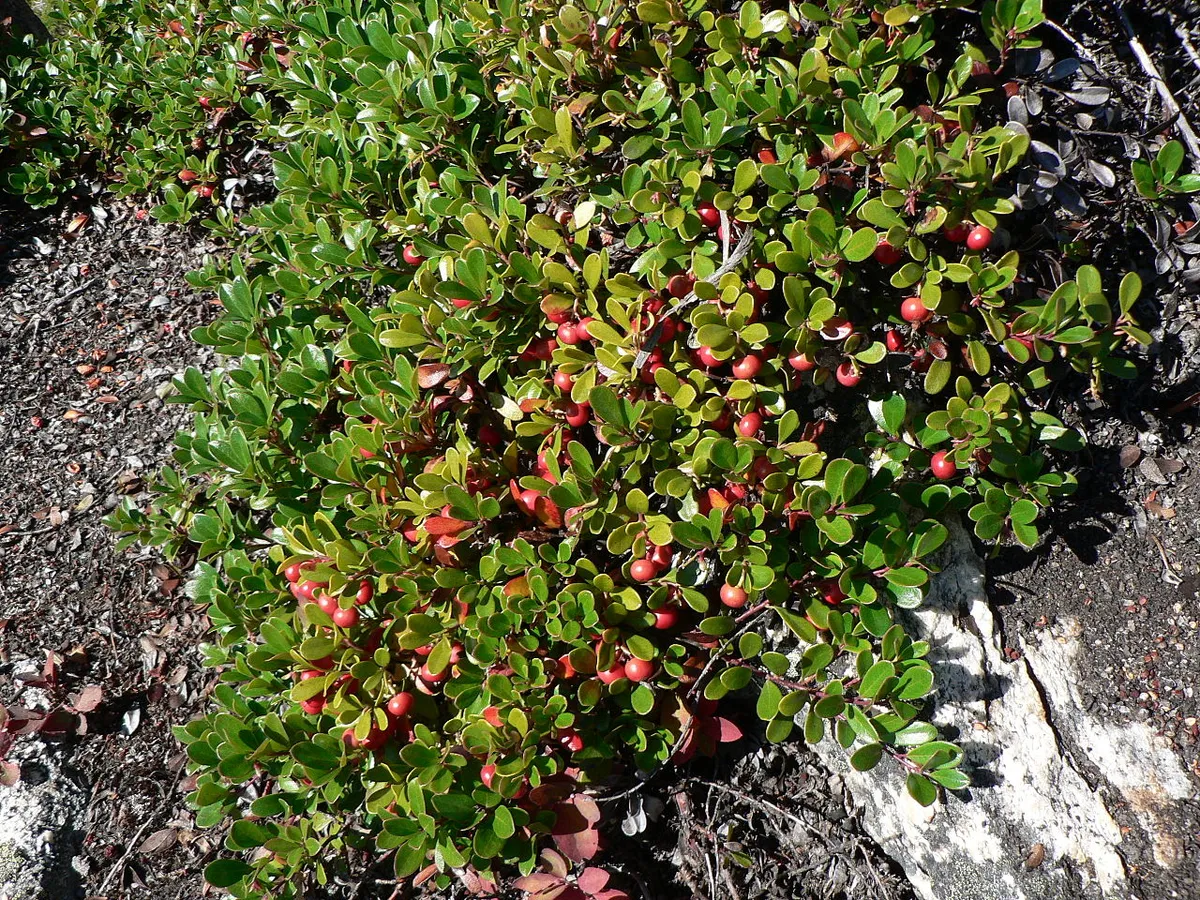
You have driven past this plant a hundred times without registering it. It is the low, glossy-leaved mat hugging the sandy shoulders along the I-90 corridor at Snoqualmie Pass, carpeting the bluffs at Fort Worden, creeping over the gravel banks at Point Defiance. Kinnikinnick (Arctostaphylos uva-ursi) grows so flat and so quietly that most people mistake it for a weed until they notice the bright red berries in October and realize it has been doing its job better than anything else in the planting.
That job is covering ground. And in Western Washington, where slopes erode, tree roots need protection, and homeowners keep looking for something that is not lawn, kinnikinnick is one of the most underused native groundcovers available.
The Plant
Kinnikinnick is an evergreen shrub in the Ericaceae (the heath family, alongside blueberries, rhododendrons, and salal). It stays under 6 inches tall. That is not a typo. This is a plant that grows horizontally, spreading 3 to 6 feet from a single crown, rooting where stems contact the ground, and forming a dense mat of small, leathery, dark green leaves that stay green through winter.
The flowers appear in spring: small, urn-shaped, white with a pink tinge, hanging in clusters at the branch tips. They are easy to overlook but pollinators do not overlook them. The fruit follows in late summer and persists through fall and winter: bright red berries about a quarter inch across, each one holding a handful of hard seeds. The common name “bearberry” is literal. Bears eat them. So do grouse, thrushes, and other songbirds.
The species is native across the entire temperate Northern Hemisphere. In the Pacific Northwest it occurs naturally from the coast to subalpine elevations, on sand, gravel, rocky outcrops, and the well-drained margins of coniferous forests. Hardiness range is Zone 2a through 8b, which makes cold tolerance a non-issue anywhere in Western Washington and most of the way up into the Cascades.
Why It Works Here
The short answer is that it evolved here. Kinnikinnick is native to the Pacific Northwest and has been growing in our soils, our rainfall pattern, and our seasonal rhythm for millennia. It does not need to be taught the climate.
The longer answer involves what it tolerates. This plant handles sandy, gravelly, nutrient-poor soils that would starve most ornamentals. It handles full sun on a south-facing slope and part shade under a Douglas-fir canopy. Once established (figure two full growing seasons with regular summer irrigation), it is drought tolerant in a way that most groundcovers in the nursery trade cannot match. It evolved on coastal bluffs and mountain gravel bars. Your parking strip is not harder than that.
For erosion control, kinnikinnick is one of the best options available. The spreading, rooting stems physically hold soil in place. The evergreen leaf mat reduces raindrop impact. On slopes, along drainage swales, or in the strip between the sidewalk and the street, it does the work that landscape fabric pretends to do, and it looks better doing it.
Wildlife value is real. The berries persist through winter and provide food for birds when little else is available. The dense mat creates cover for ground-nesting insects and small invertebrates.
Cultivars
Seven cultivars appear in the nursery trade, each with a slightly different growth habit or leaf character.
‘Massachusetts’ is the most widely available. Vigorous, reliable, resistant to leaf burn in full sun. If you are buying kinnikinnick for a large area and want consistency, this is the safe choice.
‘Vancouver Jade’ produces dense, jade-green foliage and tolerates a wider range of light conditions than most selections, performing in both sun and moderate shade.
‘Point Reyes’ has larger, glossier leaves than the species and a wide spreading habit. Originally selected from coastal populations in Marin County, California, so it carries good drought tolerance.
‘Wood’s Compact’ stays tighter and smaller than the species. Useful in containers or where you need the groundcover effect in a confined space.
What Goes Wrong
The profile documents 6 diseases and 3 pests. For a native groundcover, that is a short list, and the actual management burden is lighter than the numbers suggest.
Leaf Spot
The most common issue you will see. Fungal leaf spots show up as brown or purple-brown spots on the leaves, typically during prolonged wet springs. On kinnikinnick, this is cosmetic. The plant does not defoliate, and healthy growth pushes through. If it bothers you, improve air circulation by thinning any overhead canopy that traps humidity.
Root Rot
This is the one that matters, and it is almost always a siting problem rather than a pathogen problem. Kinnikinnick evolved on sand and gravel. Plant it in heavy clay that holds water through winter and you are creating exactly the conditions that Phytophthora and Pythium need. The plant yellows, thins, and dies in patches.
What to do: Site it right the first time. If your soil is heavy clay, either amend the planting area with coarse sand and gravel to improve drainage or choose a different groundcover. Kinnikinnick will not forgive wet feet.
Pests
Root weevils occasionally notch the leaf margins. On an established mat of kinnikinnick, this is cosmetic. The plants grow through it. If you are seeing severe damage on newly planted starts, check for larvae in the root zone.
Getting It Established
This is the part people get wrong. Kinnikinnick is drought tolerant once established, but “once established” means after two full growing seasons with consistent summer irrigation. In the first year, plan on 1 to 2 gallons per plant, once or twice a week through July and August. In the second year, extend the interval to every 7 to 10 days during hot, dry spells. By the third year, you are watering only during genuine drought stress.
Plant spacing depends on how quickly you want full coverage. For a solid mat within three years, space plants 18 inches apart. For a looser, more natural look that fills in over five years, go 24 to 30 inches.
Propagation from cuttings is straightforward if you want to expand an existing planting. Semi-hardwood cuttings taken in late summer root reliably. This is how nurseries maintain cultivar consistency, and it works in a home setting with a simple humidity tent and rooting hormone.
Seasonal Action Summary
| When | What | Why |
|---|---|---|
| March through April | Inspect for winter damage; remove any dead or brown stems | Clears space for new spring growth |
| April through May | Watch for leaf spot during wet springs | Note severity; improve air circulation if recurring |
| May through June | Plant new starts after last frost risk passes | Allows a full growing season to establish before summer drought |
| July through September | Irrigate new plantings 1-2x per week; established plantings as needed | First two years are critical for root establishment |
| October through November | Observe berry set and bird activity | Confirms plant health and wildlife value |
| Year-round | Avoid overhead irrigation on established plantings | Reduces fungal leaf spot pressure; the plant prefers dry foliage |
Sources: WSU HortSense, PNW Plant Disease Management Handbook, PNW Insect Management Handbook, OSU Landscape Plants Database, NC State Extension Gardener Plant Toolbox. This article will be referenced by the Field Brief advisory system for native groundcover recommendations.