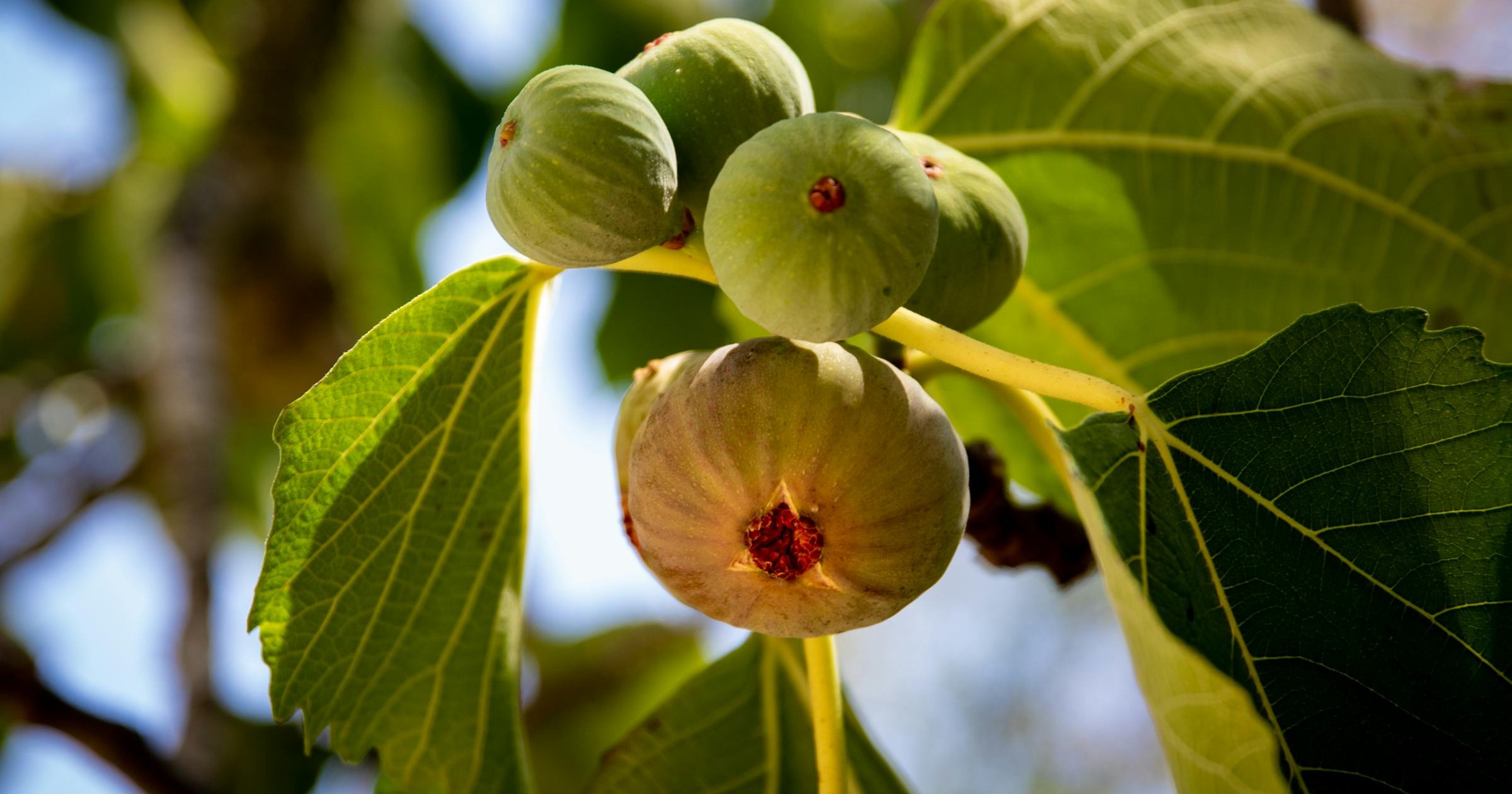
If you have been pruning your fig tree the way the internet tells you to and wondering why you get leaves but almost no fruit, the problem is not your tree. It is the advice. Most fig pruning guidance is written for California, Texas, or the Southeast, where figs fruit on the current season’s growth and hard annual pruning stimulates a heavy fall harvest. That approach, applied here, removes the wood that actually produces your figs.
In this region, summer heat is not sufficient to ripen fruit on new growth for most fig varieties. Your reliable harvest comes from the breba crop: figs that formed as tiny embryos on last year’s branches, overwintered at the branch tips, and ripened in the warmest week of August. Cut that wood off in February and you have removed your entire harvest before the season started.
The fix is simple once you understand it. Your pruning method depends on which crop type your variety produces. Get this one thing right and everything else follows.
Two Crops, Two Strategies
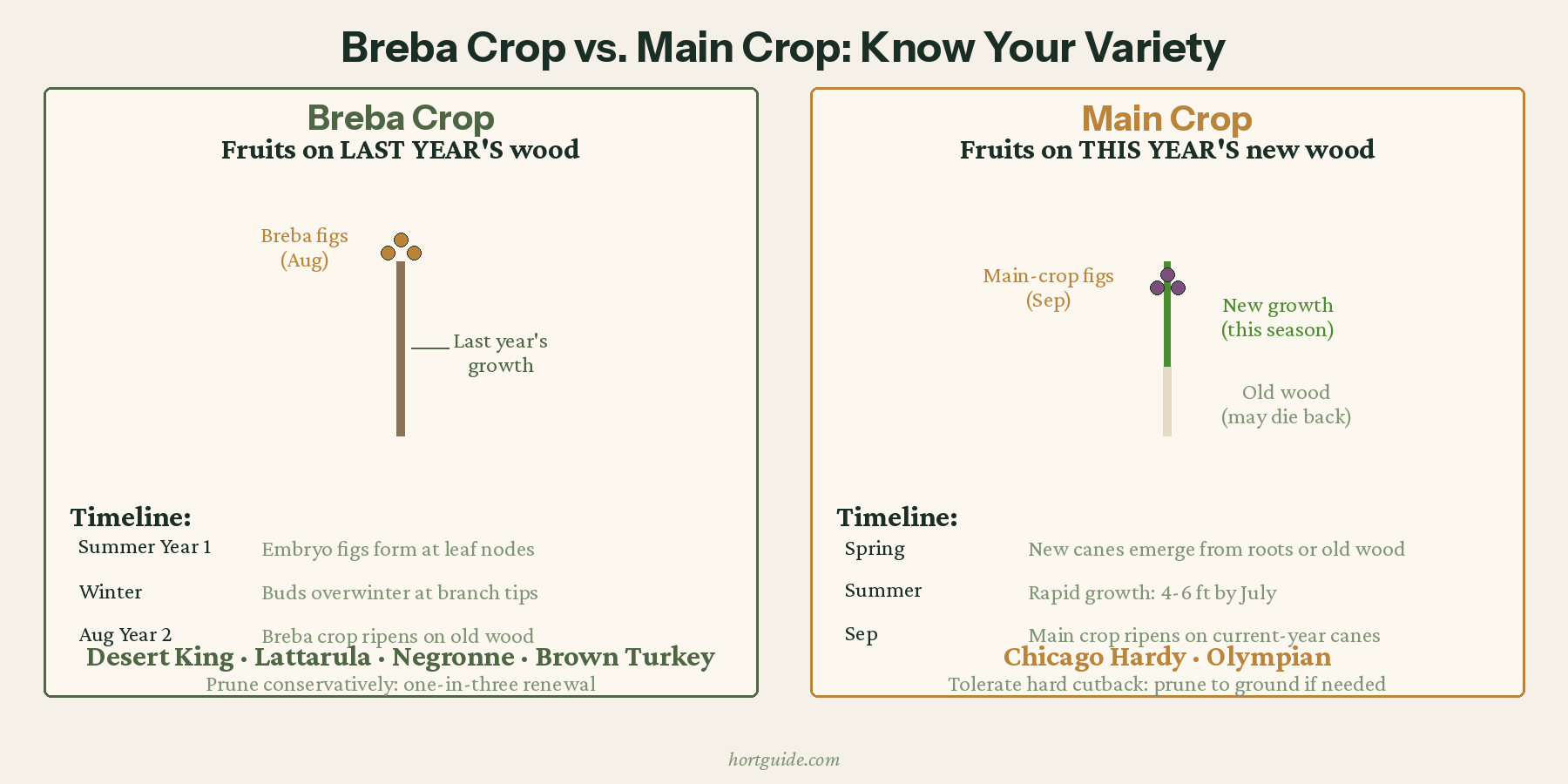 Diagram: hortguide.com
Fig trees can produce two crops per year. The breba crop develops on last year’s wood. Tiny embryo figs form at the base of leaves during summer, overwinter as pea-sized bumps near branch tips, and ripen the following August. The main crop develops on the current season’s new growth and ripens in late summer or fall.
In Mediterranean climates, the main crop is the prize and the breba is a bonus. Here, it is the reverse. Our cool summers rarely provide enough heat to ripen a main crop. The breba, ripening during our warmest stretch in late July and August, is what you actually harvest. Some years a warm autumn will push a few main-crop figs to ripeness on certain varieties, but you cannot plan around it.
This reversal of priorities is why national pruning advice fails here. When an article says “prune hard to encourage vigorous new growth,” they mean new growth that will carry a main crop. In this region, that new growth produces leaves and not much else. The wood you need to protect is last year’s growth, the branches carrying overwintering breba buds.
The exception: varieties that reliably fruit on new wood even in cool climates. Chicago Hardy and Olympian produce main-crop figs on current-season growth and can bear a crop even after being cut to the ground. For those varieties, hard pruning works.
Know Your Variety’s Crop Type
Before you make a single cut, you need to know whether your fig produces on old wood (breba) or new wood (main crop). This determines everything.
Breba-dominant varieties (prune conservatively):
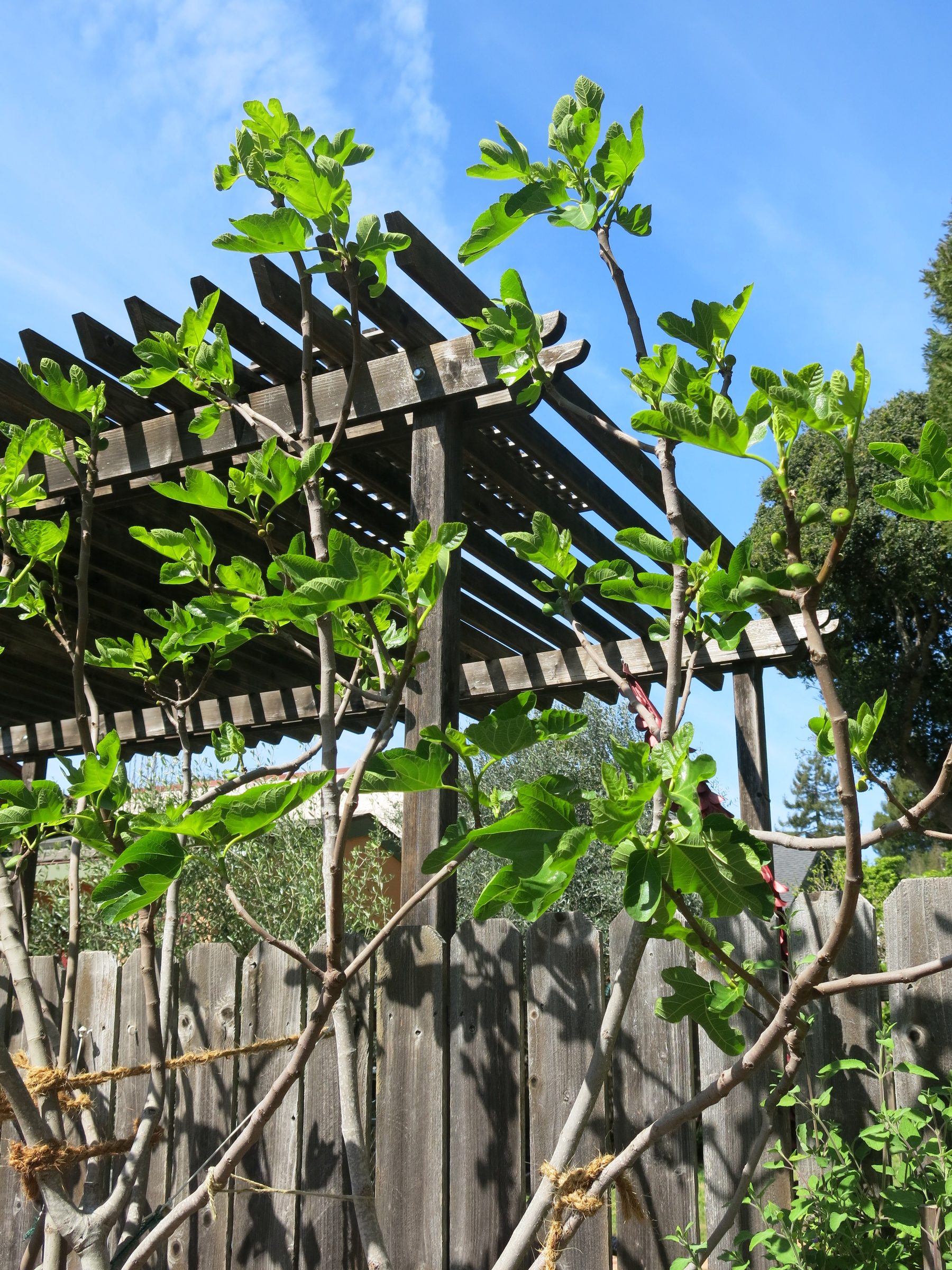 “Ficus carica Desert King” by Burkhard Mücke, CC BY-SA 4.0, via Wikimedia Commons
Desert King is the heritage fig of this region and the most widely planted variety from Seattle to Bellingham. It is a San Pedro type, which means the breba crop sets parthenocarpically (without pollination) while the main crop requires pollination by a fig wasp that does not exist here. In practical terms: Desert King gives you one reliable crop per year, the breba, and that crop comes from last year’s wood. It ripens in the first week of August in most years, greenish-white when ripe, and the entire harvest comes in a concentrated seven-to-ten-day window.
Lattarula (Italian Honey) is the second most common fig in the region. Yellow-green fruit with amber flesh. More vigorous than Desert King and may ripen both a breba and a partial main crop in warm years, but the breba is still your guaranteed harvest.
Negronne (Violette de Bordeaux) is a smaller tree with dark purple, intensely flavored fruit. Produces a reliable breba and occasionally ripens some main-crop figs in favorable autumns. Compact enough for small gardens or large containers.
Main-crop varieties (tolerate hard pruning):
Chicago Hardy is the variety marketed for cold climates, and the name is earned. It survives root temperatures down to -10°F and regrows from the ground after complete top-kill. It fruits on new wood, meaning even a plant that dies to the ground in winter can push 4 to 6 feet of new growth by midsummer and produce ripe figs by September. In Zone 8b, where winters rarely kill established wood, you get a bonus: surviving old branches carry a breba crop on top of the main-crop harvest.
Olympian, found originally near Olympia, Washington, produces dark purple fruit on current-season wood and tolerates Zone 6 winters. Similar to Chicago Hardy in its ability to fruit after dieback.
Brown Turkey falls in the middle. It produces both breba and main crops. In this region, the breba is the more reliable of the two, so treat it as a breba-dominant variety for pruning purposes: preserve some old wood rather than cutting everything back.
Understanding Fig Wood
Three types of wood are on your fig tree, and you need to recognize each before you start cutting.
Last year’s growth has smooth, grey-tan bark and visible nodes where leaves were attached. At or near the tips, you may see small, dark, rounded bumps the size of a pea. Those are overwintering breba buds, and they are next August’s figs. This wood is the most important thing on a breba-dominant fig. Do not remove it unless you have a structural reason to.
Older structural wood has rougher bark, is thicker, and forms the permanent framework of the tree: the trunk and main scaffold branches. Leave this alone unless it is diseased, dead, or crossing.
Current-season growth is green, flexible, and actively extending from spring through late summer. By autumn, it hardens off and becomes next year’s “last year’s growth,” setting the breba buds that will ripen the following August.
The parallel to grape pruning is exact. In grape vines, your variety determines whether you spur-prune or cane-prune. In figs, your variety determines whether you preserve old wood or cut hard. The underlying principle is the same: know which wood fruits, and do not remove it.
Pruning Breba-Dominant Figs
If you grow Desert King, Lattarula, Negronne, or Brown Turkey, this is your method.
The one-in-three renewal system
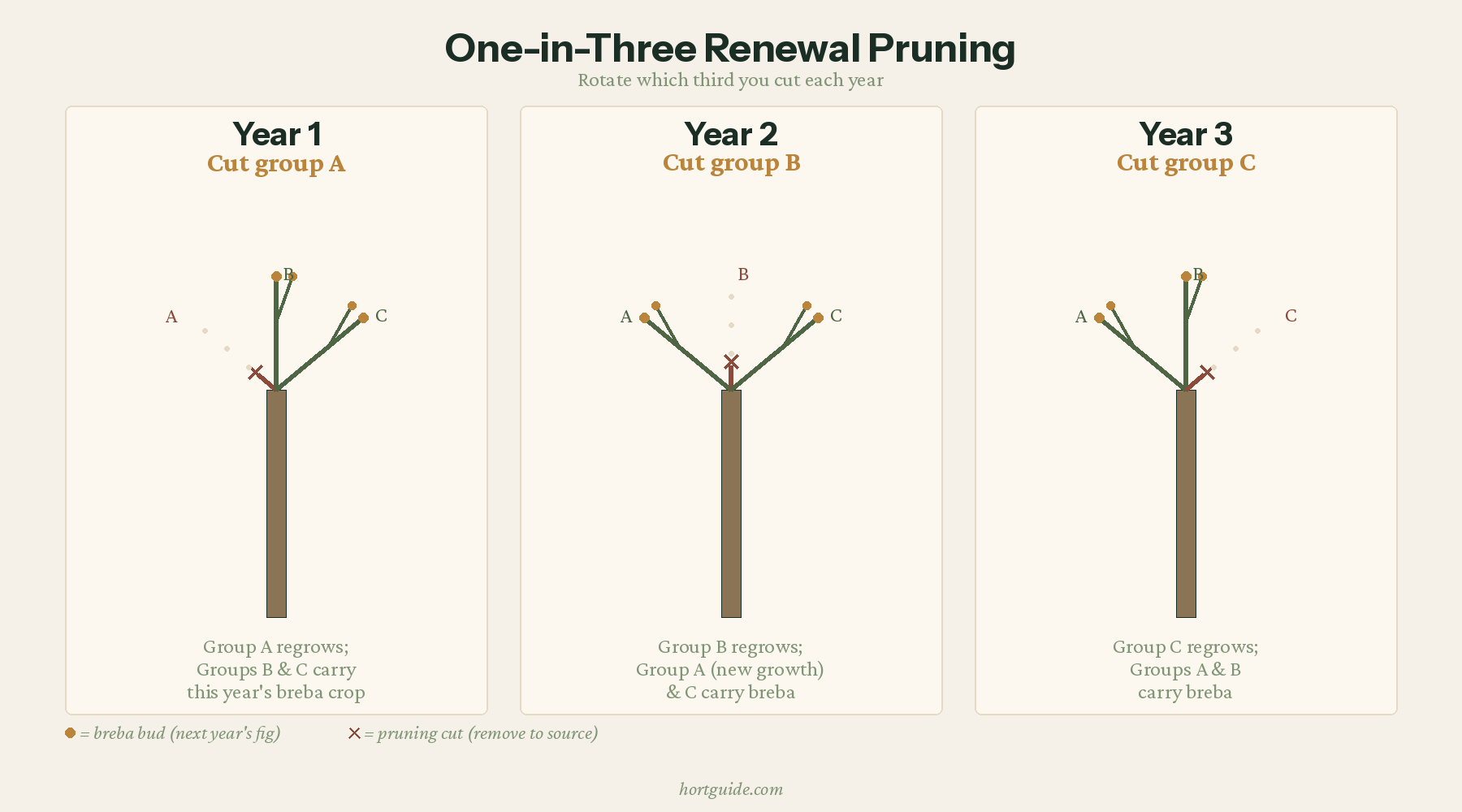 Diagram: hortguide.com
Each spring, cut approximately one-third of the tree’s branches back to their point of origin on the main scaffold. Leave the other two-thirds untouched. Those two-thirds carry this year’s breba crop. The one-third you removed will regrow vigorously during the season, and that new growth becomes next year’s fruiting wood.
This rotating cycle means every branch on the tree is never more than two or three years old, the tree stays at a manageable size, and you always have two years of fruiting wood available while one-third of the canopy regenerates.
The method comes from NW Fruit (Western Washington Fruit Research Foundation), which has trialed figs at their research garden in Mount Vernon since the 1990s. Their guidance is direct: “Prune about 1 out of every 3 limbs back to, or nearly back to, its source each spring to encourage renewal growth.”
Choosing which third to cut
Select branches that are:
- Growing too tall to reach (figs form at branch tips; if you cannot reach the tips, you cannot harvest)
- Crossing other branches or growing inward, reducing air circulation
- The oldest of the three-year cycle, having already produced two seasons of breba crops
Leave branches that have abundant breba buds visible at their tips and that are within comfortable reaching height.
Keep it within reach
This is the single most practical piece of fig pruning advice for this climate: every winter, the growing tips of your fig tree should be within reach height, because that is where the figs will be. A fig tree that grows unrestricted will push new growth 3 to 5 feet per season, and within a few years the harvest is 12 feet off the ground and belongs to the birds. The one-in-three system, combined with selecting taller branches as the ones you cut back, keeps the productive zone accessible.
A mature Desert King in the NW Fruit garden stands about 10 feet tall, a manageable size for ladder-free harvest if trained with an open canopy.
Summer pinching
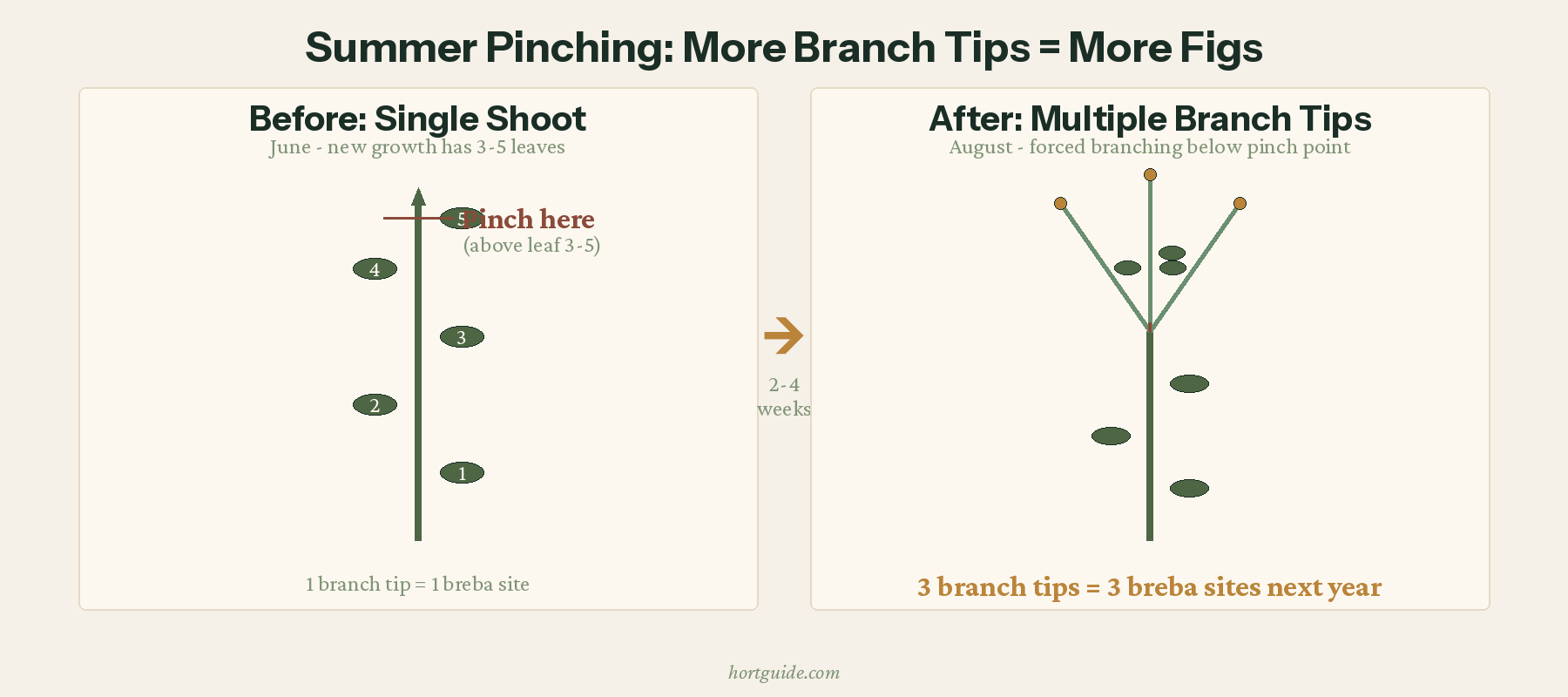 Diagram: hortguide.com
In early to midsummer, when new shoots have developed three to five leaves, pinch off the growing tip just above the last leaf. This forces the shoot to branch, and each new branch tip that matures by autumn will carry breba buds the following year. More branch tips means more breba sites, which means more figs.
Pinch selectively, not every shoot on the tree. Focus on vigorous upright shoots that would otherwise extend beyond your reach by fall. Horizontal and shorter shoots can be left to grow naturally.
Stop all pinching by midsummer. Shoots that form after that point will not have time to mature and set breba buds before the growing season ends.
Pruning Main-Crop Figs
If you grow Chicago Hardy or Olympian, pruning is simpler.
After winter dieback
In most Zone 8b winters, established Chicago Hardy will retain some live wood above ground. In colder winters or on young plants, the top may die completely to the ground. Either way, wait until new growth begins in spring (typically mid-April here) before making decisions. The tree will tell you what survived.
Remove all clearly dead wood: dry, brittle, no green beneath the bark when scratched. If in doubt, wait another two weeks. Living wood will push buds.
Shaping the regrowth
If the plant has died to the ground and is regrowing from roots, select four to six of the strongest new shoots and remove the rest at ground level. Space the retained shoots as evenly as possible to form a bush shape. These canes will grow 4 to 6 feet by midsummer and can produce ripe main-crop figs by September.
If the plant retained live wood through winter, you have more options. Prune as you would any fruit tree: remove dead, damaged, or crossing branches, thin the interior for air circulation, and cut back overly tall branches to a strong lateral. The live old wood will produce a breba crop, and new growth from the pruning cuts will produce a main crop later in the season.
The bush-form advantage
In climates where figs experience regular winter dieback, a multi-stemmed bush form is more resilient than a single-trunk tree form. If one stem dies, the others carry the harvest. If all stems die, the root system pushes new growth from multiple points. Do not fight this natural tendency by trying to train Chicago Hardy into a single-trunk tree.
Training a Young Fig Tree
However you acquired your fig (nursery container, rooted cutting, gift from a neighbor’s sucker), the first two years of training shape the tree for decades of production.
Year one
At planting, cut the main stem back to 24 to 36 inches. This forces lateral buds to break below the cut, producing the three to four branches that will become your permanent scaffold. Nursery trees shipped as whips respond well to this heading cut; branched container stock may already have a usable framework.
Plant against a south-facing or west-facing wall whenever possible. The reflected heat significantly increases ripening success. Raised beds and well-drained sites warm earlier in spring and extend the growing season, both meaningful advantages for a fruit that needs every heat unit this climate can provide.
Year two
In the second winter, select three to four well-spaced scaffold branches and cut them back to 30 to 36 inches. Remove everything else, including any suckers emerging from the base. This establishes the open-center (vase) shape that allows sunlight to reach all parts of the canopy: critical for fruit quality, since fig sweetness increases with direct sun exposure on the fruit itself.
Container growing
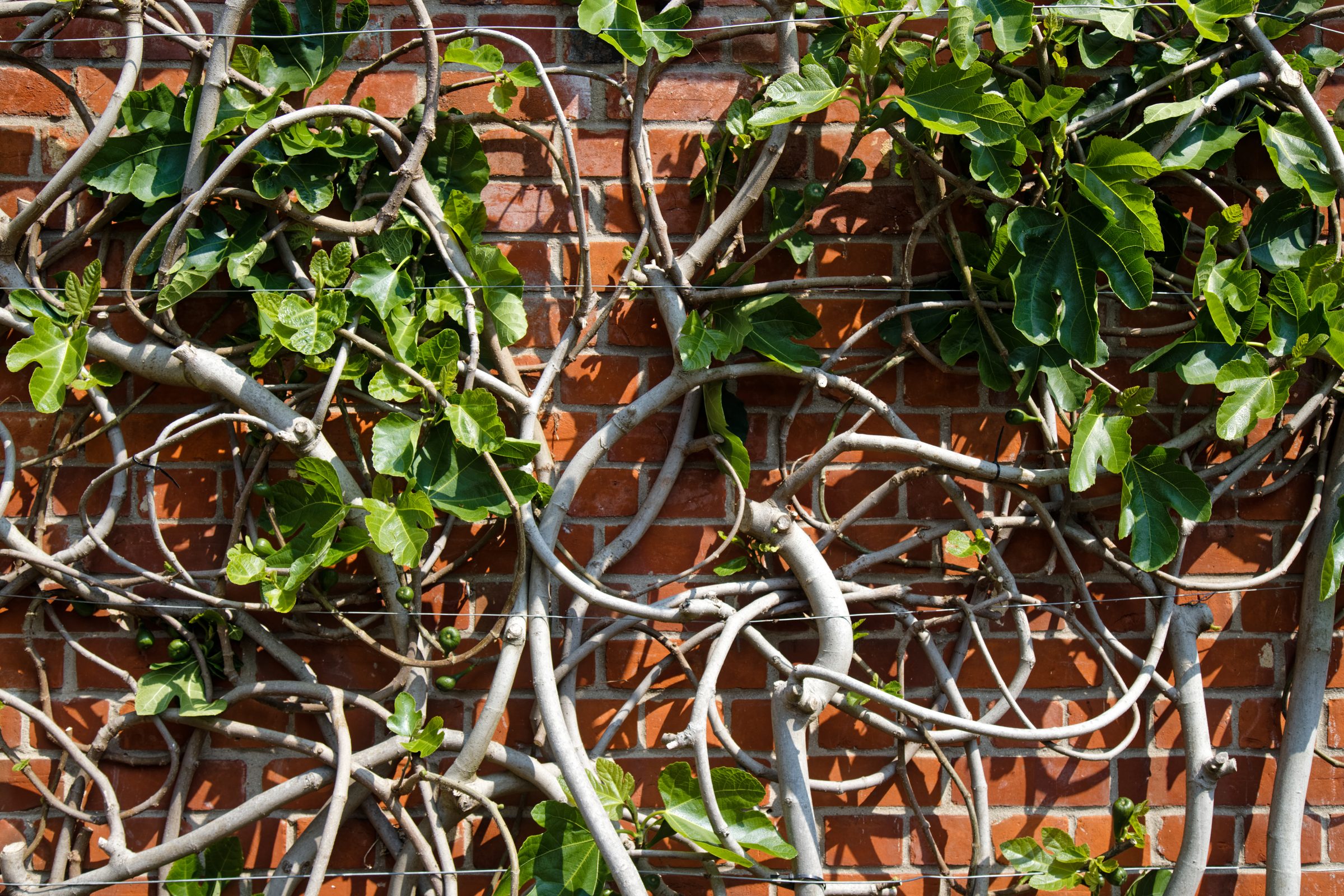 “Ficus carica Fig espalier” by Acabashi, CC BY-SA 4.0, via Wikimedia Commons
Figs grow well in large containers, which solves the winter protection problem entirely (move the pot into an unheated garage for dormancy) and provides the root restriction that some growers find improves fruiting. Dwarf varieties like Little Miss Figgy are bred for container culture. Standard varieties work in containers but need annual root pruning to manage size. Prune the same way: one-in-three for breba types, cutback for main-crop types.
When to Prune
The dry-weather rule
The same principle that governs grape pruning timing applies to figs: every pruning cut is a potential disease entry point, and wet wounds heal slowly. In the Puget Sound lowlands, late February through mid-March offers the best combination of dormancy and dry weather. Check your forecast and prune during a dry window of at least three to five days.
Avoid pruning in late fall or early winter. The tree has not yet entered full dormancy, new cuts are vulnerable to frost damage, and the months from November through January are the wettest of the year.
For main-crop varieties like Chicago Hardy, delay pruning until new growth shows you what survived winter. Mid-April is typical. Dead wood can be removed at any time.
Summer work
Summer pinching (described above) is the one exception to the dormant-season rule. Do this in June through mid-July. If you need to remove a broken branch, a root sucker, or an excessively vigorous water sprout during the growing season, make the cut, but be aware that fresh fig sap contains furanocoumarins that cause phytophotodermatitis: a skin reaction triggered by sunlight after sap contact. Wear gloves and long sleeves when cutting fig wood, especially in summer when sap flows freely.
Disease Considerations
Figs are remarkably disease-resistant compared to other fruit trees in this region. You will not face anything approaching the management intensity of apple scab or fire blight. But a few issues are worth knowing about during pruning.
Fig mosaic virus
Fig mosaic disease is the most significant pathogen of figs in this region. Symptoms include mosaic patterns and mottling on leaves, leaf distortion, and occasional premature fruit drop. The virus is transmitted by the eriophyid mite Aceria ficus and can also spread through contaminated pruning tools. There is no cure.
If you see mosaic symptoms, do not panic. Many infected trees produce acceptable crops for years. The management approach is to reduce stress (adequate water, proper nutrition) and prevent spread. Disinfect pruners with isopropyl alcohol or a 10% bleach solution between trees, especially between a symptomatic tree and a healthy one.
Canker and dieback
Occasionally shows up as dead branch tips or sunken, discolored bark. Remove affected wood by cutting at least 6 inches below visible damage. Timing matters: make these cuts during dry weather, same as other pruning, to minimize the chance of reinfection through the fresh wound.
Fruit rot
Improved air circulation from proper pruning (open center, adequate spacing between branches) is the best prevention. Remove any fruit that rots on the tree before it contacts healthy wood. In autumn, break off any half-grown figs that will not ripen before the rains arrive. Unripe fruit left on the tree through fall rains can decay and carry infection into the twig.
Common Mistakes
Following Mediterranean pruning advice. This is the mistake the guide opened with, and it bears repeating. If your source does not distinguish between breba and main crop, the advice assumes a main-crop harvest. For Desert King, Lattarula, and Negronne, that advice will cost you your figs.
Letting the tree grow too tall. Figs are vigorous. An unpruned tree adds 3 to 5 feet of height per year. Within a few seasons, every fig is out of reach and the birds harvest before you do. The one-in-three system and summer pinching exist to keep the productive zone where you can reach it.
Removing unripe fruit too late. Figs that are half-grown when fall rains begin will not ripen. They will rot on the branch and potentially introduce decay into the wood. Break them off once it is clear they will not mature. Better to lose the fruit than the branch.
Pruning during sustained rain. Less critical for figs than for grapes (fig wood is less susceptible to trunk disease pathogens), but wet wounds still heal more slowly and are more vulnerable to canker. Plan your pruning for dry weather.
Treating Brown Turkey like a main-crop variety. Brown Turkey produces both crop types, but here the breba is the reliable one. If you cut it back hard like a Chicago Hardy, you remove the breba wood and may get only a partial main crop that races the autumn rains to ripen.
Variety Quick Reference
| Variety | Crop Type | Hardiness | Pruning Method | Fruit | Ripening |
|---|---|---|---|---|---|
| Desert King | Breba only (San Pedro) | Zone 7-8b | One-in-three renewal | Green to white, sweet | Early Aug |
| Lattarula (Italian Honey) | Breba (+ some main) | Zone 7-8b | One-in-three renewal | Yellow-green, amber flesh | Aug |
| Negronne (Violette de Bordeaux) | Breba + some main | Zone 6-9 | One-in-three renewal | Dark purple, rich | Aug |
| Brown Turkey | Both | Zone 6-9 | Moderate renewal | Brown-purple, mild | Aug-Sep |
| Chicago Hardy | Main crop | Zone 5-8 | Hard cutback | Purple-brown, sweet | Sep |
| Olympian | Main crop | Zone 6-8 | Hard cutback | Purple, very sweet | Sep |
Seasonal Action Summary
| When | What | Why |
|---|---|---|
| Late Feb - mid-Mar | Prune breba-dominant figs using one-in-three renewal. Wait for a dry spell of 3-5 days. | Preserves breba crop; dry wounds heal faster |
| Late Feb - mid-Mar | Remove suckers, dead wood, crossing branches on all varieties. | Structural health; disease prevention |
| Mid-Apr | Assess winter damage on Chicago Hardy and Olympian. Remove dead wood; select strongest new growth. | Let the tree show you what survived before cutting |
| Jun - mid-Jul | Pinch new shoot tips at 3-5 leaves on breba-dominant varieties. | Forces branching; more breba sites next year |
| Late Jul - early Aug | Harvest daily during the 7-10 day breba ripening window. | Fruit quality declines rapidly; birds compete |
| Sep | Harvest main-crop figs on Chicago Hardy, Olympian if ripe. | Only some years; depends on summer heat |
| Oct | Break off unripe fruit before fall rains begin. | Prevents fruit rot carrying decay into wood |
| Nov - Jan | Protect young trees: wrap trunk with pipe insulation, mulch root zone. | Below 10°F causes damage; established trees resprout from roots |
Sources
- NW Fruit (Western Washington Fruit Research Foundation), “Home Fruit Garden Tour: Fig.” nwfruit.org
- Sonja Nelson, “The Fig Tree: A Horticultural Challenge.” WSU Extension / Skagit County Master Gardeners, 2024. WSU Extension PDF
- Rick Shory, “Growing Figs in the PNW.” 2019. rickshory.wordpress.com
- Cloud Mountain Farm Center, “Growing Figs in the Northwest.” cloudmountainfarmcenter.org
- Royal Horticultural Society, “Figs: Pruning and Training.” rhs.org.uk
- Tall Clover Farm, “Desert King Fig: At Home in the Pacific Northwest.” tallcloverfarm.com
Always read and follow the pesticide label. The label is the law.