You notice the sticky residue first. Something is dripping onto your car, your patio furniture, the hosta leaves underneath the dogwood. Then the black film shows up on the foliage, a sooty coating that does not wash off easily. Or maybe it is the other version: no stickiness at all, but the lilac by the fence has been declining for two years, and when you look closely at the bark you find it encrusted with small, grayish bumps you assumed were part of the branch.
Both problems are scale insects. But they are two different kinds, and the treatment that works on one does nothing to the other. Getting the identification right is the first decision, and it is the one that determines whether your management effort succeeds or wastes a season.
The Two Types: Armored vs. Soft
Scale insects are stationary sap-feeders in the order Hemiptera, relatives of aphids that abandoned movement in favor of a sedentary life cemented to a branch. Over 8,000 species exist worldwide; roughly 25 show up regularly in Puget Sound landscapes. They all look like bumps on bark. The similarity ends there.
Soft scales (family Coccidae) are the sooty mold culprits. They are larger, typically an eighth to a quarter inch across, dome-shaped, and their outer covering is the insect’s own body wall. They excrete honeydew, a sugary waste product that coats everything below the canopy and feeds the dark fungal growth you are seeing on your leaves. A single female can produce 1,000 to 3,000 eggs depending on species and host. Common soft scales here include lecanium scale, cottony maple scale, cottony camellia scale, and brown soft scale.
Armored scales (family Diaspididae) cause direct tissue damage without the mess. They are smaller, a sixteenth to an eighth of an inch, flat, and covered by a waxy plate that separates from the body underneath. They produce no honeydew and no sooty mold. What they do is suck cell contents from bark, leaves, and fruit until branches die back. Females produce roughly 100 eggs. Common armored scales here include oystershell scale, euonymus scale, San Jose scale, pine needle scale, and juniper scale.
The field test: Flip a bump with your thumbnail. If a waxy plate pops off and a soft-bodied insect sits underneath, it is armored scale. If the whole bump is the insect and nothing separates, it is soft scale. Crush test: a live scale exudes fluid; a dead or parasitized one is dry and hollow.
The honeydew test is even faster. Sticky residue under the tree means soft scale. No stickiness means armored scale (or that the problem is something else entirely).
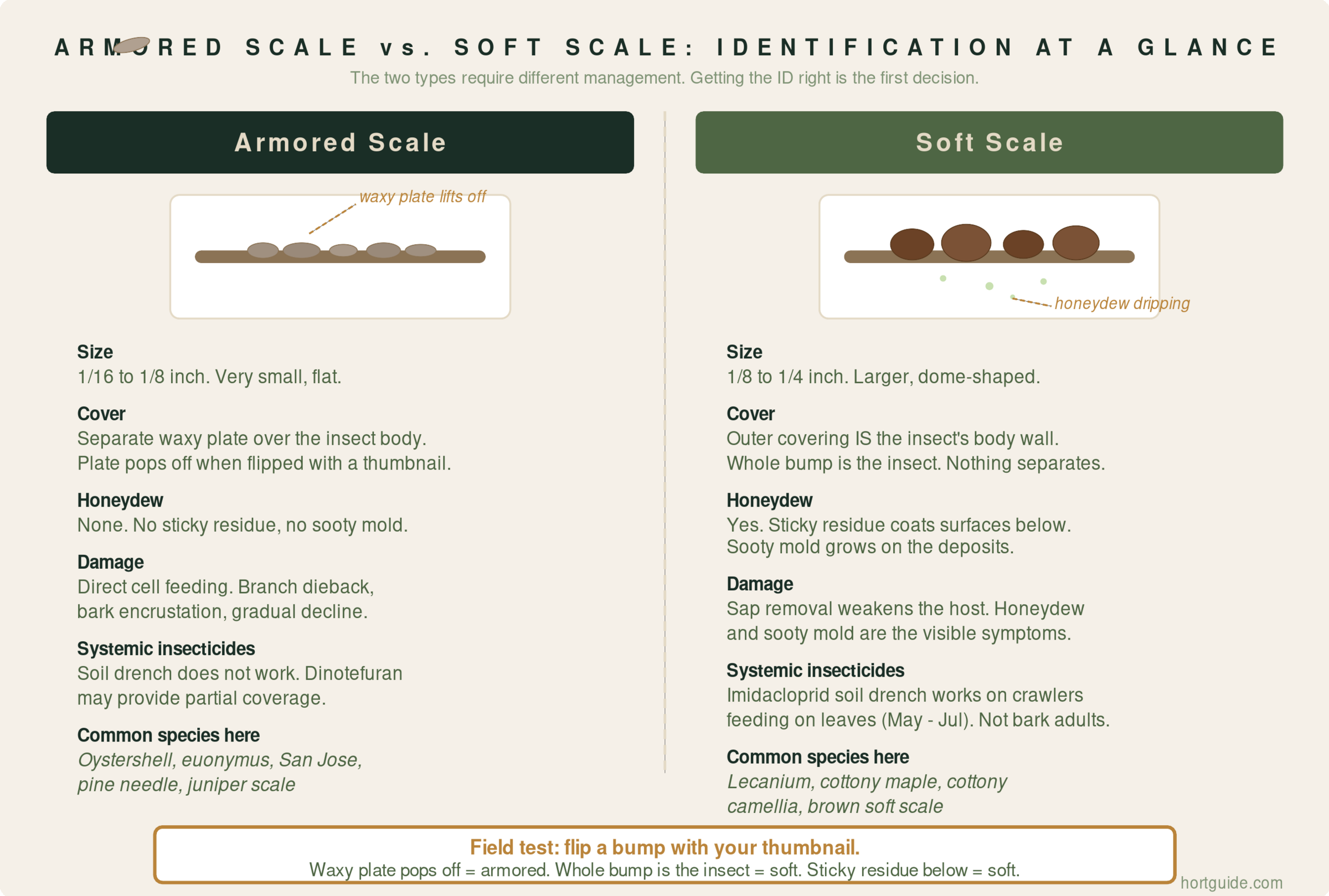
This distinction drives every management decision that follows. Systemic insecticides work on soft scales but not most armored scales. Dormant oil works on both. Natural enemies differ between the two groups. Wrong identification sends you down the wrong treatment path.
The Species You Will See Here
Lecanium Scale (Parthenolecanium spp.)
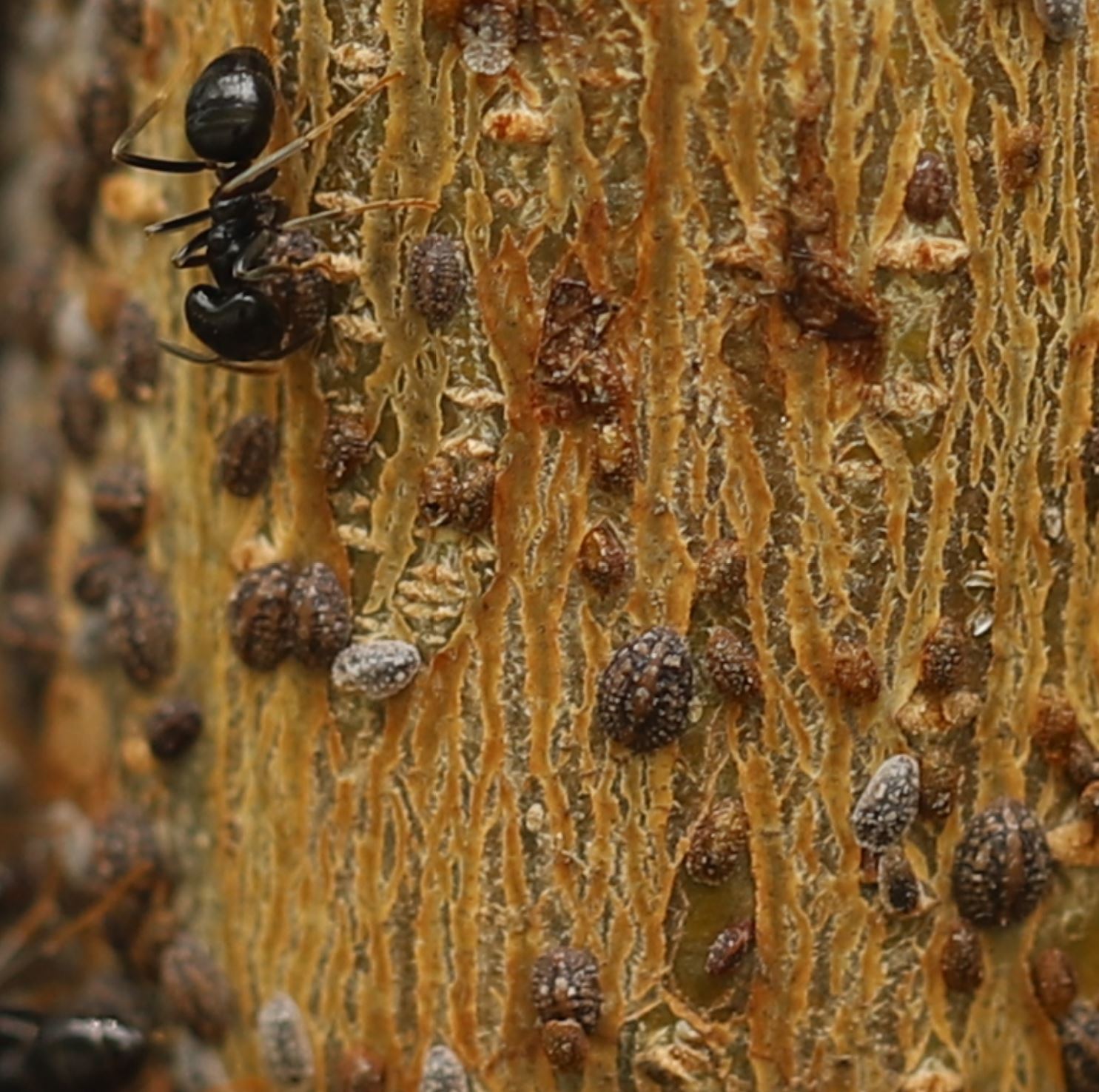 Lecanium scale on twig with attending ants. Photo: Slimguy, Wikimedia Commons, CC BY 4.0.
The most common soft scale in Puget Sound landscapes. Shiny brown helmets on twigs, an eighth to a quarter inch across, easy to mistake for a natural bud or bark feature until you realize they are everywhere. Hosts include dogwood, holly, camellia, filbert, yew, blueberry, and most fruit trees. One generation per year. Crawlers emerge mid-May to early June in this region, corresponding to roughly 3,400 to 3,600 GDD₃₂. WSU documents that natural enemies normally keep lecanium at below-damaging densities in diverse landscapes. When populations explode, it usually means something disrupted the predator-prey balance: a broad-spectrum spray application, excessive nitrogen fertilization, or ant colonies farming the honeydew.
Cottony Maple Scale (Pulvinaria innumerabilis)
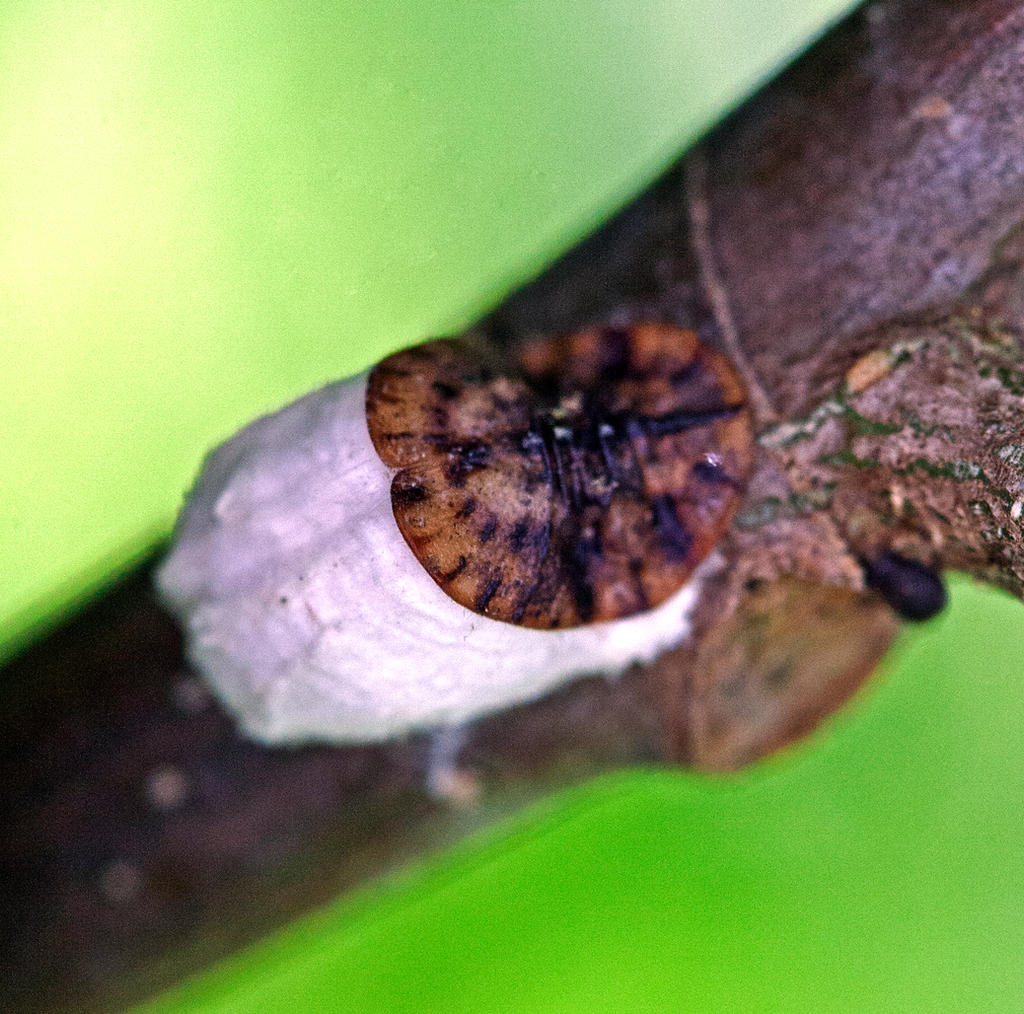 Cottony maple scale with white egg sacs. Photo: WanderingMogwai, Wikimedia Commons, CC BY-SA 4.0.
You will not miss this one. White, cottony egg sacs appear on maples in late spring, conspicuous against the dark bark, each containing up to 1,500 eggs. Silver maple and bigleaf maple are preferred hosts. Crawlers emerge around 3,600 to 3,700 GDD₃₂. Stressed and over-fertilized trees are more susceptible. The cottony masses look alarming, but healthy, vigorous maples usually tolerate moderate infestations without intervention.
Oystershell Scale (Lepidosaphes ulmi)
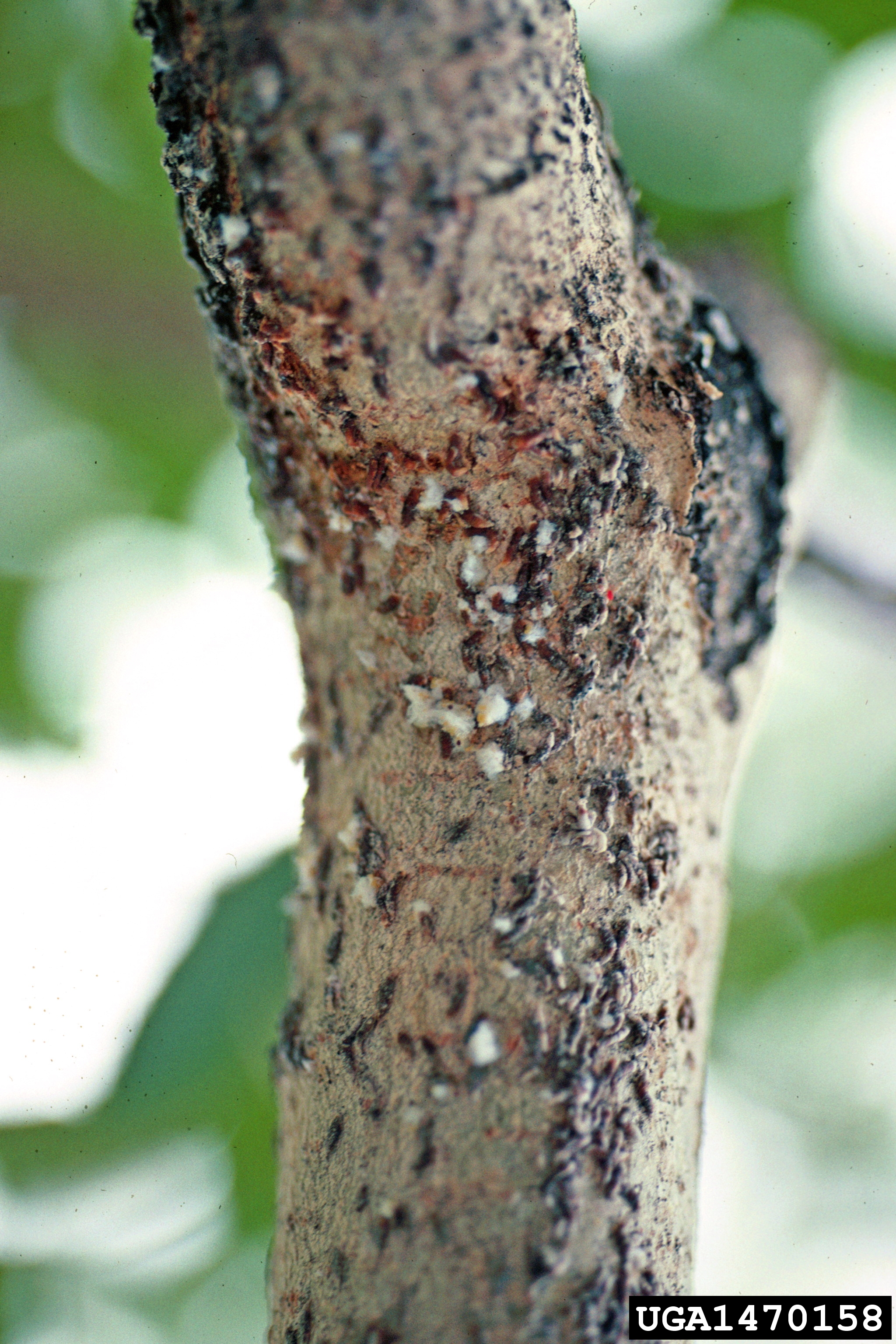 Oystershell scale encrusting bark. Photo: A. Steven Munson, USDA Forest Service, Wikimedia Commons, CC BY 3.0 US.
The most common armored scale you will encounter on deciduous shrubs and trees. Elongated, mussel-shaped, about an eighth of an inch long, grayish-brown, so well camouflaged on bark that heavy infestations go unnoticed until branches start dying. Hosts include lilac, birch, dogwood, ash, elm, and maple. Eggs hatch early, at roughly 2,500 to 2,800 GDD₃₂, making it the first crawler emergence of the common landscape species. Look for crawlers around the time lilac reaches full bloom.
Euonymus Scale (Unaspis euonymi)
Armored, and heavily associated with burning bush (Euonymus alatus) and wintercreeper (E. fortunei). Males are white and conspicuous on leaves; females are dark brown and camouflaged on stems. Crawler emergence at roughly 2,600 to 3,000 GDD₃₂, coinciding with black locust or pagoda dogwood bloom. This species produces a second generation in late summer around 5,700 GDD₃₂. A bright spot: resistant cultivars exist. E. alata ‘Compacta’ and E. fortunei ‘Acutus’ are seldom infested. E. japonica is extremely susceptible and should be avoided where euonymus scale pressure is established.
San Jose Scale (Diaspidiotus perniciosus)
Armored, tiny (a sixteenth of an inch), and capable of killing trees with repeated heavy infestations. Found primarily on fruit trees and some ornamentals. Unlike other armored scales, San Jose scale gives live birth rather than laying eggs, and crawlers can appear over an extended period. It has been in North America since the 1870s and remains a regulated pest in some fruit-growing regions. In residential landscapes, it is less commonly encountered than the species above, but when it shows up on an apple or pear it demands attention.
Other species you may encounter include cottony camellia scale on camellia, holly, and yew; pine needle scale on spruces and pines; and juniper scale on junipers and arborvitae.
Why They Thrive in This Climate
The Puget Sound lowlands present a paradox for scale management. Mild winters are the core problem: the lack of sustained hard freezes allows overwintering scale populations to survive at rates that would be lower in continental climates. Year-to-year persistence is high because winter never resets the population the way a Minnesota January does.
Cool, humid springs compound the issue. Beneficial insects that feed on scale, particularly parasitic wasps and lady beetles, are slower to become active in our extended cool springs. Scale crawlers can disperse and settle before predator populations catch up. Research has documented parasitism rates of 59 to 92 percent in scale nymphs where natural enemy communities are healthy and undisturbed, but those rates depend on warm weather mobilizing the parasitoids early enough to intercept crawlers.
Humidity also makes the cosmetic consequences worse. Sooty mold persists longer on foliage in our maritime air than it would in a dry climate, which makes soft scale infestations look more severe even when population levels are moderate.
Monitoring: Find Them Before They Find Your Tree
Scale insects are sessile, slow-building, and treatable when caught early. The monitoring calendar has three phases.
Dormant season (November through February). Scout bark and twigs for overwintering scale, particularly on plants that had problems last year. Flip bumps to check for live insects. Note which branches are heavily encrusted. This assessment determines whether a dormant oil application is warranted and where to concentrate coverage.
Crawler detection (April through June). Wrap small pieces of double-sided sticky tape around infested twigs. Check weekly with a hand lens. Crawlers show up as tiny yellow or orange specks stuck to the tape. For larger crawlers, hold a white sheet of paper under a branch and tap sharply; crawlers fall and become visible against the white background.
GDD tracking. Nearly all published crawler emergence thresholds use GDD base 50°F, but base 50 misses the mild heat that accumulates through our maritime springs; a 45°F day registers zero on a base-50 model but banks 13 degree-days on base 32. We convert to GDD₃₂ here because it tracks biological reality in this climate (see the growing degree days guide for the full rationale). The thresholds below are converted from published base-50 research through five years of Kent station data:
| Species | Crawler GDD₃₂ | Calendar Estimate | Phenological Indicator |
|---|---|---|---|
| Pine needle scale | ~2,200-2,600 | Early May | (none documented) |
| Oystershell scale | ~2,500-2,800 | Mid-May | Lilac full bloom |
| Euonymus scale (1st gen) | ~2,600-3,000 | Late May to early June | Black locust or pagoda dogwood bloom |
| Juniper scale | ~2,900-3,200 | Early to mid-June | (none documented) |
| Lecanium scale | ~3,400-3,600 | Mid-May to early June | Japanese stewartia bloom |
| Cottony maple scale | ~3,600-3,700 | Mid to late June | Littleleaf linden or ‘Annabelle’ hydrangea bloom |
| Fletcher scale | ~3,500-3,600 | Mid to late June | (none documented) |
When GDD₃₂ approaches the low end of the range for your target species, start taping. The phenological indicators give you a second confirmation: if the indicator plant is blooming, crawlers are active or imminent.
Ant trails. Ants running deliberately up and down a trunk or stem are often farming soft scale or aphid honeydew. Follow the ants and you will find the infestation. This is both a monitoring cue and a management target.
Management: The Two-Track Approach
Track 1: Cultural and Biological Control (Always First)
Healthy plants tolerate low to moderate scale populations without intervention. Right plant, right place. Avoid excessive nitrogen, which drives soft, sap-rich growth that favors scale reproduction.
Prune heavily infested branches. On small plants, scrub scale off with a soft brush or alcohol-dipped cloth. Physical removal is underrated and immediately effective.
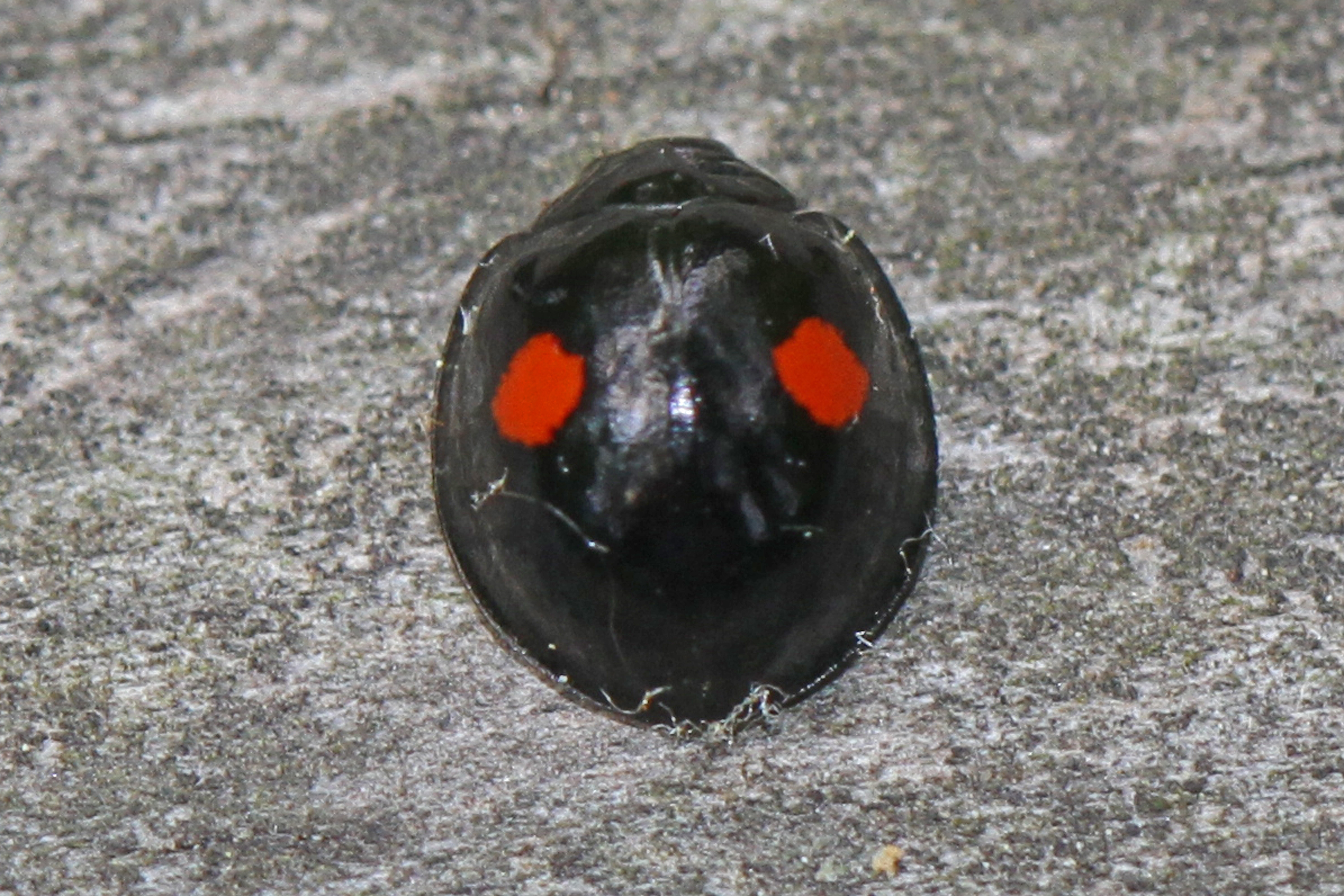 Twicestabbed lady beetle, a specialist scale predator. Photo: Judy Gallagher, Wikimedia Commons, CC BY 2.0.
Protect natural enemies. This is not a platitude. The natural enemy complex for scale insects is substantial: parasitic wasps (Aphytis, Encarsia, Metaphycus, Coccophagus, Blastothrix), lady beetles (the twicestabbed lady beetle Chilocorus stigma is a scale specialist), green lacewing larvae, and hover fly larvae. When these populations are intact and undisturbed, parasitism rates on scale nymphs reach 59 to 92 percent. A single broad-spectrum spray application that kills these predators can trigger a scale outbreak worse than the one you were trying to treat.
Break the ant bridge. This is the highest-impact single cultural intervention for soft scale. Ants farm honeydew-producing insects and aggressively attack approaching natural enemies, particularly lacewing larvae. Research on landscape trees demonstrated that excluding ants with sticky bands and basal trunk sprays reduced surviving scale nymphs by 54 percent after one growing season and 69 percent after two. On magnolia, ant exclusion alone reduced scale by 82 percent within a single year. Apply Tanglefoot or a similar sticky barrier around the trunk. For trees with rough bark, wrap the trunk with a band of fabric or duct tape first, then apply the sticky material to the band. Refresh the barrier when it fills with debris. This one action can tip the balance from a scale problem to a scale non-problem.
Flowering plants near susceptible trees provide nectar for parasitic wasps, extending their activity and reproductive success. Landscape diversity is a genuine management tool.
Track 2: Chemical Intervention (When Cultural Control Is Insufficient)
Dormant oil (January through February here). Horticultural oil applied during dormancy suffocates overwintering scale by sealing the breathing pores (spiracles) under their covers. Thorough coverage of bark and branch surfaces is essential. Apply when temperatures are above 40°F, with no rain forecast for 24 hours. For detailed application guidance, see the dormant oil sprays and dormant season spraying guides. Those guides cover the winter window; this section covers what comes after.
Crawler-stage contact treatments (spring, timed to GDD). Insecticidal soap, horticultural oil at summer rate (1 to 2 percent), or neem oil (azadirachtin) applied when crawlers are active. These require direct contact with the crawler, so timing and coverage matter. Plan on three or more applications at 7- to 10-day intervals to catch crawlers as they emerge over the hatching period. Soap and oil degrade quickly and have minimal impact on natural enemies when applied carefully.
Systemic insecticides (the nuance matters). This is where most national guides oversimplify. The standard recommendation is that imidacloprid soil drench controls soft scales. WSU clarifies the mechanism: root-drench systemics travel through the xylem (the water-transport tissue). They reach leaves effectively because xylem terminates there. But settled adult soft scales feeding on bark and twigs are tapping phloem (the food-transport tissue), not xylem. A soil-drench systemic does not reach them.
What imidacloprid soil drench does control is soft scale crawlers during the period they are actively feeding on leaves, roughly May through July for most species here. Once those crawlers settle back onto twigs and switch to phloem feeding, the systemic no longer reaches them. Dinotefuran is more mobile in plant tissue and may provide better coverage of phloem feeders than imidacloprid, and it is effective on both soft and armored scales.
Neither systemic insecticide works on armored scales through soil drench application.
The bee constraint is non-negotiable. Many common scale hosts are bee-attractive: linden, crabapple, cherry, maple, holly. Do not apply systemic insecticides to these plants during or within 30 days before bloom. For spring-blooming hosts, this means a soil drench should go in after petal fall, not before. The practical window for systemic application on bee-attractive hosts in this region is late May through July, after bloom but while crawlers are still on leaves.
What not to use. Carbaryl, malathion, and pyrethroids (bifenthrin, permethrin, cyfluthrin) kill scale’s natural enemies far more effectively than they kill scale. Pyrethroid use is directly associated with scale outbreaks. These products are counterproductive for scale management in a landscape setting.
The Sooty Mold Question
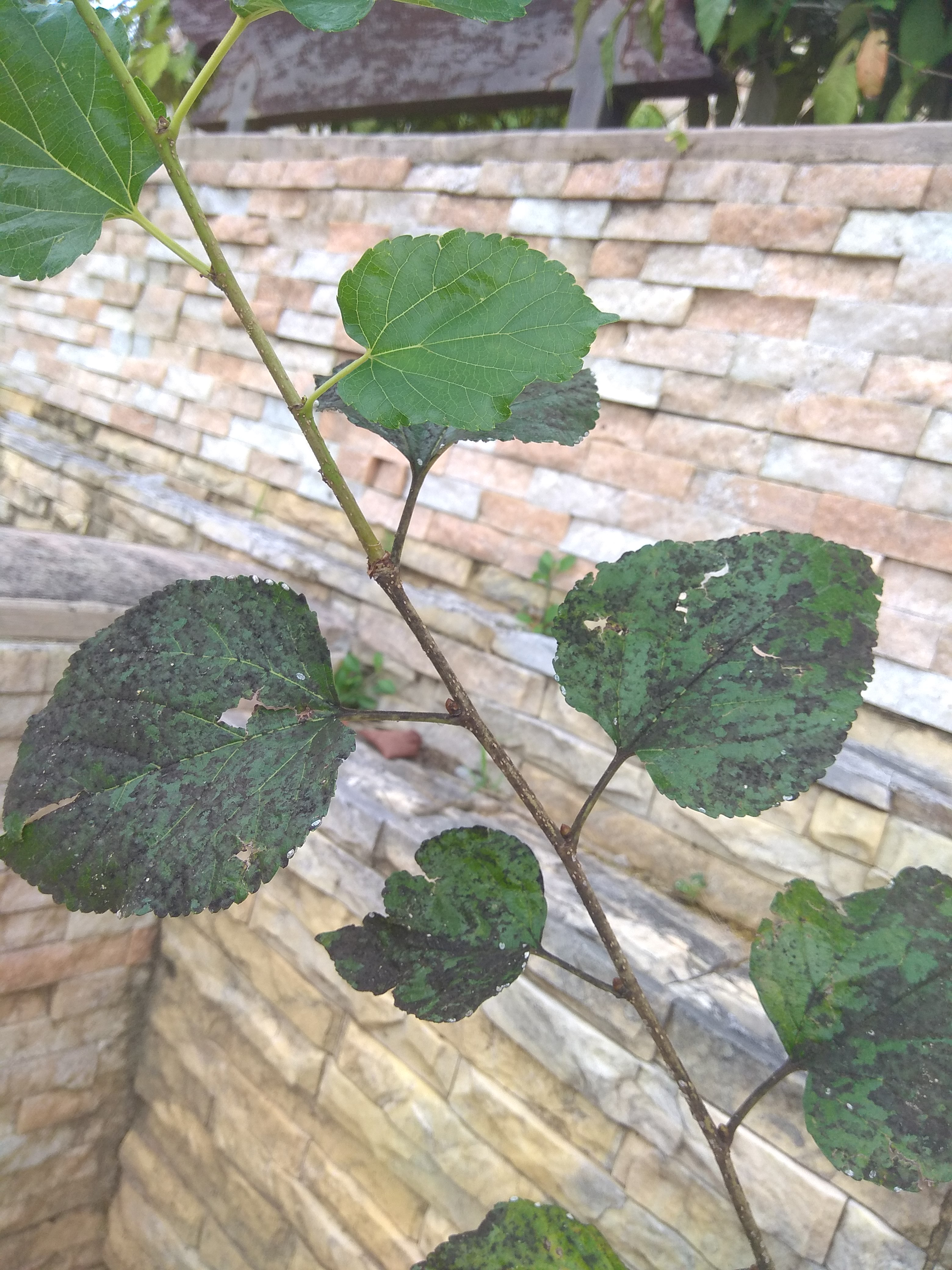 Sooty mold on mulberry leaves from honeydew deposits. Photo: Wee Hong, Wikimedia Commons, CC BY-SA 4.0.
Sooty mold is the black fungal coating on leaves and surfaces beneath soft scale (and aphid) infestations. It is cosmetic, not infectious: the fungus grows on honeydew deposits, not into plant tissue. Scrubbing it does not solve the problem because more honeydew keeps falling.
Control the soft scale and the honeydew stops. Sooty mold weathers away on its own over weeks to months. Do not waste effort treating sooty mold directly; treat the source.
The exception: heavy sooty mold coverage can reduce photosynthesis by physically shading leaf surfaces. If entire canopy sections are coated black and the plant is declining, the cosmetic problem has become a functional one, and prompt scale management is warranted.
Seasonal Action Summary
| When | What | Why |
|---|---|---|
| Nov - Dec | Scout bark for overwintering scale. Assess severity. | Determines whether dormant oil is needed and which plants to target. |
| Jan - Feb | Apply dormant oil on infested plants. Above 40°F, no rain for 24 hours. | Suffocates overwintering stages of both armored and soft scale. |
| Late Mar - Apr | Wrap sticky tape on infested twigs. Begin weekly monitoring. Track GDD₃₂. | Catches earliest crawlers (oystershell at ~2,500 GDD₃₂, euonymus at ~2,600 GDD₃₂). |
| Apr - Jun | Apply contact treatments (soap, oil, neem) at crawler emergence. Three or more applications. | Crawlers are the only mobile, exposed, vulnerable life stage. Timing is everything. |
| Late May - Jul | Systemic drench for soft scale on bee-attractive hosts (after petal fall only). | Targets crawlers while they feed on leaves. Does not reach bark-settled adults. |
| May - Jun | Apply or refresh ant barriers on trunks of soft-scale-infested trees. | Removing ants frees natural enemies and can reduce scale by 50 to 80 percent alone. |
| Jul - Aug | Assess treatment results. Monitor for second-generation euonymus scale crawlers. | Euonymus scale second generation emerges around 5,700 GDD₃₂ in late summer. |
| Sep - Oct | Final scouting. Note which plants need winter treatment. | Planning season for next year’s dormant oil applications. |
Sources
- Scale Insects - UC Davis IPM
- Scale Insects on Trees and Shrubs - UMN Extension
- Lecanium Scale (Oak Lecanium Scale) - University of Maryland Extension
- Parthenolecanium corni (European Fruit Lecanium Scale) - UMass Extension
- Vanek & Potter (2010). “Ant-exclusion barriers reduce scale populations.” Environmental Entomology 39(6):1829-1837. DOI: 10.1603/EN10093
- Camacho et al. (2018). “Predatory mite effectiveness against spider mites.” Journal of Economic Entomology 111(4):1558-1568. DOI: 10.1093/jee/toy102
- WSU PLS-63: Scale Insects (print reference)
Always read and follow pesticide label directions.