You read the canopy first. Smaller leaves on one side, thinning in the upper crown, a branch that died back since last summer. It looks like a pest problem, or maybe a disease. You check for aphids, for scale, for cankers. You find some. There are almost always some.
But the pests are not the story. They are secondary characters, opportunists that showed up after something else went wrong. The real problem is underground, in soil that was compacted by a contractor’s equipment three years ago, or roots that were trenched during a kitchen addition the homeowner forgot to mention, or a grade change that buried the root flare under eight inches of fill.
Most of the declining trees in residential landscapes here are not sick. They are stressed, and the stress started in the root zone months or years before the canopy showed anything. The pests and diseases you find are real, but treating them without fixing the site is like taking cough medicine for pneumonia.
This is the pattern arborists call the stress exploiter cascade. Armillaria root rot colonizes trees whose roots are already oxygen-starved from compaction. Phytophthora takes hold in waterlogged sites that healthy drainage would have prevented. Bronze birch borer targets birches under drought stress. The pathogen or insect is real and may need treatment. But it will come back if the site problem stays.
What the Soil Is Actually Doing
Healthy soil is roughly half solid material and half pore space, divided between air and water. Tree roots need both. When air-filled porosity drops below about 10%, most roots cannot get enough oxygen to function. They stop growing, stop absorbing water, and begin to die.
Compaction destroys pore space by crushing the gaps between soil particles. Bulk density, the weight of dry soil per unit volume, is the standard measure. In fine-textured soils like clay and silt loam, root growth becomes restricted in the range of 1.4 to 1.6 g/cm³. In coarser sandy soils, the threshold is higher, around 1.7 g/cm³. A penetrometer reading above 2.0 MPa (about 290 psi) means roots are struggling; above 3.0 MPa, they are largely excluded. The first four passes of heavy equipment over a site cause the greatest increase in bulk density. After that, the damage is mostly done.
Poor drainage compounds the problem. When water cannot move through compacted or restrictive soil, oxygen drops, anaerobic conditions develop, and root-rotting pathogens find exactly the environment they need. The sequence is mechanical: compaction reduces drainage, poor drainage reduces oxygen, low oxygen kills roots, dead roots invite disease. Each step makes the next one worse.
On Alderwood soils, which dominate residential development across the Seattle-Tacoma corridor, this plays out as a paradox. The densic contact layer (glacial till) at 20 to 40 inches creates a hard ceiling on rooting depth. In winter, a perched water table at 12 to 36 inches saturates the root zone for months. In summer, the same restricted depth means roots cannot reach deep moisture. The tree drowns in February and drought-stresses in August, from the same root restriction.
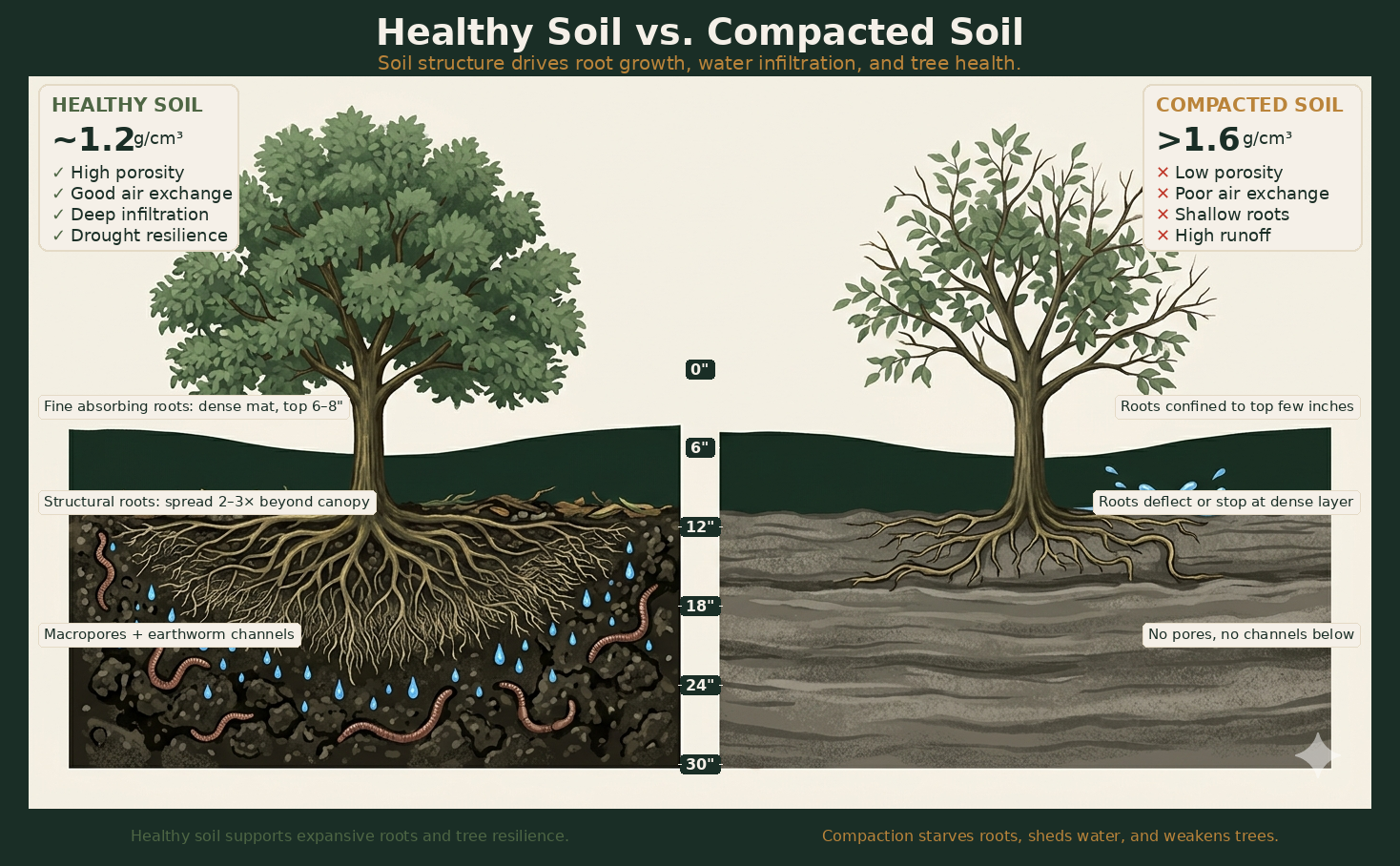 Healthy soil (left) supports a wide root plate, deep infiltration, and active soil biology. Compacted soil (right) confines roots to the surface, sheds water as runoff, and eliminates the pore space roots need.
One distinction is worth keeping. Texture, the ratio of sand, silt, and clay particles, is fixed. You inherited it from the last glacier. Structure, the way those particles aggregate into clumps with pore space between them, is improvable. That is where remediation works, and where damage happens. Texture tells you what you are working with; structure tells you how well it functions.
Five Site Factors That Kill Trees Slowly
Construction Damage
The most common cause of tree decline in established residential neighborhoods. Equipment compacts the critical root zone. Trenching for utilities severs absorbing roots. Grade changes bury the root flare or expose protected roots to drying. Often all three happen on the same project. The first four vehicle passes cause the greatest increase in bulk density; by the time the concrete truck arrives, the damage is done.
The timeline makes construction damage hard to connect to symptoms. A tree can lose a quarter or more of the roots in its critical root zone and show nothing in the canopy for three to seven years. The homeowner forgets the remodel happened. The arborist who shows up in year five sees dieback and secondary pathogens, not the equipment that staged materials under the drip line.
Grade Changes and Fill
The common assumption is that adding fill soil over roots kills them. The research tells a different story. Work from Cornell’s Urban Horticulture Institute found that fill soil alone did not reduce tree growth. The damage came from compaction and root disturbance during the process of adding the fill, the equipment driving across the root zone, the grading that sheared roots, the mechanical disruption. The fill itself was a secondary factor.
This matters because it changes what you protect. Preventing the compaction and root damage matters more than preventing the fill. When builders must change grade, careful hand placement of uncompacted material over an undisturbed root zone is survivable. A loader dumping and spreading clay fill while tracking across the roots is not.
Restricted Rooting Volume
Parking strips, sidewalk pits, raised planters, tree wells surrounded by impervious surface. Research from the Morton Arboretum found that the average sidewalk-pit tree lives about ten years. The root system hits the curb, the foundation, and the compacted base layer under the pavement. It runs out of room.
Impervious surface coverage quantifies the problem. Below 33%, trees generally perform well. Between 33% and 66%, performance is fair but declining. Above 67%, conditions are poor, and pest pressure increases dramatically: research from NC State and University of Florida documented pest abundance over 200 times higher at the most heat-stressed urban sites. The impervious surface is not just restricting roots. It is raising soil and canopy temperatures, reducing gas exchange, and altering hydrology around the tree.
Salt Accumulation
Four scenarios recur in this region: shoreline exposure from salt spray, deicer runoff from driveways and roads in winter, over-fertilized containers where salts build up because there is no flushing volume, and hard water irrigation in sites with alkaline well water. The diagnostic feature of salt injury is always the site context. Brown leaf margins look like drought, sunburn, or nutrient deficiency. What separates salt damage is where the tree is standing and what has been applied to the soil around it.
pH-Driven Nutrient Lockout
Concrete foundations, sidewalks, and alkaline construction fill raise soil pH. Above 7.0, iron becomes unavailable even when it is present in the soil. The tree shows interveinal chlorosis, yellow leaves with green veins, that does not respond to fertilizer because the nutrient is locked in the soil chemistry, not absent. Manganese follows the same pattern at high pH. If the chlorosis is on a tree planted near a foundation or in imported fill, test the pH before you reach for chelated iron.
The Three-to-Seven-Year Delay
This is the part that fools everyone, including professionals.
A mature tree stores enough energy in its root system, trunk, and branches to sustain a full canopy for years after the root zone is compromised. It draws down reserves like a savings account. The canopy stays green. The leaves look normal. The homeowner says the tree is fine. The landscaper says the arborist was wrong.
I wrote a report on a row of large western red cedars after a condo complex was built next to them. The excavation contractor had made drastic soil cuts for retaining walls, and the landscape contractor wanted to know if the cuts would affect the trees. I told them the trees would eventually fail.
For the first couple of years, nothing happened. The canopy stayed full. The landscape contractor came back and told me I was wrong. I kept driving past the site.
Around year five, the canopy started to thin. By year seven, the HOA paid to have those trees removed.
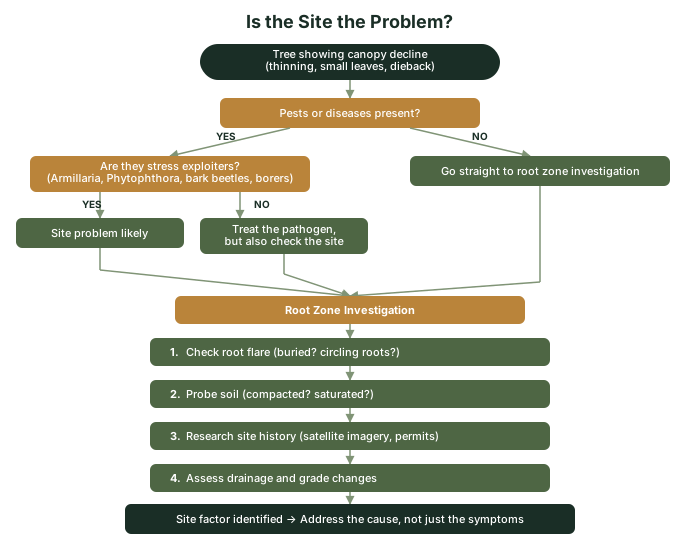 Diagnostic flowchart for site-related tree decline. All paths lead to root zone investigation.
The delay is not mercy. It is the most dangerous feature of site damage, because it breaks the cause-and-effect connection in people’s minds. The construction happened in 2019. The tree looked fine in 2020 and 2021. Nobody connects the dieback in 2024 to the equipment that drove across the root zone five years earlier.
Research on urban tree stress quantifies why the combination is lethal. Research from NC State’s entomology program tracking gloomy scale on urban red maples found that pest density increased over 200 times across sites that differed by roughly two degrees Celsius in canopy temperature. Trees survived any single stress (heat alone, drought alone, pests alone). But the combination cascaded: hot, drought-stressed trees with heavy pest loads lost canopy dramatically compared to trees facing the same heat with adequate water. The single-stress survival is what gives the false confidence. The cascade is what kills.
One diagnostic move anyone can learn: check the site history before you diagnose the canopy. Google satellite imagery shows construction timelines, equipment staging, material storage yards. Street View’s time-lapse feature reveals grade changes, removed trees, new impervious surfaces. Permit records confirm the scope of work. When a tree starts declining with no obvious pest or disease cause, the satellite imagery from three to seven years earlier usually has the answer.
Why This Matters More Here
The soil under your property is not the same as the soil two miles away. The Puget Sound lowlands are a patchwork of glacial deposits, alluvial valleys, and marine sediments, and the soil series that resulted from those processes behave very differently from each other. Woodinville silt loams on the valley floor are winter-wet but have no hardpan ceiling, so deep rooting is possible when drainage improves in summer. Bellingham series soils are true clay with shrink-swell properties, requiring a different management approach entirely. Everett series soils drain so fast they create the opposite problem: summer drought stress on shallow-rooted plants even without a restricting layer. Web Soil Survey will tell you which series is under your property. Knowing the answer changes what you plant and how you protect it.
Alderwood series soil deserves special attention because it underlies most residential development from Everett to Olympia. If you live in the Puget Sound lowlands, you are probably standing on it.
The Alderwood problem is structural. Glacial till at 20 to 40 inches depth creates a densic contact layer that roots cannot penetrate. That layer is not going anywhere. Above it, the soil is a gravelly sandy loam with decent structure when undisturbed. Below it, nothing grows. The effective rooting volume on Alderwood is whatever sits above the hardpan, and that volume fills with water from December through April as the perched water table rises to 12 to 36 inches below the surface.
This creates the central paradox of tree care in this region. The same root restriction that drowns roots in winter prevents deep moisture access in summer. A tree on undisturbed Alderwood can manage this if its surface root system is intact, spreading laterally through the upper horizon where drainage is adequate. But compact that upper horizon with equipment, sever those lateral roots with a trench, or bury the root flare with fill, and the tree loses its only functional rooting zone. The hardpan underneath was already the limiting factor. Now the surface soil is compromised too.
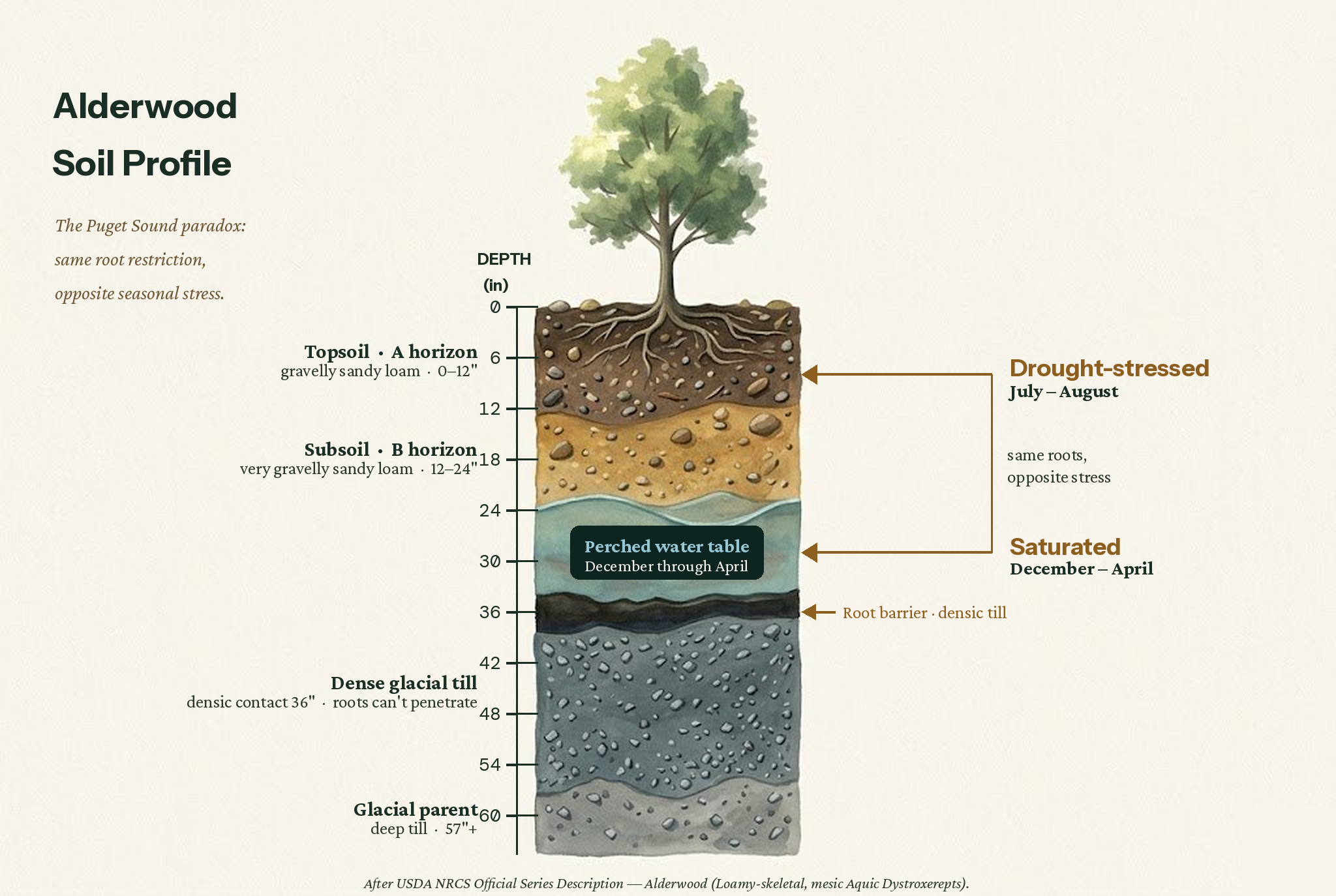 Alderwood soil profile. The same root restriction causes saturated conditions in winter and drought stress in summer.
Fill soil over Alderwood adds depth above the hardpan, but the original drainage restriction persists below. The fill itself may be fine. The problem the fill was meant to solve has not changed.
What You Can Do About It
Prevention outperforms every remediation technique by an order of magnitude.
Match the species to the site. A tree that tolerates wet winter soils and moderate summer drought will survive on Alderwood where a species adapted to deep, well-drained soils will not. Species-site matching is the highest-leverage decision you make. If construction is planned, mark the critical root zone with fencing before equipment arrives. The cost is negligible. The alternative is replacing the tree in seven years.
When compaction has already occurred, remediation options exist but take years to show results. Radial trenching, cutting narrow trenches radiating outward from the trunk and backfilling with amended soil, improved fine root density by 320% and rooting depth by 68% in Morton Arboretum trials on mature white oak. Air spading combined with biochar and mulch was the most effective long-term combination in a separate five-year study. Vertical mulching, drilling holes into compacted zones and filling with organic material, addresses compaction at depth that surface treatments cannot reach.
Mulch is the single most cost-effective intervention for trees on stressed sites. Two to four inches of arborist chips spread to three times the trunk diameter, kept away from the trunk, moderates soil temperature, retains moisture, feeds soil biology, and gradually improves structure in the upper horizon. It is not a cure for a severed root system or a buried hardpan. But for a tree on compacted soil, it buys time and supports recovery while the root zone restructures.
When to call an arborist: if you suspect root severance from construction, significant compaction over a large portion of the root zone, or a grade change that altered drainage, an ISA Certified Arborist can assess the extent of damage and whether the tree is recoverable. If the problem is cultural, no mulch, buried root flare, poor drainage from a downspout aimed at the root zone, you can act directly.
When to Assess
| When | What | Why |
|---|---|---|
| March-April | Assess drainage and soil saturation around declining trees | Peak perched water table on Alderwood; root stress visible before leaf-out |
| June-July | Check for drought stress on restricted sites | First dry month reveals trees whose roots cannot access deep moisture |
| After any construction | Inspect for compaction and root zone disturbance | Damage is invisible at the surface; symptoms may not appear for 3-7 years |
| Fall (Oct-Nov) | Evaluate overall canopy condition before leaf drop | Full-season cumulative stress most visible in fall canopy quality |
If you suspect site-related tree decline, an ISA Certified Arborist can assess root zone conditions and recommend whether remediation or replanting is the better path forward.
Sources
Peer-reviewed research:
- Hirons, A. D. & Thomas, P. A. 2020. “Managing Soil Compaction Around Trees.” ISA Arborist News, October 2020. Bulk density thresholds, penetrometer limits, vehicle-pass compaction data.
- Watson, G. W. et al. 1996. Radial trenching efficacy on mature white oak: root density and rooting depth improvements. Cited in Watson & Custic 2014.
- Fite, K. et al. 2023. “The Influence of Soil Decompaction and Amendments on Soil Quality.” Arboriculture & Urban Forestry 49(4). Five-year soil remediation comparison (air spading, biochar, mulch).
- Day, S. D., Bassuk, N. L., & van Es, H. 2004. “Effects of Four Compaction Remediation Methods for Landscape Trees on Soil Aeration, Mechanical Impedance, and Tree Establishment.” Arboriculture & Urban Forestry 30(1). Fill soil study.
- Watson, G. W. & Custic, S. 2014. “Management of Tree Root Systems in Urban and Suburban Settings II.” Arboriculture & Urban Forestry 40(5). Sidewalk-pit lifespan data.
- Dale, A. G. & Frank, S. D. 2014. “The Effects of Urban Warming on Herbivore Abundance and Street Tree Condition.” PLOS ONE. Pest density and temperature data. Also summarized in Frank, S. D. 2019. “The Vicious Cycle of Stress.” ISA Arborist News, February 2019, pp. 44-47.
Extension and government sources:
- USDA NRCS. Alderwood Series Official Soil Description. Densic contact depth and perched water table data.
- Gilman, E. F. et al. “Impervious Surface Thresholds for Sustainable Urban Tree Planting.” NC State Extension. Quantitative framework for surface coverage effects.
- University of Georgia Extension. Construction Damage to Trees. Grade change thresholds and decline timeline.