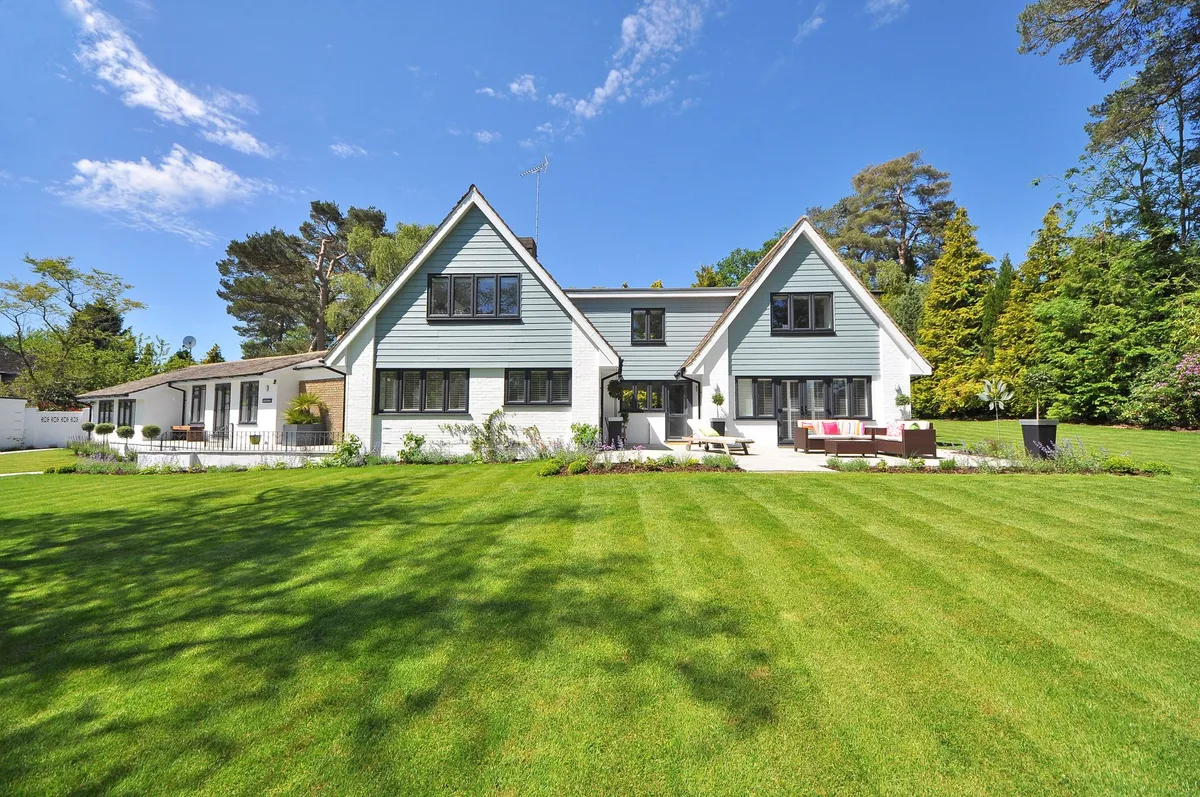
Some time between late May and mid-July, the rain stops. Not gradually. One week you are mowing twice because the grass is growing faster than you can keep up, and the next week the sprinkler heads come on and you are in a different season. The smell of that first cut after the spring flush is the closest thing this region has to a calendar marker: summer lawn care starts now.
If you followed the early spring lawn care sequence, your lawn has been aerated, fertilized, overseeded, and mowed back into shape. Everything in that guide was about recovering from winter. Everything in this guide is about surviving summer, and it starts with a question most lawn care advice refuses to ask: how much effort do you actually want to put into this?
What Happens Underground
The grass above ground looks fine through June. What you cannot see is that the roots are already losing ground.
Cool-season grasses, the perennial ryegrasses and fine fescues that make up most lawns here, grow roots best when soil temperatures sit between 50 and 65 degrees. At Kent, soil at two inches averages around 62 degrees in June. By early July it crosses 67 degrees and stays there through August. That is above the threshold where root growth slows sharply. The roots that were building through March, April, and May begin dying back, and new roots cannot replace them fast enough.
This is the fundamental problem behind every summer lawn complaint. The grass cannot grow roots fast enough to keep up with the water those roots need to supply. It is not that summer is too hot for cool-season turf. It is that the soil is too warm for root replacement while the air above demands more water than a shrinking root system can deliver.
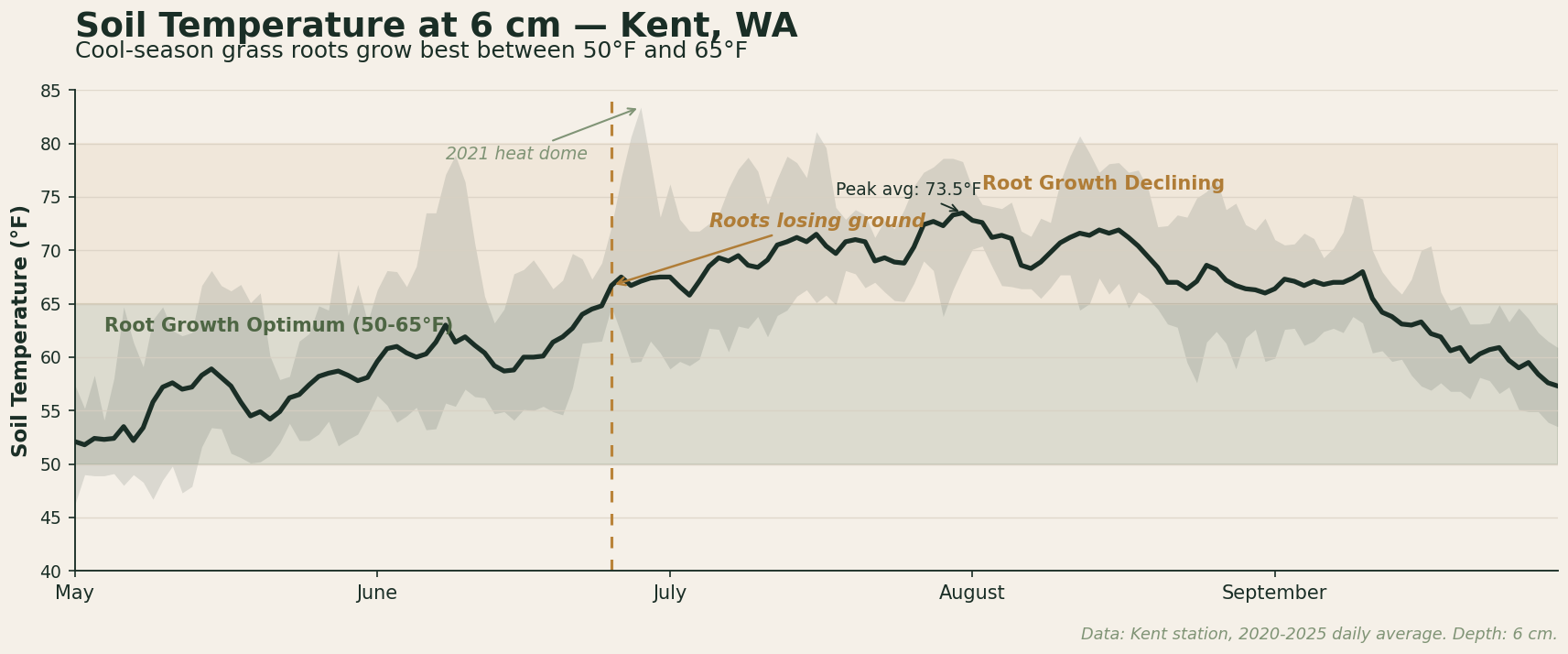 Soil temperature at 6 cm, Kent station, 2020-2025 daily average. The green band marks the root growth optimum (50-65°F). Once soil crosses that ceiling in late June, root replacement slows and the lawn becomes progressively more drought-vulnerable.
Six years of Kent weather data (2020 through 2025) put the surface conditions in context: the Puget Sound lowlands average 28 days above 80 degrees per summer, with a peak around 94 degrees in a typical year. The longest dry streak runs 9 to 27 days depending on the year. Total summer rainfall ranges from 3.3 to 5.9 inches, scattered across 15 to 37 rain days. That is not zero rain, but it is not enough. And the date when dry weather settles in shifts by ten weeks from year to year, from early May in some seasons to mid-July in others. You cannot calendar your irrigation start date. You have to watch for it.
Three Paths Through Summer
Most lawn care advice presents a binary: water it or let it go brown. That framing comes from climates with hotter, longer, drier summers than ours, where the choice really is all or nothing. Here, the maritime conditions create a third option that most guides never mention, and it is the one most homeowners in this region already follow without realizing they have a name for it.
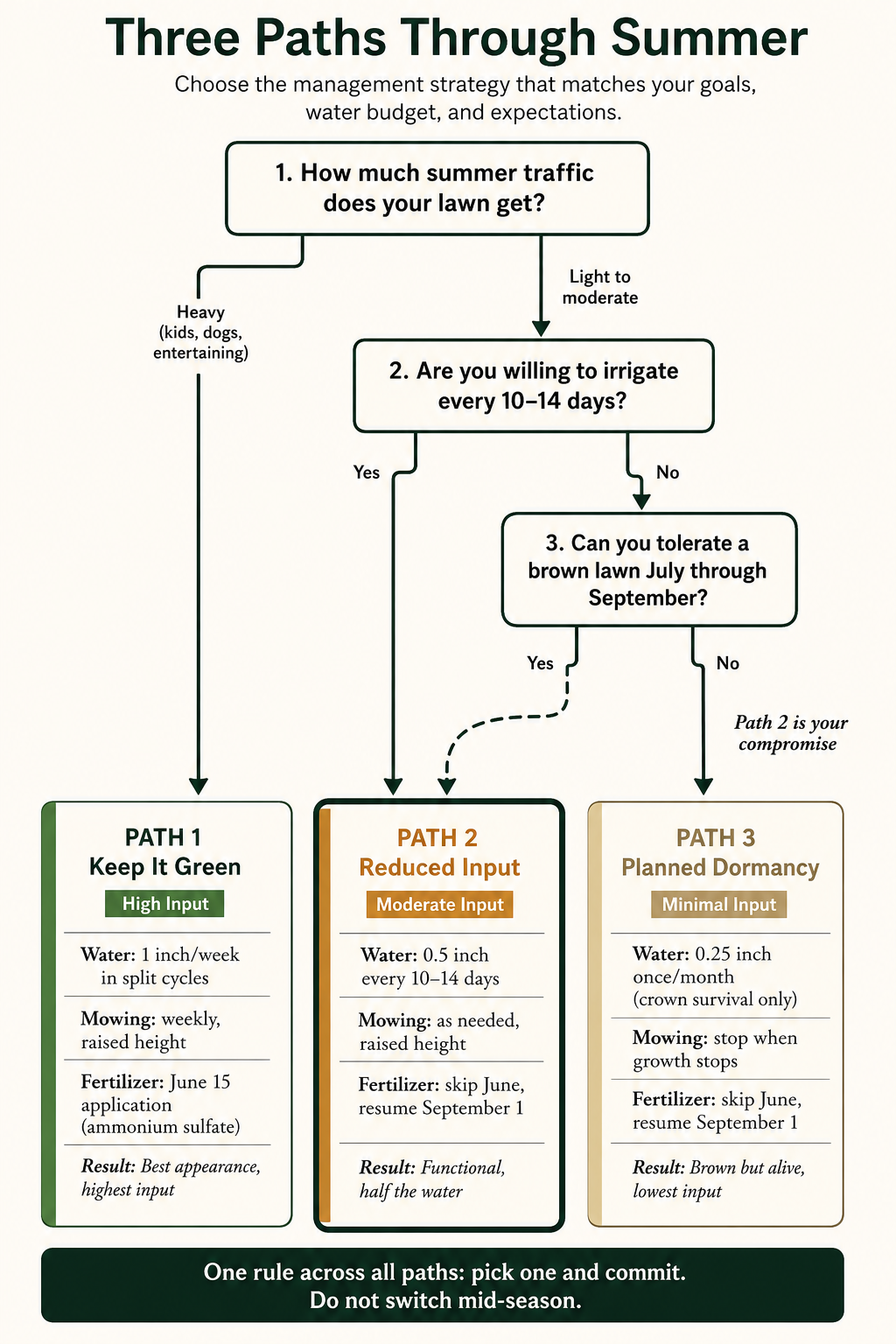 Summer lawn care decision tree. Choose the management strategy that matches your goals, water budget, and expectations.
Path 1: Keep it green
Irrigate about one inch per week, mow weekly, apply the mid-June nitrogen. This is the WSU-recommended full-maintenance approach. It produces the best-looking lawn and it works. Choose this path if the lawn gets heavy use through summer: kids, dogs, entertaining, foot traffic.
Path 2: Reduced input
Irrigate half an inch every ten to fourteen days. Raise the mowing height. Skip the June fertilizer. The lawn will not look magazine-perfect, but it stays green enough to use, recovers faster in fall than a fully dormant lawn, and uses roughly half the water of Path 1.
This is the path most Puget Sound lawns end up on by default. The homeowner starts with good intentions about watering every other day, life gets busy, the sprinklers run every week and a half, and the lawn looks fine. The problem is not the approach; it is that nobody validates it. That changes here.
Path 3: Planned dormancy
Stop irrigating. Stop mowing when growth stops. The grass turns brown, the crowns go dormant, and the lawn waits for fall rain. Water one quarter inch once a month to keep crowns alive, and do nothing else until September.
Planned dormancy works here better than the national literature suggests. Perennial ryegrass survives 45 to 60 days without water. Fine fescues handle about four weeks. In this region, the longest dry stretches rarely exceed 27 days, and most summers include enough scattered rain to extend survival well past those minimums. For years I let most of my own lawn go dormant through summer and irrigated only the patch the kids used. It works. The grass comes back.
The one rule across all three paths
Pick one and commit to it. The worst thing you can do is oscillate: let the lawn go dormant for two weeks, panic and irrigate heavily, then let it go dormant again. Each cycle of dormancy and rehydration depletes the carbohydrate reserves the grass needs to survive. A lawn that stays consistently dormant recovers well. A lawn that gets jerked back and forth may not.
Irrigation on Clay
If you chose Path 1 or Path 2, you are watering. And if you are watering on the clay soils that dominate the Puget Sound lowlands, the standard advice (“one inch per week, apply in one session”) creates more problems than it solves.
Clay accepts water slowly. If you run a sprinkler for 45 minutes straight, the first 20 minutes soak in and the last 25 run off the surface, down the slope, and into the street. The lawn gets half the water you applied and the sidewalk gets a bath.
Split your watering into two cycles. Run the sprinkler for 20 minutes, wait an hour for the water to soak in, then run another 20 minutes. On slopes or heavy clay, three shorter cycles work even better. The goal is to wet the top six inches of the root zone without exceeding the soil’s infiltration rate.
When to water. Early morning, before 8 AM. In this region, dew sits on grass blades through most summer mornings regardless of whether you irrigated. Watering at dawn does not meaningfully extend the leaf-wetness period. Watering in the evening does, and leaf wetness overnight is the single biggest driver of fungal disease on turf.
How to know when. Walk across the lawn in the late afternoon. If your footprints stay visible for more than a few seconds, the grass is starting to wilt and it is time to water. If the footprints spring back, the grass has enough moisture. This is more reliable than any schedule because it responds to what the grass actually needs, which changes week to week based on temperature, wind, cloud cover, and whether it rained Thursday.
How much. Set out a few empty tuna cans or cat food cans across the sprinkler’s coverage area. Run it until the cans hold half an inch (Path 2) or one inch (Path 1) total across your split cycles. Measure once, note the time, and use that as your baseline.
Summer Mowing
Raise the mowing height. This is the single most underrated summer lawn practice.
The early spring guide set mowing heights at the standard range for each grass species: 1.25 to 1.5 inches for perennial ryegrass and fine fescues, 1.5 to 2 inches for tall fescue. For summer, raise those settings by half an inch to an inch.
| Grass type | Spring height | Summer height |
|---|---|---|
| Perennial ryegrass | 1.25 to 1.5 inches | 2 to 2.5 inches |
| Fine fescues (red, chewings, hard) | 1.25 to 1.5 inches | 2 to 2.5 inches |
| Tall fescue | 1.5 to 2 inches | 2.5 to 3 inches |
Taller grass blades shade the crown and soil surface. Shaded soil stays cooler, which slows evaporation and gives roots a slightly better temperature environment. Taller blades also mean more leaf area for photosynthesis, which supports root growth at exactly the time roots need the most help.
Mow when the grass needs it, not on a schedule. During hot dry stretches, growth slows to almost nothing. Running a mower over a stressed, barely growing lawn is worse than letting it get a little tall. The one-third rule still applies: never remove more than one-third of the blade height in a single mowing.
Continue leaving clippings on the lawn. They decompose quickly and return nitrogen. The only exception: if you are seeing red thread or rust on the blades, bag those clippings to reduce spreading the fungus.
If you have not sharpened the mower blade since spring, do it now. Dull blades tear grass instead of cutting it, leaving ragged tips that brown and invite disease. A mid-season sharpening makes a visible difference.
The June Fertilizer Decision
The WSU fertilizer schedule for this region calls for four applications: mid-November through early December, April 15, June 15, and September 1, each at one pound of nitrogen per thousand square feet.
If you are on Path 1, follow it. Apply the June 15 nitrogen. Use ammonium sulfate as the source. It costs less than blended fertilizers, releases nitrogen immediately even in warm soil, and the sulfur component (at two to three pounds per thousand square feet per year) suppresses red thread, turf rusts, and take-all patch. That is three diseases reduced by the act of fertilizing.
If you are on Path 2 or Path 3, skip the June application. Pushing nitrogen into a lawn that is about to receive less water creates a flush of blade growth on a root system that cannot support it. The grass grows lush on top and weakens underneath, which is exactly the combination that makes it most vulnerable to drought stress. Save the nitrogen for September 1, when the fall recovery application does the most good.
One hard rule regardless of path: never fertilize during or immediately before a heat wave. Nitrogen plus heat plus drought equals fertilizer burn.
Summer Diseases Worth Knowing
The most common summer lawn diseases in the Puget Sound lowlands are not the ones national guides emphasize. If you have been reading about brown patch and dollar spot, you can probably relax.
Red thread
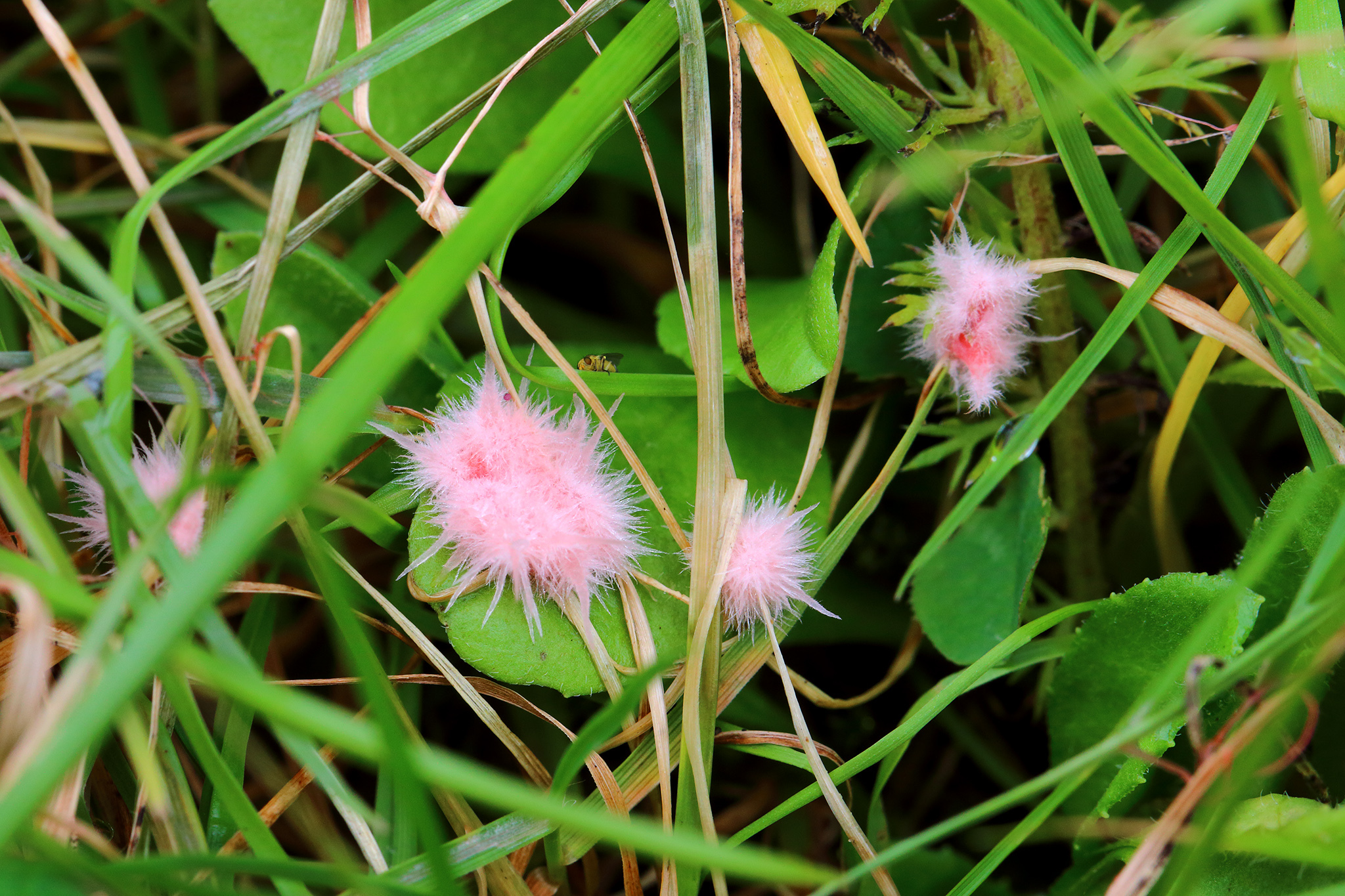 Red thread (Laetisaria fuciformis) on lawn grass, showing the characteristic pink mycelial tufts at blade tips. Photo: Tina Ellegaard Poulsen, Wikimedia Commons, CC BY 4.0.
This is the summer disease you will actually see. Look for irregular patches of tan or bleached grass with fine pink to red threads growing from the blade tips, about a quarter inch long. Red thread is caused by Laetisaria fuciformis, a fungus that thrives between 60 and 75 degrees with extended leaf wetness. It goes dormant above 85 degrees.
Red thread is a nitrogen problem, not a fungicide problem. The single most reliable predictor of red thread severity is low fertility. A light application of quick-release nitrogen, half a pound per thousand square feet, will usually resolve an active infection within a week or two. Hard fescues are naturally resistant. Perennial ryegrass and fine fescues are the most susceptible, which means most lawns here are in the target range.
WSU is clear on this: fungicide is not recommended for red thread on home lawns. The cost exceeds the benefit, the disease is cosmetic, and the lawn recovers faster from a nitrogen boost than from a spray program.
Turf rusts
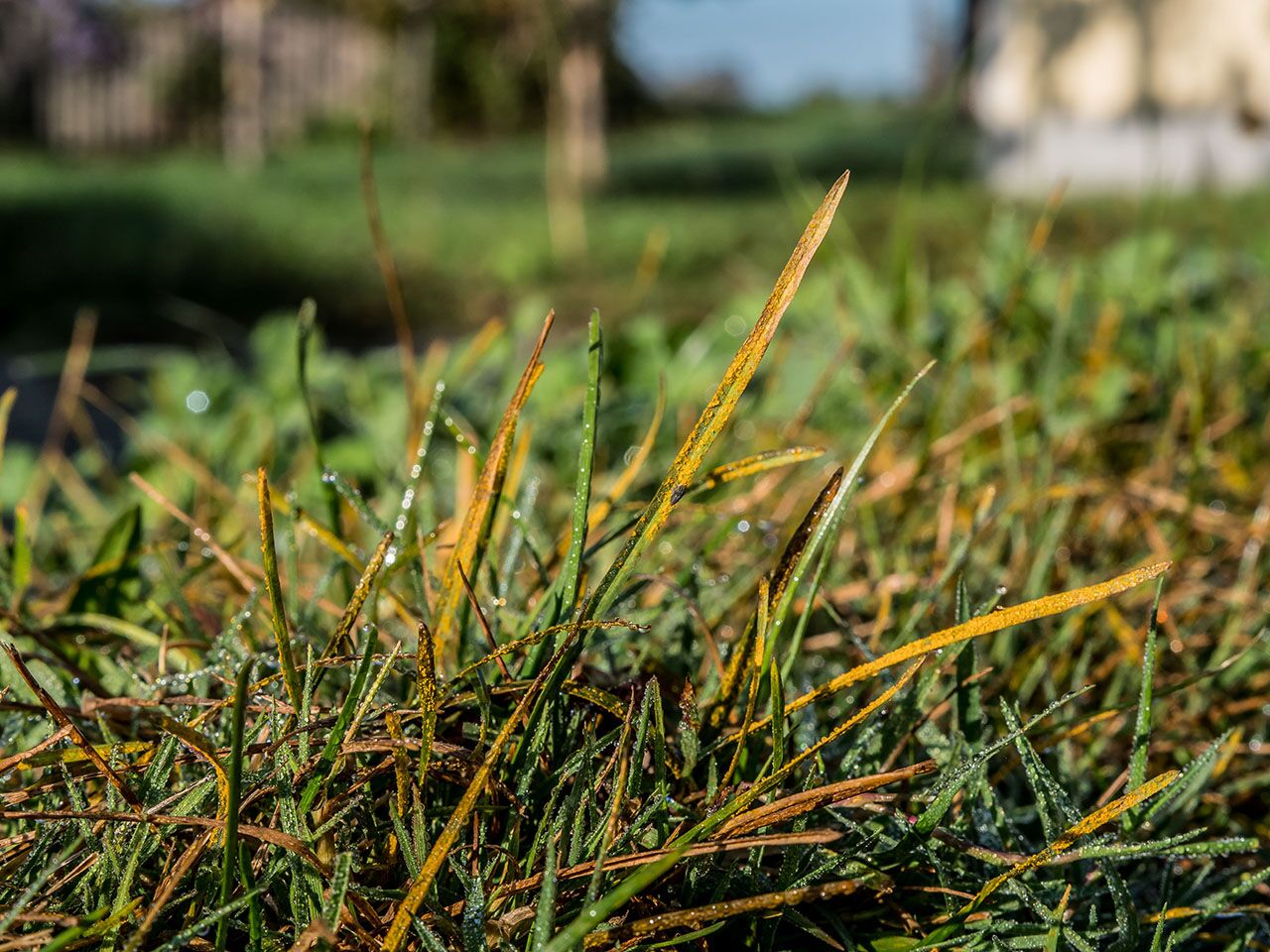 Turf rust (Puccinia spp.) on grass blades. The orange pustules stain shoes, clothes, and hands on contact.
Orange or reddish-brown pustules on blades, the kind that stain your shoes when you walk through an infected area. Rust (multiple Puccinia species) favors the same conditions as red thread: slow-growing, stressed, nutrient-deficient turf in shade. The prescription is the same: fertilize, water properly, improve air circulation by pruning overhanging branches, and mow regularly so the infected blade tips get removed.
Bag the clippings while rust is active. This is the one exception to the leave-clippings-on-the-lawn rule. The spores spread mechanically on mower decks and clipping fragments.
What you probably do not have
Brown patch (Rhizoctonia solani) needs sustained temperatures above 82 degrees with high humidity. It is relatively rare west of the Cascades. If you are reading national lawn forums where brown patch dominates the summer disease conversation, that advice is written for a climate you do not live in. Overfertilized, overwatered lawns are the most susceptible, which is another reason Path 2 has advantages.
Dollar spot requires warm days and cool nights with extended dew. WSU calls it “not a major disease in western Washington.” If you are seeing small, circular, slightly sunken patches a few inches across, check fertility first. Like red thread, dollar spot responds to nitrogen.
Slime molds
Whitish-yellow blobs that look alarming and are completely harmless. Slime molds feed on dead organic matter in the thatch layer, not on your grass. They appear after warm wet weather, look strange for a week or two, and disappear on their own. Mow over them, rake them off, or wash them away with a hose. No treatment needed, no treatment effective.
Protecting Trees in the Lawn
Summer mowing is when most tree trunk damage happens. String trimmers are the worst offenders: a few seconds of nylon line against bark creates a wound the tree can never repair, only compartmentalize, and opens the door to decay fungi. Repeat that weekly for a growing season and you have a tree with a ring of dead bark at the soil line.
The fix is permanent and it pays for itself. Maintain a mulch ring of two to four inches of wood chips over the root zone, starting a few inches from the trunk and extending as far out as you can manage. A three-foot radius ring eliminates the need to mow or trim near the trunk entirely. The tree benefits from the mulch more than it benefits from turf competing for the same water in the top six inches of soil.
If you do not have mulch rings around your trees, this is the single most impactful thing you can do for them this summer. Not pruning. Not fertilizing. Just putting a barrier between the string trimmer and the bark.
Late Summer: The September Transition
Three things happen at the end of summer that set up the rest of the lawn year.
Stop irrigating after Labor Day if you have a history of European crane fly damage. Adult crane flies lay eggs in moist soil during September and October. Dry soil deters them from choosing your lawn. If crane flies have not been a problem, you can continue irrigating through September, but most years the fall rain returns soon enough that it does not matter.
Apply the September 1 nitrogen. This is the most important fertilizer application of the year for cool-season turf. The grass is transitioning from summer survival back to active growth, and fall nitrogen fuels the root development that will carry the lawn through winter. One pound of nitrogen per thousand square feet, same rate as every other application. If the lawn went dormant or semi-dormant through summer, this application plus the return of rain is what brings it back.
Plan renovation work for September. Aeration, overseeding, dethatching: September is the optimal window for all three. The soil is warm enough for seed germination, the fall rain is coming to keep it moist, and the grass has the entire cool season ahead to establish before the next summer. If your lawn needs more than mowing and fertilizing, the fall renovation guide covers the full process.
Seasonal Action Summary
| When | What | Path | Why |
|---|---|---|---|
| Late May to mid-June | Watch for the dry switch: the first sustained stretch without rain | All | Signals when to start irrigation or commit to dormancy |
| When rain stops | Begin irrigation or commit to dormancy | All | The three-path decision point |
| June to August | Raise mowing height 0.5 to 1 inch above spring settings | 1 and 2 | Shades crowns and soil, reduces evaporation |
| June to August | Irrigate 1 inch per week in split cycles | 1 | Full maintenance |
| June to August | Irrigate 0.5 inch every 10 to 14 days | 2 | Reduced input |
| Monthly (July and August) | Water 0.25 inch once to keep crowns alive | 3 | Crown survival during dormancy |
| Mid-June | Apply 1 lb nitrogen per 1000 sq ft (ammonium sulfate) | 1 only | Mid-season nitrogen; sulfur suppresses red thread and rust |
| As needed | Treat red thread or rust with nitrogen, not fungicide | 1 and 2 | Cultural control is the first and usually only response |
| After Labor Day | Stop irrigation | All | Deters crane fly oviposition; fall rain returns soon |
| September 1 | Apply 1 lb nitrogen per 1000 sq ft | All | Fall recovery; most important application of the year |
| September | Plan aeration, overseeding, or renovation | All | Optimal window for all three |
Sources
- Washington State University Extension. Home Lawns (EB0482E). Mowing heights, fertilizer schedule, sulfur recommendation, grass species selection.
- Oregon State University Extension. Practical Lawn Care for Western Oregon (EC-1521). Dormancy as management option, crane fly irrigation cessation.
- UMass Extension. Turfgrass Response to Water Deficits. Root growth temperature optimums, deep infrequent irrigation research.
- University of Minnesota Extension. Mid-Summer Lawn Care. Raising mowing height for heat stress.
- UC Davis IPM. Red Thread / Turfgrass. Red thread biology and nitrogen management.
- NC State Extension. Red Thread in Turf. Quick-release nitrogen as primary control.
- Oregon State University Extension. Soil Texture Determines How Much and How Often to Water. Clay soil irrigation rates and split-cycle method.
Pesticide product mentions are for identification only. Always read and follow label directions. Washington state regulations may restrict some products; verify registration before purchase.