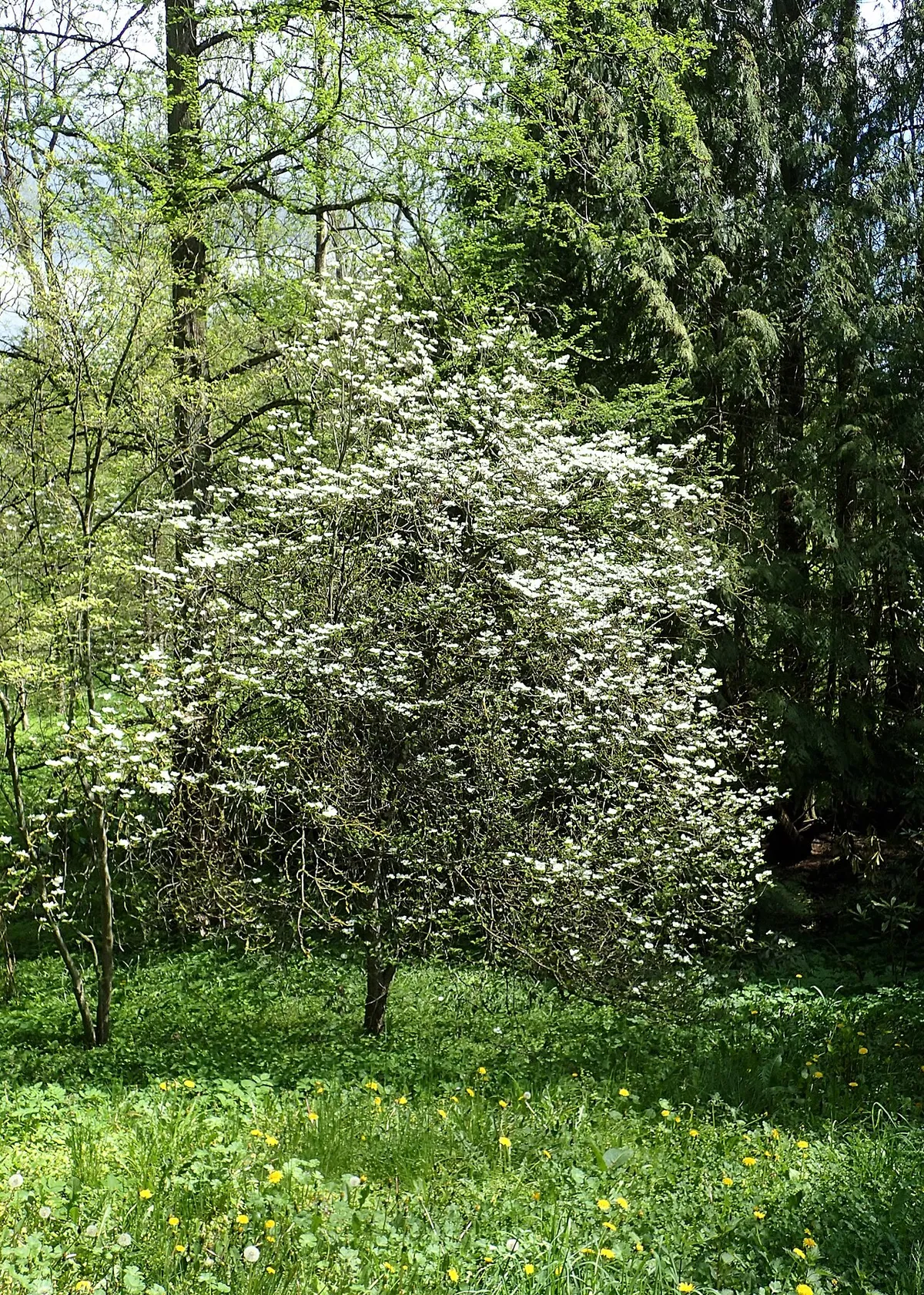
You Might Already Know This Tree
If you’ve spent time in the eastern United States during spring, you’ve seen flowering dogwood. Its white or pink “flowers” (actually colorful bracts surrounding small true flowers) have made it one of the most beloved understory trees in zones 5-8. But if you live in Western Washington, you’re in a different bioregion entirely. This native eastern tree grows here, but it’s not your native equivalent. Understanding where it fits in a Puget Sound landscape means knowing what it is, what it isn’t, and what serious disease pressure you’ll face if you plant it.
The Tree
Flowering dogwood is a deciduous, understory-adapted tree in the Cornaceae family. It grows slowly to 20-35 feet tall in its native eastern habitat, with a layered branching structure and a dense crown. The tree is cold-hardy to zone 5a and performs well through zone 8b. In spring, before leaf-out, the conspicuous bracts (modified leaves) appear in white or pink, depending on the cultivar. The true flowers are tiny and greenish, clustered in the center of those showy bracts. Fall foliage ranges from burgundy to deep red. The growth rate is slow, typically 12-24 inches per year, which means you’re making a long-term commitment when you plant it.
The species prefers sun to part shade, needing at least 4-6 hours of direct light for good bract production. It requires well-drained soil with a slightly acidic pH between 5.0 and 7.0. Standing water or compacted clay is problematic. In its native range, it thrives as an understory layer beneath larger canopy trees, which in the Puget Sound would mean dappled light during our dry summers and some wind protection during our wet winters.
Not Your Native Dogwood
Western Washington has its own flowering dogwood: Cornus nuttallii, the Pacific dogwood. It’s native to moist coniferous forests from British Columbia south to California. Pacific dogwood grows larger (30-60 feet), produces bigger white bracts, and flowers in spring with a second, smaller bloom in late summer. It’s adapted to our wet winters and dry summers in a way that Cornus florida is not.
The distinction matters because flowering dogwood, while cold-hardy, is not optimized for the Puget Sound’s specific climate stressors. Our persistent winter moisture and cool, humid springs create ideal conditions for fungal diseases that Cornus florida isn’t well-equipped to handle. If you see flowering dogwood thriving in eastern Washington, inland microclimates, or south-facing slopes in Western Washington, that’s because those areas are drier and warmer. You can’t assume the same success in Seattle, Tacoma, or the lowlands around Olympia.
Disease Pressure: Why You Should Pay Attention
The single most serious threat to flowering dogwood in Western Washington is dogwood anthracnose, caused by Discula destructiva. This fungus attacks the twigs and branches, causing canker formation, branch dieback, and eventual tree death if left unchecked. It spreads during wet conditions (which we have in abundance) and is particularly aggressive during cool, wet springs. Anthracnose has devastated Cornus florida populations along the East Coast and is present in the Pacific Northwest. It is not something to ignore.
Powdery mildew is nearly inevitable in our humid conditions, coating leaves with white fungal growth. While it rarely kills the tree, it weakens vigor and looks unsightly. You’ll see it most commonly in late summer and fall when nights cool down and humidity rises.
Nine documented diseases affect flowering dogwood in North America. Beyond anthracnose and powdery mildew, you may encounter leaf scorch, root rot in poorly drained soils, spot anthracnose, and others. Six insect pests are also recorded, including dogwood club gall midge and various scale insects, though these are less problematic in the Pacific Northwest than in the species’ native range.
Why Kousa Dogwood Might Be Better
If your heart is set on a flowering dogwood-type tree for your Western Washington garden, consider Cornus kousa, the Kousa dogwood. It’s a Japanese and Chinese species that shows significantly better disease resistance to anthracnose in our region. Kousa dogwood has later-blooming white bracts (May to June, after Cornus florida), similar cultural requirements, and better overall performance in humid climates. The Puget Sound region has a track record of success with well-established Kousa dogwoods. It’s not native, but it’s a more honest choice for this landscape.
What Goes Wrong Here
If you plant flowering dogwood in Western Washington, watch for these problems:
- Anthracnose cankers on branches, with sunken bark and twig dieback. Branches beyond the canker will die. In wet springs, this progresses quickly.
- Powdery white coating on leaves, particularly on the lower leaf surface. Defoliation may occur if severe.
- Poor establishment in clay soil or areas with standing water after heavy rain.
- Reduced bract production or smaller flowers in insufficient light or humid, cloudy springs.
- Root issues if planted too deeply or in compacted soil.
Seasonal Action Summary
| Season | Action |
|---|---|
| Winter (Dec-Feb) | Prune out any dead or diseased branches during dormancy. Remove branches with cankers below the visible damage. Improve site drainage if tree sits in wet soil. |
| Early Spring (Mar-Apr) | Monitor for emerging canker symptoms. Inspect for powdery mildew as leaves unfold. Ensure good air circulation by thinning crowded interior growth. Apply dormant oil if scale insects are present. |
| Spring (May-Jun) | Observe bract production and overall vigor. If powdery mildew appears, apply sulfur or neem oil according to product label. Do not overwater even if spring is dry. |
| Summer (Jul-Aug) | Water deeply but infrequently during drought. Monitor for pest activity. Avoid pruning, which stresses the tree. |
| Fall (Sep-Nov) | Rake leaves if powdery mildew was present (removes fungal spores). Do not add diseased leaves to compost. Avoid high-nitrogen fertilizer, which promotes soft new growth susceptible to anthracnose. |
The Bottom Line
Flowering dogwood is not impossible to grow in Western Washington, but it’s swimming upstream. It’s not native, it’s not disease-resistant to our primary threats, and there are better regional choices. If you already have a healthy specimen, maintain it by managing anthracnose aggressively. If you’re choosing a new tree, either commit to Kousa dogwood or look at native alternatives like Pacific dogwood (if you have the space and proper forest conditions) or Cornus sericea subsp. occidentalis (red-osier dogwood), a native shrubby species that thrives in our wet winters.
The Eastern dogwood’s spring display is stunning, but beauty alone isn’t reason enough to plant it here. Choose the right tree for the Puget Sound, and you’ll spend less time fighting disease and more time enjoying your landscape.
Sources
- Cornaceae family classification and distribution data, USDA PLANTS Database
- Dogwood anthracnose (Discula destructiva) pathology and Pacific Northwest presence, Oregon State University Extension Service
- Cornus florida and Cornus kousa disease resistance comparisons, University of Tennessee Agricultural Extension
- Native dogwood species distribution and ecology, Washington Native Plant Society
- Regional hardiness zones 5-8b, USDA Plant Hardiness Zone Map