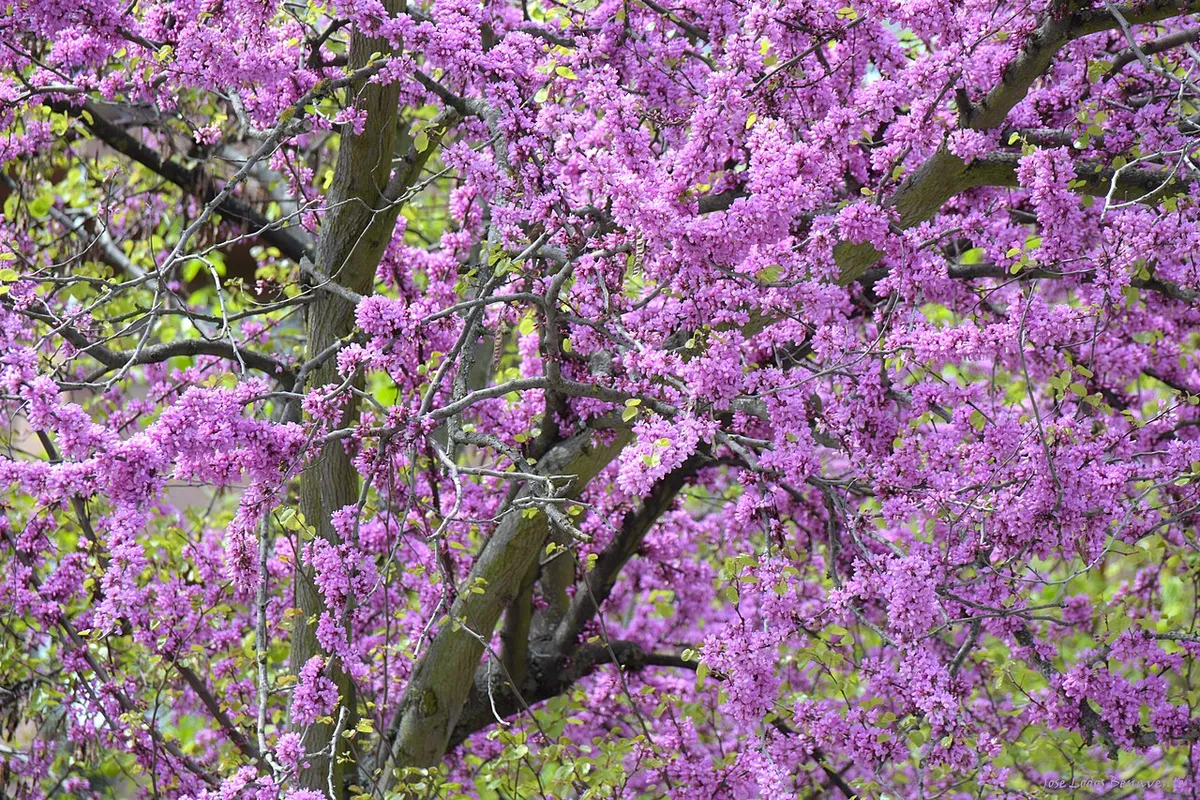
If you’ve grown eastern redbud (Cercis canadensis) in Western Washington, you’ve already proven you can succeed with the genus. The Judas tree is its Mediterranean cousin, and it offers something that makes it worth the garden space: an unforgettable spring display where magenta-pink flowers burst directly from the bark weeks before any leaves appear.
You’ll encounter Cercis siliquastrum in warmer microclimates throughout the Puget Sound region. It thrives where you have afternoon shelter and good drainage. Give it those conditions, and you’ll have a shrub or small tree that demands attention every April, asks little of you the rest of the year, and proves remarkably tougher than you’d expect for something so showy.
What You’re Looking At
The Judas tree reaches 15 to 30 feet tall in its native Mediterranean and western Asian habitat, though you’ll more commonly see specimens in the 20-foot range in our region. It belongs to the Fabaceae family (the legumes), which means it fixes nitrogen from the atmosphere, improving soil fertility without your input.
The leaf structure is simple: heart-shaped, blue-green, with a waxy finish that sheds water efficiently. Foliage emerges after flowering, so you get a full month of bare-branch display. By summer, the dense canopy provides dappled shade. In autumn, leaves shift to yellow before dropping. The branching habit is naturally sculptural, spreading in a broad, multi-stemmed form that looks good even in dormancy.
But it’s the flowering that matters. This is cauliflory: blossoms emerging directly from the trunk and old branches, not from new twig growth. Tiny magenta-pink pea-flowers cluster so densely that dark bark nearly disappears under color. For a four-to-six-week window starting in early April, your tree becomes a focal point. Flowers are followed by flat, papery seed pods that persist through fall and winter, adding textural interest when little else is happening in the garden.
Growing It in Western Washington
You need three things: warmth, drainage, and patience.
Warmth comes from placement. Your Judas tree does not tolerate the wet feet that maritime climates deliver freely in winter. It needs a location with afternoon sun exposure and air movement, ideally elevated slightly so winter rain doesn’t pool at the base. If you’re in a frost pocket, move upslope. The plant survives hard freezes once established, but it needs enough growing season warmth to develop the floral buds that make it worthwhile.
Drainage is non-negotiable. Amend heavy clay or silt loam with 4 to 6 inches of compost worked into the planting hole. Plant slightly high: the root collar should be one to two inches above grade. Water during the first two growing seasons to establish a deep root system, then back off. Once mature, your tree is significantly more drought tolerant than C. canadensis. You may never water it again after year three.
Pruning is minimal. Remove dead or crossing branches in late winter, before the flowering display. Resist the urge to shape it tightly. The branching structure is part of the appeal, especially when flowers light it up bare and sculptural. If you’re bothered by the seed pods, clean them off in winter, but this is optional.
The Pest and Disease Picture
This is where the Judas tree simplifies your life. Pacific Northwest arboricultural records document only two notable disease associations in the region: fungal canker (rare, usually confined to stressed specimens) and anthracnose (occasional, rarely severe). Insect pressure is minimal. You won’t fight the scale, borers, or spider mites that plague eastern redbud. You won’t spray fungicides every spring.
That’s not to say nothing can go wrong. Waterlogged soil in winter can cause root rot. Hard late-spring frosts after flowering may sacrifice some floral display in following years. Wind exposure can split leaders if the tree grows too tall too fast without lateral development. But these are site-management issues, not endemic plant problems.
Choosing Your Spot
Look for a location in the warmer parts of your property. South-facing walls work beautifully, as does the margin of full sun moving into afternoon shade. If you’re in Bellingham or the north Puget Sound, a heat pocket against a building or south-sloping bank will make the difference between a marginal specimen and a showpiece. In the Seattle metro area or south toward Olympia, you have more flexibility.
Pair it with plants that won’t compete for the moisture it’s stingy about: lavender, cistus, rosemary, or catmint make natural companions. The bare spring branches are perfect for interplanting spring bulbs underneath. By the time your tree is fully leafed out, the bulbs are done for the year.
The Bottom Line
The Judas tree asks you to be thoughtful about placement and willing to let the landscape do the talking in spring. In return, it delivers drama without maintenance, and it prospers in the kind of warm, well-drained microclimate that Western Washington gardeners are learning to create as summers lengthen and soils warm. If you’ve dismissed it as too tender or too ornamental, reconsider. In the right spot, it’s one of the most reliable small trees in the maritime Pacific Northwest.
Sources
- Dirr, M.A. (2009). Manual of Woody Landscape Plants, 6th ed. Stipes Publishing.
- Jacobson, A.L. (1996). North American Landscape Trees, 2nd ed. University of California Press.
- Washington State University Extension. Plant Clinic Records and Pathology Database (accessed 2025).
- U.S. Department of Agriculture Plant Hardiness Zone Map, Pacific Northwest Zone 8-9.
- Royal Horticultural Society Plant Guide for Cercis siliquastrum.