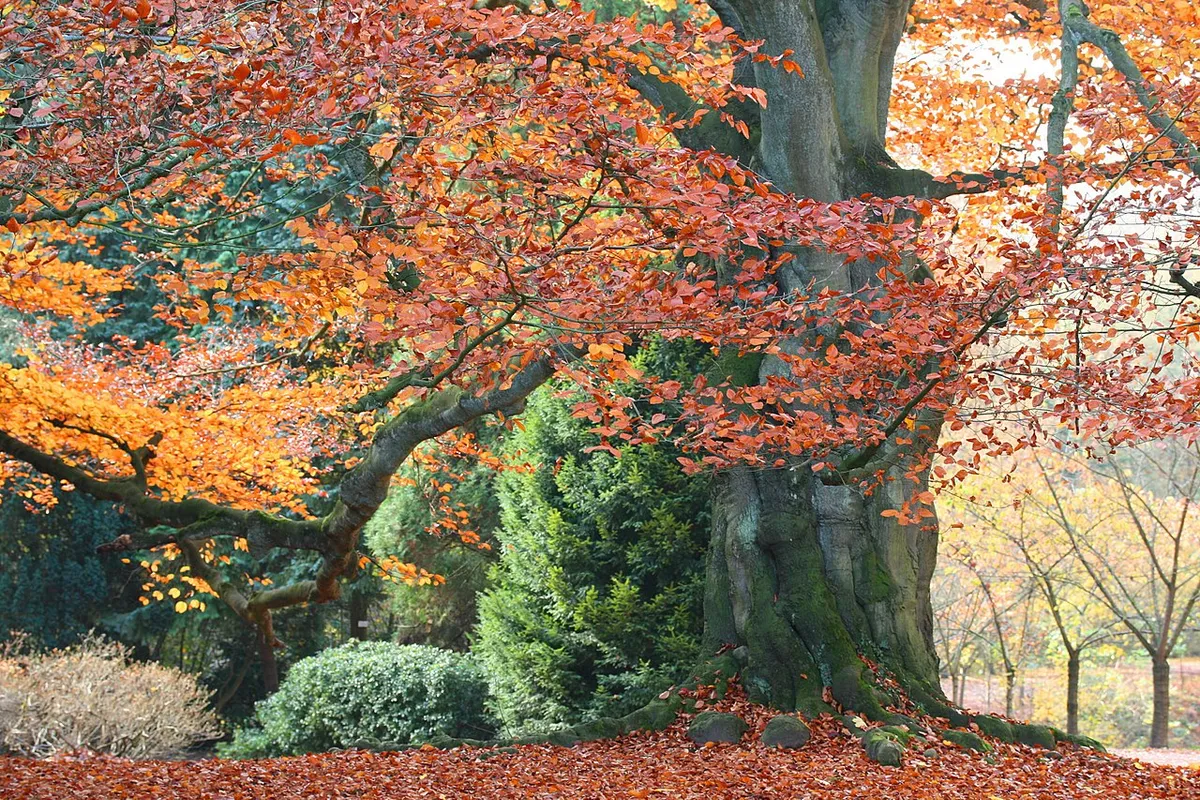
When you drive through the older neighborhoods of Western Washington, you’ll spot them immediately: those massive, fountain-shaped European beeches with trunks the size of car hoods and branch architecture that looks sculpted. They’re landmarks. But if you love the deep purple foliage and elegant form of beech without the real estate demands of the species, ‘Red Obelisk’ is your answer. This narrow columnar cultivar gives you the beech experience in a footprint that actually works for parking strips, side yards, and the tight spaces where the full-size species would become a problem in 20 years.
‘Red Obelisk’ matures at roughly 45 to 50 feet tall and 15 feet wide. That’s a fundamental difference from its parent, Fagus sylvatica, which reaches 80 feet and spreads nearly as wide. The cultivar’s form is strictly vertical, almost pencil-like when young, gradually thickening as it ages but never assuming the massive rounded crown of the species. You’re looking at a tree that respects property lines in a way that regular European beech never will.
The foliage is what makes beech memorable. Spring emerges with a vibrant red-purple that gradually deepens through summer, holding that rich wine color through fall before dropping. Unlike some purple-leafed trees that look a bit washed out by midsummer, ‘Red Obelisk’ maintains saturation all season. It’s one of those trees that genuinely earns its place through three seasons of color, not just spring novelty.
Growing Conditions
‘Red Obelisk’ performs best in full sun to part shade across zones 4b through 8b, putting Western Washington squarely in its sweet spot. The maritime climate here, with its moderate temperatures and reliable moisture, suits European beech extremely well. This is a tree that has thrived in the Pacific Northwest for over a century, proving its regional compatibility through countless mature specimens.
You need well-drained soil with a pH between 5.0 and 7.0. Beech cannot tolerate wet feet. If you have clay soils or areas that remain soggy after heavy rain, this isn’t the right tree. More than one gardener has learned this lesson the hard way. The species prefers slightly acidic soil, which is common in Western Washington, but will tolerate neutral soils if drainage is excellent. Amend heavy soils with compost before planting rather than trying to “fix” a poor site after establishment.
What You Need to Know About Beech
Here’s the hard truth: beech is slow to establish. The first few years, you’ll barely notice growth. Don’t panic. The tree is working on its root system, and once established (usually around year five or six), growth accelerates. Water regularly during the first two seasons, but do not keep the soil perpetually wet. Deep watering once or twice weekly is far better than frequent shallow watering.
Beech has a shallow, dense root system. This is why the species is so commanding visually (those roots sometimes surface dramatically) but also why nothing grows underneath a mature specimen. Plan accordingly. Don’t plant groundcovers or shade-loving plants beneath beech expecting them to thrive. They won’t.
The narrow form of ‘Red Obelisk’ actually works in your favor here. You’re looking at less total root spread than the parent species, which means slightly less competition for nearby plantings, though the shallow-root characteristics remain.
Regional Disease and Pest Pressure
Nationally, beech bark disease has become a serious concern. The disease involves a complex of beech scale insects and secondary fungal pathogens. In affected regions, mature beeches can decline rapidly and die. However, this disease has not reached significant levels in Western Washington. The scale insect vector prefers continental climates with colder winters and lower humidity. Our maritime environment, paradoxically, is one of beech’s safest refuges. This advantage could shift if climate patterns change significantly, but for now, Western Washington gardeners can plant beech with confidence that beech bark disease is not a present threat.
Other pests and diseases in the broader Fagus sylvatica complex include minor foliar issues and occasional pest pressure, but nothing that substantially limits the species’ use in our region. ‘Red Obelisk’ has shown no cultivar-specific vulnerabilities beyond those affecting its parent species.
The Real-World Decision
‘Red Obelisk’ makes sense when you want the distinctive purple foliage and elegant form of European beech but lack the space for the full-size species. It’s a replacement option for parking strips, narrow side yards, and properties where you need vertical architecture without horizontal sprawl. The tree does require patience during establishment and intolerance for wet sites, but neither of these is unique to this cultivar. They’re inherent to beech itself.
In Western Washington’s established neighborhoods, older European beeches remain some of the most impressive specimen trees on the landscape. ‘Red Obelisk’ lets you participate in that tradition without the landscape-altering footprint of the species. That’s a meaningful option to have.
Sources
Dirr, M. A. (2009). Manual of Woody Landscape Plants: Their Identification, Ornamental Characteristics, Culture, Propagation and Uses. Stipes Publishing.
Hardin, J. W., & Arena, S. J. (1997). Atlas of United States Trees, Volume 7: Hardwoods. US Department of Agriculture Forest Service.
Kulba, S., & Kehr, E. (2014). Beech bark disease in eastern North America: history, impact and management. Canadian Journal of Forest Research, 44(8), 900-909.
Shigo, A. L. (1989). Tree Pruning: A Worldwide Photo Guide. Shigo and Trees, Associates.
United States National Arboretum. (2023). Plant Hardiness Zone Map. USDA.