The Tree That Defines Your Forest
Walk a cedar trail in old growth forest, and you know you are home. The scent hits first: warm, complex, almost medicinal. Then the scale of it registers, the buttressed trunks rising without branch for fifty feet, the bark fibrous and cinnamon-red, shredding in long strips between your hands.
Western Redcedar (Thuja plicata) is the tree that shaped the Pacific Northwest, long before European settlement and long after. Indigenous peoples built entire civilizations from its bark and wood. Your neighbors plant it as a hedge. Drive through the neighborhoods of the Puget Sound in spring, and you see it in a hundred green forms, from columnar accents to dense screens. But the wild thing, the old growth tree, is what stays with you. It is the living memory of what this region was.
The Tree: Anatomy of a Cypress Masquerading as Cedar
Despite its common name, Western Redcedar is not a true cedar. It belongs to the family Cupressaceae, the cypress family, and that distinction matters more than it seems. True cedars are in the genus Cedrus; they are Old World trees adapted to Mediterranean climates. Thuja plicata is something else entirely: a North American conifer shaped by wet, cool climates, by glaciation, by a landscape where rain is reliable and summers are short.
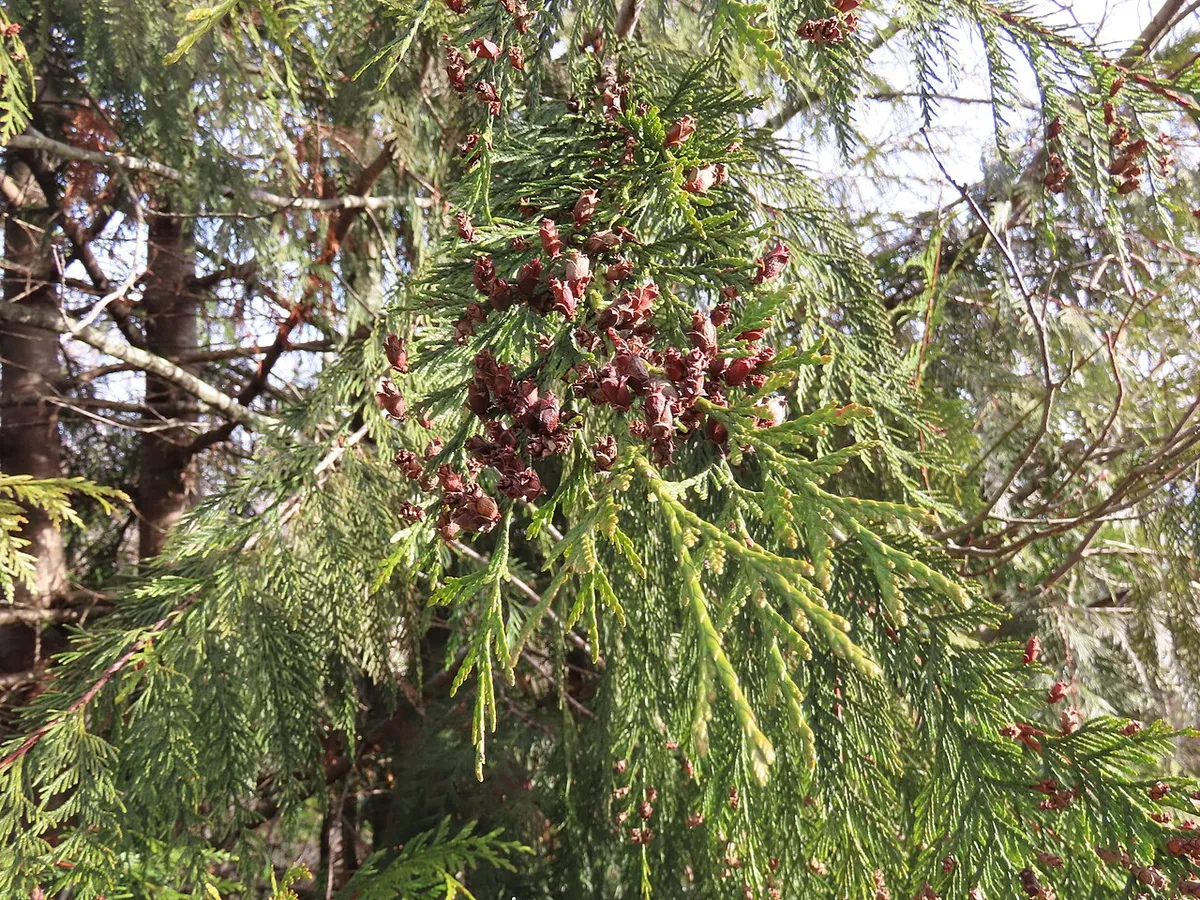
The name plicata comes from the Latin word meaning “pleated,” referring to the way the scale-like leaves fold along the shoots. If you hold a sprig of Western Redcedar and look at the underside, you see the reason for that detail: tiny white “butterflies” of waxy coating that mark the base of each scale leaf. Those white marks are how you confirm the species in the field. The foliage is feathery, frond-like, aromatic when crushed. This is not the tough, angular foliage of a true cedar; it is soft, almost fern-like, speaking of moisture and shade.
The cones are tiny, only 12 millimeters long, dry and brown when mature. They drop readily in fall and winter, and you will find them under mature trees, waiting for winter moisture and temperature to trigger germination. The bark of a young tree is smooth and greenish; on mature trees, it becomes deeply furrowed and fibrous, cinnamon to reddish-brown, peeling in long, continuous strips. Those strips are not a sign of disease or stress. That is how the tree sheds its outer skin, maintaining its protective layer beneath.
The growth form of Western Redcedar distinguishes it from most other conifers in the region. Young trees grow pyramidal and dense, perfect for hedging. Mature wild trees develop a characteristic shape: buttressed at the base (sometimes dramatically), with a long, clear trunk and foliage concentrated in the upper crown. The buttressing is most pronounced in wet sites or riparian zones. It is a structural response to unstable soil and high water tables, a tree balancing itself for centuries on marginal ground.
This is the largest tree in the Cupressaceae family. In the wild, Western Redcedar grows 150 to 200 feet tall, with some ancient trees exceeding those measurements. Spread ranges from 30 to 40 feet for landscape trees, narrower for columnar cultivars. Age estimates for the largest wild specimens exceed 1,000 years. The growth rate, especially in landscape conditions, is moderate to fast: expect 2 to 3 feet of vertical growth per year in favorable conditions, which means a young hedge tree reaches 20 feet in less than a decade.
The native range runs from southeastern Alaska south through British Columbia, western Washington, Oregon, and northern California, with populations extending inland to western Montana. Here, you encounter it from sea level to 5,000 feet, though it grows most vigorously in the lowlands and foothills where rainfall is abundant. This is not a tree that adventured eastward across the continent; it stayed where the wet, cool climate suited it. That is important to remember when you plant one: you are honoring its ecological preference, planting it where it belongs.
Cultivars: Trees for Different Purposes
The straight species is rarely what you find in nurseries. Breeders have selected cultivars suited to specific landscape uses, each with particular character and requirements.
‘Atrovirens’ is the hedging standard here. It grows 30 to 45 feet tall, with dense, fine-textured foliage. The growth habit is naturally pyramidal and columnar, ideal for shearing. Foliage is dark green year-round. This is the cultivar you choose if you want a privacy screen that responds well to pruning and maintains a tidy appearance. Expect to shear it at least once per year, ideally twice, to keep it looking finished.
‘Excelsa’ is another hedging favorite, taller and more narrow than ‘Atrovirens’, sometimes reaching 60 feet in optimal conditions. It is excellent for columnar screens and can be left largely unpruned, though it benefits from light shaping. The foliage is brighter, slightly more yellowish-green than ‘Atrovirens’.
‘Hogan’ is a true columnar form, sometimes called a pencil cedar in the trade. It grows 20 to 25 feet tall and only 3 to 5 feet wide, making it invaluable where space is tight. It works well as a vertical accent, in narrow buffer plantings, or in contemporary landscapes where linear forms are desired.
‘Can Can’ is a dwarf form, reaching approximately 8 feet tall with a spread of 5 to 6 feet. The foliage is fine-textured and slightly variegated with creamy tones. It is useful in smaller gardens, containers, or as a specimen plant where you want the cedar charm without the size.
‘Grune Kugel’ is a true miniature, sometimes called green ball. It grows slowly to about 1 foot tall and wide, perfect for rock gardens, containers, or bonsai-style cultivation. The foliage is tight and bright green.
‘Stoneham Gold’ offers golden-yellow foliage, particularly bright in new growth. It reaches 7 feet tall and prefers dappled shade to sun for best color. The golden tones brighten shadier corners of the garden and provide year-round interest.
‘Zebrina’, also called ‘Aureo-variegata’, is a variegated form with cream and yellow sections in the foliage, giving it a striped or zebra-like appearance. It grows to 40 feet tall and combines the hedging utility of the species with ornamental coloring.
Beyond these, specialty nurseries maintain dozens of cultivars. Before selecting one, ask yourself what you need: privacy and screening, accent and color, or something smaller for specimen use. The cultivar you choose determines how much work you undertake. A hedging cultivar requires regular pruning; a columnar form demands less maintenance but offers narrower function.
What Western Redcedar Does Well: Why You Should Plant It
In Western Washington, Western Redcedar excels at several things that other conifers struggle with.
Hedge Material. This is the primary reason it is in so many yards. It shears cleanly, responds well to pruning, regenerates from old wood, and maintains a formal appearance. If you want a classic green hedge in the Puget Sound region, Western Redcedar is the gold standard. Competitors like Green Giant arborvitae or Leyland cypress (though less hardy here) may offer faster growth, but none match the sophistication and longevity of a well-maintained cedar hedge.
Clay Soil Tolerance. Many conifers struggle in the clay-heavy soils here. Their roots cannot penetrate compacted clay, and they suffer waterlogging. Western Redcedar tolerates heavy clay, particularly if you do not waterlog the site with poor drainage. It makes sense: its native habitats include wet clay flats and riverine soils. The tree evolved in the mud.
Black Walnut Tolerance. Juglans nigra, black walnut, produces a chemical called juglone that poisons many plants. Western Redcedar is among the few conifers that tolerate it. If you have a black walnut in your landscape, and you need screening or a specimen tree, Western Redcedar can coexist with it. Plant it away from the drip line if possible, but juglone toxicity is less of a barrier here than with many species.
Rain Garden Suitability. Western Redcedar tolerates periodic waterlogging, making it useful in bioretention areas and rain gardens. It prefers good drainage and hates standing water, but temporary inundation does not kill it the way it kills drought-adapted plants. This is especially valuable in low-lying areas of the Puget Sound where stormwater management is increasingly important.
Fast Growth. At 2 to 3 feet of growth per year, Western Redcedar reaches screening size quickly. A 3-foot whip planted in spring is 8 to 10 feet tall by year three, tall enough to screen most views. This appeals to homeowners who do not want to wait a decade for privacy.
Wildlife Value. Western Redcedar is a significant wildlife resource in the Pacific Northwest. Woodpeckers excavate cavities in the softer wood. Swallows and swifts nest in the branches. Chickadees and other small songbirds glean insects and seeds. Deer browse the lower foliage, especially in winter. Elk utilize it in higher elevations. Raccoons nest in cavities. The seeds feed some birds, though most cedar seed is not a significant food source. What matters more is the structure: a cedar provides shelter and nesting opportunity that deciduous trees do not offer in winter. Plant a hedge, and you are creating habitat.
Indigenous Significance. For thousands of years, First Nations peoples of the Pacific Northwest harvested Western Redcedar sustainably. The bark yields material for baskets, mats, and ropes. The wood is light, durable, and does not rot easily, making it ideal for canoes, longhouse posts, and totem poles. The tree was and is revered as the “Tree of Life” to many tribes. When you plant a Western Redcedar, you are honoring a relationship that predates European settlement by millennia. Understanding that context changes how you see the tree. It is not merely a landscape specimen; it is a keeper of cultural knowledge.
What Goes Wrong: A Regional Guide to Cedar Problems
Western Redcedar thrives here, but the region throws challenges at it. Understanding these problems helps you prevent them or respond quickly when they appear.
Cedar Flagging: Brown Tips and Seasonal Shedding
The most common concern homeowners raise is brown branch tips appearing in late summer or fall. The new growth suddenly looks scorched or bleached, turning brown from the tip inward along the shoot. Then, come spring, the tree greens up again, and the brown growth is shed. Is the tree dying? No. This is cedar flagging, a physiological response to stress, not a disease.
Cedar flagging occurs when Western Redcedar experiences water stress or temperature fluctuation late in the growing season. Here, this typically happens in late August through September, when summers finally get warm and dry. The tree has stopped growing, hard tissues have formed, and sudden stress causes the new growth to brown. The tree cannot recover that tissue; it sheds it come spring.
Management is preventive: ensure adequate soil moisture through August and September. This is not about overwatering; it is about consistent moisture. Mulch the root zone to buffer soil temperature and moisture fluctuation. Cedar flagging is not a disease requiring fungicide; it is a signal that your watering strategy needs adjustment. In a wet year, you may see little or no flagging. In a drought year, expect it on stressed trees.
The condition is cosmetic, not lethal. The tree is not infected; the foliage will not spread disease to adjacent plants. The brown tips fall off naturally. Pruning them off does not help; the tree is already programmed to shed them. Some gardeners prune them in spring when they are obviously dead. This is not necessary but is not harmful either.
Keithia Leaf Blight: The Serious Problem in Nurseries and Hedges
Keithia leaf blight, caused by the fungus Didymascella thujina, is the most serious foliar disease affecting Western Redcedar in the Pacific Northwest. It appears as small, tan or gray spots on the foliage, usually with a reddish-brown margin. Over time, the spots coalesce, the foliage browns, and in severe cases, entire sprigs die back.
This disease is most problematic in nurseries and on young, dense hedges where foliage moisture persists. The wet, mild springs and falls here are ideal for fungal development. Keithia loves humidity and moderate temperatures. It is not a problem in open, well-ventilated trees but can defoliate dense hedges.
Management begins with site selection and air movement. Hedge rows planted too densely, in shade, or in areas with poor air drainage are at high risk. When you plant a hedge, space it properly: 4 to 6 feet on center for ‘Atrovirens’, depending on your ultimate density goal. Do not plant hedges in low, frost pockets where cold air settles and moisture persists. Position them on slopes with air movement.
Prune your hedge to maintain open structure in the interior. Keithia cannot establish on foliage that dries quickly. Shearing that forces dense regrowth right up to the drip line creates the perfect Keithia environment. Thin the interior when you prune; keep the center open. Remove lower branches to encourage air circulation.
If you detect Keithia, monitor the extent before treating. Light spotting on a few branches is not worth fungicide application. Moderate to severe infection, particularly on young or high-value specimens, warrants fungal intervention. Copper fungicides, sulfur, or newer chlorothalonil products address Keithia effectively. Apply in spring and fall when conditions are humid and temperatures favor disease development. Always follow label directions; some fungicides can damage cedar foliage if applied in heat.
Prevention is more effective than cure. Buy nursery-grown trees from suppliers who manage Keithia through cultural practice and prevention. Inspect trees before purchase, looking at the interior foliage for spotting. Healthy nursery stock should show no signs of disease.
Seiridium Canker: Killing Branches and Stems
Seiridium canker, caused by the fungus Seiridum unicorne, is less common here than in warmer regions but appears sporadically. It manifests as sunken, resinous cankers on branches and stems. The branch beyond the canker dies, becoming brown and obviously dead. The canker itself is dark, often oozing resin.
This disease is primarily a problem on stressed trees. Drought, mechanical injury, frost crack, or pruning wounds provide entry points. It is uncommon on healthy, vigorous trees.
Management is primarily cultural. Maintain tree vigor through appropriate watering and care. Avoid unnecessary pruning; when you must prune, make clean cuts. If you observe a Seiridium canker on a branch, remove the branch at its base, cutting beyond the visible canker. Disinfect your pruning tools with a 10% bleach solution between cuts to avoid spreading the disease. Canker removal is the only effective treatment; there is no chemical cure.
If canker is widespread on a specimen tree, the tree’s long-term health is in question. Discuss with a certified arborist whether removal is warranted.
Root Rot Issues: The Invisible Killer
Western Redcedar can develop root rots from various Phytophthora species in poorly drained soils. Standing water, low-lying sites, and compacted clay with minimal internal drainage create conditions for root rot. The tree declines slowly, yellowing over seasons, eventually dying.
Yellow root rot (Armillaria) is another fungal problem causing similar symptoms. It often enters through pruning wounds or mechanical damage.
Prevention is critical because cure is impossible. Ensure proper drainage at the planting site. Do not plant in actual swamps or areas with true standing water. If your site has poor drainage, amend heavily with compost, consider a rain garden design that moves water through the soil quickly, or choose a different species.
If you suspect root rot, dig away the mulch and examine the base of the trunk and root collar. Root rots often create visible symptoms at the soil line: dark discoloration, sunken bark, reduced foliage. By the time you observe these signs, the tree is usually beyond recovery. This is why prevention through proper site selection and drainage is essential.
Cypress Tip Moth: Twisting Growth
The cypress tip moth (Argyresthia cupressella) occasionally infests Western Redcedar. The larva burrows into the terminal growth, causing it to wilt, twist, and discolor. Affected shoots turn brown and appear blighted.
This pest is rarely catastrophic but is cosmetically annoying. The damage is most noticeable on young, recently planted trees. Mature trees typically tolerate light infestation without significant impact.
Monitor new growth in spring for wilting or distortion. If you observe affected shoots, prune them off and dispose of them in the trash, not the compost pile. This interrupts the life cycle. If infestation is severe, insecticidal soap or neem oil applied to new growth can suppress populations, but this is rarely necessary. Most infestations self-resolve or remain at low, tolerable levels.
Scale Insects: Juniper Scale and Spruce Bud Scale
Juniper scale (Carulaspis juniperi) and spruce bud scale (Physokermes piceae) occasionally affect Western Redcedar, particularly in areas with low humidity or stressed trees. These armored scales appear as tiny, waxy bumps on the foliage and twigs. Heavy infestations can weaken the tree, causing yellowing and branch death.
Scale is not common on healthy, well-maintained cedar hedges here. It is more problematic in drier regions or on trees in water stress. Maintain adequate moisture and vigor, and scale is rarely an issue.
If you discover scale, examine the extent. Light infestations can be ignored. Moderate to heavy infestations warrant treatment. Horticultural oil applied in late winter or early spring, before growth resumes, suffocates overwintering stages. Insecticidal soap is effective in spring when crawlers are mobile. Avoid broad-spectrum insecticides that kill natural enemies.
Spider Mites in Summer Drought
Two-spotted spider mite (Tetranychus urticae) and other spider mites occasionally proliferate on Western Redcedar in hot, dry conditions. Heavy infestations create fine webbing on the foliage and cause yellowing or bronzing of the foliage. The tree looks stressed and unhealthy.
Spider mites are drought-related pests. They establish when humidity drops and plants are water-stressed. In the normally wet summers here, this is not a major issue. But in drought years, it is something to watch for.
Prevention is cultural: maintain adequate soil moisture, especially in July and August. Do not plant cedar in hot, exposed sites with full afternoon sun if you cannot reliably water. Misting the foliage with water in early morning discourages spider mites; they prefer dry conditions.
If spider mites appear, initiate regular water application to increase humidity. Horticultural oil or neem oil applied in early morning or evening suppresses populations. Avoid sulfur-containing fungicides if spider mites are present; sulfur can actually stimulate mite reproduction. A strong spray of water from the hose disrupts populations and can be surprisingly effective.
The Drought Problem: Why Your Cedar Is Turning Brown
Here it is, directly: Western Redcedar has HIGH water needs and LOW drought tolerance. This is the number one reason gardeners call with problems. They plant a cedar where other conifers would survive a dry spell, assume it will thrive, and then watch it gradually brown out in summer.
Western Redcedar evolved in a climate with reliable moisture. Rainfall in its native range averages 60 to 100+ inches annually. Summer precipitation is common, even in the dry season. The tree is not built for drought. Its root system is shallow and fibrous, adapted to absorbing moisture from rich, wet soil. It cannot tap deep water reserves the way ponderosa pine or Douglas fir can.
Here, this means certain sites are genuinely wrong for cedar. Hot, south-facing slopes with sandy soil are poor choices. Raised beds with minimal water-holding capacity are problematic. Sites on bluffs or hills with wind exposure and rapid drainage will see brown-out in dry years.
The solution is not mystery fungicide or magical soil amendment. The solution is adequate water. Ensure your cedar receives approximately 1 inch of water per week, from rainfall or irrigation. In July and August, when rain is scarce, supplement with irrigation. Mulch the root zone with 3 to 4 inches of compost or wood chips to buffer soil moisture and temperature. This is not difficult; it requires attention and intention, not complicated technique.
If you have planted a cedar in a marginal site and it is browning out, you have two choices: increase irrigation commitment, or remove it and plant something more drought-tolerant. There is no shame in the latter choice. The tree is telling you it does not belong there. Listen to the tree.
Hedge Versus Specimen: Different Trees, Different Needs
Western Redcedar functions in two distinct landscape roles, and the management diverges significantly.
Hedge: Formal Privacy and Screening
Hedging cultivars like ‘Atrovirens’ and ‘Excelsa’ are grown for consistent, formal appearance and function. They are pruned regularly, shaped carefully, and maintained at a particular height and width. A mature hedge is a refined, architectural element.
Hedge spacing depends on your target density. For ‘Atrovirens’, plant on 4 to 6-foot centers for a tight, formal hedge, or 6 to 8-foot centers for a more relaxed appearance. Space ‘Excelsa’ at 6 to 8 feet for a tall screen. Water and care for the establishment year; once established, a well-maintained hedge requires minimal inputs beyond pruning.
Shearing timing is important. The conventional wisdom is to prune once in late June or early July, after the main growth flush. A second shearing in late August or early September is beneficial for maintaining form but risks stimulating tender new growth that may frost-burn in a cold winter. Here, where winters are mild and late frosts are uncommon, two passes are fine. Stop pruning by late September to allow the tree to harden off before cold weather.
Use hand shears or hedge shears to maintain the form; power equipment is faster but risks damaging foliage. The goal is a slightly convex face, wider at the base than the top, allowing light to reach lower branches and maintaining density. If the hedge is allowed to grow too narrow at the base, the lower foliage thins and the hedge fails structurally.
Hedge height and width depend on your site and needs. A hedge that screens a view must be at least as tall as what it screens, plus additional height for perspective. A 6-foot hedge screens views at eye level from a typical sitting position. A 10-foot hedge blocks views from upper floors of homes. Do not plant a hedge that is taller than you are willing to maintain; a 15-foot redcedar hedge requires either a tall pruning platform or hiring professional maintenance.
Specimen: Open, Airy Form
Specimen Western Redcedar, whether ‘Hogan’, a cultivar like ‘Stoneham Gold’, or a young tree intended to grow large, benefits from quite different management. These trees are allowed to develop their natural form, with less constraint from shearing.
Remove lower branches only to reveal the trunk or open sight lines. Do not shear; thin instead. Open the interior of the canopy to air and light, preventing the dense, moisture-retaining form that encourages fungal disease. Reduce competing leaders if multiple leaders are forming, but allow the tree to express its natural habit.
Specimen trees require less frequent maintenance but benefit from the same watering strategy as hedges, particularly in establishment years. A young specimen planted in spring should receive regular, deep watering through the first two growing seasons.
Seasonal Action Summary
This table provides a quick reference for cedar care throughout the year:
| Season | Action |
|---|---|
| Early Spring (March-April) | Remove winter damage. Inspect for scale, mites, and disease. Apply dormant oil if scale was problematic. Begin hedge shearing in late April as growth resumes. |
| Late Spring (May-June) | First hedge pruning, approximately mid-June after main growth flush. Plant new trees. Establish regular watering schedule. Scout for Keithia blight and cypress tip moth. |
| Summer (July-August) | Maintain consistent moisture, especially in late summer. Second hedge pruning in late August if desired. Monitor for spider mites in hot, dry conditions. Watch for cedar flagging as growth slows. |
| Early Fall (September-October) | Stop pruning by September to allow hardening-off before winter. Clean up fallen foliage to reduce disease inoculum. Continue watering until hard freeze. |
| Late Fall/Winter (November-February) | No active care required. Heavy snow may weigh down hedge branches; brush off gently if accumulation is significant. Plan for spring hedge work. |
Planting and Establishment
Choose a site with full sun to part shade, good drainage, and adequate moisture during the growing season. Here, the wet climate handles moisture; your job is ensuring drainage. Amend heavy clay with compost before planting; this improves both water retention and drainage by increasing organic matter.
Dig a hole slightly wider than the root ball and no deeper. Western Redcedar root systems are shallow and fibrous; deep planting strangles them. Set the root collar at grade level. Fill with amended backfill, water thoroughly, and apply 3 to 4 inches of mulch, keeping it away from the trunk.
Water deeply once per week for the first growing season, more frequently in summer if rainfall is sparse. By year two, the tree should be established; taper watering to less frequent, deeper applications as the root system expands. Mature, landscape-established trees need supplemental water only in sustained drought or on exceptionally hot, dry sites.
Fertilizer is not necessary if your soil is reasonably healthy. If soil tests show deficiency, apply a balanced, slow-release fertilizer in early spring. Do not fertilize in late summer; this stimulates tender new growth that frost will damage.
Sources
Disease and pest management:
- PNW Plant Disease Management Handbook: Cedar Leaf Blight (Keithia Blight)
- PNW Plant Disease Management Handbook: Cedar Yellow Root Rot
- WSU Puyallup REC: Cypress Tip Moth (PLS-60)
- RHS: Thuja plicata
Plant descriptions and cultivar data:
- Oregon State University Landscape Plants: Thuja plicata
- NC State Extension: Thuja plicata
- Missouri Botanical Garden: Thuja plicata
Research:
- Russell, K. & Chastagner, G. 2023. “Western redcedar: natural history and pathosystems, with emphasis on cedar leaf blight.” Canadian Journal of Plant Pathology
- Grossnickle, S. et al. 2007. “Variation in cedar leaf blight resistance of western redcedar.” Canadian Journal of Forest Research