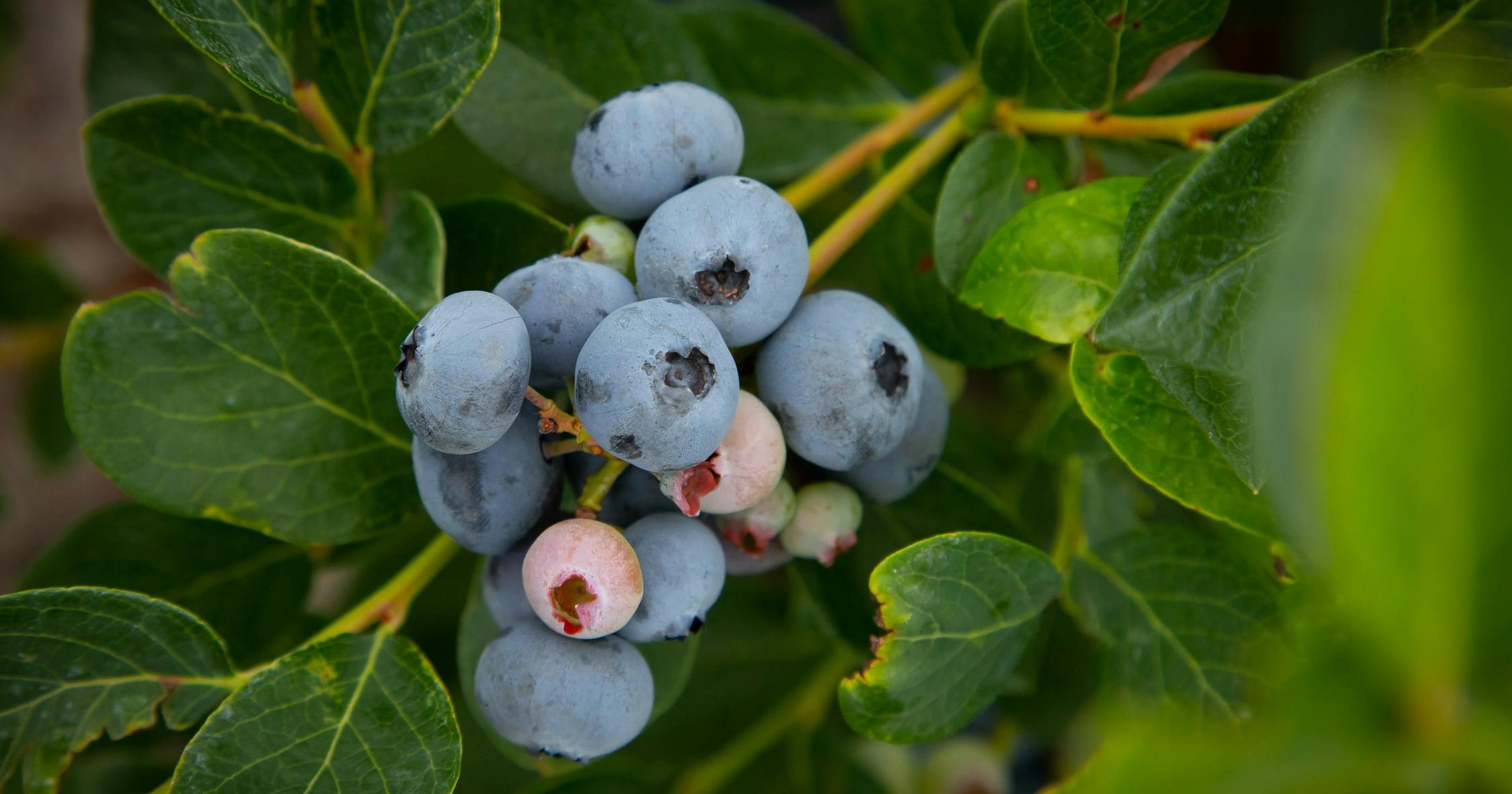
You are already growing the right fruit and you do not know it yet. Blueberries are native to North America, adapted to acidic soils, built for cool maritime summers, and happier in the Puget Sound lowlands than in most of the places the internet writes about them from. Every national guide opens the same way: test your pH, add sulfur, make your soil acidic enough. That advice is calibrated for Ohio and Georgia, where soils run pH 6.5 to 7.5. Your soil is a different starting point entirely, and the assumption that you need to fix it before you plant is the first thing most people get wrong.
The second thing they get wrong is drainage. On the sandy, well-drained soils that cover the upland plateaus around here, blueberries practically plant themselves. On the silt loams and clays that fill the river valleys, the problem is not pH at all. It is waterlogging, and the cultivar you choose determines whether that matters or not.
The principle is simple: test before you amend, and know whether your problem is pH, drainage, or both. The answer depends on where you stand.
Why Blueberries Belong Here
Northern highbush blueberries (Vaccinium corymbosum) need 800 to 1,000 chill hours below 45°F to break dormancy and set fruit. The Puget Sound lowlands deliver 800 to 1,200 every winter without fail. Chill is never limiting here. That single fact eliminates the entire category of problems that Southeast growers spend their time worrying about, and it means every northern highbush cultivar on the market will perform.
The maritime summer helps too. Blueberries produce their best fruit in moderate temperatures with consistent moisture. Your July highs of 75 to 80°F are the sweet spot. Gardeners in the Central Valley and the Southeast fight heat stress, sunscald, and irrigation deficits that you simply do not have.
Your soil is likely closer to the right pH than you think, though how close depends on your specific soil series. The Alderwood gravelly sandy loam on the plateaus around Puget Sound tends to run pH 5.0 to 5.5, already within the 4.5 to 5.5 blueberry optimum. The Woodinville silt loam in the river valleys may sit at 5.5 to 6.5 depending on management history. Construction fill, prior lime applications, and years of alkaline tap water can push any soil above 6.0. The point is not that your soil is automatically fine. The point is that you need to test it rather than assume it needs fixing.
Do not plant rabbiteye blueberries (Vaccinium virgatum). They need more summer heat than this region provides, and fruit often fails to ripen fully before fall. Do not plant southern highbush cultivars either. They bloom in late winter and the flowers get frost-damaged in most years. The joint WSU/OSU cultivar guide (PNW 656) is explicit: neither type is recommended for the Pacific Northwest. Northern highbush is the one that works here, and it works exceptionally well.
Choosing Cultivars
Start with three plants minimum, not for pollination logistics but for season extension. All northern highbush cultivars are cross-compatible, so any combination works. But early, mid, and late-season varieties planted together stretch your harvest from early July through September, which is the difference between a two-week picking window and three months of fruit.
One myth to clear up: selecting a late-season cultivar does not give you a late bloom date. PNW 656 documents that all northern highbush cultivars bloom within about one week of each other regardless of when their fruit ripens. Duke and Spartan, both early fruiters, actually bloom later than average. Bloom timing is not a tool for avoiding spring frost here. It is functionally the same across cultivars.
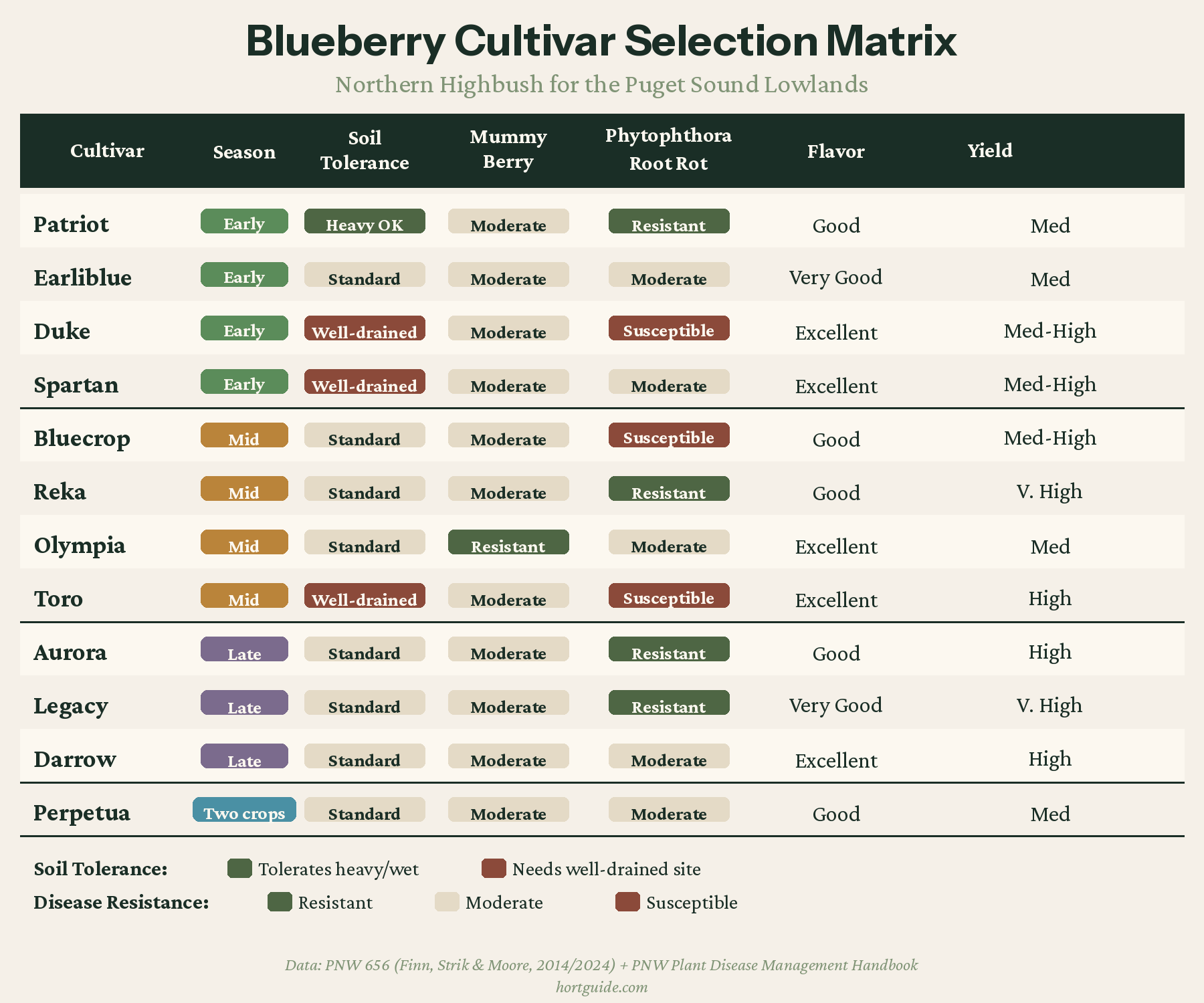
The organizing principle for choosing cultivars in this region is not season or flavor. It is soil tolerance. PNW 656 flags four cultivars with explicit warnings about heavy or poorly drained soil: Duke, Spartan, Toro, and Berkeley. If you garden on clay or silt loam and do not plan to build raised beds, those four are off the table. One cultivar, Patriot, carries the opposite note: “tolerant of heavier, wetter soils.” That makes it the safe early-season pick for gardeners who want to plant at grade on imperfect drainage.
Early season (July): Patriot tolerates wet soil, ripens early, and produces very large berries with concentrated ripening, but it is sensitive to bacterial blight (Pseudomonas syringae), so watch for dieback on young stems after cold, wet springs. Earliblue is sweet and aromatic with no soil warnings. Duke has excellent eating quality and high yield but needs a well-drained site; on clay, it invites Phytophthora root rot.
Mid season (late July to August): Bluecrop is the industry standard for a reason: vigorous, adaptable, easy to grow. It overproduces if you do not prune it, which leads to small, tart berries, but that is a management problem, not a genetic one. Reka yields heavily and handles a range of conditions. Olympia is the flavor pick: PNW 656 calls it “excellent sweet flavor,” though yield is only medium and the thin skin cracks in rain. Toro produces excellent fruit but is very susceptible to root rot and does not perform on heavier soil.
Late season (August to September): Aurora hangs well on the bush and sweetens over time, making it forgiving for weekend-only harvesters. Darrow and Chandler produce large berries with excellent flavor but both are sensitive to bacterial blight. Legacy yields heavily across a long season and carries resistance to Phytophthora root rot, but it is a southern highbush hybrid with cold damage risk at 0 to 5°F. In the lowlands that is rarely an issue; in Bellingham or the Cascade foothills, think twice.
Containers and small spaces: Perpetua produces two crops per year (early and late), tops out at three to four feet, and has ornamental foliage. It is the cultivar for deck and patio gardeners. Sunshine Blue stays compact at three feet. Northland reaches four feet and yields heavily.
The competitive advantage of choosing cultivars this way, soil tolerance crossed with disease resistance, is that it prevents the problem before it starts. A cultivar that tolerates your drainage and resists mummy berry is worth more than one with slightly better flavor that dies in year three.
The Soil Question
Get a soil test. Not because your soil is necessarily wrong, but because the answer determines what you do next, and the three most common soil scenarios in this region call for completely different approaches.
Sandy, well-drained sites (Alderwood, Indianola series). Your pH is probably close to the 4.5 to 5.5 range already. Drainage is fine. Your constraint is moisture retention during the dry months. Mulch heavily with Douglas-fir bark or sawdust (two to three inches), irrigate through July and August, and you may not need to amend at all.
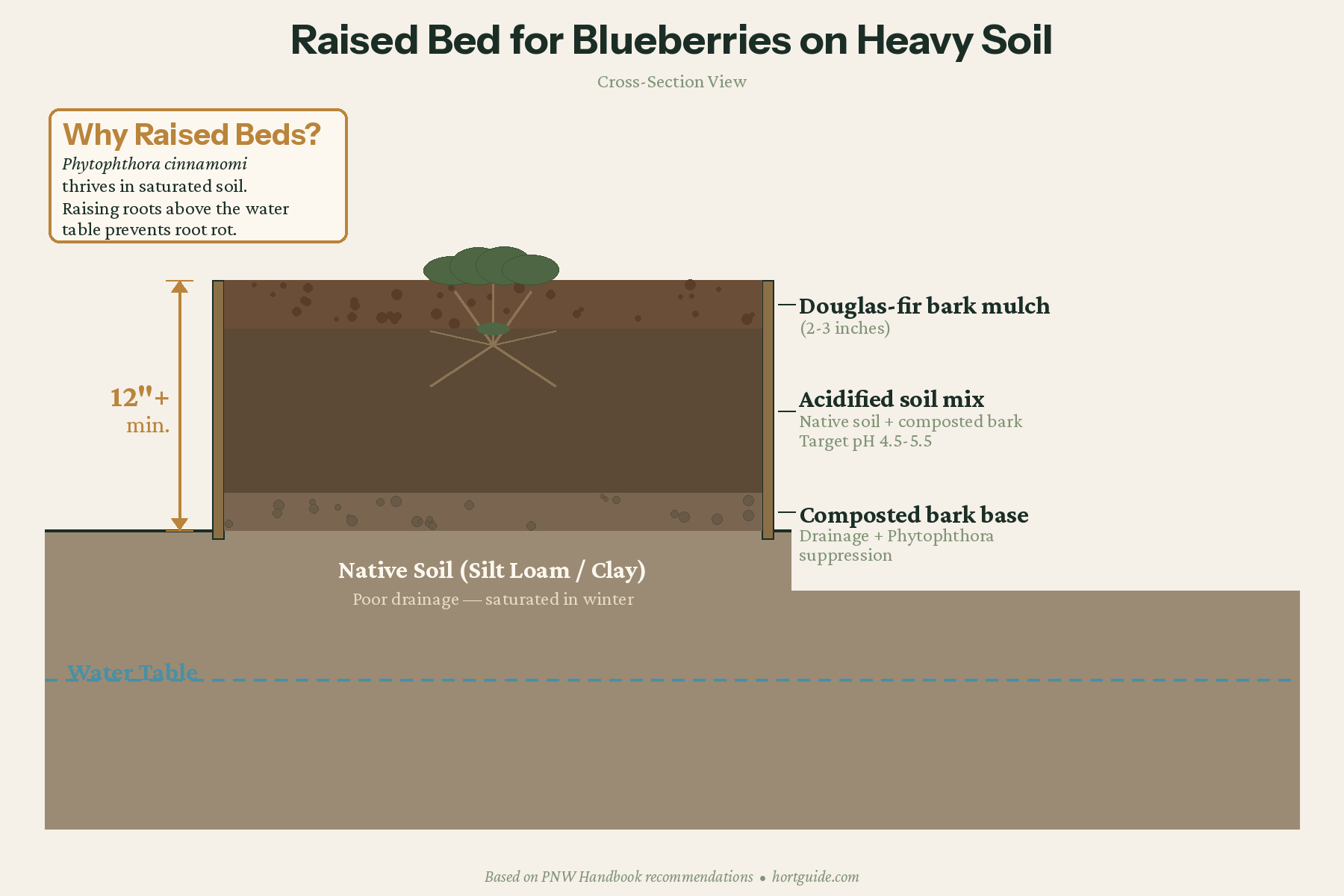
Silt loam and clay sites (Woodinville, Bellingham series). Drainage is your primary problem. These soils hold water through winter and into spring, creating exactly the saturated conditions that Phytophthora cinnamomi needs to attack roots. If you plant at grade on poorly drained silt loam or clay, you are gambling with root rot regardless of cultivar. Build raised beds at least 12 inches high, fill with a mix of native soil and composted bark (bark is naturally suppressive to Phytophthora), and choose resistant cultivars: Patriot, Legacy, Liberty, Reka, or Aurora. Avoid Duke, Bluecrop, Draper, and Toro on these sites.
Sites with management history. Former lawns that received lime, vegetable gardens with years of alkaline irrigation, construction sites with imported fill: these can run pH 6.0 to 7.0 regardless of the native soil series. You need sulfur, and you need to apply it six to twelve months before planting. Elemental sulfur is the standard amendment. Rates vary by soil texture because clay buffers more and needs higher applications. The PNW Handbook recommends up to one ton per acre to lower a pH 6.0 clay loam to 4.5, but home gardeners working a single bed can scale that down. Apply no more than two pounds per 100 square feet at a time and retest before adding more.
One problem affects every site regardless of starting soil: the tap water treadmill. Puget Sound municipal water typically runs pH 7.5 to 8.5. Every time you irrigate, you nudge the soil pH back up. The solutions are using ammonium sulfate as your nitrogen source (it acidifies as it feeds), collecting rainwater for irrigation, or testing annually and re-amending as needed. This is the same dynamic that makes hydrangea flower color drift from blue to pink over time.
The PNW Handbook offers a low-tech monitoring trick worth borrowing: plant a hydrangea at the end of your blueberry row. Blue flowers mean your soil pH is in the right range. Pink flowers mean it has drifted too high. It is not a soil test, but it is a season-long visual indicator that costs nothing.
Three Problems Worth Knowing About
Forty-three diseases and seven pests are documented on blueberry in the PNW Handbooks. Most are minor or episodic. Three are worth understanding before you plant, because two of them are prevented at planting and the third requires a plan before fruit ripens.
Mummy Berry
This is the signature blueberry disease. The fungus Monilinia vaccinii-corymbosi overwinters in mummified berries on the ground beneath your bushes. Mummies can survive five years or more. In early spring, when soil temperature rises above 45°F, cup-shaped fruiting bodies (apothecia) grow from those mummies and release spores into the wind. The timing is not coincidental: ascospore release at roughly 1,020 GDD₃₂ is synchronized almost exactly with blueberry bud break at 1,068 GDD₃₂. The pathogen evolved to attack flowers the moment they open, and flowers that have already been pollinated are less susceptible than those that just opened.
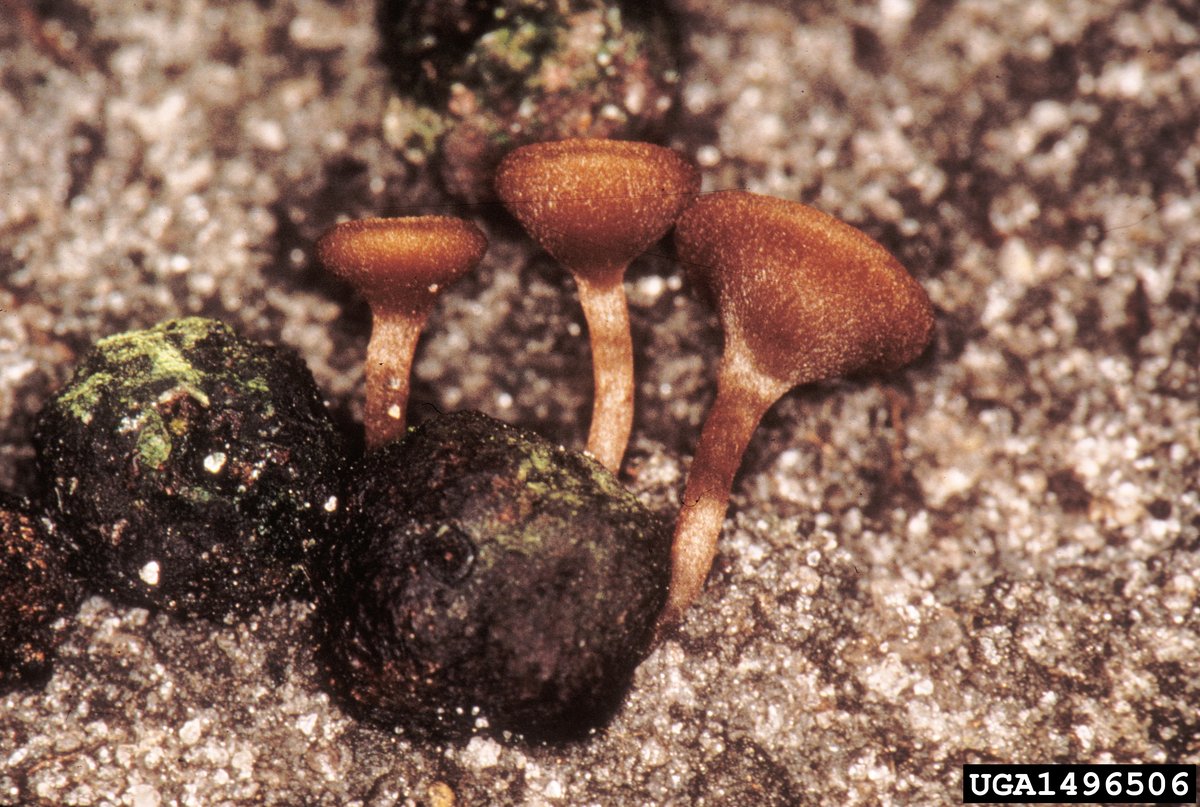 Photo: UGA Plant Pathology / Wikimedia Commons / CC BY 3.0

You will recognize it by flowers that turn brown and wilt as if frosted, followed by shoots that collapse and die. Infected berries develop spongy white fungal growth inside the carpels, eventually shriveling into hard gray mummies that fall to the ground and start the cycle again.
Cultural controls work. Rake or shallowly cultivate under bushes in fall to bury mummies. A two-inch layer of Douglas-fir sawdust applied during dormancy reduces apothecial emergence in spring. In early spring, before bloom, rake or disturb the soil surface to destroy developing apothecia. Resistant cultivars (Bluetta and Olympia are documented as resistant to both phases) are the best long-term prevention.
Spotted Wing Drosophila
Unlike common fruit flies that attack overripe or damaged fruit, spotted wing drosophila (Drosophila suzukii) has a serrated ovipositor that cuts into intact, ripening berries. The female lays eggs inside sound fruit, and by the time you notice the larvae, the harvest is ruined. SWD is most active between 60 and 80°F, which describes a Puget Sound summer precisely. In hotter regions, temperatures above 86°F suppress the fly. Here, it thrives all season.
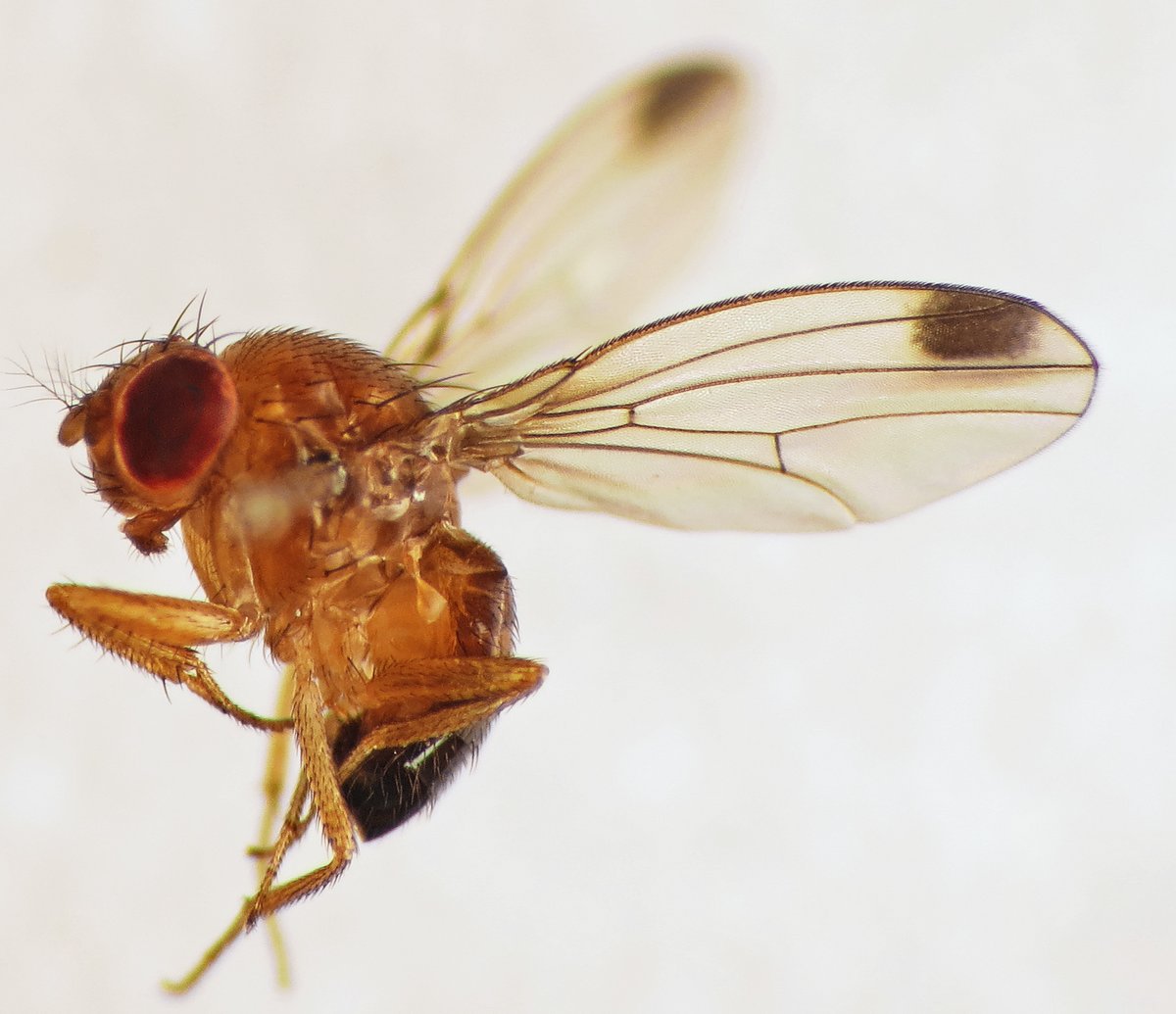 Photo: Martin Cooper / Wikimedia Commons / CC BY 2.0
_male.jpg)
Fine-mesh exclusion netting (openings less than 1mm) is the most effective home garden defense. Deploy it after pollination is complete but before fruit begins to color. Cornell research found infestation rates of 0.37 to 0.53% with netting versus 60% without. Harvest frequently. Remove fallen fruit. If you need a spray, spinosad is the preferred option for home use. Set monitoring traps in late May (apple cider vinegar plus a drop of dish soap in a container with small holes) so you know when the fly is active in your yard.
Phytophthora Root Rot
This circles back to drainage. Phytophthora cinnamomi thrives in saturated soil. The disease you prevent at planting, not after. If your site drains poorly, the raised bed and composted bark approach described above is not optional; it is the difference between a productive planting and a slow decline. The PNW Handbook documents cultivar resistance clearly: Aurora, Legacy, Liberty, Patriot, and Reka carry resistance. Bluecrop, Duke, Draper, and Toro are susceptible. If leaves yellow uniformly (not interveinal chlorosis, which is iron deficiency from high pH) and do not recover with watering, suspect root rot. By the time the canopy shows it, the root system is already compromised.
Botrytis blight on blueberry flowers and lecanium scale are also documented in this region but are secondary concerns compared to these three.
What to Do Right Now
Blueberries are blooming now in the Puget Sound lowlands. Mummy berry ascospores are active (the 1,020 to 1,498 GDD₃₂ window spans roughly March through mid-May in a typical year). If you see browning flowers on existing bushes, it may be mummy berry infection, not frost damage.
Plant container stock now through May. Prepare beds with composted bark, not peat. Bark is cheaper, more sustainable, naturally suppressive to Phytophthora, and performs better in PNW soil than peat does. If planting on clay or silt loam, build raised beds first. Do not plant at grade on poorly drained sites.
If you are planting first-year bushes, remove every flower. All of them. The plant needs to build roots and shoots, not fruit. NC State Extension recommends removing flowers for the first two full years for best long-term establishment. It is the hardest thing to do and the most consequential.
Have SWD netting ready before your fruit colors. Set vinegar traps in late May to monitor. The fly arrives before you expect it.
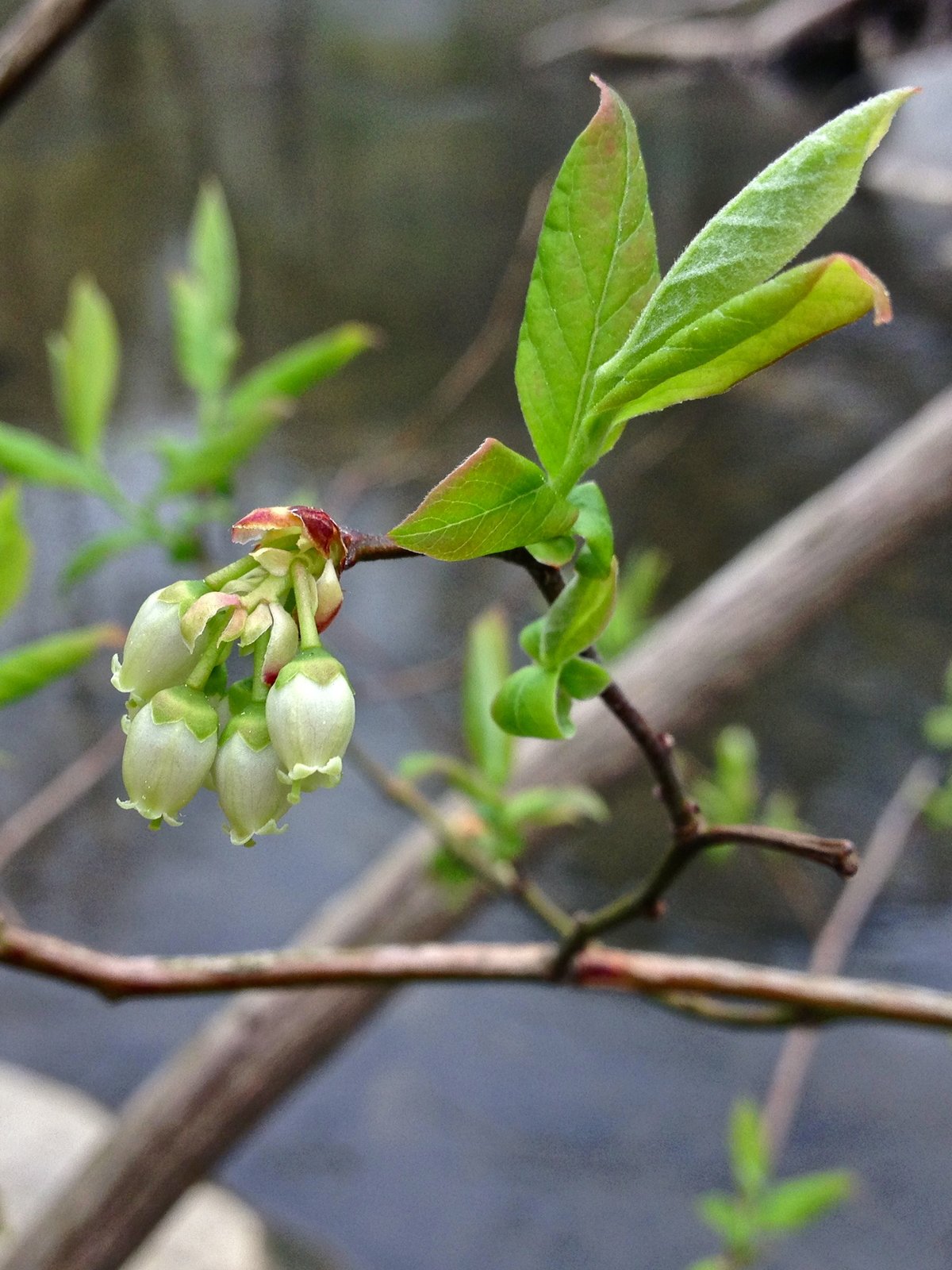 Photo: Fritzflohrreynolds / Wikimedia Commons / CC BY-SA 3.0

Seasonal Action Summary
| When | What | Why |
|---|---|---|
| Feb-Mar | Apply sulfur if soil test shows pH above 5.5 | Slow-acting; needs months to lower pH |
| Mar-Apr | Rake under bushes, disturb soil surface | Destroys mummy berry apothecia before spore release |
| Apr-May | Plant container stock; remove first-year flowers | Establishment; root development over fruit production |
| Late May | Deploy SWD monitoring traps | Detect fly activity before fruit is vulnerable |
| Jun | Install exclusion netting after pollination, before fruit colors | Physical SWD exclusion before oviposition begins |
| Jul-Sep | Harvest every 2-3 days; remove fallen fruit | SWD sanitation; prevents mummy berry inoculum |
| Oct-Nov | Rake up mummified berries; apply 2” bark or sawdust mulch | Breaks mummy berry overwintering cycle |
| Dec-Feb | Prune (year 3+): remove dead wood, thin interior, cut oldest canes | Dormant season; before bud break; maintains airflow |
Sources
- Finn, C., Strik, B.C., & Moore, P.P. (2014, reviewed 2024). Blueberry Cultivars for the Pacific Northwest (PNW 656). WSU/OSU Extension.
- PNW Plant Disease Management Handbook: Blueberry - Mummy Berry.
- PNW Plant Disease Management Handbook: Blueberry - Root Rot.
- UC IPM Pest Notes: Spotted Wing Drosophila (No. 74158).
- Pest Prophet: Mummy Berry Growing Degree Day Model. GDD₃₂, biofix Jan 1.
- Waller, T.J. et al. (2021). Mummy Berry Diagnostic Guide. Plant Health Progress PHP-09-21-0120-DG. DOI.
- Cornell University: Economic Analysis of Exclusion Netting for SWD in Organic Blueberry.
- Missouri Botanical Garden: Vaccinium corymbosum Plant Finder.
- NC State Extension: Vaccinium corymbosum.
- PNW Plant Disease Management Handbook: Blueberry - Incorrect Soil pH.
Pesticide products named in this guide are registered for homeowner use in Washington State at the time of writing. Always read and follow the label. Product registration can change; verify current registration at the WSDA Pesticide Database.
Last updated: April 2026