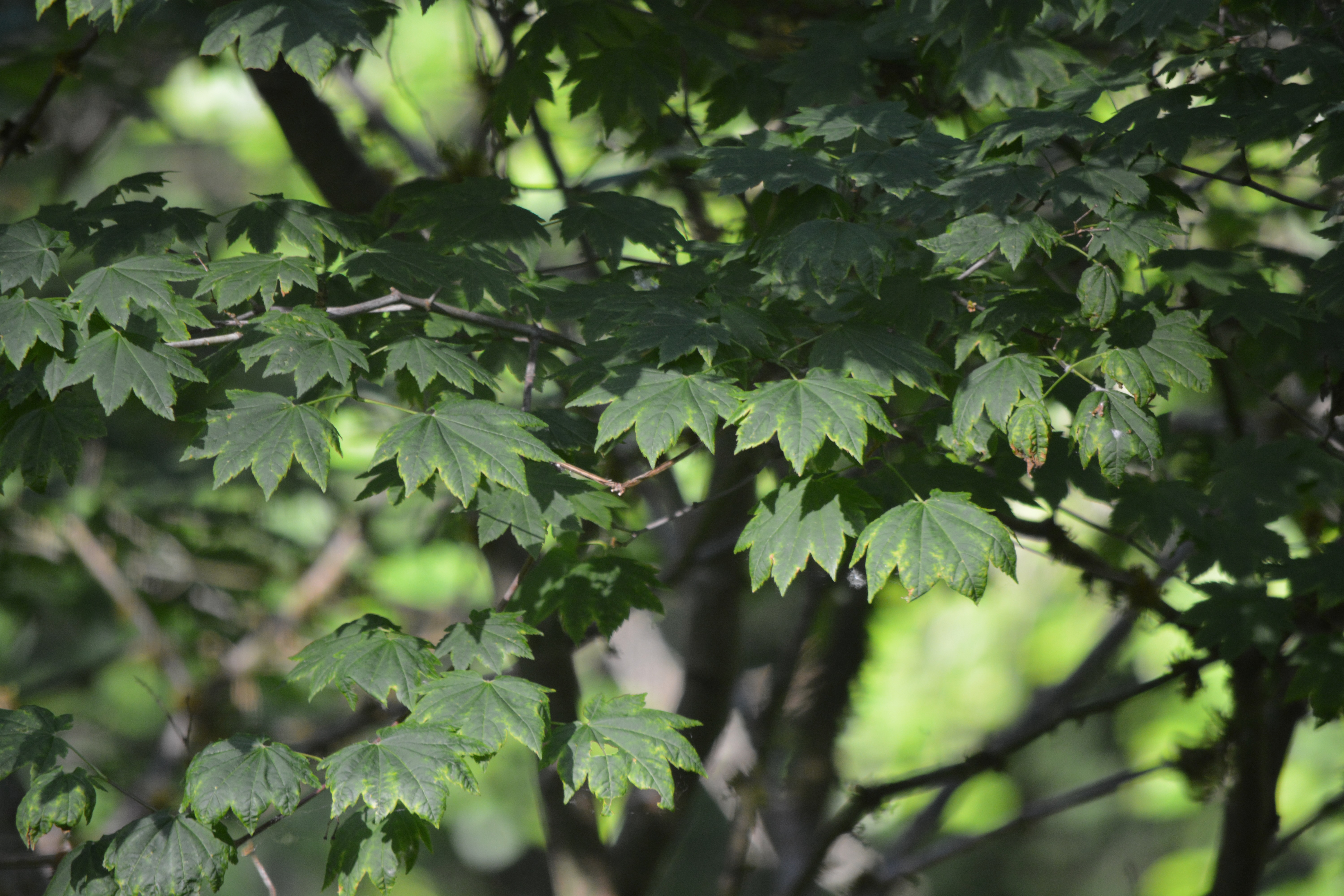
Vine maple (Acer circinatum) in late spring. Every square centimeter of leaf surface is photosynthetic real estate. Photo: Chris Welch
You look at a tree canopy and call it “healthy” or “thin.” What you are actually assessing is the performance of millions of individual leaves, each one a solar panel wired into the vascular system below and dependent on the roots feeding it water. Understanding what is inside those leaves turns that visual impression from a guess into something closer to a diagnosis.
The trunk and branch structure, wood and bark, and root architecture all exist to support this organ. Conifer needles follow a different blueprint, covered separately.
The Outer Skin: Epidermis and Cuticle
Pick up a fallen bigleaf maple leaf in October. Run your thumb across the top surface. That slight glossiness you feel is the cuticle, a waxy waterproof coating over the epidermis, which is the single-cell-thick outer skin on both the upper and lower surfaces of the leaf. The cuticle keeps the leaf from drying out through its top surface, the side that faces the sun all day.
Not all cuticles are the same thickness. A leaf that grew in full sun develops a thicker cuticle than one that grew in shade. This is one reason a shade-grown hosta scorches when you move it into a sunny bed. The whole leaf was built for low light: thinner waterproofing, fewer internal layers for processing intense light, lower capacity to shed heat. It is not just sunburn. The leaf literally cannot handle the energy load it was never designed for.
Where Sugar Gets Made: The Mesophyll
Peel back the epidermis (mentally, at least) and you reach the mesophyll, the green tissue where photosynthesis happens. It comes in two layers, and each has a different job.
The upper layer is the palisade mesophyll: tall, tightly packed cells standing on end like columns, aimed straight at incoming sunlight. These cells are packed with chloroplasts, tiny green structures that contain the pigment chlorophyll. Chloroplasts are where the actual chemistry happens. They capture light and use that energy to build sugar from carbon dioxide and water. A single cell may hold dozens of them, all running the same reaction independently.
Below that is the spongy mesophyll: loosely arranged cells with air spaces between them. Those air spaces are not empty wasted room. They are the corridors through which carbon dioxide flows in to reach the chloroplasts and oxygen flows out. Think of the palisade layer as the factory floor and the spongy layer as the ventilation system.
The Plumbing: Leaf Veins
Hold a maple leaf up to the light and you can see the veins branching through it. Each vein is a tiny bundle of two types of pipe: xylem carrying water up from the roots, and phloem carrying sugars back down to the rest of the tree. The branching pattern ensures no cell in the leaf is far from a supply line or an export route.
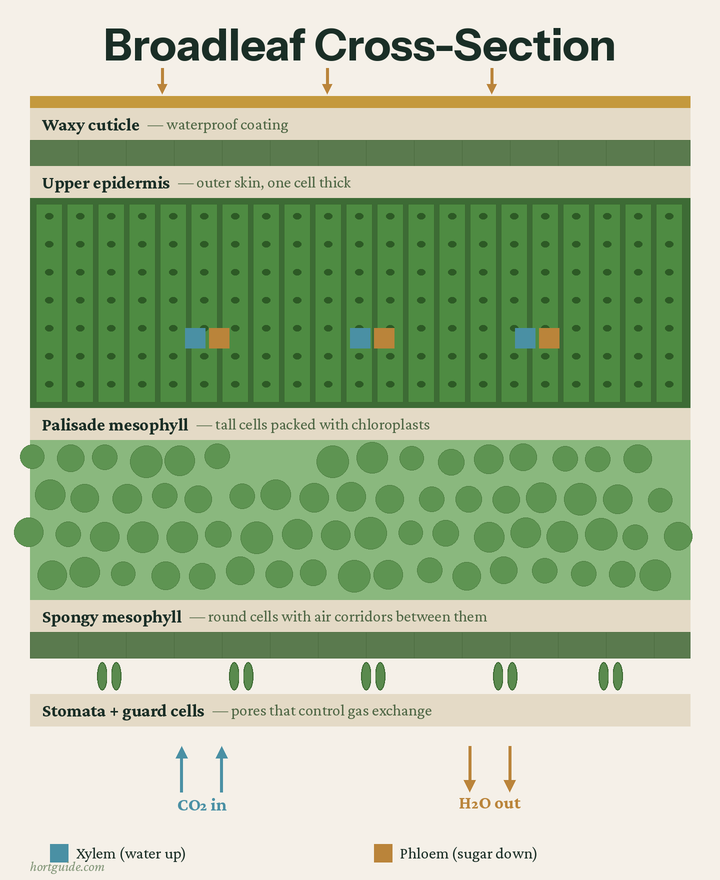 Cross-section of a broad leaf. Sunlight enters from the top, passes through the cuticle and epidermis, and reaches the chloroplast-packed palisade cells below. Air spaces in the spongy mesophyll let gases circulate. Stomata on the bottom surface open and close to regulate the exchange.
Stomata: The Valves That Run Everything
Flip that leaf over. The underside is perforated by thousands of tiny pores called stomata, each one flanked by a pair of guard cells. You cannot see individual stomata without magnification, but you are looking at the most important control surface on the tree.
Each stoma works like a valve. When the guard cells fill with water, they swell and bow apart, opening the pore. When they lose water pressure, they go limp and the pore closes. Simple mechanics, enormous consequences.
What Open Stomata Do
When stomata are open, three things happen at once. Carbon dioxide enters the leaf for photosynthesis. Oxygen exits as a byproduct. And water vapor escapes, a process called transpiration.
That escaping water is not just a cost of doing business. It is the engine that pulls the entire water column up from the roots. As water evaporates out of the stomata, it creates tension in the xylem, pulling water upward from the soil without the tree spending any energy on pumping. Every open stoma is both a gas exchange port and a pump head.
The Daily Tradeoff
Here is the catch: every open stoma loses water. To photosynthesize, the tree must open its stomata. But on a hot, dry afternoon, losing water faster than the roots can replace it is a death sentence. So the tree closes its stomata to conserve moisture, accepting that photosynthesis slows to a crawl.
This is why a canopy can look fully leafed out and green but still be struggling. The leaves are all there, but the stomata are shut. The factory looks fine from outside, but the machines are off. A tree that does this chronically, closing its stomata every afternoon through a dry summer, is quietly falling behind on its energy budget. That deficit shows up later as smaller growth rings, slower wound closure, and weaker defenses against disease.
Here is a field trick worth knowing: a leaf that is actively transpiring feels cool to the touch because evaporation pulls heat away. A leaf with closed stomata heats up. On a hot afternoon, if a leaf feels warm instead of cool, the stomata may be shut.
Why Stomata Are on the Bottom
Stomata concentrate on the lower surface of the leaf, facing away from direct sun. The underside sits in a thin layer of still air (the boundary layer) that slows evaporation. Both factors help the tree lose less water per unit of gas exchange. Some species in harsh environments put stomata on both surfaces, and conifer needles take a completely different approach (covered in needle anatomy), but most broadleaf trees keep their stomata on the bottom.
Antitranspirants: Forcing the Tradeoff
Antitranspirants are products designed to reduce water loss from leaves, most commonly used during transplanting or drought stress. There are two types.
Film-forming antitranspirants are wax or polymer sprays that coat the leaf surface, physically blocking some of the stomatal openings. Metabolic antitranspirants use a plant hormone called abscisic acid (ABA) to chemically signal the guard cells to close, mimicking the tree’s own drought response.
Both types work. Both also reduce photosynthesis, because anything that blocks water from leaving also blocks carbon dioxide from entering. You are not giving the tree a free pass on water loss. You are trading growth for survival, a trade worth making only when the alternative is losing the plant.
Abscission: How Trees Drop Their Leaves
Deciduous trees do not just let their leaves fall off. They take them apart.
In autumn, a specialized band of cells called the abscission zone forms at the base of each leaf stem (the petiole). The tree seals the connection with a waxy layer, breaks down the cell walls in the zone, and recovers nitrogen and other mobile nutrients from the leaf before cutting it loose. The seal prevents water loss and blocks pathogens from entering through the scar.
What Triggers Leaf Drop
The primary trigger is day length. As days get shorter in autumn, the tree reads the signal and begins the shutdown process. Temperature and soil moisture play supporting roles, and drought or an early frost can accelerate things independently, but the calendar of daylight is the main clock.
This is why, here in the Puget Sound lowlands, a warm October does not delay leaf fall much. Day length shortens on schedule regardless of temperature. What warmth does is keep photosynthesis running longer in the remaining leaves, sometimes making fall color more vivid. Sugars accumulate in leaves that are already sealed off from the rest of the tree, and those trapped sugars produce the reds and oranges. The most vivid maples in this region are often on warm south-facing sites where the trees stay metabolically active right into the abscission window.
When Leaf Drop Goes Wrong
A tree that drops its leaves prematurely, whether from drought stress, defoliation by insects, or disease, may not have time to complete the nutrient recovery process. It loses the leaves and the nutrients they contain. That is a double hit: reduced photosynthesis for the rest of the season, plus a nutrient deficit going into the next one.
Sources
- How Trees Work: Understanding Tree Structure - Penn State Extension
- Tree Biology and Dendrology - University of Wisconsin Extension
- Antitranspirant and Transplant Stress - University of Maryland Extension
- Leaf Structure and Function - LibreTexts Biology