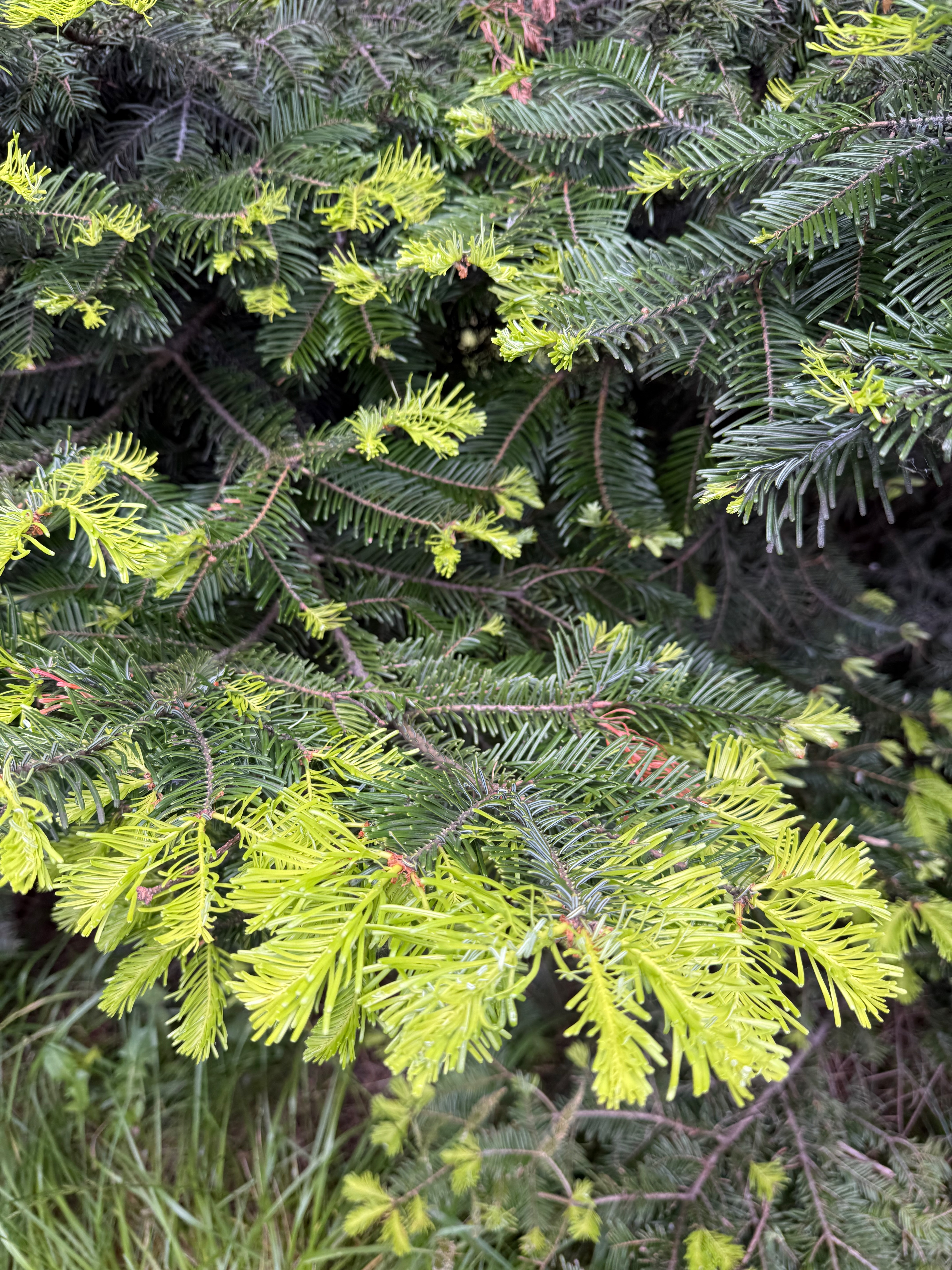
Douglas-fir (Pseudotsuga menziesii) new growth at Clark Lake Park, Kent. The light-green tips are this year’s needles; the darker foliage behind them may be five to eight years old. Photo: Chris Welch
A conifer needle is a leaf. It does the same job as the broad, flat leaf on a maple: captures sunlight, pulls in carbon dioxide, builds sugar, and releases oxygen. But the engineering is completely different. Where a bigleaf maple spreads out a huge surface to catch every photon, a Douglas-fir needle does the opposite. It is narrow, waxy, and built to hold onto water. Understanding why tells you a lot about why conifers dominate the forests in this region.
If you have read how a broad leaf works, the contrast is striking. The same tree anatomy series covers trunk and branch structure, wood and bark, and root development.
What Is Inside a Needle
If you could slice a Douglas-fir needle crosswise and look at it under a microscope, you would see a very different layout than the inside of a maple leaf.
The outer skin (epidermis) is reinforced with a thick, waxy cuticle, much heavier than what you find on a broadleaf. Below that is a layer called the hypodermis that adds structural stiffness, something broadleaf leaves do not have at all. The photosynthetic tissue (mesophyll) is packed tight with less air space, and the stomata (the gas exchange pores) sit in sunken pits or grooves instead of flush with the surface.
Those sunken stomata are the key feature. By sitting in a recessed channel, each stoma traps a tiny pocket of still, humid air above it. That pocket reduces the rate at which water vapor escapes. The result: a needle loses far less water for every unit of sugar it makes compared to a broad leaf.
Deeper inside, resin canals run through the tissue, producing the sticky pitch that seals wounds and discourages insects. The vascular bundle (xylem and phloem, the water and sugar pipes) sits at the center, wrapped in a sheath of cells called the endodermis that controls what flows in and out. The whole structure is more compact and more fortified than a broadleaf interior.
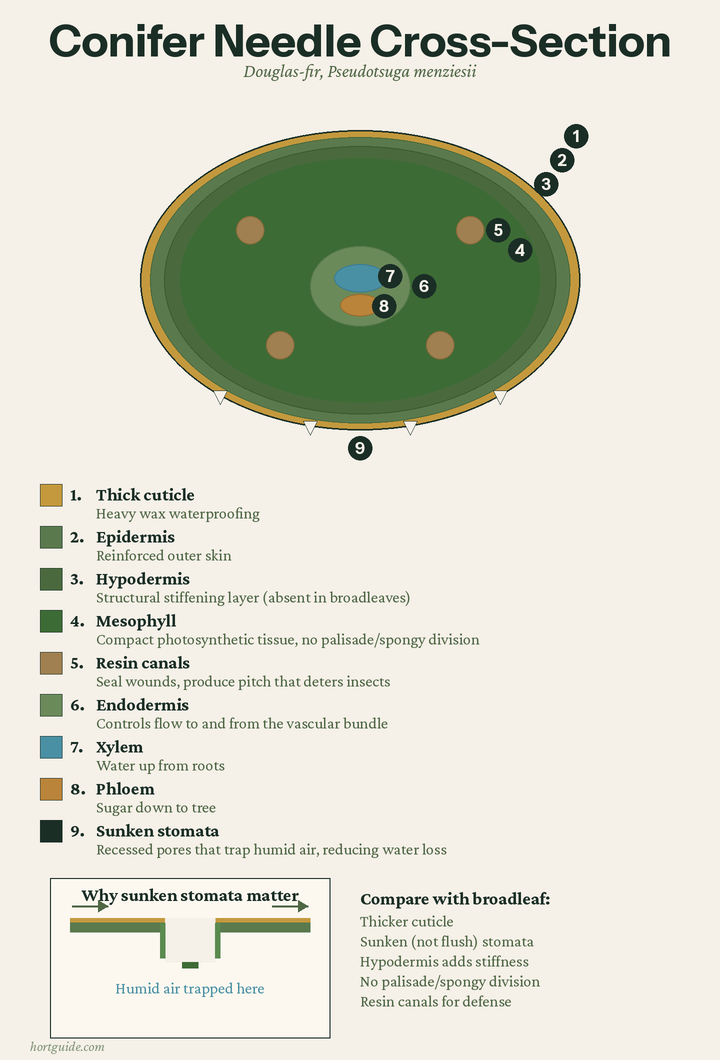 Cross-section of a Douglas-fir needle. The concentric rings of armor (cuticle, epidermis, hypodermis) protect the compact mesophyll inside. Stomata sit in recessed pits rather than flush with the surface. Resin canals and a central vascular bundle complete the fortified interior.
Why Needles Are Shaped This Way
Needle anatomy evolved primarily as a response to drought. Over roughly 150 million years of drying climates, conifers developed leaves that prioritize holding onto water: thick waterproofing, recessed pores, compact internal structure. Cold tolerance came along for the ride, since frozen soil is effectively dry soil from a root’s perspective. The narrow shape also sheds snow well and holds up in wind.
In Western Washington, that water-saving design gives conifers a different kind of advantage. Our winters are mild and wet, but they are dark. A deciduous tree shuts down from roughly November through March, five months with zero photosynthetic income. A Douglas-fir or western hemlock keeps its needles and makes sugar whenever conditions allow, even on a clear day in January. That year-round capacity is a big part of why conifers dominate here. They are not just surviving winter. They are working through it.
This matters when you think about a conifer’s site. A Douglas-fir on a south-facing slope with winter sun has a longer effective growing season than one on a shaded north-facing slope a few hundred feet away. Same needle anatomy. Different energy income.
Needle Retention: What Is Normal and What Is Not
A single Douglas-fir needle can live five to eight years. That is longer than most people expect. But most needles do not reach their maximum age, because the tree sheds its oldest, most shaded needles each autumn, a process called interior needle drop. Those inner needles cost more to maintain than they earn in photosynthesis, so the tree cuts its losses. This is normal. It is not a disease.
You can read a branch’s history by counting needle cohorts back from the tip. Each year of growth produces a distinct band of needles separated by a visible bud scar. Because inner cohorts get shaded out before they reach full lifespan, a healthy Douglas-fir branch in good light typically carries four to six years of needles. If only one or two cohorts remain, the tree is under more stress than the green tips suggest. This takes about five seconds to check in the field and tells you something real about the tree’s energy situation.
The pattern of needle loss matters more than the amount. Interior drop on older branches is maintenance. But when a tree sheds needles from the outer crown, or loses more cohorts than usual across the whole canopy, something is wrong. In this region, common causes include Swiss needle cast (a fungal disease that literally plugs the stomata with fruiting bodies, suffocating the needle from the outside), drought stress, and root damage from construction or compaction.
Western Red Cedar: The Awl Leaf Variation
Western red cedar does not have needles in the traditional sense. Its leaves are tiny, flat scales pressed tight against the twig in overlapping sprays. These are called awl leaves, and they follow the same principles as needles (thick cuticle, reduced surface area, sunken stomata) but in a different form.
The overlapping arrangement creates a sheltered microclimate. Each scale partially covers the one below it, slowing air movement across the stomata and reducing water loss even further. This is part of why western red cedar can grow in the soggy, poorly drained sites where other conifers struggle. It is not that the tree loves wet feet. It is that its extremely efficient water management means it can tolerate the root stress that comes with waterlogged soil, because it does not need to transpire as heavily to move water through its system.
Deciduous Conifers: The Exceptions
Not every conifer is evergreen. A few species drop all their needles every autumn and grow new ones in spring, just like a maple or an oak.
Western larch, found east of the Cascades and into the northern Rockies, is the best-known example in the Pacific Northwest. Its needles are thinner and less waxy than an evergreen conifer’s because they only need to last one growing season. The tree trades the evergreen advantage of year-round photosynthesis for lighter, more efficient summer needles and zero winter maintenance costs.
Dawn redwood (Metasequoia glyptostroboides), a common specimen tree in Puget Sound parks and gardens, does the same thing. So does bald cypress (Taxodium distichum), planted occasionally here as a landscape tree. If you see a conifer turning gold and dropping its needles in November, check whether it is one of these three before assuming it is dying. All of them are perfectly healthy when bare in winter.
Sources
- How Trees Work: Understanding Tree Structure - Penn State Extension
- Tree Biology and Dendrology - University of Wisconsin Extension
- Leaf Structure and Function - LibreTexts Biology
- Douglas-fir (Pseudotsuga menziesii) - USDA Forest Service, FEIS
- Western Red Cedar (Thuja plicata) - USDA Forest Service, FEIS
- Silvics of North America, Vol. 1: Conifers - USDA Forest Service