You’re not going to find Pagoda Dogwood crowded into the ornamental section of your local nursery. It’s not the tree garden centers push in spring marketing blitzes. But if you’re looking for something distinctive, architecturally striking, and well-suited to Western Washington’s climate, Cornus alternifolia rewards the patience required to track one down.
The name tells you exactly what makes this tree worth seeking out. The horizontal, layered branching habit is so pronounced and sculptural that it looks like the tree is wearing its bones on the outside. Branches radiate outward in tiers, stacking vertically like the roofs of a pagoda or the tray tables of a display stand. Walk around the tree and you see clean, stratified lines in winter that persist even after leaf-out. This is the kind of structural quality that carries a landscape through the quiet months.
Cornus alternifolia is native to eastern North America, thriving in the understory of deciduous and mixed forests from Ontario down to Georgia. The plant name refers to its unusual leaf arrangement: “alternifolia” means leaves emerge alternately along the stem, opposite to what you’d expect from most dogwood species. In the Cornus genus, where opposite leaves dominate, this trait makes the tree immediately recognizable.
In your Western Washington woodland garden, Pagoda Dogwood reaches 15 to 25 feet tall with a spread approaching or exceeding its height. It’s rated hardy to zones 3a through 8b, which puts it well within range for the Puget Sound climate. Growth is moderate, not the explosive expansion you get with many ornamentals, so plan for a tree that takes its time settling in.
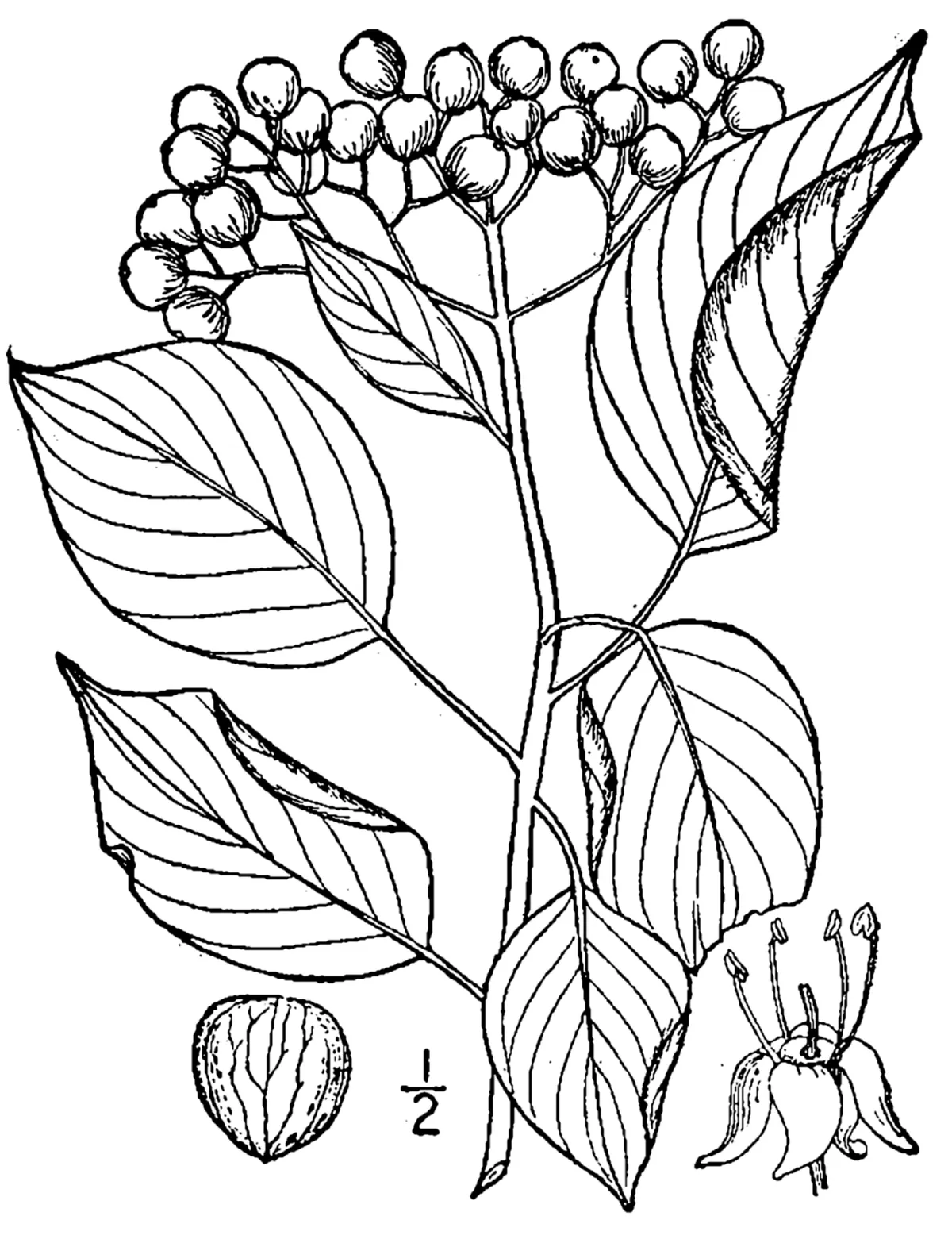
The ornamental value extends beyond winter architecture. In late spring, small creamy-white flowers appear in flat-topped clusters (called cymes) held above the emerging foliage. They’re not showy in the sense of a flowering cherry or redbud, but their subtlety fits the plant’s overall character. By late summer, the display shifts to fruit: small blue-black drupes held on distinctive red stalks. The color contrast between the dark fruit and the colored stems is intentional. Birds read that display as an advertisement. Robins, thrushes, and cedar waxwings strip the fruit by mid-fall, which means you get the architectural benefit without a mess of dropped berries staining your pathways and deck.
Summer foliage is fine-textured, with alternate leaves creating a lighter canopy than you’d get from opposite-leaved dogwoods like Cornus sericea or Cornus kousa. The leaves turn burgundy or purplish in fall, adding another seasonal shift.
Where Pagoda Dogwood earns its reputation as a connoisseur’s tree is in the care it requires in Western Washington. This is not a plant to install and ignore. In our maritime climate, with spring rains and persistent moisture, the tree is susceptible to twig blight and anthracnose-related leaf spot. These fungal diseases aren’t fatal but can disfigure the tree if conditions favor rapid spread. A wet spring followed by poor air circulation creates ideal pathogen conditions.
Site it carefully: choose a location with morning sun and afternoon shade, with air movement to dry foliage quickly after rain. Avoid planting in dense, poorly ventilated areas or where water pools around the base. If you’re placing it in a woodland garden, resist the temptation to surround it with shrubs that trap humidity. You’re essentially managing for the same conditions that keep the disease pressure down in its native eastern understory: dappled light, good drainage, and sufficient air flow.
Pruning should be minimal and done in late winter. The tree’s natural branching structure is its primary asset, and aggressive pruning destroys the architectural effect. Remove only dead wood, crossing branches that compromise the layered appearance, and any branches that are obviously diseased or weakly attached. The goal is to enhance the pagoda form, not reshape it.
In terms of pest pressure, Cornus alternifolia faces potential issues from dogwood borer, scale insects, and leaf spot fungi, but none of these are typically severe enough to warrant regular preventive spraying. A healthy, well-sited tree usually manages populations without intervention.
If you garden in Western Washington and you’re drawn to structural plants with restrained elegance, Pagoda Dogwood offers something different from the Japanese maples and ornamental cherries that dominate connoisseur plant collections. It’s a plant that reveals itself gradually through the seasons: a geometry lesson in winter, a quiet bloomer in spring, a fruiting display in fall, and finally a burgundy statement before the leaves drop.
The challenge is getting one established. Specialty nurseries may carry it, or you might need to special order. But once you’ve planted it in a site that meets its needs, you’ll understand why gardeners who know Cornus alternifolia return to it again and again. It’s the kind of tree that improves your understanding of what understory architecture can do in a garden.
Sources
Dirr, Michael A. Manual of Woody Landscape Plants. 6th ed., Stipes Publishing, 2009.
Vertrees, James D., and John D. Vertrees. Japanese Maples. 3rd ed., Timber Press, 2009.
Gilman, Edward F., and Scott W. Watson. “Cornus alternifolia: Pagoda Dogwood.” University of Florida IFAS Extension Fact Sheet ST-161.
Rutgers New Jersey Agricultural Experiment Station. “Diseases of Dogwood.” Plant & Pest Advisory Bulletin.