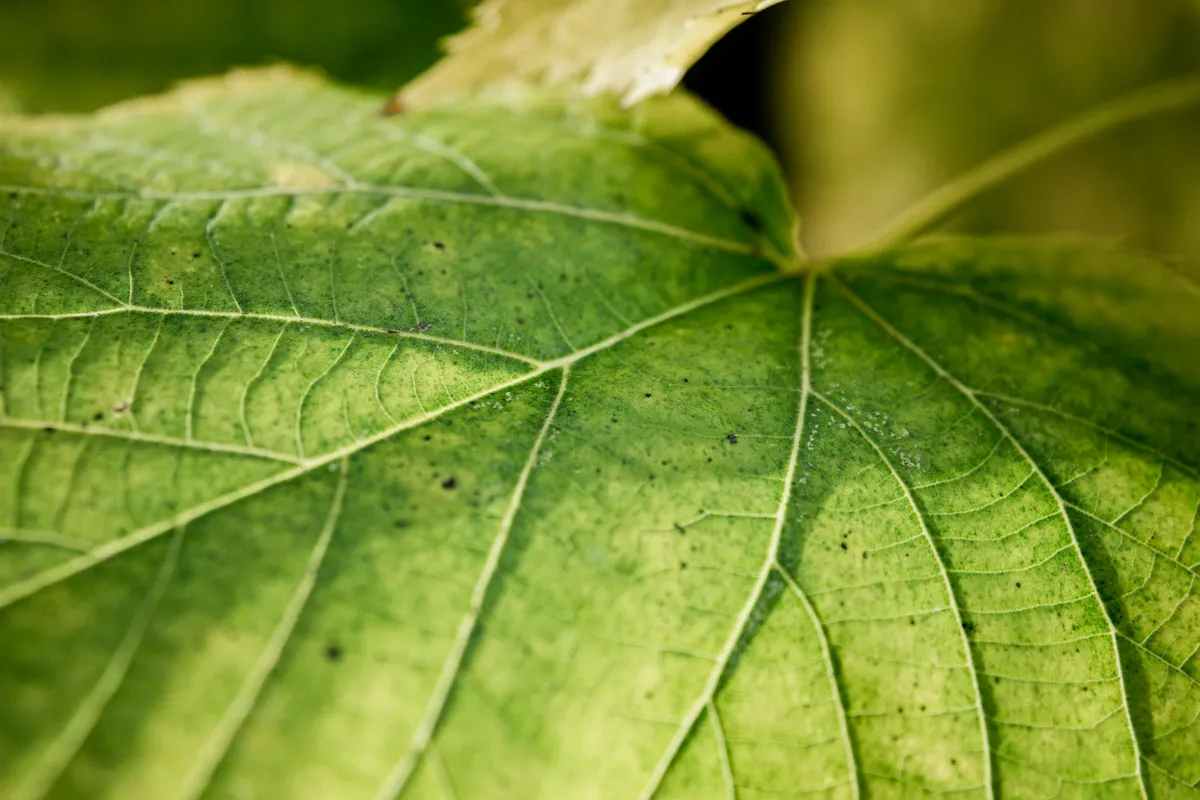
You find them every spring on the same plants. Small brown dots on the lower leaves of the hydrangea. Tan blotches spreading across the Japanese maple. Black circles on the roses, again. By August, half the foliage on your flowering dogwood looks like it lost a paintball fight. You search for answers and find a hundred pages telling you to spray, rake, replace, or worry.
Most of those pages skip the only question that matters: is this actually a problem? For the vast majority of leaf spots on established landscape plants in this region, the answer is no. The plant looks ugly in August and leafs out normally in April. The few leaf spots that actually threaten plant health are identifiable by a simple pattern, and learning that pattern saves you from unnecessary spraying, unnecessary worry, and the occasional unnecessary plant replacement.
What You Are Looking At
Leaf spots are discrete, discolored lesions caused by fungi, bacteria, or environmental stress. They range from pinpoint dots to blotches covering half a leaf. On any given plant in the Puget Sound lowlands, you are probably looking at one of three things.
Fungal leaf spots are the most common. Their spots tend to be circular with well-defined margins, often a lighter center ringed by a darker border. Look closely with a 10x hand lens at the spot surface and you may see tiny dark dots: pycnidia, the fruiting bodies that produce the next generation of spores. If you see them, you have a fungal leaf spot. That is the single most useful diagnostic feature. The specific fungus varies by host: Phyllosticta on maples and rhododendrons, Septoria on dogwoods and tomatoes, Cercospora on hydrangeas, Diplocarpon on roses and strawberries. The genus matters when you get to treatment, but at the diagnostic stage, the circular shape and the pycnidia are what you need.
Bacterial leaf spots look different. Caused by Pseudomonas or Xanthomonas, bacterial spots are angular rather than circular because the bacteria spread through leaf tissue and stop at the veins. The margins are water-soaked, translucent when held up to light, and often surrounded by a yellow halo. Pseudomonas thrives in cool wet weather and is the more common culprit here; Xanthomonas prefers warm wet conditions and is less aggressive in our climate.
Not leaf spot at all. Before you treat a disease, confirm you have one. Nutrient deficiencies produce discoloration that mimics disease: interveinal yellowing from iron or manganese deficiency follows a regular pattern between veins, while disease spots scatter irregularly. Chemical injury from herbicide drift or fertilizer burn creates uniform edge necrosis or spray-droplet patterns. Sunscald affects one side of the plant, the exposed face. If the pattern is too regular, too uniform, or too one-sided, look for an abiotic cause before reaching for fungicide.
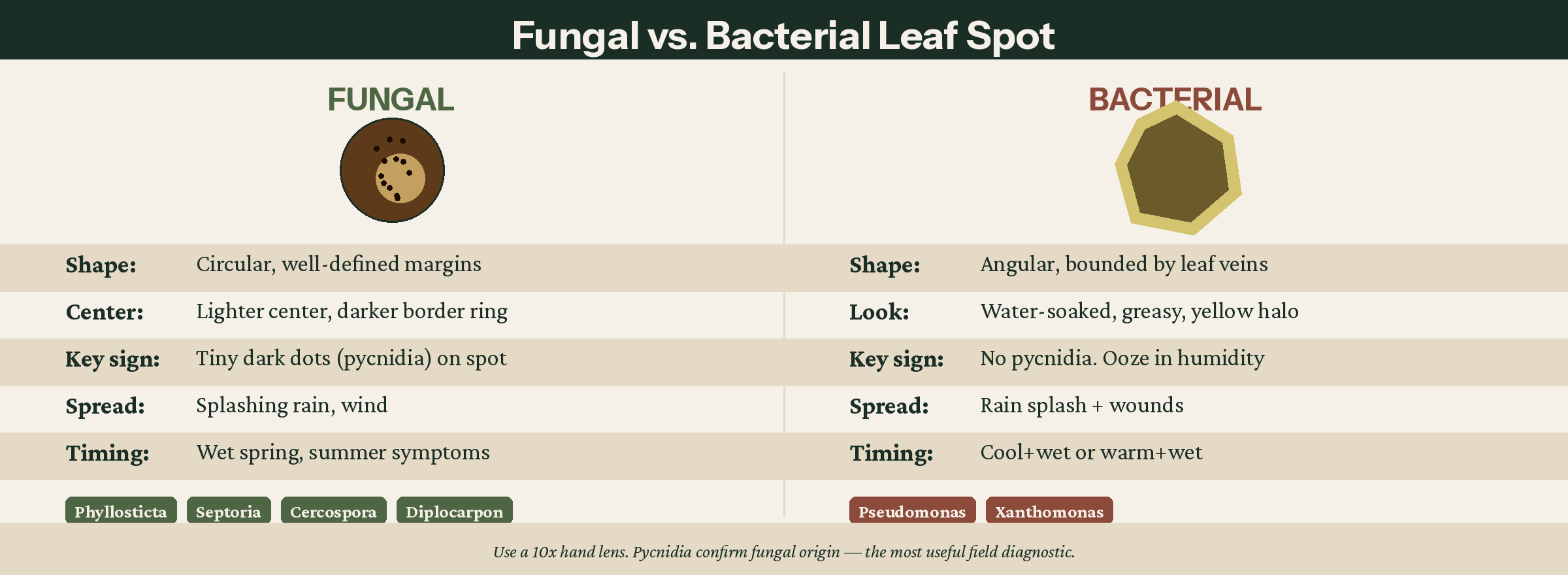 Fungal spots are circular with tiny dark dots (pycnidia) on the surface. Bacterial spots are angular, bounded by leaf veins, with a water-soaked look and yellow halo.
Is This Worth Treating?
This is the question most leaf spot guides skip. They go straight to the spray schedule. But treatment is expensive, disruptive, and often unnecessary.
The clearest threshold comes from University of Minnesota Extension: leaf spot becomes a genuine health concern when a plant experiences moderate to complete defoliation for two to four consecutive years. Below that threshold, the plant recovers. It looks ugly in August, it leafs out normally in April. One bad year is not a pattern. Two bad years are not yet a trend. Three or four years of heavy leaf loss, where the canopy is visibly thin by midsummer and the tree is declining in vigor, is when you reassess.
When to worry. Young or newly planted trees that lose most of their leaves before establishing a root system. Plants declining over multiple seasons with progressively thinner canopies and shorter shoot growth. Bacterial spots causing stem dieback, not just leaf spotting (Pseudomonas on hydrangea can kill stems; Xanthomonas on Indian hawthorn can defoliate entire hedges). Repeated defoliation on fruit trees reducing next year’s crop.
When to accept it. Maple tar spot: dramatic black blotches on bigleaf maple and vine maple every fall. Purely cosmetic; the Morton Arboretum confirms no treatment is needed or recommended. Phyllosticta on Japanese maple: the brown spots look alarming against red cultivar foliage, but the tree tolerates them without consequence. Late-season spotting on any established tree: if the spots appear in August or September, the tree has already banked its carbohydrates for the year.
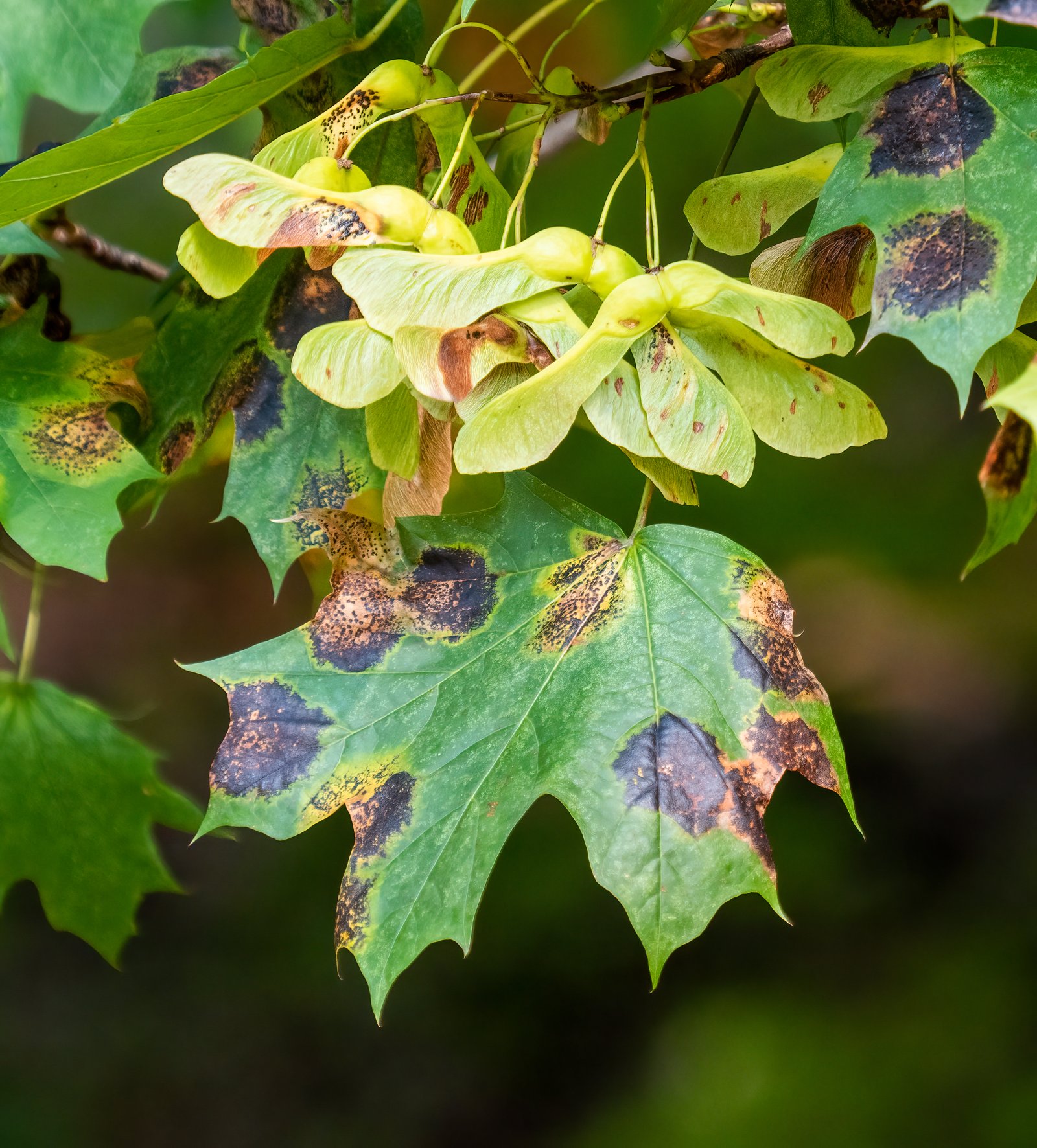 Tar spot (Rhytisma acerinum) on maple. These dramatic black blotches look alarming but cause no meaningful harm to established trees. Photo: Rhododendrites, via Wikimedia Commons, CC BY-SA 4.0.
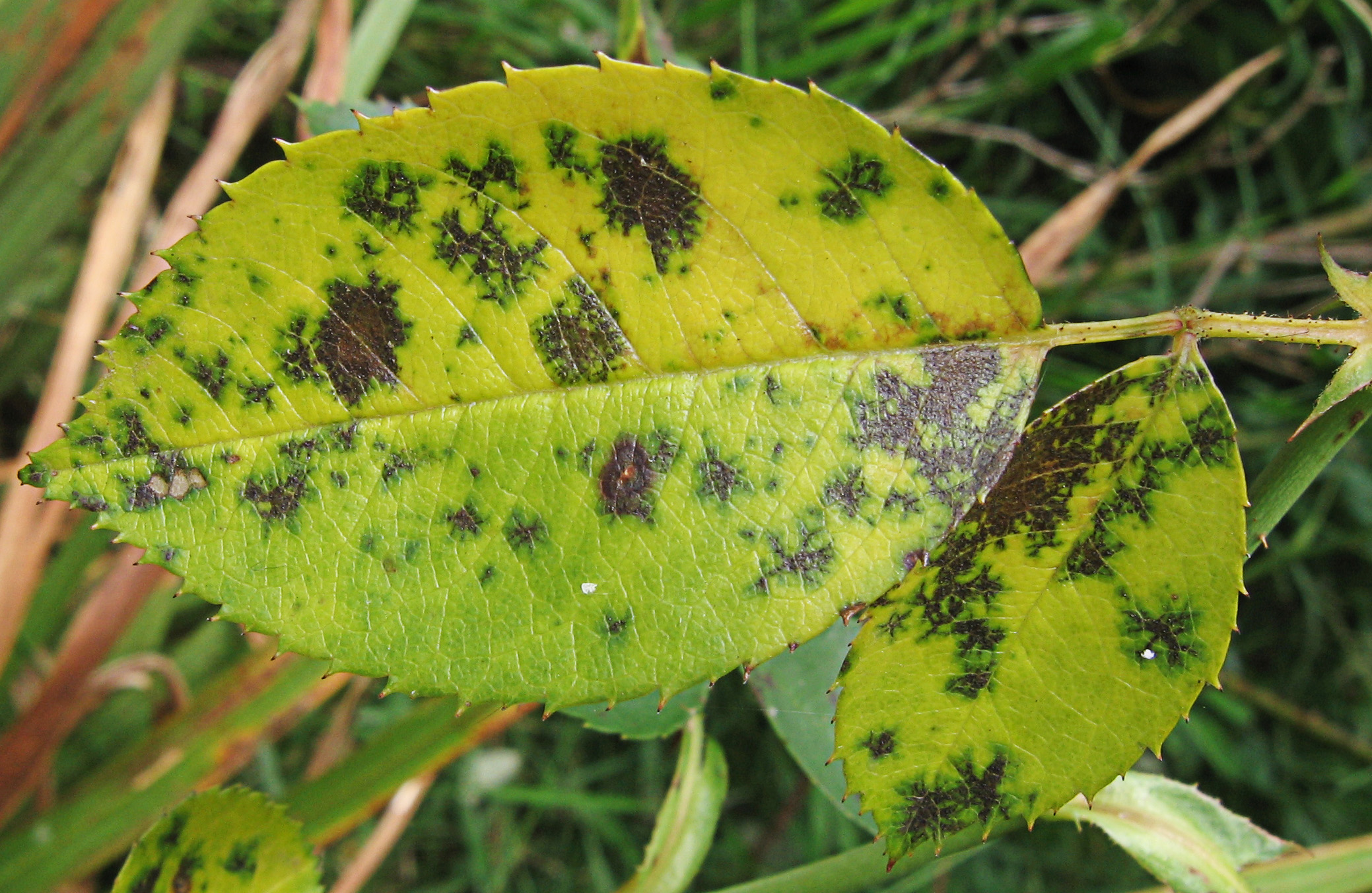 Rose black spot (Diplocarpon rosae). Unlike tar spot, black spot causes progressive yellowing and leaf drop that weakens the plant over repeated seasons. This is the kind of leaf spot worth treating. Public domain, via Wikimedia Commons.
Why Your Climate Is Both the Problem and the Solution
Every plant disease requires three things at the same time: a susceptible host, a pathogen capable of attacking it, and an environment that favors infection. Plant pathologists call this the disease triangle. Remove any one side and the disease cannot establish. This is not academic; it is the framework that explains why your management calendar looks different from what the national guides recommend, and it is the reason most of your leaf spot problems solve themselves by midsummer.
Most national leaf spot advice assumes the growing season is the danger zone: hot, humid summers driving wave after wave of fungal infection. That framing is backwards for the Puget Sound lowlands, because it misreads which environment completes our disease triangle.
Here, the primary infection window is spring. Cool temperatures between 50 and 65°F, frequent rain, fog, and slow-drying foliage create ideal conditions for Septoria, Phyllosticta, and Pseudomonas before summer arrives. These pathogens need 12 to 24 hours of continuous leaf wetness to infect, and our March-through-May weather delivers that routinely. The host is there (new foliage expanding), the pathogen is there (overwintered in last year’s debris), and the environment completes the triangle. By the time national guides say “watch for leaf spots,” our infection window is already closing.
The warm-weather pathogens that dominate national leaf spot discussions, Cercospora and Xanthomonas, need temperatures of 77 to 95°F for optimal infection. Cercospora requires only 6 hours of leaf wetness but at temperatures our summers rarely sustain for extended periods. This is why Cercospora leaf spot on hydrangea is present in Puget Sound gardens but less aggressive here than in the Southeast or Mid-Atlantic. Our summer climate breaks the environment side of their triangle.
This is your regional advantage. Summer drying naturally suppresses most leaf spot pathogens by July. The same dry spell that makes you water your tomatoes is removing the environment leg for fungal infection. You are managing a spring infection event with a natural summer reprieve, not fighting leaf spots all season.
The triangle also explains why some plantings get hammered while the same species a block away stays clean. A hydrangea crammed under a north-facing eave with no air movement, drip from the roofline extending leaf wetness by hours, and dense companion planting trapping humidity is completing the environment side of the triangle every night from March through June. The same hydrangea in an open bed with morning sun and decent spacing may never develop spots worth noticing. If you are seeing recurring leaf spot on the same plants year after year, the disease is often telling you something about the site before it is telling you anything about the pathogen.
The implication for management: most of your effort belongs in fall (sanitation, removing the pathogen’s overwintering reservoir) and early spring (protection if warranted). Every cultural control in the next section works by breaking one side of the triangle. The national spray calendar assumes summer is the battleground. Here, the battle is already over by July.
Which Plants Get Hit Hardest
Not all leaf spots are equal, and not all hosts respond the same way. Match the host to the severity, then decide.
Ornamental trees (mostly cosmetic). Japanese maple gets Phyllosticta leaf spot almost universally in this region. The spots are unsightly on red cultivar foliage but irrelevant to the tree’s health. Bigleaf maple picks up Phyllosticta plus Sphaerulina and the iconic tar spot (Rhytisma); all cosmetic. Flowering dogwood is more vulnerable: Septoria, Cercospora, and Elsinoe can cause progressive defoliation on Cornus florida, and stressed trees in dense shade may decline over multiple seasons. Cherry species are the real exception: repeated defoliation from cherry leaf spot (Blumeriella jaapii) weakens trees and reduces fruit set.
Shrubs (variable). Rose black spot (Diplocarpon rosae) is the most widely treated leaf spot in residential landscapes. It responds well to cultural controls and cultivar selection; rugosa types and Knockout series roses are functionally immune. Hydrangea gets a double hit: Cercospora (fungal, warm-season) and Pseudomonas/Xanthomonas (bacterial, cool-season). On bigleaf hydrangea, moderate Cercospora spotting is common but rarely threatens the plant. Photinia and Indian hawthorn face Entomosporium leaf spot, which can defoliate hedges to the point of replacement. If your red-tip photinia hedge is thinning year after year, Entomosporium is almost certainly the cause, and the honest answer may be to replace the plant.
Fruit trees. Apple and crabapple leaf spots are covered in the apple scab guide. Strawberry gets common leaf spot (Ramularia grevilleana), manageable with sanitation and resistant varieties. Cherry leaf spot (Blumeriella) is the most serious fruit tree leaf spot in this region.
The pattern. Maple tar spot: always cosmetic. Japanese maple Phyllosticta: always cosmetic. Rose black spot: manageable with cultivar choice. Cherry leaf spot: watch the defoliation pattern across years. Photinia Entomosporium: consider replacing the plant. Hydrangea Cercospora: tolerate unless defoliation reaches the multi-year threshold.
When to Stop Treating and Start Replacing
Sometimes the right answer is not better sanitation or a tighter spray schedule. It is a different plant.
The decision usually comes down to three questions. First, is the plant declining despite consistent management? If you have been doing fall cleanup, managing irrigation, and the defoliation is still getting worse each year, the site conditions may be fundamentally wrong for that species. Second, is the cost of annual treatment approaching the cost of replacement? Three to four fungicide applications per spring, every spring, on a $40 photinia hedge that keeps thinning anyway is not management; it is life support. Third, is there a resistant alternative that fills the same role?
Red-tip photinia (Photinia × fraseri) is the clearest case. Entomosporium leaf spot is so persistent on photinia in this climate that WSU Extension no longer recommends planting it. If your hedge is declining, the options are continued annual treatment with diminishing returns or replacement with something that fills the screening role without the disease pressure: Portuguese laurel (Prunus lusitanica), Viburnum tinus ‘Spring Bouquet’, or native Oregon grape if the site is right.
English hawthorn (Crataegus monogyna) gets hit by multiple leaf spot pathogens plus rust plus fire blight. Most other hawthorn species resist. If you are managing a declining English hawthorn, Crataegus × lavallei or Crataegus viridis ‘Winter King’ shrug off the same diseases.
For landscape professionals, this is often the most valuable conversation you can have with a client. Three years of spray bills on a plant that keeps declining is not a disease management program; it is a sign that the plant-site combination is wrong. Framing the replacement recommendation around the disease triangle (this site completes the environment leg every spring and no amount of fungicide changes that) gives the client a reason that makes sense, not just “the plant is sick.”
What Works: Cultural Controls
Cultural controls are the foundation of leaf spot management. They are free, they work in this climate, and they reduce the need for fungicide in most situations.
Fall sanitation is the single most effective practice. This is the pathogen side of the triangle. Every major leaf spot fungus overwinters in fallen leaf debris, producing spore-bearing structures through the winter that release the next spring’s infections. Raking and removing fallen leaves from under susceptible plants eliminates that reservoir. This matters more here than in drier climates because our wet winters keep leaf litter moist for months, giving those overwintering structures ideal development conditions. Applying urea to leaf litter in fall accelerates decomposition and destroys them before spring; the research on apple scab demonstrated this conclusively, and the principle applies broadly across leaf spot pathogens.
Irrigation management prevents new infections. This is the environment side. Most leaf spot pathogens require 12 to 24 hours of continuous leaf wetness to infect. Switch to drip irrigation or soaker hoses. If overhead is unavoidable, water early enough that foliage dries before evening. From October through May, the sky handles the watering; your job is to avoid adding to the leaf wetness budget during the growing season.
Airflow reduces humidity in the canopy. Prune for canopy thinning on dense shrubs. Space plants adequately at installation. Avoid cramming susceptible species into shaded, enclosed planting beds where air stagnates and leaves stay wet hours longer than they would in open sites.
Resistant cultivars break the host side. For roses, Knockout series and rugosa types are functionally immune to black spot. For hawthorn, avoid English hawthorn (Crataegus monogyna), which is highly susceptible; most other species resist. For hydrangea, Blue Deckle, Fasan, Lilacina, and Ayesha show tolerance to Cercospora; most popular mophead types are susceptible.
When Spraying Makes Sense
For most leaf spots on most landscape plants, spraying does not make sense. Extension pathologists at the University of Minnesota, UC Davis, and the Missouri Botanical Garden all reach the same conclusion: fungicides for leaf spot are warranted only for plants with two or more consecutive years of heavy defoliation, or for high-value specimens where cosmetic damage is unacceptable.
The timing constraint is absolute. Leaf spot fungicides are protectant: they prevent new infections but cannot cure existing spots. By the time you see spots, the infections that produced them are weeks old. The decision to spray must be made in March or April based on last year’s disease pressure and the current weather pattern, not in June based on symptoms.
Timing. Begin at bud break on plants that had heavy leaf spot the previous year. Repeat every 10 to 14 days through wet spring weather. Stop when dry summer weather arrives and new infections cease.
Homeowner products. Chlorothalonil (Daconil; FRAC M5) is the broadest-spectrum protectant available to homeowners and covers most fungal leaf spots. Myclobutanil (Immunox; FRAC 3) is systemic with kickback activity, meaning it can suppress infections that occurred within the last few days; useful when spring rains catch you between applications. Copper fungicides (FRAC M1) are organic-approved and uniquely effective against both fungal and bacterial leaf spots, making them the default choice when you are unsure which pathogen you have.
For bacterial leaf spots specifically. Standard fungicides (chlorothalonil, myclobutanil) do not work against Pseudomonas and Xanthomonas. Copper is the primary option. There is no systemic bactericide available to homeowners. Cultural controls carry the management load for bacterial leaf spots.
Resistance management. If you spray more than twice in a season, rotate between FRAC groups. Chlorothalonil (M5) and copper (M1) are multi-site protectants with low resistance risk. Myclobutanil (Group 3) is a single-site systemic where resistance develops faster with repeated use.
Most leaf spots on established landscape trees and shrubs in this region do not warrant chemical treatment. The plant tolerates them. Summer drying suppresses them. Fall sanitation prevents them. Spraying is for the exceptions.
Seasonal Management Calendar
| When | What | Why |
|---|---|---|
| October - November | Rake and remove fallen leaves from under susceptible plants. Apply urea to remaining leaf litter. | Fallen debris is the primary overwintering site for leaf spot pathogens. Wet winters keep litter moist, favoring pathogen development. |
| November - February | Prune for airflow in dense plantings. Note which plants had the worst damage last year. | Improving canopy structure reduces humidity and leaf wetness next spring. Planning now avoids reactive spraying later. |
| March - April | Assess whether protectant fungicide is warranted (plants with 2+ years of heavy defoliation). If yes, begin at bud break; repeat every 10-14 days through wet weather. | Fungicides are protective only. Spring rains drive primary spore release. |
| May - June | Monitor new leaves for first spots. Switch irrigation to drip or base-of-plant. | Early detection confirms whether spring infections occurred. Eliminating overhead irrigation removes the leaf wetness window. |
| July - August | Tolerate cosmetic spots on established plants. Remove heavily spotted leaves from small plants if practical. | Summer drying naturally suppresses most leaf spot pathogens. The infection window has closed. |
| September | Begin fall sanitation as leaves drop. Identify which plants had the worst damage for next spring’s planning. | Early cleanup catches the first leaves before winter rains saturate them. |
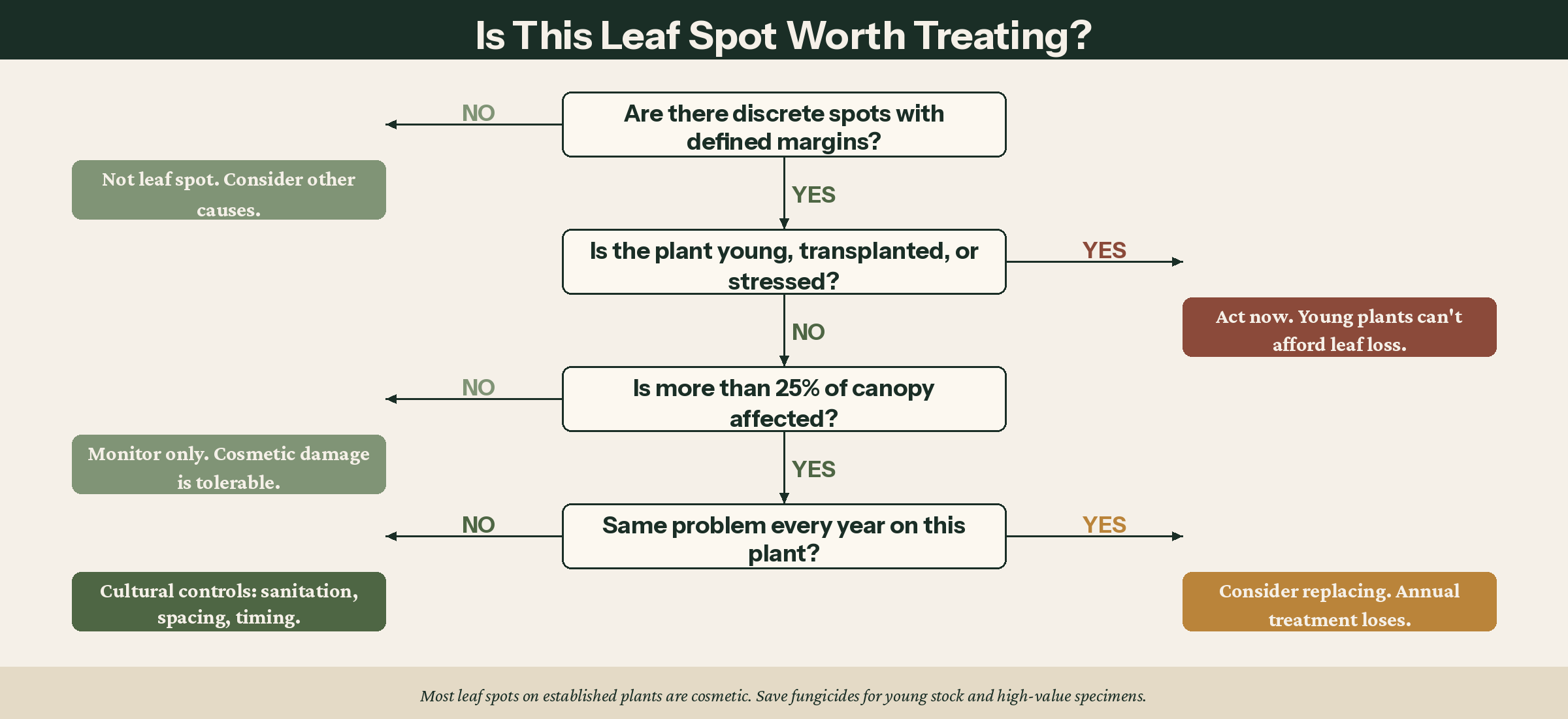 Most leaf spots on established plants are cosmetic. This decision tree helps you focus treatment where it matters.
Disclaimer: All disease management recommendations come from university extension sources and the PNW Plant Disease Management Handbook. These recommendations apply specifically to the maritime Pacific Northwest. Always read and follow pesticide label directions. The label is the law.
Sources
- Leaf Spot Diseases of Trees and Shrubs - University of Minnesota Extension. Defoliation threshold framework and management philosophy.
- Leaf Spot Diseases - UC Davis IPM. Confirms treatment rarely warranted for established plants.
- Leaf Spot Diseases of Shade Trees - Missouri Botanical Garden. Fungicide timing and late-season tolerance.
- Diseases and Disorders, Ch. 5 - NC State Extension. Disease triangle framework, diagnostic process.
- Rose Black Spot - Royal Horticultural Society. Maritime climate management parallels, cultivar resistance.
- Leaf Spot Diseases of Floricultural Crops - UMass Extension. Fungicide active ingredients with FRAC groups.
- Fungicides for Disease Management in the Home Landscape - PNW Handbooks. Regional homeowner fungicide availability.
- Septoria Leaf Spot - Wisconsin Horticulture. Septoria biology, pycnidia as diagnostic feature.
- Tar Spot of Maple - Morton Arboretum. Confirms tar spot is purely cosmetic.
- Diagnosing Plant Damage, Ch. 6 - Virginia Cooperative Extension. Abiotic vs. biotic diagnosis.
- de Oliveira Jucá Pinto, C.M. et al. (2020). Cercospora beticola: the intoxicating lifestyle of the leaf spot pathogen of sugar beet. Mol. Plant Pathol. 21(8): 1007-1020. DOI: 10.1111/mpp.12937.