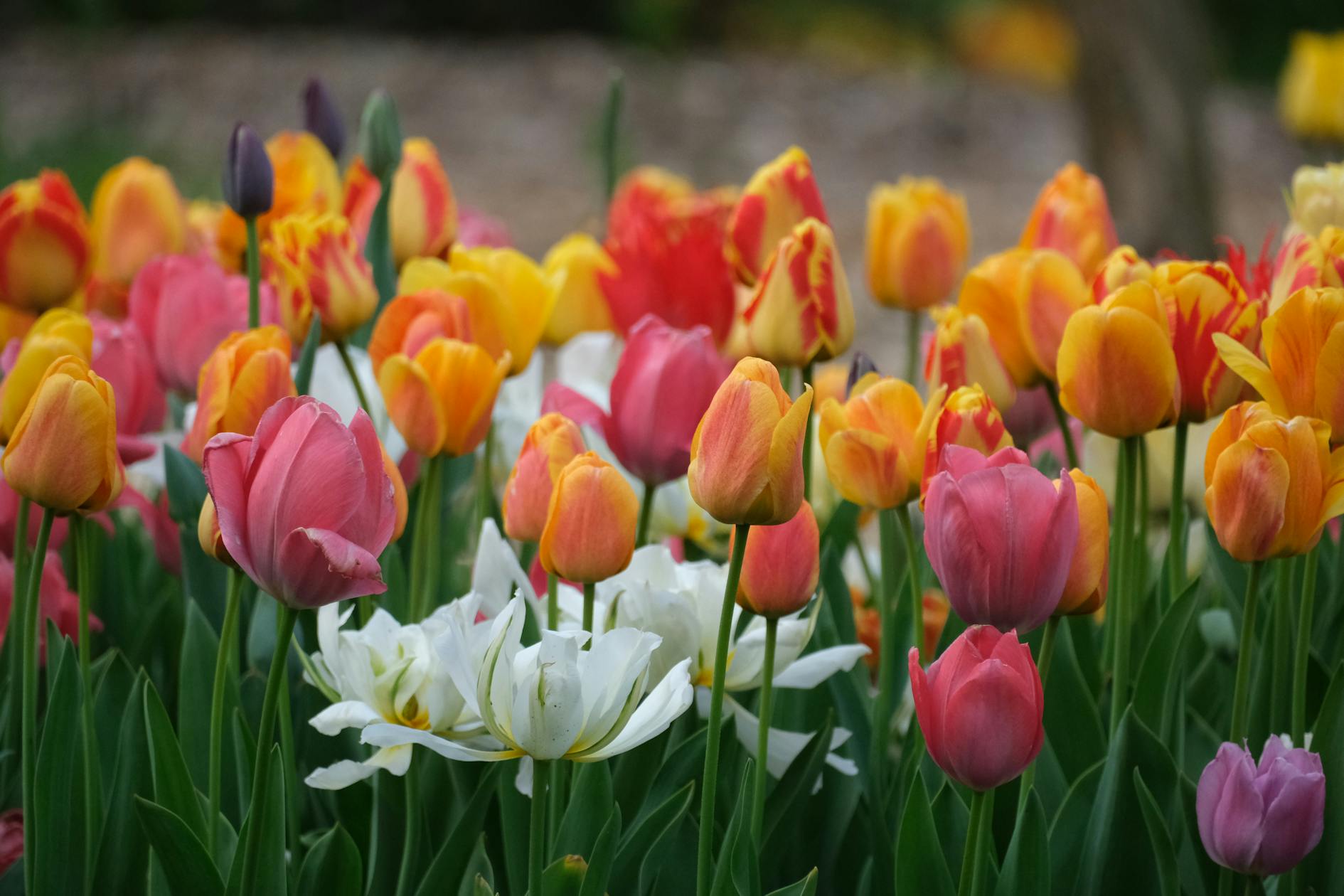
Over the years I have sold thousands of spring bulbs. Some went into permanent landscape plantings where they still bloom a decade later. Others went into beds that were ripped out within weeks of flowering, the foliage tossed into the yard waste bin to make room for summer annuals. Every one of those discarded bulbs was mid-sentence in the most important conversation of its year: the six-week window after bloom when next year’s flowers are made. Cut that conversation short and the bulb never recovers.
If you are staring at collapsing daffodil leaves right now, wondering whether you can clean them up: do not touch them. Here is why that foliage matters, what you should actually be doing right now, and how to design your plantings so the ugly phase never bothers you again.
The Recharge Window
A spring bulb is a storage organ. Its fleshy scales are packed with carbohydrates and nutrients, a pantry that fuels the entire growth cycle: roots in autumn, shoots in late winter, flowers in spring. By the time a daffodil finishes blooming in April, that pantry is nearly empty. Everything was spent pushing up a flower stalk.
The six weeks after bloom are when the pantry gets restocked. Every green leaf is photosynthesizing, converting sunlight into carbohydrates and shipping them down into the bulb for storage. Without this recharge, the bulb shrinks. A smaller bulb produces fewer flowers the following spring, then fewer still the year after, until it stops blooming entirely and eventually dies. The decline is gradual enough that most gardeners blame the soil, the winter, or the variety rather than the cleanup they did in May.
Here in the Puget Sound lowlands, cooler June temperatures actually extend the foliage phase compared to continental climates where early summer heat triggers dormancy by late May. That extended window is a benefit: more photosynthesis, more storage, stronger bulbs. It also means the foliage sticks around longer than the gardening internet suggests, sometimes into late June or early July for late-blooming daffodil cultivars. Patience pays.
The tug test: When foliage has turned fully yellow and lies limp on the ground, give a leaf a gentle pull. If it releases from the bulb with no resistance, the transfer is complete and you can remove it. If it holds, leave it alone.
Three Things That Kill Next Year’s Bloom
Cutting the foliage early. This is the obvious one, and it still happens constantly. The leaves look ragged, the bed looks messy, and the shears come out. Every leaf removed while still green is a solar panel disconnected from the charging system. Even cutting half the foliage reduces the carbohydrate budget the bulb has to work with.
Braiding, tying, or rubber-banding the leaves. This is the tidy gardener’s compromise, and it does not work. Bundled leaves shade each other. Only the outer surfaces receive light, and photosynthesis drops accordingly. A neatly braided clump of daffodil foliage looks better than a sprawling one, but it produces a measurably weaker bulb. If the foliage bothers you, the solution is in planting design, not in origami.
Mowing naturalized bulbs too early. If you have daffodils or crocus naturalized in your lawn, the mowing schedule creates a real conflict. The rule is simple: no mowing through the bulb patches for at least six weeks after the last flowers fade. Crocus finishes its growth cycle faster than daffodils (three to four weeks), so patches of crocus in the lawn are a shorter compromise. For daffodils, either mow around the patches or choose early-blooming cultivars like ‘February Gold’ or ‘Peeping Tom’ (both Narcissus cyclamineus hybrids) that finish their foliage cycle earlier in the season.
Deadhead Now, Leaves Later
There is one thing you should cut right away: the spent flower. Once a bloom fades, the plant redirects energy toward seed production, forming a seed pod at the top of the stalk. That energy comes straight out of the bulb’s recharge budget. Snap or cut the flower stalk below the spent bloom as soon as petals drop. Leave the stalk itself if it is still green; it photosynthesizes too.
For small bulbs like crocus, grape hyacinth (Muscari), and snowdrops (Galanthus), deadheading is not practical or necessary. Their foliage is minimal enough that the entire plant can be left alone; it will senesce and disappear on its own within a few weeks.
The Tulip Question
This is the section where the generic advice and the regional reality diverge most sharply. National extension sources describe tulips as perennials, and they are, technically. But in the Puget Sound lowlands, most hybrid tulips behave as annuals.
The problem is a combination of our soils and our springs. Tulip bulbs are native to the dry, rocky, well-drained slopes of Central Asia. Our clay soils hold moisture through the summer months, and persistent soil moisture above 60°F invites Fusarium, Botrytis (including the tulip-specific B. tulipae, known as tulip fire), and bacterial soft rot. Hybrid tulips also tend to “shatter” after their first year, dividing into clusters of small daughter bulbs, each too small to bloom. In humid maritime climates, re-blooming rates for most hybrids drop below 30 percent after year one.
The honest advice: budget Parrot, Fringed, and Double Late tulips the way you would annual bedding plants. Enjoy them for one spectacular spring and replace them. If you want tulips that come back, plant Darwin Hybrids (‘Parade’, ‘Akebono’), Emperor types, or species tulips (T. greigii, T. kaufmanniana, T. fosteriana). These retain genuine perennial tendencies and tolerate our conditions better. ‘Queen of the Night’ (Single Late) and ‘Christmas Dream’ (Single Early) also naturalize reasonably well in this climate.
For the tulips you do want to perennialize, the foliage recharge window matters even more than it does for daffodils. They need every calorie.
Daffodils, by contrast, are the reliable long-term investment here. They tolerate heavy, wet soil, resist the rot pressure that kills tulips, and naturalize aggressively. A clump of daffodils planted in Puget Sound clay will still be blooming decades from now, provided you leave the foliage alone each spring.
Design Around the Ugly Phase
The best solution to unsightly foliage is not removing it. It is never seeing it in the first place. A few planting strategies make the recharge window invisible:
Companion perennials that expand as bulbs fade. Hostas, daylilies, and hardy geraniums (Geranium macrorrhizum, G. × cantabrigiense) emerge and fill in during exactly the weeks when bulb foliage is collapsing. Hostas are the classic partner: their broad leaves spread outward through May and June, screening the yellowing daffodil leaves below them. Daylilies work the same way, and their timing is nearly perfect for the Puget Sound calendar. Ferns (sword fern and maidenhair are both native options) and lady’s mantle (Alchemilla mollis) fill the same role in shadier sites.
The native succession option. Common camas (Camassia quamash) blooms in May, right as daffodils and tulips are senescing. It thrives in wet clay, tolerates seasonal flooding, and naturalizes freely. Planting camas among your spring bulbs creates a bloom handoff: daffodils finish, camas picks up, and by the time camas foliage matures the companion perennials are fully expanded. Checker lily (Fritillaria affinis) and fawn lily (Erythronium oregonum, E. revolutum) add woodland options, and all three are deer and rabbit resistant.
The deciduous tree advantage. Spring bulbs planted under deciduous trees receive full sun during bloom and foliage recharge (the canopy is still bare or just leafing out). By midsummer, when the bulb foliage has died back, the tree canopy has closed and shades the ground, hiding the gap and suppressing weeds. This is how naturalized bulbs work in mature landscapes.
Feeding and Dividing
Fertilize once, not twice: either when shoots first emerge in late winter or immediately after flowers fade. Not both. A low-nitrogen, higher-phosphorus fertilizer (5-10-5 or similar) at two to three pounds per hundred square feet is the standard rate. Do not apply fertilizer after the plant has started blooming; late feeding encourages bulb rot, especially in our wet soils.
Over time, daffodils multiply by producing daughter bulbs. Eventually the clump becomes overcrowded: you will see plenty of foliage but fewer and smaller flowers each year. The fix is dividing. Wait until the foliage has completely died back (mid-July in most years), dig the clump, separate the bulbs, and replant at proper spacing. Plan to divide every three to four years for large-cupped and trumpet daffodils. Small bulbs like crocus and grape hyacinth rarely need division; they naturalize without overcrowding.
Seasonal Calendar
| When | What | Why |
|---|---|---|
| Bloom fades (March through May, depending on species) | Deadhead spent flowers. Leave all foliage. | Prevents seed formation. Maximizes carbohydrate recharge. |
| Six weeks post-bloom | Hands off the foliage. Water if spring is unusually dry. | Green leaves are still photosynthesizing and storing energy. |
| Foliage yellows and pulls free (May through July) | Remove dead foliage. Mark locations for fall planting if needed. | Recharge is complete. Cleanup is safe. |
| Mid-July | Divide overcrowded daffodil clumps. | Bulbs are dormant and handle disturbance well. |
| October through November | Plant new bulbs. Amend clay soils with drainage material if needed. | Bulbs need 10 to 14 weeks of cool soil for vernalization before spring bloom. |
Sources:
- Care of Spring-Flowering Bulbs After Bloom, Iowa State Extension
- Spring-Flowering Bulbs, Clemson HGIC
- Caring for Spring-Blooming Bulbs After Flowering, Illinois Extension
- Spring Flowering Bulbs FS1220, Rutgers NJAES
- Naturalising Bulbs in Grass, Royal Horticultural Society
- How to Grow Tulips in Seattle, Flowers by Dr. Jo
- Why Bulbs Sleep: Dormancy to Bloom, NC State Extension
Pesticide and fertilizer recommendations are based on published extension research. Always read and follow the product label.