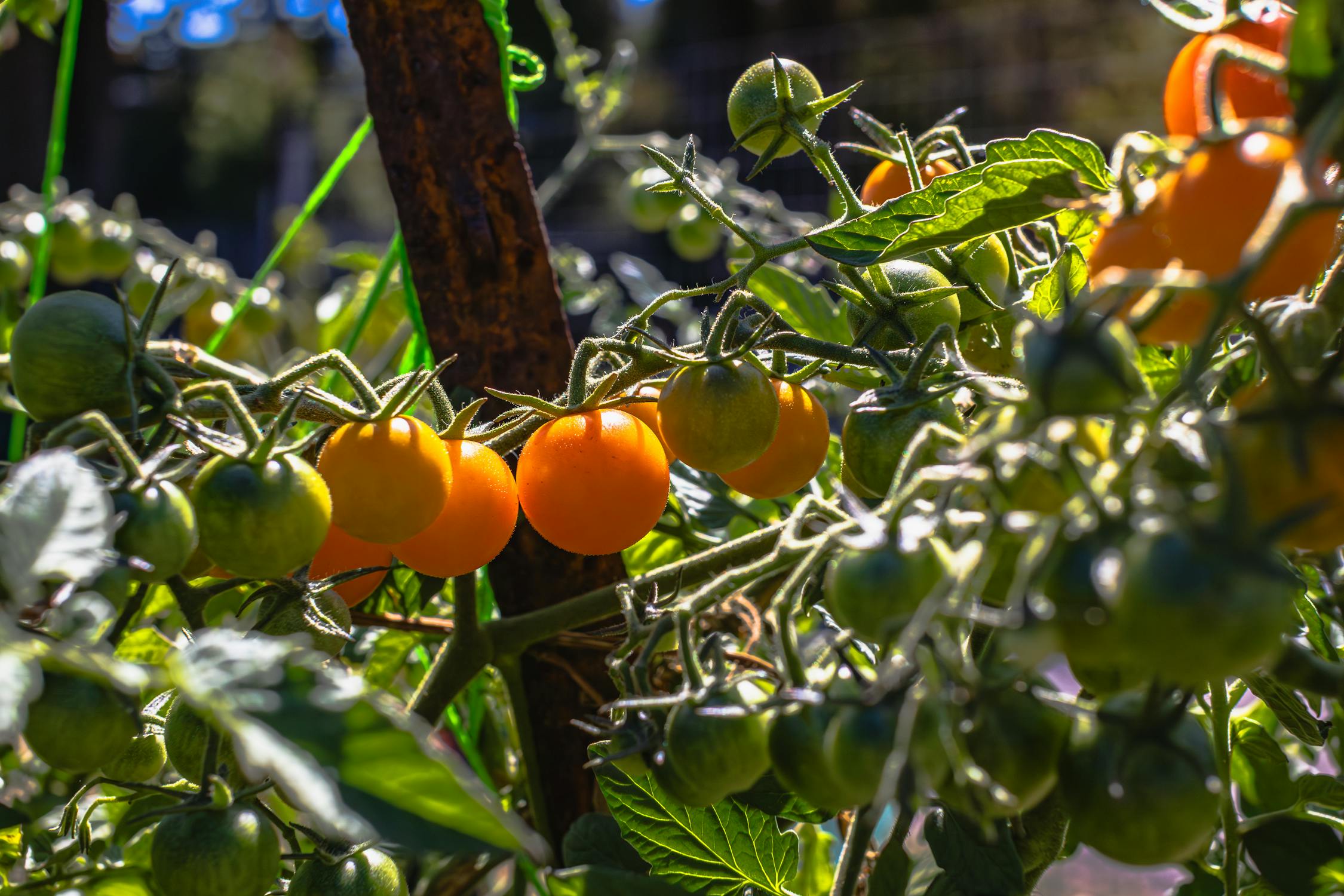
You are standing at the nursery in May, looking at four tables of tomato starts. Brandywine, Cherokee Purple, San Marzano, Big Boy. The labels promise 78 days, 80 days, 90 days to maturity. What the labels do not tell you is that those numbers assume a growing season twice as long as yours. Your real window, from the day soil is warm enough to transplant through the week late blight moves in with the fall rain, is 10 to 14 weeks. The UW Miller Library puts it plainly: any tomato advertised as needing more than 72 days for maturity will not likely reach a ripe age in this region.
That 72-day number is the filter everything else passes through. It shapes which varieties work, which are a gamble, and which are a waste of a season. If you have already read the spring vegetable planting guide, you know the soil temperature side of this: transplants go in when ground hits 65°F at four to six inches, which in most Puget Sound yards means early to mid-June. Count 72 days forward from a June 10 transplant and you land on August 21. That is your reliable harvest window for the first ripe fruit. Everything after that is racing the rain.
The Decision That Drives Everything Else
National gardening guides present the choice between determinate and indeterminate tomatoes as a matter of preference. Bush or vine. Compact or sprawling. One big harvest or a long season of picking. Here, that framing misses the point. In a climate where cool springs delay planting and wet falls end the season early, the determinate-versus-indeterminate decision is a climate strategy.
Determinate varieties set all their fruit in a concentrated window, ripen over two to four weeks, then stop. The plant reaches a fixed height (typically three to four feet), flowers in a burst, and puts its energy into bringing that single set of fruit to maturity. For this region, the advantage is straightforward: determinates finish before the rain comes back. They are the safe bet. They are also the right choice for sauce and canning, because you get a usable volume of fruit at once rather than a trickle over months.
Indeterminate varieties keep growing and setting fruit until frost or disease kills the vine. They produce more total fruit over the season, but each flush of blossoms sets new fruit that needs another 40 to 60 days to ripen. Fruit set in late July may ripen in September. Fruit set in August probably will not ripen before late blight arrives. If you grow indeterminates here, you are betting on a warm September, and you should be ready to pick green tomatoes and ripen them indoors when the weather turns.
Semi-determinate varieties split the difference. Glacier (55 days) is the most common example in Puget Sound nurseries: it grows larger than a true determinate but stops earlier than a full indeterminate. For containers or small spaces where you want some extended harvest without the full commitment of staking a six-foot vine, semi-determinates are a practical middle ground.
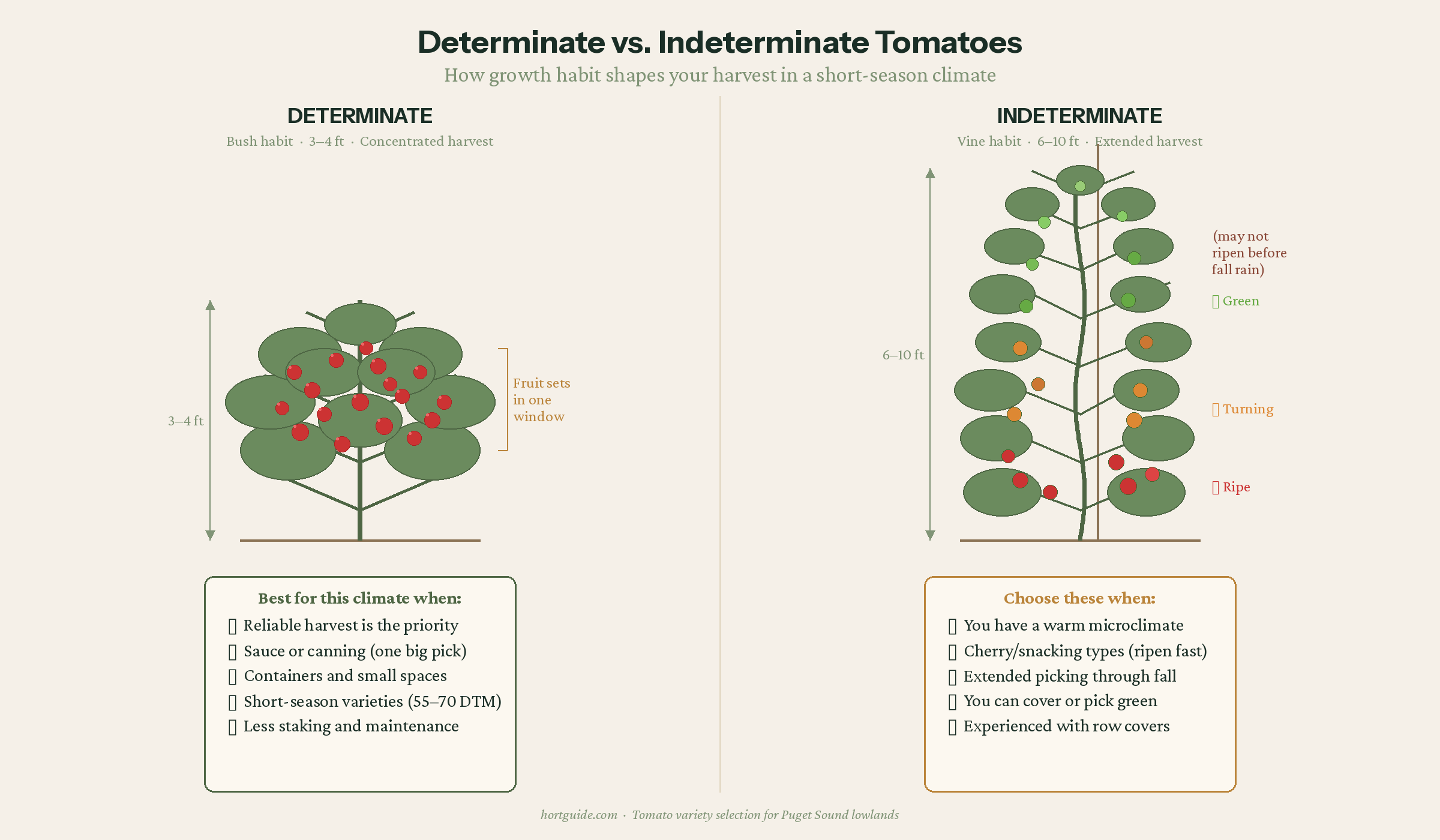 Determinate varieties concentrate fruit in one window; indeterminate varieties spread ripening across the season, risking unripe fruit when fall rain arrives.
The experienced approach is to plant both. Two or three determinates for guaranteed production, and one or two indeterminates (cherry types, which ripen fast on the vine) for extended picking. That way, you get sauce tomatoes in August no matter what, and fresh snacking tomatoes as long as the weather holds.
What the Letters on the Tag Mean
Flip over a nursery tag and you may see a string of letters after the variety name: VFN, VFNT, VFFNTASt. These are disease resistance codes, and in this climate, some of them matter far more than others.
V stands for Verticillium wilt, and it matters here. Verticillium is a soilborne fungus that persists in the ground for decades. It is common in Puget Sound clay soils, and once your garden has it, the only defense is resistant varieties or raised beds with fresh soil. If you have grown tomatoes, potatoes, or strawberries in the same bed for several years, assume Verticillium is present.
F (or FF, FFF) stands for Fusarium wilt races 1, 2, and 3. Fusarium prefers warmer soils than ours, so it causes less trouble in the Puget Sound lowlands than in California or the Southeast. Useful resistance to have, but not the deciding factor here.
N is for root-knot nematodes. Nematodes are primarily a problem in warm, sandy soils. In our cool clay, they are a non-issue for most home gardeners.
T is for tobacco mosaic virus, which spreads by handling. Important in greenhouse production, less so in backyard gardens.
Ph is the one to look for. It indicates resistance to Phytophthora infestans, the oomycete that causes late blight. Late blight is the disease that ends tomato season here. It thrives in cool, wet conditions, spreads explosively through foliage when temperatures sit between 50°F and 70°F with high humidity, and can kill a plant in days once established. Research from Cornell shows that varieties carrying both the Ph-2 and Ph-3 gene combination provide the strongest resistance against current US-23 lineages of the pathogen. No commercial variety is immune, but the gap between a resistant variety and a susceptible one can be the difference between harvesting fruit and watching your plants collapse in mid-September.
For this region, the priority ranking is: Ph first, V second, F as a bonus, N and T irrelevant for most home gardens.
Varieties by Use Case
The nursery organizes tomatoes by color and size. This list organizes them by what you actually want to do with the fruit and whether they will ripen before your season runs out. Days to maturity are from transplant. Add 10 to 14 days if you garden in a cooler microclimate: north-facing slope, close to the water, shaded by trees or buildings.
Cherry and Snacking Tomatoes
Cherry types have the highest success rate in this climate. Small fruit ripens fast even on indeterminate vines, and most cherry varieties shrug off light disease pressure that would devastate a large-fruited slicer.
Sungold (60 to 65 days, indeterminate). Golden-orange, intensely sweet, and the variety that every Puget Sound gardener eventually settles on for daily eating. It produces heavily from late July until frost. No disease resistance codes on the tag, but it outruns most problems through sheer vigor. If you grow one cherry tomato, grow this one.
Gold Nugget (60 days, determinate). OSU-bred for the Pacific Northwest. Yellow, among the first to ripen, and determinate, which means you get an early flush of fruit without staking a tall vine. Good for containers.
Oregon Cherry (58 to 62 days, determinate). Another OSU release, compact enough for an 18-inch pot, thin-skinned, and sweet. The smallest plant on this list, topping out at 18 to 24 inches. Built for patios and small gardens.
Matt’s Wild Cherry (60 to 65 days, indeterminate). The bridge between heirloom flavor and disease resistance. This Mexican heirloom produces copious tiny fruit and carries natural late blight resistance comparable to bred varieties in Cornell’s evaluation trials. Flavor is intense and tart. Let it sprawl or cage it, but give it room.
Sweet Million (60 to 65 days, indeterminate). Crack-resistant with multiple disease resistance codes (FNT). Heavy producer. A reliable workhorse cherry that holds up better than Sungold in wet weather.
Sugar Lump (60 days, indeterminate). A German heirloom with crack-resistant skin and balanced sweetness. Sky Nursery carries it as a staff pick. Does well in containers with support.
Fresh Eating Slicers
This is where variety selection gets consequential. Large-fruited slicers need more heat and more time than cherries, and the wrong choice means you are staring at green tomatoes in October.
Legend (60 to 65 days, determinate). If you do not know what to grow, grow Legend. Developed by Jim Myers at Oregon State specifically for Pacific Northwest conditions, it carries late blight resistance, sets fruit without pollination (parthenocarpic, which means cool weather that keeps bees away does not stop it), and produces larger fruit than Oregon Spring or Siletz. It is the default recommendation for this region. Not the most complex flavor, but it reliably puts ripe tomatoes on the counter in August.
Oregon Spring (60 to 70 days, determinate). The OSU variety bred for early yield. Produces a heavy first flush of medium-sized fruit. Also parthenocarpic. Good flavor for an early variety, slightly tart. If you want tomatoes before anyone else on the block, this delivers.
Early Girl (60 to 65 days, indeterminate). The national standard for early slicers, and it works here too. Produces 4 to 6 ounce fruit steadily from late July onward. Indeterminate, so it needs staking or caging, but it ripens fast enough that the late fruit usually beats the rain. VFF resistance.
Siletz (70 to 75 days, determinate). OSU-bred, reliable, and good flavor. Pushing the days-to-maturity window, so site it in your warmest spot. No late blight resistance, which means it is more vulnerable in wet Septembers than Legend.
Stupice (60 to 65 days, indeterminate). A Czech heirloom valued for cold tolerance. Sets fruit at lower temperatures than most varieties, which gives it an edge in our cool springs. Smaller fruit (2 to 3 inches) but with the kind of bright, acidic tomato flavor that larger hybrids often lack.
Glacier (55 days, semi-determinate). The earliest variety commonly available in Puget Sound nurseries. Small fruit (about two inches), but you will be eating tomatoes in late July while your neighbors are still waiting. Good for containers. Compact enough to tuck into a flower border.
Moskovich (60 to 65 days, indeterminate). A Siberian heirloom that handles cold snaps better than most. Crack-resistant skin and good flavor. Swansons Nursery in Seattle carries it as a staff recommendation.
Sauce, Canning, and Paste
Paste varieties are bred for dense, meaty flesh with low moisture, which is what you want for cooking down into sauce. The challenge here is that the best paste tomatoes tend to be later-maturing. Determinates are strongly preferred for this category: you need a single large harvest, not a trickle of fruit.
Oroma (70 days, determinate). OSU-bred, the earliest paste tomato adapted for this climate. Produces earlier than Roma but with comparable flesh density. If you want to can, start here.
Roma (72 to 75 days, determinate). The industry standard paste tomato. VF resistance. Pushing the 72-day limit, so it needs your warmest bed and a June transplant with no delays. Productive when it works (up to 200 fruit per plant), but you are on the edge of the window.
Anna Russian (75 days, indeterminate). An oxheart heirloom with dense, meaty flesh that makes excellent sauce. Beautiful heart-shaped fruit. At 75 days indeterminate, this is a gamble, but the payoff in flavor and texture justifies the risk if you have a warm microclimate.
The Flavor Gambles
These varieties ripen past the 72-day line and carry little to no disease resistance. You are growing them for flavor, not reliability. Plant them against a south-facing wall, in a raised bed over pavement, or anywhere you can steal extra heat. Be prepared to harvest green and ripen indoors.
Black Krim (70 to 80 days, indeterminate). Smoky, salty-sweet, and the variety that converts people who think they do not like tomatoes. The dark fruit cracks easily in wet weather. Worth the effort if you can shelter it from rain.
Cherokee Purple (72 to 80 days, indeterminate). Complex, wine-like flavor. Thin skin that splits at the first hard rain. If Black Krim is a gamble, Cherokee Purple is a bigger one, but the flavor ceiling is higher.
Jaune Flamme (75 days, indeterminate). A French variety that Sky Nursery highlights for Puget Sound performance. French heirloom tomatoes were selected in a maritime climate not unlike ours, and Jaune Flamme benefits from that breeding history. Orange, apricot-sweet, and crack-resistant. One of the safer flavor gambles.
Japanese Black Trifele (85 days, indeterminate). At 85 days, this should not work here. Sky Nursery calls it “absolutely worth the gamble” and stocks it every year. Pear-shaped, dark, with exceptional depth of flavor and crack-resistant skin. Only for gardeners with warm microclimates and patience.
Brandywine (78 to 90 days, indeterminate). The famous heirloom. Legendary flavor, legendary difficulty. Thin skin, no disease resistance, and a maturity window that barely fits even in a perfect year. If you must grow it, treat it as an experiment, not a plan.
Buying Smart
Where you buy matters as much as what you buy. Regional nurseries curate their stock for this climate; big-box stores order from national growers and fill the tables with varieties that sell everywhere but do not necessarily ripen anywhere in the Puget Sound lowlands.
Local nurseries like Swansons in Seattle and Sky in Shoreline test and recommend varieties specifically for this region. Their staff picks are worth paying attention to. When they label a variety “PNW Favorite,” that label represents observed performance, not marketing copy.
Regional seed companies do the same pre-screening for gardeners who start from seed. Territorial Seed (Cottage Grove, Oregon) and West Coast Seeds (Delta, BC) select for maritime and short-season performance. Their catalogs are already filtered for your conditions.
Read the tag before you buy. You are looking for three things: days to maturity under 72, growth habit (determinate or indeterminate), and resistance codes (V and Ph being the most valuable here). If the tag only says “tomato” and a color, put it back.
One emerging option: grafted tomatoes, where a high-flavor variety is grafted onto a disease-resistant rootstock. They cost two to three dollars more per plant, but the rootstock provides Verticillium and Fusarium resistance from below while the top growth gives you the variety you actually want. Increasingly available at Puget Sound nurseries and worth the premium for expensive heirloom varieties that lack disease resistance.
The Three Threats That End Your Season
Variety selection is your first line of defense against the three problems that consistently ruin tomatoes in this region.
Late blight
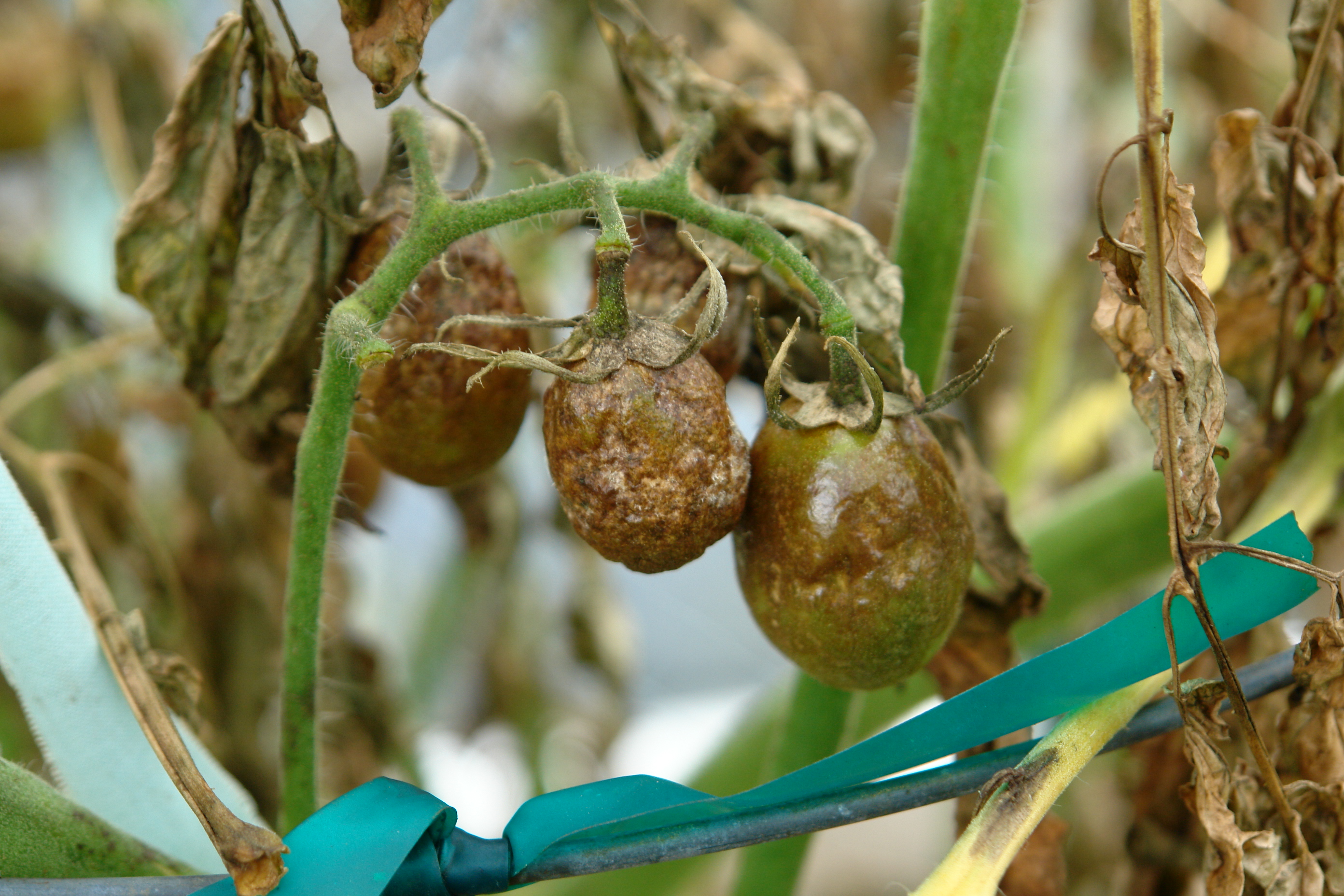 Late blight fruit rot on tomato. The disease can destroy an entire crop in days under cool, wet conditions. Photo: Scot Nelson, Wikimedia Commons (CC0).
Phytophthora infestans is the reason this region cannot grow tomatoes the way the rest of the country does. The same cool, moist conditions that define our climate are the conditions late blight needs to explode. It moves from plant to plant on wind-driven spores, and a week of nights in the 50s with morning fog is enough to trigger an outbreak.
Resistant varieties buy you time, not immunity. Legend, Mountain Magic, Defiant, and Iron Lady all carry Ph-gene resistance. Matt’s Wild Cherry and Lemon Drop show natural resistance in Cornell trials. Even with resistant varieties, space plants for airflow, water at the base (never overhead), remove any volunteer potato plants (they harbor the same pathogen), and have copper fungicide on hand as a protectant before symptoms appear.
Verticillium wilt
The soil pathogen that persists for decades. If tomatoes, potatoes, eggplant, peppers, or strawberries have grown in the same bed before, assume Verticillium dahliae is present. Symptoms show as one-sided wilting: half the plant yellows while the other half looks fine, and no amount of water fixes it.
V-coded varieties are the primary defense. Rotating crops helps reduce inoculum but does not eliminate it. Raised beds filled with fresh potting mix bypass contaminated ground entirely, and for gardens with a confirmed history of Verticillium, that is the most reliable path. For the full picture, see the Verticillium wilt guide.
Blossom end rot
The sunken, dark lesion on the bottom of the fruit is not a disease and not a variety problem. It is a calcium uptake issue caused by inconsistent watering. The plant has enough calcium in the soil; it just cannot move it to the fruit when soil moisture swings between dry and saturated. The fix is consistent irrigation, not calcium sprays. Mulch to stabilize moisture. Water deeply on a schedule rather than shallowly when you remember. This is worst in clay soils with poor drainage, where the cycle between waterlogged and bone-dry happens fast.
Seasonal Action Summary
| When | What | Why |
|---|---|---|
| February to March | Choose varieties and order seeds | Best selection before nurseries sell out of starts |
| Mid-April | Start seeds indoors, 6 weeks before transplant | Match to June transplant window |
| Late April to May | Harden off seedlings; prep beds; warm soil with black plastic | Bridge the gap between indoor starts and outdoor conditions |
| Early to mid-June | Transplant when soil hits 65°F at 4 to 6 inch depth | Soil temperature, not the calendar, is the gate |
| June to July | Stake or cage, mulch 3 to 4 inches deep, begin consistent watering | Support structure and moisture management from day one |
| Late July to August | First ripe fruit from early varieties; begin late blight monitoring | Harvest begins; disease pressure starts to build |
| September to October | Harvest remaining fruit; pull plants at the first sign of blight | Green tomatoes ripen indoors on a windowsill or in a paper bag |