You have driven past them without thinking about it, these tall spires rising above the suburban canopy and the remnant patches of second-growth forest that define the Puget Sound region. The Douglas-fir is so woven into the texture of Western Washington that most people stop seeing it entirely. Yet understanding this tree, with its particular vulnerabilities and particular gifts, matters more now than at any other time in regional forestry history. The climate is changing. The diseases that plague coastal populations are intensifying. And the question of whether to plant, remove, or coexist with Douglas-fir has become urgent in backyard design and landscape management across the region.
Douglas-fir is not actually a fir at all, which is why foresters write it as “Douglas-fir” rather than “Douglasfir” or “Douglas Fir.” Botanically, it lives in its own genus, Pseudotsuga, a distinction that matters because true firs (Abies species) have different needle attachments, different cone structures, and different ecological relationships. You learn this distinction quickly if you spend time in Pacific Northwest forests, because Douglas-fir behaves differently under stress, responds differently to pests, and occupies a different successional role than the true firs that share its habitat.
The tree is named for two men: David Douglas, the Scottish botanist who collected plants across the Pacific Northwest in the 1820s and 1830s, and Archibald Menzies, a Scottish physician and naturalist who traveled the same region slightly earlier. Neither man was from here. Both recognized something remarkable in this conifer, and the name has stuck for nearly two centuries.
The Tree
Douglas-fir in its native habitat can reach 300 feet tall, with lifespans exceeding 1,300 years. The oldest known specimen, on the Oregon Coast Range, dates to 1520. In cultivation, you should plan for a tree that reaches 50 to 80 feet tall at maturity, with a spread of 65 feet, though some cultivars break this expectation dramatically. Growth is moderate, faster than true firs but not as rapid as some other Pacific Northwest conifers.
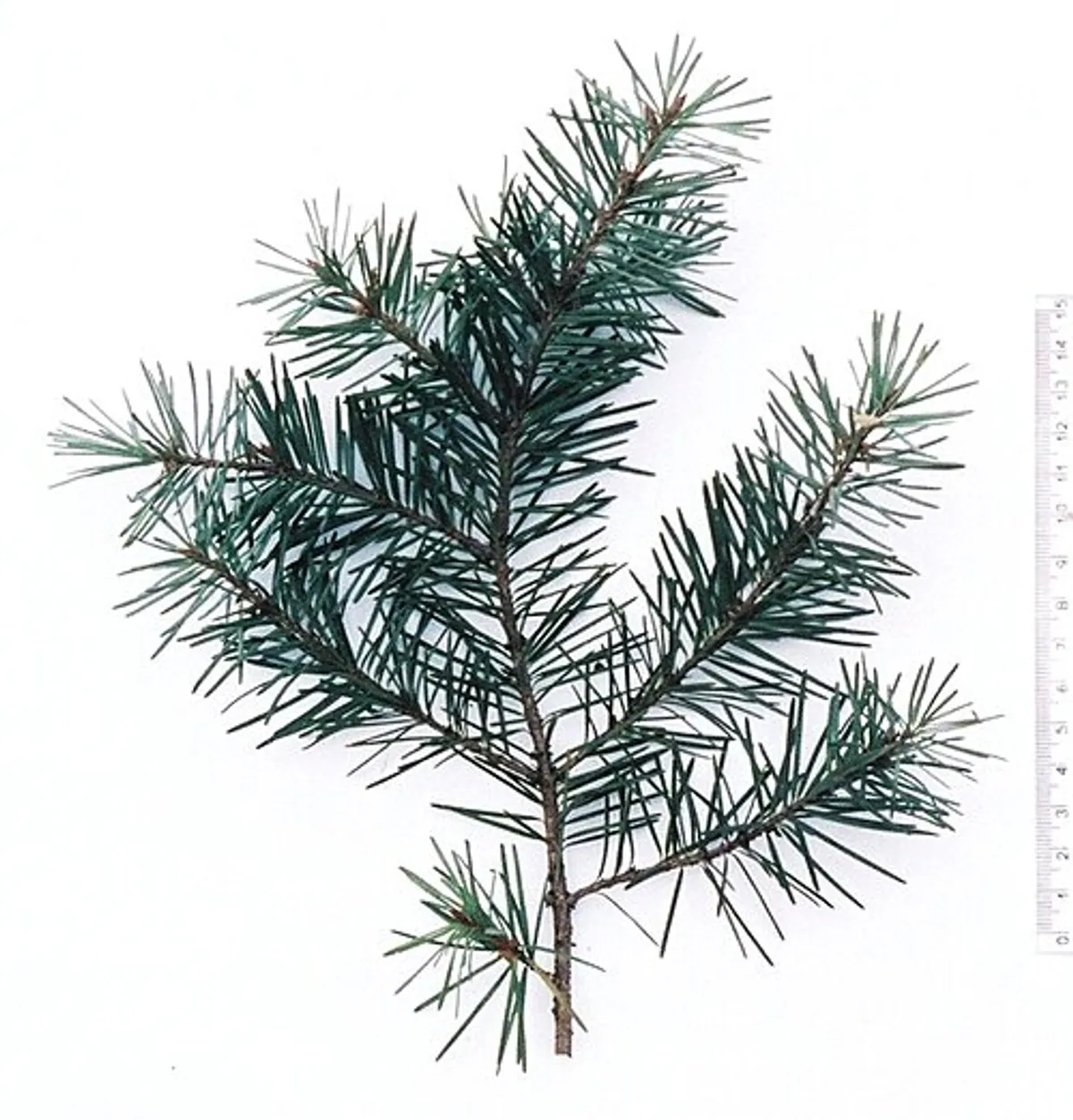
The needles are flat, soft to the touch, and arranged in two ranks along twigs that branch in a herringbone pattern. When you crush a Douglas-fir needle, it releases a citrusy, almost clean smell that distinguishes it immediately from grand fir or noble fir. The cones, which mature in a single season, are three to four inches long with distinctive three-pronged bracts that protrude between cone scales, looking exactly like a mouse’s tail sticking out. No other conifer has this trait. It is the easiest field mark to recognize in winter or summer.
The species is native from British Columbia south to central California, and through the Rocky Mountains from Canada to Arizona and Texas. What matters to you in Western Washington, though, is the distinction between coastal and inland varieties. Coastal Douglas-fir (var. menziesii), which grows naturally west of the Cascade crest in Oregon and Washington, is the tree that dominates second-growth forests from the Willamette Valley to the north end of Puget Sound. Rocky Mountain Douglas-fir (var. glauca) is found east of the Cascades and throughout the Interior West. This distinction is not merely academic. Coastal varieties are generally more resistant to the needle diseases that ravage trees in our humid marine climate. Rocky Mountain varieties, when planted in western Washington or Oregon, become susceptible to severe diseases that rarely trouble them in their native range. If you plant Douglas-fir, source matters absolutely.
The cultivar landscape has expanded considerably, and you should know what is available:
Eddyville is a selected clone from coastal Oregon that grows 50 to 60 feet tall at maturity. It represents the standard ornamental size for residential landscapes, with good disease resistance and consistent growth form. Eddyville was selected for reliability rather than novelty, which means you see it less often in nurseries but encounter it more often in older landscaping where someone made a sensible decision decades ago.
Elt is a dwarf cultivar reaching only 8 feet tall, useful for residential settings where a full-size conifer would overwhelm the space. It maintains the typical Douglas-fir form in miniature.
Graceful Grace (sometimes listed as Graceful Arch) is a weeping or pendulous form with a notably irregular canopy, selected for ornamental interest rather than timber characteristics. It creates drama in the landscape but requires more careful siting than standard forms.
Idaho Gem is a compact form, roughly 25 to 30 feet tall at maturity, with dense foliage and a tighter branching pattern. It offers a middle ground between dwarf and full-size cultivars.
Pendula is a strongly weeping form reaching 12 feet tall, with branches that drape dramatically downward. It is used as a weeping specimen plant and requires careful staking and training during establishment.
Vail is another compact selection, similar in size to Idaho Gem, with a dense form.
Most of these cultivars are available from specialty nurseries but not from typical big-box retailers. If you want a specific form, you will need to seek out a grower or order through a wholesale network.
What It Does Well
Douglas-fir succeeds across a broad range of conditions, which partly explains its ecological dominance across the Pacific Northwest. You have encountered it on steep slopes where it seemed to anchor soil with minimal soil depth, in clearings where it competed fiercely with other species, and in older suburban landscapes where it has grown for decades with minimal care.
The tree tolerates sun to partial shade, though it performs best in full sun. It requires moderate water once established, which means it performs well in the summer-dry environment of the Puget Sound region, where the dry season runs from June through August. Unlike some conifers that demand acidic soil, Douglas-fir accepts a pH range from 5.0 to 7.5, meaning it grows in everything from the sandy, slightly acidic soils of the Glacial Outwash plain to the volcanic soils of the Cascade foothills.
This ecological flexibility is part of why Douglas-fir became, and remains, the most commercially important timber tree in North America. The wood is strong, straight-grained, and valuable across multiple markets: dimension lumber for framing, larger beams for structural applications, and plywood and veneer from better grades. Walking through a typical wood-frame house built in the Pacific Northwest, you are walking through Douglas-fir. The posts, the joists, the header beams: they are almost certainly this species. It is not a tree valued primarily for beauty or ornamental contribution. It is valued because it does useful work.
Ecologically, Douglas-fir supports a distinctive wildlife community. Birds and small mammals eat the seeds. Grouse, deer, and elk eat the needles and twigs, especially in winter when other browse becomes scarce. The tree is a host plant for the Pine White butterfly and the Ceanothus Silkmoth, insects that have coevolved with the species across millennia. When you remove Douglas-fir, especially old growth, you are removing structure that other species depend on.
The tree is Oregon’s state tree, designated in 1927 long before the ecological implications of old-growth harvest became a national issue. It remains the symbol of the Pacific Northwest timber industry and the focal point of bitter arguments about land use, forestry practice, and ecological preservation. Few trees carry as much cultural and political weight.
What Goes Wrong
Here is where the romance of living with Douglas-fir in Western Washington becomes complicated. The tree is vulnerable to multiple diseases and pests, several of which have intensified over the past twenty years. Some are merely annoying. Others can kill trees. Understanding them is essential if you plant Douglas-fir or inherit one on your property.
Swiss Needle Cast (Nothophaeocryptopus gaeumannii)
This is the most serious disease threat to coastal Douglas-fir in the maritime Pacific Northwest, and it has become more prevalent and more severe over the past two decades. The disease is caused by a fungal pathogen that infects needles during their first year, then sporulates (produces spores) in subsequent years, causing needle loss and crown thinning. Trees do not die quickly, but they decline over time, losing their visual impact and eventually becoming hazardous as branches thin and weaken.
The disease favors the humid conditions that define the Puget Sound climate. If you live west of the Cascades below 3,000 feet, you live in Swiss needle cast country. The fungal structures appear on one-year-old and older needles in the form of small fruiting bodies visible on the needle undersurface. By spring, trees begin to lose affected needles, sometimes losing entire year classes of foliage.
Here is the critical distinction: coastal Douglas-fir (var. menziesii) is generally resistant to Swiss needle cast. Rocky Mountain Douglas-fir (var. glauca) is highly susceptible when grown in western Oregon and Washington. This is why sourcing matters absolutely. A Rocky Mountain Douglas-fir planted in Puget Sound is planted for disease. A coastal Douglas-fir in the same location will likely perform far better. Unfortunately, nurseries do not always specify the source or variety, and some conifers sold as Douglas-fir are actually Rocky Mountain stock selected for appearance or growth rate rather than regional suitability.
There is no chemical control for Swiss needle cast. Fungicides can reduce disease severity on young trees in the nursery environment, but they are not practical for landscape trees. The only reliable management is prevention: plant coastal varieties, plant in sites with better air circulation, and select alternative species in high-disease-hazard environments. Western hemlock, Sitka spruce, western redcedar, and red alder all perform well in maritime sites and offer different ecological properties.
Rhabdocline Needle Cast
This is another fungal disease of Douglas-fir needles, also favored by the moisture and humidity of coastal climates. The disease causes purple-brown discoloration on year-old needles, typically becoming visible in spring as a banding or streaking pattern. Like Swiss needle cast, it does not kill trees quickly but causes needle loss and crown thinning over time.
Coastal Douglas-fir varieties are generally more resistant to Rhabdocline than inland varieties, following the same pattern as Swiss needle cast. The management approach is identical: select coastal sources, plant in good air circulation, and consider alternatives in high-disease environments.
Laminated Root Rot (Phellinus weirii, formerly known as Coniferoporia sulphurascens)
This is arguably the most important root disease of Pacific Northwest conifers, and it deserves your attention if you own land where Douglas-fir grows, especially in forest or forest-garden settings. The disease is caused by a basidiomycete fungus that persists in root systems and spreads through root-to-root contact between infected and healthy trees. Once established, it creates expanding pockets of infected trees. Stumps of freshly harvested trees remain a vector for disease spread for decades; the roots stay alive and infectious.
Laminated root rot causes decay in the roots and lower stem, weakening trees until they blow over or die gradually. There is no chemical control, no vaccine, and no cure for infected trees. Management relies on avoiding the pathogen or removing infected trees to slow spread. If you discover a pocket of thin or dying Douglas-fir in a forested area, root rot is a likely suspect.
Armillaria Root Rot
This is a soilborne pathogen that affects a broad range of trees, including Douglas-fir. Armillaria ostoyae, the honey mushroom, causes a spreading root disease that is especially problematic in stressed trees. In late fall and early winter, the fruiting bodies appear as distinctive honey mushrooms at the base of infected trees, usually clustered together. There is no chemical control, though removing infected trees can prevent further spread in some situations.
Douglas-fir Tussock Moth (Orgyia pseudotsugata)
This native defoliator is a cyclical pest, meaning outbreaks occur irregularly and often collapse as suddenly as they develop. During peak years, tussock moth larvae can strip entire trees of foliage, and populations can erupt across thousands of acres simultaneously. Defoliation weakens trees, making them vulnerable to secondary pests and diseases. In severe outbreaks, trees may be killed entirely.
The moth has no practical chemical control in the landscape setting, though Bacillus thuringiensis (Bt) can reduce populations in high-value areas if applied when caterpillars are actively feeding. Most homeowners simply wait for the outbreak to collapse, which they invariably do. In forest management, tussock moth outbreaks are monitored closely, and spraying programs are deployed only in the most valuable timber stands.
Cooley Spruce Gall Adelgid (Adelges cooleyi)
This small insect alternates between spruce and Douglas-fir as hosts. On Douglas-fir, the adelgid causes cottony masses to appear on needles, and affected needles may discolor or drop prematurely. The insect is a pest primarily on landscape trees, where it becomes visible and concerning. In forest settings, it rarely causes serious damage. Horticultural oil can reduce populations on high-value specimens, but control is usually not necessary.
Douglas-fir Twig Weevil (Cylindrocopturus furnissi)
This insect kills branch tips on Douglas-fir, especially on trees that are stressed or growing poorly. The female weevil lays eggs in twig tips, and the developing larvae girdle the twig internally, causing it to die and drop. This can create ragged crowns and loss of form, especially on young trees. The insect is far more damaging to Rocky Mountain Douglas-fir than to coastal varieties. Stressed trees are much more susceptible than vigorous trees, so management focuses on maintaining tree vigor through adequate water and freedom from competition.
Living With a Big Tree
If you inherit a large Douglas-fir on your property, or if you plant one, you are making a long-term commitment that extends decades and involves real costs and real risks.
The first reality is limb drop. Douglas-fir branches, especially the lower and inner branches, naturally senesce and drop as the tree ages. This is not disease; it is normal biology. A 60-year-old Douglas-fir with a full crown at age 20 will have lost substantial interior branching by age 60. You see this especially clearly in winter, when you can trace the internal structure of the crown. Most of this branching is overhead, and limbs regularly drop, creating a hazard for anything below: cars, structures, people. A large Douglas-fir cannot be safely coexisted with without active management. You must remove deadwood regularly, monitor branch unions for included bark, and prune to remove obviously hazardous limbs before they fail. This requires a certified arborist with experience in conifer pruning. It requires budget.
The second reality is root architecture. Douglas-fir does not develop a deep taproot; instead, it develops a spreading lateral root system adapted to the shallow soils and frequent wind of the Pacific Northwest coast. This means the root plate is wide and relatively shallow. On poorly drained or compacted soils, roots spread even wider, seeking moisture and oxygen. You may see surface roots crossing lawns, breaking through pavement, or invading underground utilities. The roots themselves are usually not aggressive enough to cause catastrophic damage, but they complicate drainage and can enter leaking pipes or sewers if conditions are right.
The third reality is summer drought stress. Yes, Douglas-fir tolerates summer drought once established, but “established” means years, not months. A newly planted Douglas-fir in a Puget Sound landscape requires supplemental water through the first three or four dry seasons. Without it, trees suffer stress that invites attack by twig weevil, bark beetles, and other secondary pests. Once stressed, trees decline rapidly. So the calculus is: water carefully for the first several years, or accept a high risk of failure.
The fourth reality is utility conflict. Douglas-fir grows tall and wide. If you plant one near power lines, you are selecting for future conflict. Utility companies will prune aggressively and repeatedly, disfiguring the tree. The pruning wounds invite disease. Eventually, someone decides the tree must go entirely. If you plant Douglas-fir, place it where it can grow without compromising utility lines or needing future relocation.
The fifth reality is disease risk, which we have already discussed. If you live in a Swiss needle cast zone and plant Rocky Mountain Douglas-fir, you have selected for decline. This is not a guess; this is documented forest pathology. Understand what you are planting and understand your climate.
Seasonal Action Summary
| When | What | Why |
|---|---|---|
| Late February to March | Prune deadwood and remove obviously hazardous branches | Dormant season allows better visibility; removes infection courts before spring growth |
| April to May | Monitor emerging foliage for signs of needle disease or insect damage | Early detection of problems allows treatment before disease/pest populations explode |
| June to August | Water newly planted trees if natural rainfall is absent | First three to four growing seasons are critical for establishing deep roots |
| September to October | Inspect lower trunk and root collar for signs of root disease or insect damage | Honey mushrooms appear in fall; root diseases become apparent as trees weaken |
| October to December | Remove fallen limbs and debris | Allows inspection of ground for fungal fruiting bodies; clears hazards |
| Throughout year | Monitor for limb drop, especially after storms | Remove hanging or partially detached limbs before they fall unexpectedly |
Final Thoughts
Douglas-fir is deeply woven into the forest ecology and the human history of the Pacific Northwest. It is not a tree to plant casually or assume will require minimal maintenance. It demands understanding, active management, and realistic expectations about disease risk and tree behavior in residential settings.
Yet it is also irreplaceable in the right context. An old Douglas-fir in a forest-garden setting, tended carefully and monitored for hazards, provides ecological value, cultural continuity, and visual presence that few other trees can match. The key is intentionality. Plant a Douglas-fir knowing what you are planting, where you are planting it, and what you are committing to over the decades ahead.
Choose coastal sources for Swiss needle cast resistance. Monitor for disease and pest damage. Water young trees through the establishment period. Prune deadwood and hazardous branches regularly. Accept that the tree will change form as it ages. And understand that in the Puget Sound region, Douglas-fir remains not a decorative afterthought but a working tree and an ecological cornerstone.
Sources:
Hessburg, Paul F., et al. “Restoring Fire-Adapted Forest Ecosystems.” Journal of Forestry, vol. 113, no. 4, 2015, pp. 335-346.
Mullin, Thomas J., et al. “Douglas-fir Breeding and Genetic Resource Conservation.” Silvae Genetica, vol. 56, no. 3-4, 2007, pp. 100-109.
Stone, Jennifer K., et al. “Diseases of Douglas-fir.” Forest Health Technology Enterprise Team, USDA Forest Service, 2008.
Ciesla, William M. Forest Entomology: A Global Perspective. John Wiley and Sons, 2011.
Harrington, Timothy C. “Fungi Associated with Non-Native Insects in Dead Wood.” Applied and Environmental Microbiology, vol. 71, no. 3, 2005, pp. 1250-1260.
Cooley, Richard A. Politics of Conservation. Knopf, 1963.
Boyd, Robert. The Coming of the Spirit of Pestilence. University of North Columbia Press, 1999.