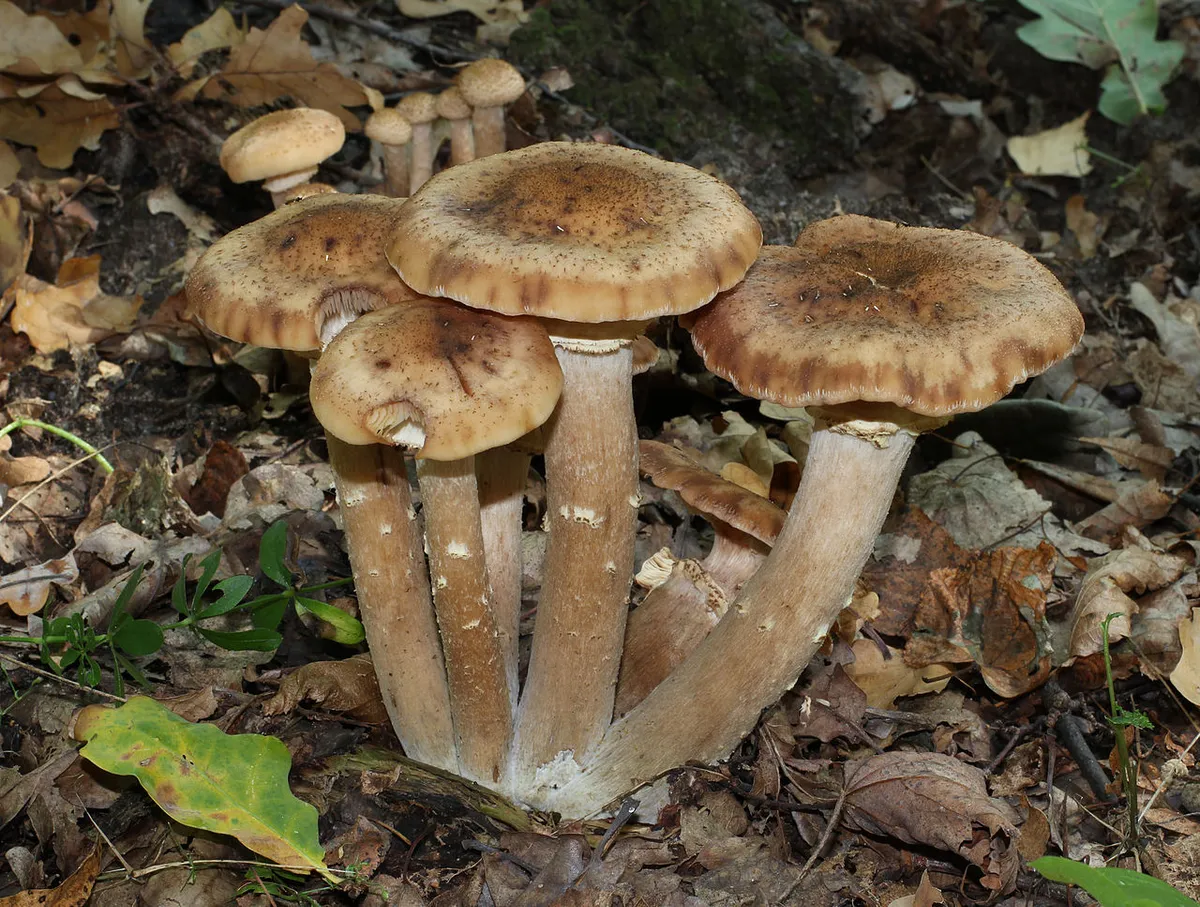
You will not see this disease coming. A tree that looks completely healthy for ten, fifteen, sometimes twenty years can begin to decline without warning, its roots already destroyed by a fungus that has been feeding in the soil the entire time. By the time the first symptoms appear above ground, the infection is decades deep. Accept this reality: there is no fungicide for Armillaria root rot. No chemical cure exists. No arborist can save an infected tree. Your only option is prevention, and that means understanding what lives in the soil beneath your landscape, what stress triggers the fungus to attack, and which practices prevent infection.
Armillaria ostoyae exists everywhere in the Pacific Northwest. It lives in the soil of every residential yard in this region, dormant and harmless in the forest litter, waiting for the moment a tree becomes stressed enough to be worth attacking. That moment often comes during the first five to ten years after planting, when site conditions are poor and the tree’s vigor is not yet established. The fungus exploits wetness, compaction, and improper planting depth with brutal efficiency. You are dealing with an endemic baseline problem that affects measurable numbers of new plantings in the Puget Sound lowlands every year.
What You Will See (if Anything)
Armillaria root rot presents in stages, and the earliest stages produce no visible signal at all.
In phase one, nothing happens above ground. The fungus feeds on roots deep in the soil, breaking down wood fiber and bark with complete silence. This silent period can last five to twenty years depending on the tree species, site drainage, and how much stress the tree already carries. You can walk past an infected tree every day and have no idea what is happening at the root collar.
When decline finally becomes visible, it announces itself quietly. The canopy thins slightly over a growing season. New growth emerges shorter than it should. Leaves look paler than normal, as though the tree cannot quite muster its full color. You might assume the tree needs water. You might think it lacks nutrition. You might not notice anything until the tree is far more damaged than it was when the decline began.
Then fall arrives. Honey-colored mushrooms suddenly appear at the base of the tree or emerging from soil cracks nearby. These are Armillaria fruiting bodies, and they confirm what has been happening underground for years. The mushrooms typically reach four to six inches tall with caps two to four inches across, often dotted with brown scales. They emerge in response to moisture and cool temperatures, meaning they fruit prolifically here through October, November, and into January if conditions stay wet.
By the time the mushrooms appear, the tree is usually approaching the end. Its root system has been compromised. The fungus has girdled the roots, severed the connection between the root system and the trunk, and stopped the upward movement of water. Within one to three years of the mushrooms first appearing, the tree will usually die standing. Some trees fall in windstorms or wet snow events. Others simply deteriorate from the inside, their canopies failing branch by branch until the tree stops trying.
The diagnostic signature is the one tool you have for definitive identification. If you suspect Armillaria in a declining tree, dig down roughly one foot below the soil surface at the root collar (where the trunk meets the roots) and carefully remove thin layers of bark with a pocketknife. If Armillaria is present, you will see distinctive white, papery mycelial fans adhering to the inner bark and wood beneath. These fans are unmistakable: thick layers of white fungal tissue that looks like pressed paper or fan-folded fabric growing under the bark. You may also find black, shoestring-like structures called rhizomorphs within or emerging from the bark. These are the fungus’s transport structures, moving through soil and wood with remarkable speed.
In conifers, watch for resinosis at the base: excessive resin flow or dark, sticky leaching from the basal trunk. Western hemlock and other non-resinous conifers show a yellow stringy root rot, often visible only after excavation. Hardwoods display a general decline with crown thinning easily confused with drought stress, compaction, or other site problems.
What Is Actually Happening Underground
Armillaria ostoyae functions as a living saprophyte in every forest ecosystem in the Pacific Northwest. It breaks down dead wood, feeding on stumps, roots, and organic matter in soil. Under normal conditions, this is entirely benign. The fungus is part of the decomposition cycle, a recycler without malice.
But the moment a living tree becomes stressed, Armillaria can shift from saprophyte to pathogen. It invades living roots, colonizes the root tissue, and girdles the roots by growing under the bark. As it expands up toward the trunk, it eventually reaches the root collar and begins to destroy the connection between roots and canopy. The tree cannot transport water upward. The decline follows.
The disease requires three elements: the pathogen (present in nearly every landscape in this region), a host plant, and stress. A 2015 OSU Extension study confirmed that removing stress allows vigorous trees to coexist with Armillaria infection indefinitely. Add stress, and the fungus will kill the tree. This is not hypothetical. It is consistent and predictable.
What counts as stress? Trees planted too deeply, where soil covers the root collar. Trees in saturated soil or poorly drained sites where roots languish in anaerobic conditions. Trees planted in compacted urban fill. Trees subject to extreme moisture swings, wet in winter and dry in summer. Trees already weakened by bark beetles, other root diseases, or poor genetics. A young tree planted with low-quality nursery stock that never establishes a robust root system. A tree planted in conditions mismatched to its climate requirements.
In our maritime climate, the situation is particularly acute. Wet winters create ideal conditions for fungal growth. The Douglas-fir stumps left behind from land clearing in the 1990s and 2000s harbor Armillaria inoculum in massive quantities. A new development carved out of a clear-cut site is literally planted into soil loaded with the pathogen. Add poor site preparation (undisturbed stumps and root systems), poor planting practices (trees planted too deep), or inadequate initial care (insufficient or improper irrigation), and infection becomes nearly inevitable.
The infection process is direct. Armillaria grows through soil as vegetative mycelium or as rhizomorphs, structures that function almost like roots, penetrating soil at remarkable speed. When the fungus encounters a stressed root, it invades, colonizing the tissue and girdling it by growing under the bark. As it expands toward the trunk, it eventually reaches the root collar and basal trunk, destroying the connection between roots and canopy. This process is relentless because Armillaria produces no spores that infect new hosts. The mushrooms are beautiful but functionally irrelevant to disease spread. Infection occurs entirely through direct contact of rhizomorphs with roots. This is both the disease’s strength and the point where you can interrupt it.
In this region, Armillaria typically becomes a problem in stressed plantings: young forest plantations with poor site preparation, newly developed residential landscapes planted in old clear-cut soils, or mature trees stressed by compaction and poor drainage. The disease is most common in Douglas-fir plantations between ages ten and twenty-five, when trees are growing rapidly but site stress from poor establishment is still active.
Which Trees Get Hit
Armillaria is not indiscriminate, but it targets certain species with clear preference.
Conifers are the most vulnerable. Douglas-fir, western hemlock, and true firs (grand fir, white fir) are the primary targets in regional forests. Douglas-fir is the most susceptible. Western larch and incense cedar rank notably resistant. Grand and white fir occupy the middle ground. This hierarchy matters if you are replanting a site with known Armillaria risk. A new conifer planting should avoid the most vulnerable species or, better yet, diversify into hardwoods and resistant conifers.
Oaks and maples are common secondary hosts, particularly coast live oak, Oregon white oak, and bigleaf maple. In landscape settings, these trees are often planted in compacted urban soils or sites with shallow surface drainage. A mature oak declining mysteriously over several years on a residential property is statistically more likely to be Armillaria-infected than most homeowners suspect.
Fruit and nut trees carry significant risk. Apple, cherry, walnut, and filbert are all susceptible. Newly planted fruit orchards are particularly vulnerable if the site was previously cleared of forest or if old stumps were not fully removed during site preparation. Many home gardeners have lost young fruit trees within five to ten years of planting, often attributed to “winter kill” or “poor soil” when Armillaria was the actual cause.
Ornamental shrubs round out the host list: roses, berries, and landscape shrubs planted in poorly drained soils or in sites with the classic risk factors. Home rosarians sometimes plant roses in heavy clay with mulch piled against the crown, creating conditions Armillaria actively exploits.
In this region, the highest-risk scenario is a newly developed residential landscape planted on old forest land, particularly land that was clear-cut and poorly prepared. The second-highest risk is any tree planted in clay soils with a root collar at or below grade, regardless of site history. The third is any tree under stress from compaction, poor drainage, or inappropriate watering practices.
What You Can Actually Do
There is no fungicide for Armillaria root rot. Your options are strictly preventive and managerial. Once a tree is infected, it will die. The faster you remove it, the faster you can manage the inoculum and prepare the site for replanting.
Prevention at Planting Time
The single most important action is proper planting depth. The root collar of any tree must be planted at or slightly above grade, never buried. Trees planted with soil piled over the root collar create anaerobic conditions and prevent the trunk from drying in high-humidity periods. This stress makes them vulnerable to Armillaria infection within five to ten years. Check your existing trees now. If you can see soil above where roots begin to splay at the base, you have a problem tree. Excavate the soil carefully and remove it down to the root collar. Do this in fall or very early spring, then allow the exposed roots and lower trunk to dry during the growing season before replacing soil before freezing weather arrives.
On new construction or newly developed land, site preparation is critical. If the site was forested, remove all stumps and roots greater than one inch in diameter if possible. This requires mechanical excavation, ripping, or trenching. Douglas-fir stumps in particular should be girdled before removal to hasten decay and prevent the fungus from colonizing the fresh-cut wood. Deep-rip the soil in multiple directions to bring large roots to the surface where they can decompose. Burn all woody debris if possible. In high-risk scenarios, leave the ground fallow for at least one year, preferably three, before planting.
If infection centers already exist on the property (dead or declining trees showing Armillaria fruiting bodies), remove them entirely. Cut out not just the tree but also the stumps and fine roots in a radius around it. Do not chip or compost this material; destroy it on-site or haul it away from the property and any tree-growing areas.
Maintaining Tree Vigor
Once trees are established, focus on keeping them vigorous. Vigor is the best defense against Armillaria infection.
Water deeply when you water. Do not surface-spray lawns or create wet mulch under trees. Shallow, frequent watering keeps the root zone in the wet-dry oscillation that stresses roots and invites fungal invasion. Deep, infrequent watering (when actually needed) allows soil to dry somewhat between waterings, reducing the anaerobic conditions this fungus exploits. In this region, established trees rarely need supplemental water unless summer temperatures are truly exceptional. Let the winter rains do most of the work.
If you use drip irrigation, move emitters away from the crown and trunk base after the first growing season. Do not bury the drip line against the trunk. The goal is to reach roots extending from the trunk without creating sustained wet conditions immediately around the base.
Remove soil from a three-foot radius of the trunk in high-risk situations, particularly if the tree shows stress signs. This allows the root collar and upper roots to dry, reducing fungal pressure. This is a temporary measure. Replace some mulch or soil once the tree is clearly vigorous again, but err on the side of dryness.
Avoid wounds and infections. Beetles and other pests can accelerate decline once Armillaria has begun its work. Maintain structural pruning during the first five to ten years of a tree’s life to establish strong form. Remove dead or diseased limbs as they appear. Do not create unnecessary wounds; pruning saws and herbicides open entry points the fungus exploits.
If a tree shows clear signs of decline and diagnostic excavation confirms Armillaria infection, remove it and all visible roots immediately. Do not hold out for recovery. The tree will die. The faster you remove it, the faster you can manage the inoculum and prepare the site for what comes next.
Replanting After Armillaria
If you are replanting a site where Armillaria was documented, select resistant species. In conifers, favor western larch or incense cedar. In hardwoods, oaks are more vulnerable than maples, though bigleaf maple also carries susceptibility. Diversify: plant a mix of species rather than monoculture. Ensure proper site preparation: remove stumps and roots, rip the soil, and wait at least one year before planting. Some research suggests plastic-lined trenches may slow rhizomorph movement from an adjacent infected site, but this is a temporary measure and not a reliable control. The goal is creating distance and ensuring new trees do not inherit the infection.
Why This Region Is Different
Online resources about Armillaria often emphasize the fungus’s role in forest disease, particularly in eastern forests. National gardening websites frequently focus on Armillaria as a problem primarily in cool, wet mountain regions or in eastern deciduous forests. This sometimes creates a false sense that Armillaria is exotic or rare in residential landscapes.
Here, it is neither exotic nor rare. It is ubiquitous. The disease is endemic to the Pacific Northwest and particularly common in recently developed residential areas planted on former forestland. Our wet winters, our Douglas-fir-dominated forest history, and the high rate of forest clearing for development in the past two decades have created nearly ideal conditions for the fungus. You are not unlucky if you encounter it. You are dealing with a regional baseline problem.
Many national sources recommend fungicide treatment for Armillaria, but either those options do not exist or they are not legal for homeowner use in Washington. If a source recommends fungicide treatment, it is outdated. There is no homeowner fungicide. Professional forestry may have limited options in specialized contexts, but for landscape and residential trees, the answer is no chemical treatment.
Seasonal Management Calendar
| When | What | Why |
|---|---|---|
| Year of planting | Ensure root collar is at or above grade | Trees planted too deep stress immediately and become vulnerable to infection. Non-negotiable. |
| Summers 1–5 | Deep, infrequent watering only | Shallow, frequent watering keeps root zone in anaerobic stress. Water deeply when truly needed, then allow drying. |
| Summers 1–5 | Avoid mulch piled against trunk | Wet mulch against the trunk creates root collar stress. Leave a 6-inch clearance. |
| Year 1, early fall | Move drip irrigation away from trunk if used | Sustained wet conditions at the crown invite fungal pressure. Redirect emitters after establishment. |
| Ongoing | Scout for decline symptoms | Thinning canopy, pale foliage, short new growth. Early detection allows you to confirm infection before advanced decline. |
| Fall–winter | Watch for mushrooms at tree base | Armillaria fruiting bodies appear in response to fall and winter moisture. Presence confirms infection. Document location. |
| If decline suspected | Excavate and inspect root collar | Dig down 12 inches at the trunk base and peel bark with a pocketknife to look for white mycelial fans or rhizomorphs. |
| Upon confirmation | Remove tree and roots completely | No cure exists. Dead trees become inoculum sources. Complete removal prevents further spread to adjacent plantings. |
| Site preparation | Deep-rip and remove roots if planting after infected tree | Rip in multiple directions; remove roots larger than 1 inch if possible. Leave fallow 1–3 years before replanting. |
Disclaimer: This article is a reference document. All management recommendations come from the PNW Plant Disease Management Handbook and WSU HortSense. Armillaria root rot is a serious disease with no chemical cure; prevention and proper cultural practices are the only viable management tools.
Sources
Disease management:
- WSU HortSense Armillaria Fact Sheet
- PNW Plant Disease Management Handbook
- Cornell University Plant Pathology Division
- UC Davis IPM Root Disease Management
Research:
- Harrod RB, Goheen DJ. 1990. “Identification of Armillaria species in the Pacific Northwest.” USDA Forest Service Research Note.
- Kim SH, Olsen RT. 2011. “Armillaria infection in forest and urban settings.” Journal of Arboriculture. 37(5): 223-231.
General reference: