The Tree Everyone Has an Opinion About
Drive through Western Washington in late May or early June, and you’ll see it: clouds of white fluff drifting through neighborhoods like snow, coating cars and windowsills with a cottony layer that looks and feels like midsummer’s surreal snowstorm. You’ll hear about it too. Your neighbor will complain about it. Your cousin will tell you to cut it down. Your email will fill with questions about “that tree that makes all that mess.” And then, if you’re lucky, someone who knows riparian ecology will quietly mention that this tree is holding the entire health of your local streams in its branch canopy.
That tree is the black cottonwood (Populus trichocarpa), and it deserves your attention, respect, and serious consideration before you do anything permanent about it.
This is a tree that forces you to choose a side. It’s the tallest native hardwood in the Pacific Northwest. It’s one of the fastest-growing trees in North America. It was the first tree species to have its entire genome sequenced. It provides critical shade to salmon streams across the Pacific Northwest. It’s also a tree that drops branches the size of small oaks, aggressively seeks out sewer lines, and produces enough cottony seed that it clogs gutter systems and fills the air with visible clouds every early summer. You can understand why people have conflicting feelings about it.
The good news is that once you understand what a black cottonwood actually does and why it does it, you can make a better decision about whether to keep one on your property, where to plant one, or when to remove one. And that decision doesn’t have to be simple, even if the internet insists otherwise.
Meet the Black Cottonwood
The black cottonwood is a member of the Salicaceae family, which also includes willows and aspens. Its botanical name, Populus trichocarpa, comes from the three-lobed capsule (trichocarpa means “three-fruit”) that contains its seeds. Some older references still call it by synonyms like Populus balsamifera subsp. trichocarpa, a reflection of how closely it relates to its eastern relative, the balsam poplar.
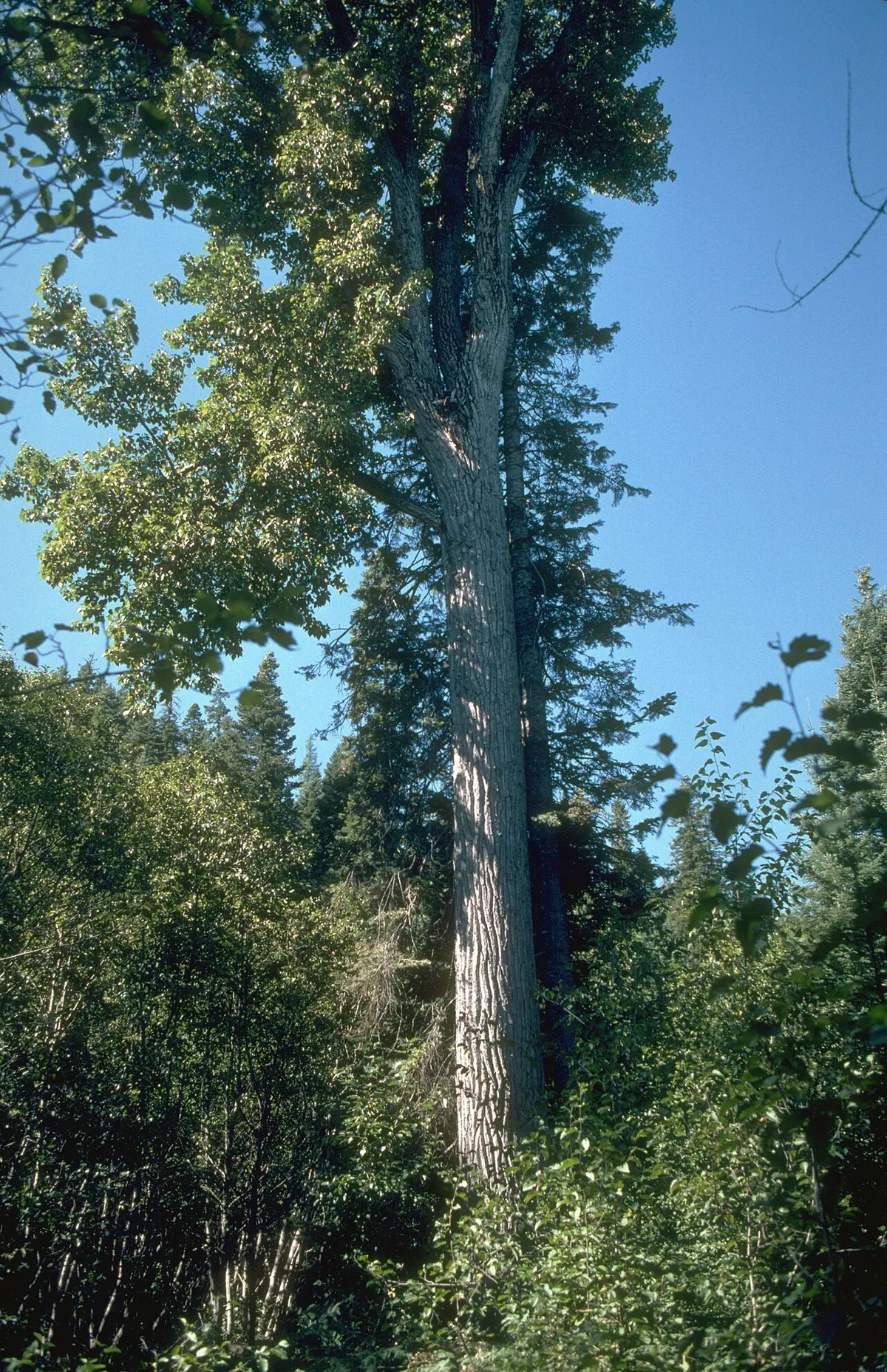
These trees are enormous. A mature black cottonwood typically reaches 120 feet tall, though some grow significantly taller. The spread is usually around 39 feet, which sounds less impressive until you’re standing under one and realize that branch reaches from your property line almost to the middle of your block. The open branching structure and light foliage create a canopy that feels airy and somewhat delicate, even at maturity. That initial impression will mislead you about branch strength, which is something we’ll discuss in detail later.
The bark is one of the easier identification features, especially on mature trees. You’re looking for dark gray-brown coloring with distinctive flat-topped ridges separated by deep V-shaped grooves, running vertically up the trunk. Younger trees have smoother bark that becomes increasingly ridged and furrowed with age. The wood itself is quite pale, almost white, which you might notice if a branch breaks or if you see fresh pruning cuts.
The leaves are equally distinctive. They’re triangular to heart-shaped, 2 to 4 inches long, with flattened petioles (leaf stems) that cause the leaves to quiver in even slight breezes. This constant movement is where the genus name Populus comes from: the Latin term for “popular,” referring to the tree’s traditional use in public spaces. The leaves are waxy, deep green on top, paler beneath, with fine marginal teeth along the edges. In fall, black cottonwoods turn a clear bright yellow, which creates stunning riparian corridors in October and November when you’re driving through the valleys.
What This Tree Does Well
A Riparian Cornerstone
If you live anywhere in the Puget Sound region near a perennial stream, you’re almost certainly living in a landscape shaped by black cottonwoods. These trees are the dominant riparian species across much of the Pacific Northwest, and they’re there for a reason that has nothing to do with human landscaping decisions.
Black cottonwoods grow fast, grow big, and tolerate wet feet. They’re pioneer species, the first trees to establish on disturbed or bare riparian ground after floods, erosion events, or other landscape disruption. But they’re not temporary colonizers that get shaded out by slower-growing shade trees. Instead, these fast-growing giants quickly create a dense canopy that moderates stream temperatures, provides habitat structure, and creates the cool, shaded environment that native salmon and trout require.
The relationship between black cottonwoods and salmon is intimate and essential. Every summer, Chinook salmon, coho salmon, steelhead, and coastal cutthroat trout depend on the shade cast by cottonwood-dominated riparian zones. That shade keeps water cool. Even a few degrees of water temperature increase can stress salmon and push them into poor habitat or high-stress situations. In the Puget Sound region, where riparian function has been degraded by development and forest clearing over the past 150 years, the remaining black cottonwood stands are often literally the difference between viable salmon streams and streams where only the toughest fish survive.
This isn’t abstract conservation biology. This is your local salmon runs depending on trees in backyards, parks, and riparian corridors across the region. If you have a black cottonwood on your property near a stream, that tree is doing something directly valuable for the fish that people have spent billions of dollars trying to protect.
The Fastest Growing Native Tree
Black cottonwoods are aggressive growers. In ideal conditions, a young tree can grow 3 to 4 feet per year, and some exceptional specimens have been documented adding even more. This speed is unusual among Pacific Northwest natives. Your Douglas-fir will eventually be taller, but it will take decades longer to get there. Your western red cedar will eventually be a better neighbor, but it’s adding inches while the cottonwood is adding feet.
This rapid growth rate is valuable if you need quick shade, quick screening, or quick establishment of riparian habitat. It’s also the reason black cottonwoods were historically planted in shelter belts and windbreaks across agricultural areas. In situations where you need a tree to establish quickly and create canopy fast, this is your native option.
The fast growth comes with a cost, which we’ll discuss. But the simple fact is that if you’re trying to restore a riparian zone or create quick shade in a bottomland area, black cottonwoods deliver results faster than almost any native alternative.
A Genomic First
In 2006, the black cottonwood became the first tree species to have its entire genome sequenced, published in Science by Tuskan et al. This wasn’t random. Researchers selected it specifically because of its combination of a relatively compact genome, its economic importance, and its role as a model for understanding tree growth and wood formation.
This genome sequence has become foundational for understanding how trees grow, how they respond to stress, and how they form wood and cellulose. The research has implications for forestry, for bioenergy production, and for understanding how trees might adapt to climate change. Your black cottonwood might look like a simple neighbor tree, but the scientific infrastructure built around its genetics is shaping how we understand tree biology globally.
This doesn’t change what you do with your actual tree on your property. But it’s worth knowing that the tree dropping cotton on your car is, in a very real way, helping science understand how all trees work.
Pioneer and Colonizer
Black cottonwoods are specialists in disturbed environments. They thrive where other trees won’t immediately establish. Fresh gravel bars, recently eroded stream banks, burn scars, clear-cuts being regenerated: these are all places where black cottonwoods excel at establishing first.
This isn’t just persistence. It’s an ecological role. The fast-growing canopy and dense branching structure create the conditions where slower-growing, more persistent species can establish in the understory. The tree essentially creates the conditions for its own long-term replacement while providing short-term ecosystem services.
In your landscape, this means that black cottonwoods are excellent for quick restoration projects, riparian rehab, or erosion control on disturbed sites. They’re also the tree that colonizes vacant industrial sites, abandoned properties, and other degraded landscapes, gradually making them more habitable for other plants and animals.
What Goes Wrong
Now we need to talk about why your neighbor wants you to cut yours down. These are real issues, not overblown complaints.
Cotton: The Real Problem
Let’s start with the thing that everyone notices. In late May and early June, female black cottonwoods release seeds contained in cottony fluff, similar to what dandelions produce. The difference in scale is enormous. A large female cottonwood can release enough cotton that it creates visible clouds and accumulates in gutters, window screens, and the corners of gardens. It’s not toxic. It won’t harm anything. But it’s annoying if you have a female tree in your yard or nearby.
Here’s what matters: there are male and female cottonwoods. Males have catkins but don’t produce the cotton. If you’re planting a cottonwood, you can request a male clone. Some nurseries carry male grafted clones specifically for people who want the tree without the cottony mess.
If you already have a female tree producing cotton, you have limited options. You can’t reliably change its sex. You can reduce cotton production somewhat by removing female catkins in spring before they open, though this requires annual effort. Or you can accept that this is part of the deal from May through June.
This is worth solving before you decide the tree needs to come out. The genetic difference between a desirable male tree and a problem female tree is relatively minor. The ecological loss of removing a large riparian cottonwood to avoid the cotton problem for a few weeks per year is substantial.
Limb Drop: The Real Danger
Now we talk about something that actually poses a risk. Black cottonwoods are prone to dropping branches, sometimes quite large ones. The wood itself is relatively soft and more prone to splitting, cracking, and decay than many other hardwoods. This combination means that branches fail more readily than in trees with stronger wood.
The limb drop isn’t random. It tends to happen during storms, after heavy snow, or during the spring flush when the tree is leafing out and the new foliage is heavy and water-saturated. The first strong spring storm after budbreak can see significant branch failure on some trees.
The dropped branches can be substantial. It’s not uncommon to see limbs 6 to 12 inches in diameter on the ground beneath a cottonwood. If one of those lands on a structure, a person, or a vehicle, it causes real damage.
This is why tree selection matters for placement. A large mature black cottonwood near a house is a higher-risk situation than one in the middle of a park or an open yard. This is also why proper pruning and maintenance matter. A well-maintained tree with proper structure, appropriate weight distribution, and dead wood removed regularly, is less likely to have catastrophic failures.
If you have a black cottonwood near buildings or frequently occupied areas, professional inspection every few years is reasonable. If it has obvious structural issues, weak crotches, included bark, or heavy limbs overhanging structures, pruning or removal might be justified.
Aggressive Roots
The black cottonwood’s ability to quickly seek water is part of what makes it an excellent riparian tree. That same characteristic means it will aggressively pursue sewer lines, drain fields, and water pipes. If you have a cottonwood near any underground utility, you should assume that roots will eventually find it.
This doesn’t mean the tree should automatically be removed. It means you need to be aware of where utilities run and monitor that situation carefully. If roots have already infiltrated a sewer line, you have a problem that removal might solve, depending on the extent of damage.
In new plantings, separation matters. You wouldn’t plant a large cottonwood directly over a septic system or close to sewer lines. But if you have an existing tree and existing utilities, the two coexist in many Puget Sound yards. Careful root barriers, regular pipe maintenance, and understanding what’s beneath your property all help manage this issue.
The Disease List
Black cottonwoods are susceptible to a long list of fungal and bacterial diseases. The most visible is Marssonina leaf spot, which causes premature defoliation and can make the tree look seriously unhealthy by mid to late summer, even though it recovers the following spring.
Other issues include various leaf rusts, cankers that girdle branches, bacterial blight (Xanthomonas), Armillaria root rot in older trees, and various other fungal infections. The good news is that most of these are cosmetic or slowly progressive rather than immediately fatal. The less good news is that there’s no chemical control for most of them. Proper tree health, good air circulation, and removal of dead wood help. Beyond that, you’re mostly managing the presence of these diseases rather than eliminating them.
If a black cottonwood in your landscape develops serious disease symptoms, the question isn’t always “remove or don’t remove.” It’s often “how do we manage this tree to maximize health and minimize disease spread, and is that worthwhile?” Sometimes the answer is removal. Sometimes it’s ongoing care and acceptance that the tree will have seasonal issues.
Short-Lived Wood
The wood of the black cottonwood is relatively quick to decay once exposed. A branch that breaks and sits on the ground will rot within a few years. A tree that dies will hollow out within a decade or two. This rapid decomposition is part of the ecological cycle in riparian zones, where dead wood provides critical habitat. It’s less pleasant when it’s your fence or the structure you’re trying to support.
This means that salvage from a cottonwood isn’t practical for most projects. The wood isn’t ideal for construction or long-term outdoor use. It’s one reason the tree historically was used more for pulp and particle board than for solid wood products.
The Removal Question
So when do you actually need to remove a black cottonwood?
The answer is: fewer times than the internet suggests, but more times than pure conservation advocates admit.
Consider removal if the tree is:
- Clearly hazardous to structures, power lines, or people, with no practical mitigation available
- Infected with a disease that’s progressively killing it
- Blocking critical views or shading gardens where it’s truly counterproductive
- Creating damage to utilities that can’t be managed any other way
- Dominating a landscape so heavily that other trees can’t establish
Consider keeping the tree if it’s:
- Near a stream or riparian area, where it’s providing critical ecological services
- Providing significant shade or screening where that’s valuable
- A male tree without the cotton issue
- Healthy and structurally sound
- Part of the existing native tree canopy in your area
The honest answer is that many decisions fall somewhere in the middle. You might keep the tree but have it professionally pruned to reduce weight and improve structure. You might remove lower branches and accept some of the cotton because you want the shade. You might remove the tree knowing you’ll plant other native species in its place.
The worst decision is removing the tree without thinking about what replaces it or what ecosystem services you’re losing. The other bad decision is keeping a clearly hazardous tree and hoping it doesn’t fail.
Seasonal Action Summary
If you have a black cottonwood, here’s what to watch for through the year.
Winter: This is the time for structural pruning if needed. The tree is dormant, you can see the branch structure clearly, and the cuts will heal best. Winter is also when you might do removal if you’ve decided that’s the right choice. Cold weather means less sap flow and easier cleanup.
Spring: The cottonwood is one of the first trees to leaf out. New foliage is water-heavy and puts stress on the branch structure. This is when you’re most likely to see limb failures, especially during spring storms. Watch for broken branches and identify any that might be hanging hazardously.
Late Spring/Early Summer: This is cotton season if you have a female tree. The catkins appear in May, open in late May and early June, and then the fluffy seeds disperse. This is when the complaints will start. If you’re going to manually remove catkins, do it before they open. If you’re going to prune to reduce cotton production, do it after the season so you can see which branches to focus on next year.
Summer: The tree is at its most vigorous. Growth is fast, and the canopy is full. This is when you’ll see if diseases like Marssonina leaf spot are developing. Early defoliation is common by mid to late summer and isn’t necessarily an emergency. The tree will re-leaf in the spring. Extreme heat or drought will stress the tree, as cottonwoods prefer consistent moisture.
Fall: The tree turns bright yellow. Growth has slowed. This is a good time to assess the overall structure and make notes about pruning or maintenance needed. It’s a terrible time to do major pruning, as the tree is moving sugars back to the roots for winter storage and damage at this time is more serious.
Living with the Tree
The black cottonwood is not a simple tree. It’s not the best tree for every situation. It’s not a tree to remove casually, and it’s not a tree to keep without awareness of what you’re dealing with.
But here’s what matters: this is the tallest native hardwood in the Pacific Northwest. It’s literally the tree that salmon depend on. It’s one of the fastest-growing natives, the tree that pioneered modern genomic science, and the tree that colonizes disturbed landscapes and starts the long process of turning wastelands back into habitat.
Every June, when the cotton fills your air and clogs your gutters, that’s a reminder that you’re living with one of the most important trees in Pacific Northwest ecology. The fact that it’s inconvenient sometimes is a small price for what it does.
Know your tree. Maintain it properly if you keep it. Replace it thoughtfully if you remove it. And understand that whatever you decide, you’re making a choice that affects more than just your own yard.
Sources
Genomics:
- Tuskan, G. A., et al. “The Genome of Black Cottonwood, Populus trichocarpa.” Science 313(5793), 2006, pp. 1596-1604. DOI: 10.1126/science.1128691
Silviculture & growth characteristics:
- USDA Forest Service Silvics of North America: Populus trichocarpa
- British Columbia Ministry of Forests: Black Cottonwood Tree Species Compendium
Riparian ecology & salmon habitat:
- NOAA Fisheries: Restoration of Salmon and Steelhead Habitat on the West Coast
- Washington Department of Fish & Wildlife: Puget Sound Nearshore Program
Disease management:
Wood properties & arboriculture:
- USDA Forest Products Laboratory: Populus Species
- International Society of Arboriculture. “Recognizing Tree Risk” and “Mature Tree Care.” TreesAreGood® series.