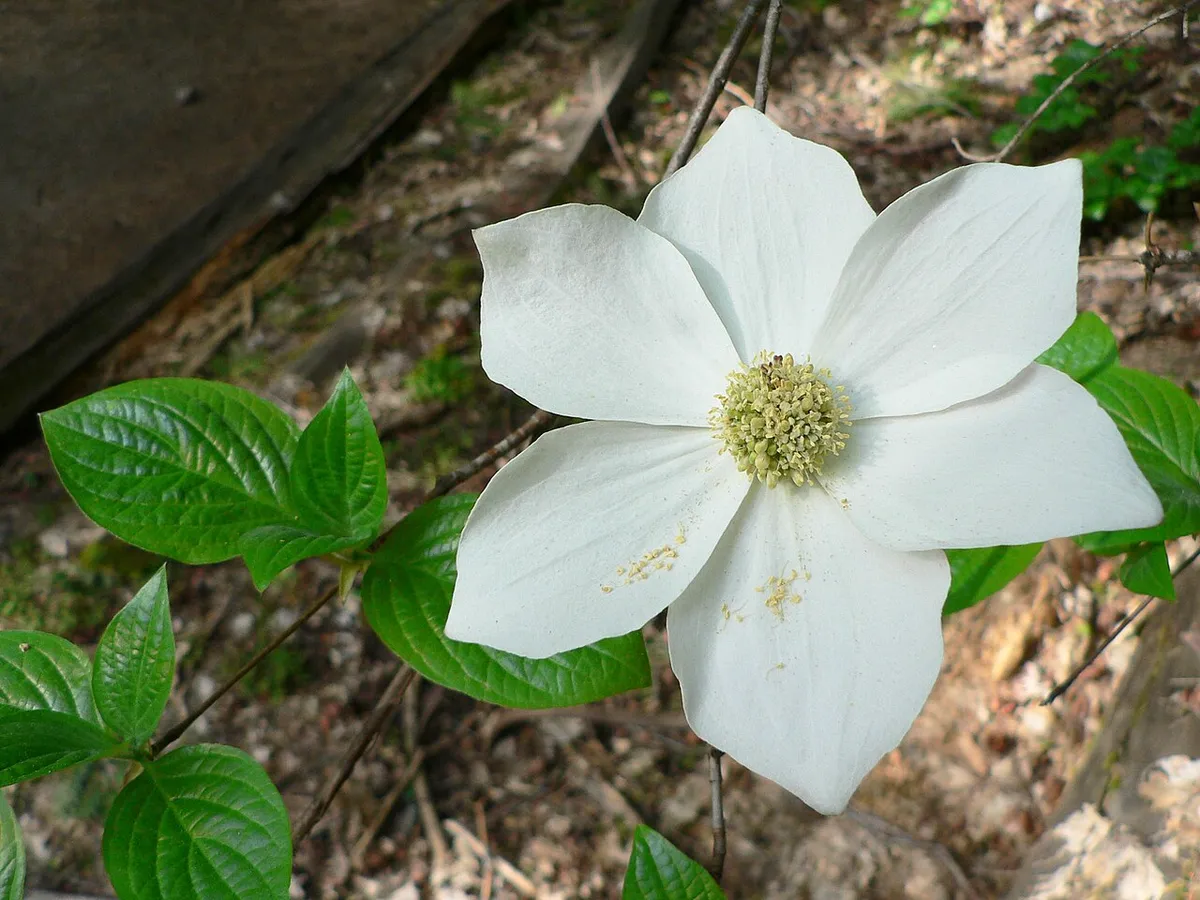
The White Bracts That Define Spring
In April, when the forest here is still mostly brown and gray, Pacific Dogwood stops you in your tracks. Not because of true flowers, though there are flowers, but because of bracts: four large, white, petal-like structures that surround the actual flowers and make the tree look like it’s covered in snow or paper stars. These aren’t petals. They’re modified leaves, and the botanical distinction matters because it helps explain why this tree, more than any other native understory species in the Pacific Northwest, captures your attention and holds it.
Walk through a second-growth Douglas-fir forest from late April through May, and you’ll find Pacific Dogwood. The small white stars appear in clusters along the branches, first in scattered pockets, then gradually filling in until the tree glows white against the darkening foliage of surrounding conifers. The tree rarely reaches the canopy. Instead, it lives in the space between the conifer shade and the forest floor, reaching 15 to 40 feet on average, sometimes climbing toward 60 feet in old-growth settings, but always operating as an understory player.
This is the tree that inspired British Columbia to choose it as the provincial flower. Not the bloom itself, but the dramatic white bracts that appear at this specific moment in spring. In a landscape where spring often feels delayed and tentative, where rhododendrons take weeks to crack open their buds and native shrubs move slowly from dormancy to active growth, Pacific Dogwood announces itself decisively. The tree is saying: spring is here, and here is the proof.
And then, devastatingly, something changed. Beginning in the 1990s, a fungal disease appeared that would reshape the future of this species throughout the Pacific Northwest. Dogwood anthracnose, Discula destructiva, started killing trees. Not slowly, as many diseases do, but systematically, progressively, lethally. The white bracts that defined spring became harder to find. Trees that had been understory fixtures for 50 years began to die. And suddenly, what you thought you knew about Pacific Dogwood as a reliable native species had to be completely reconsidered.
The Tree: What You’re Really Looking At
Pacific Dogwood (Cornus nuttallii) belongs to the Cornaceae family, the dogwood family, which includes Eastern Flowering Dogwood (Cornus florida), Cornelian Cherry (Cornus mas), and dozens of other dogwood species found across the Northern Hemisphere. The family is characterized by flowers that lack obvious petals, shrubby or small-tree habit, red or white bracts, interest in autumn color, and a tendency toward disease susceptibility that keeps arborists and horticulturists engaged in ongoing problem-solving.
Pacific Dogwood is native to the Pacific coast from British Columbia south to Southern California, ranging inland approximately 200 miles. In the Puget Sound lowlands, it’s a native species found naturally in mixed conifer forests, typically in the understory where it receives dappled light and consistent moisture from the forest environment. Its natural range includes the Puget Sound lowlands, the foothills of the Cascade Mountains, and the open oak woodlands of the Willamette Valley to the south.
The tree grows at a moderate rate, nothing like the aggressive fast-growing species that dominate nursery catalogs. In typical growing conditions, you can expect 3 to 4 feet of new growth per year, which means a 20-year-old Pacific Dogwood might be 40 to 45 feet tall. At maturity in our region, most specimens top out between 15 and 40 feet, with an upright, somewhat pyramidal crown, particularly when growing in conditions similar to their native understory habitat where they’re reaching toward light filtering down from taller conifers.
The leaves are deciduous, opposite one another along the branches, roughly oval in shape, 2 to 4 inches long, with a pointed tip and entire margins. The leaf surface is a medium to bright green in spring, darkening somewhat through summer, then turning a distinctive reddish purple in fall before dropping. This autumn color is actually quite attractive; you’ll see Pacific Dogwoods that are nearly the color of wine-red ornamental plums in October, a quiet but undeniable visual event in a landscape of yellows and browns.
The flowers themselves are unremarkable: small, greenish, arranged in a tight cluster at the center of each bracts display. They’re wind-pollinated primarily, though insects visit them occasionally. The real visual drama comes from the bracts, those four white structures (occasionally tinged with pink on older or stressed trees) that surround the flower cluster. Each bract is roughly 1.5 to 2 inches long and somewhat diamond-shaped, and the four of them are arranged so that they form a cross. This is what stops you in the forest in April. This is what British Columbia put on its provincial seal.
The fruit that develops after flowering is a small red drupe, roughly 0.5 inches in diameter, that ripens in late summer and fall. Birds eat these berries enthusiastically: cedar waxwings, robins, varied thrushes, and other species actively seek them out. If you’re growing Pacific Dogwood for wildlife value, the berries are your justification. The tree feeds the birds that feed on insects that would otherwise reach pest populations. It’s a functional part of the ecosystem.
Interestingly, Pacific Dogwood often produces a second, smaller flush of white bracts in fall, typically August through September, though this second bloom is much lighter than the spring display and often goes unnoticed. Some years it’s dramatic; some years it’s subtle. This is one of the delightful surprises of living with the tree over multiple seasons. You get spring blooms that you can count on, and then autumn offers a bonus.
The tree was named by the Scottish botanist David Douglas, who first documented the species in the early 1800s during his explorations of the Pacific Northwest. The species name, nuttallii, honors Thomas Nuttall, another botanist and naturalist of that era.
One detail that matters for understanding the species: Pacific Dogwood requires winter chilling to break dormancy. This is why the tree thrives here and struggles in warmer climates. The cold nights and freezing temperatures of a Pacific Northwest winter aren’t a stress for this species; they’re a requirement. Without adequate chilling hours, the tree won’t flush with new growth properly, and flowering is reduced. This is important if you’re considering moving to a warmer region and hoping to take your dogwood with you. You can’t. The tree is genetically tied to our winter.
What This Tree Does Well: The Win Column
Pacific Dogwood’s primary strength is the dramatic spring flowering display. There’s no native understory tree in this region that equals the visual impact of Pacific Dogwood’s white bracts in April. The eastern flowering dogwood (Cornus florida) produces a similar visual display and has more cultivars and color options, but it’s not native here, it’s less cold-hardy, and it’s increasingly threatened by the same anthracnose disease that affects Pacific Dogwood. If you want native, you want Pacific Dogwood.
The tree fills an important ecological role in the understory. It tolerates part shade better than most native deciduous trees, making it valuable for integrating into mixed plantings of conifers and shrubs. It’s not a canopy tree; it’s not competing with Douglas-fir and western hemlock for dominance. Instead, it’s occupying the vertical space between the conifer canopy and the shrub layer, providing structure, seasonal interest, and wildlife food at a specific height that other native species don’t fully occupy.
The fall color, while quieter than the spring display, is attractive. A mature Pacific Dogwood turning wine-red in October provides a visual anchor point in a landscape of yellows and browns. Paired with other native species with different autumn transitions, dogwood contributes to a layered, dynamic fall landscape.
Wildlife value is significant. The berry crop attracts birds; the tree provides nesting habitat; the foliage feeds insects that birds hunt. If you’re growing Pacific Dogwood, you’re providing resources for native species. The tree is part of the functional native plant community, not just a decorative accent.
The tree’s growth habit is naturally attractive. Even without deliberate pruning, Pacific Dogwood develops a pyramidal, somewhat layered branching structure that’s visually interesting in winter when the deciduous canopy is bare. The branching pattern is fine and relatively delicate, without the massive limb structure of oaks or maples. This gives the tree a lighter visual quality, particularly valuable in smaller landscapes where a smaller deciduous tree doesn’t overwhelm the space.
Longevity is another strength. Pacific Dogwood can live to be 100 to 150 years old in favorable conditions, which is not as long as some conifers or oaks, but substantial enough that a healthy tree you plant today could provide decades of visual interest and function. This is particularly important in the context of the species’ current disease pressures; a healthy, well-sited Pacific Dogwood is increasingly valuable as resistant individuals become more difficult to find.
What Goes Wrong: The Reality Check
This is where the conversation becomes serious, because Pacific Dogwood has moved from being a straightforward native understory tree to being a tree under active threat from a disease that can kill it over a period of several years.
Dogwood Anthracnose: The Existential Threat
Dogwood anthracnose, caused by the fungal pathogen Discula destructiva, first appeared in the eastern United States in the 1970s, where it systematically devastated plantings of Eastern Flowering Dogwood. The disease didn’t arrive in the Pacific Northwest until the 1990s, but once it did, it spread through dogwood populations with devastating efficiency.
Here’s what’s crucial to understand: dogwood anthracnose is not the cosmetic anthracnose that hits sycamores and maples. This is not a disease that causes temporary leaf spotting and defoliation that the tree recovers from. Dogwood anthracnose is a disease that kills the tree. Period. It progresses systematically, year after year, reducing the canopy, creating branch dieback, and eventually girdling the trunk with cankers that cut off vascular function. An infected tree doesn’t recover. It declines.
The disease manifests in a characteristic way. In spring, small purplish blotches appear on the leaves. These expand into larger necrotic areas with purple margins. The affected leaves drop prematurely, sometimes as early as May or June. As summer progresses, shoot cankers develop on current-year twigs, forming elongated lesions that can girdle the shoot and kill everything distal to the canker. Branch cankers develop on larger branches, sunken and eventually causing complete branch death. In the following years, more and more branches die back, the canopy thins dramatically, and new cankers develop on the trunk and major limbs.
Eventually, trunk cankers girdle the main stem, cutting off vascular function, and the tree dies. The timeline varies. Some trees show rapid decline over 3 to 5 years. Others slowly decline over a decade or more. But the trajectory is nearly always one-directional: downward.
The disease thrives in cool, wet conditions, which means the Pacific Northwest is ideal habitat for Discula destructiva. The spores spread through water, particularly from rain splash or overhead irrigation. The fungus overwinters in infected twigs and leaves that remain on the ground or caught in the crown. A single infected twig can serve as a source of spores for an entire season.
This is critical to understand: if you have an infected Pacific Dogwood, you are at risk of spreading the disease to other dogwoods in your neighborhood, to dogwoods in nearby natural areas, to dogwoods anywhere within rain splash distance. The management of an infected tree is not just about saving that individual tree. It’s about preventing the spread of a devastating pathogen to other populations.
The distinction between Pacific Dogwood anthracnose and Eastern Flowering Dogwood anthracnose is important. The eastern species was already under pressure from the disease when it first appeared in the Pacific Northwest. Eastern Flowering Dogwood is also more susceptible to the disease than some other dogwood species. Pacific Dogwood is not immune, but there’s evidence that some genetic individuals show greater resistance or slower disease progression than others. This is where a sustainable future for the species might lie: in identifying and propagating individuals with resistance.
Other Diseases: The Secondary Threats
Beyond anthracnose, Pacific Dogwood faces several other disease challenges that, while not necessarily lethal, can seriously compromise the tree’s health and appearance.
Powdery mildew is common in the Pacific Northwest during years when conditions favor the disease. You’ll see a white coating on the leaves, typically starting in mid-summer, particularly on leaves in the lower canopy that have reduced air circulation. The disease is rarely serious enough to warrant intervention, but it’s cosmetically annoying. Improve air circulation around the tree, avoid overhead watering, and accept that this is part of growing dogwood in a maritime climate.
Leaf scorch can appear as tan or brown areas on leaf margins, typically during hot, dry periods in summer, or on trees that are water-stressed. This is not a disease in the infectious sense; it’s an environmental stress response. The tree’s leaves are reaching the limit of their capacity to transpire water under hot, dry conditions. The symptom indicates that the tree needs water or is in a site that’s too exposed to afternoon sun and heat.
Collar rot and Phytophthora canker can occur on trees planted in poorly drained soil or in sites where water pools around the base of the tree. These are primarily problems of cultural conditions, not pathogenic inevitability. If your Pacific Dogwood has good drainage and isn’t sitting in standing water, these diseases are unlikely.
Armillaria root rot and branch canker are less common but possible, particularly on stressed or weakened trees. The best prevention is to keep the tree healthy through proper siting and care.
Pests: Minor but Notable
The dogwood borer (Xyleborinus saxesenii) is a wood-boring beetle that can infest stressed or declining trees. The pest itself is usually a symptom of a larger problem, not the root cause. Scale insects occasionally appear on dogwoods, usually coated on the underside of branches or at branch junctions. Both of these pests are rarely serious enough to warrant treatment; they’re usually managed by removing infested branches or improving the overall health of the tree.
Living With Dogwood Anthracnose: Management Strategies in the Age of Disease
The hard truth is that if you plant a Pacific Dogwood today, you’re taking on the very real possibility that the tree will contract dogwood anthracnose and eventually decline from the infection. You can’t eliminate this risk. But you can implement management strategies that either delay the disease or eliminate susceptible specimens before they become significant disease sources.
Site Selection: The Foundation
Choose a location with excellent air circulation. Dogwood anthracnose thrives in high humidity. A site with moving air, where afternoon breezes flow through the canopy, is less favorable to the fungus than a still, sheltered location. Avoid planting in the bottom of a valley or in a tightly enclosed garden space where humidity lingers.
Full sun to part shade, with afternoon shade preferred in hot regions, is ideal. Stressed trees are more susceptible to severe disease progression. A tree that’s getting adequate light and is vigorous is more likely to coexist with the pathogen or show slower disease development than a tree that’s struggling in deep shade.
Ensure good drainage. While Pacific Dogwood is more water-tolerant than Pacific Madrone, it still prefers well-drained soil. Wet soil stresses the tree and makes it more susceptible to secondary infections.
Avoid sites with overhead irrigation or with neighbors who spray from overhead sprinklers. The fungal spores spread through water. If you’re irrigating your dogwood, water at the base only, never the foliage.
Preventive Pruning and Sanitation
If you have an uninfected Pacific Dogwood, preventive pruning and sanitation can reduce disease risk. Remove any dead branches or twigs promptly, cutting back to healthy wood and disposing of the infected material in the garbage, never composting it. The spores overwinter in infected twigs and leaves, so every piece of infected material you remove is reducing the fungal inoculum available to infect new growth.
Keep the canopy open and well-ventilated. Thin out crowded branches to improve air movement through the crown. This reduces humidity in the canopy and makes it less favorable for disease development.
Avoid wounding the tree. Fungal cankers enter through wounds or through leaf scars. The fewer injuries the tree sustains, the fewer entry points for the pathogen.
Chemical Management: Limited Effectiveness
Fungicide applications can reduce disease severity, but they don’t eliminate it. Research has shown that applications of certain fungicides (propiconazole is one option) during the vulnerable period of new leaf emergence in spring can reduce the severity of leaf blight and slow disease progression. However, this requires repeated applications throughout the growing season, adds expense, and doesn’t cure an infected tree.
If you’re considering fungicide applications, consult with a certified arborist or your local extension service for current recommendations on products and timing. But be clear on what fungicides can and cannot accomplish: they can slow disease progression, but they won’t prevent infection or cure an infected tree.
The Infected Tree: When to Remove
If your Pacific Dogwood shows signs of anthracnose, the ethical approach is to consult with a certified arborist about the severity of infection and the likely trajectory. If the tree is in its first year of infection, showing leaf blight but no obvious branch cankers, aggressive management (preventive pruning, improving site conditions) might slow progression. If the tree is in the middle stages of infection, with obvious branch dieback and trunk cankers, the tree’s days are numbered. The ethical question becomes: am I maintaining a disease source that threatens other dogwoods in the neighborhood?
The argument for removing an infected tree is that you’re eliminating a source of fungal spores that could spread the disease to other Pacific Dogwoods nearby, in your neighborhood, or in natural forest areas if spores blow and splash to adjacent properties. The argument for maintaining a declining tree is sentimental: this tree has been here for decades, it’s provided beauty and shade, and removing it feels like giving up.
There’s no objective answer. The choice depends on your values, your site, and the presence of other dogwoods nearby. But if you’re in a neighborhood with multiple dogwoods, or if you’re adjacent to a natural area with wild dogwood populations, removing a severely infected tree is the responsible choice.
Genetic Resistance: The Long-Term Solution
The most promising long-term strategy for Pacific Dogwood is the identification and propagation of genetically resistant individuals. Some dogwoods show greater resistance or slower disease progression than others, suggesting that genetic variation exists within the species that confers greater ability to coexist with the pathogen. Conservation organizations and research institutions throughout the Pacific Northwest are working to document this genetic variation and propagate resistant selections.
If you’re looking to plant a new Pacific Dogwood, inquire whether the nursery or propagator has screened their material for disease resistance. In another decade or two, resistant cultivars might be available commercially, fundamentally changing the calculus of whether it’s advisable to plant dogwood. For now, this work is ongoing at university research stations and conservation nurseries, and the results are still in the future.
The Legal Note: You Cannot Pick Dogwood in British Columbia
A small but important detail: in British Columbia, Pacific Dogwood (called the Pacific or Western Flowering Dogwood) is legally protected. It’s illegal to pick flowers or branches. The beautiful bracts that appear in April are protected by provincial law, a recognition that the species is significant to the region and that wild populations need protection from collection pressure.
In Washington State, there’s no blanket protection, but in your own garden, you can cut flowers and branches for arrangements if you wish. In natural areas where dogwood is growing, respect any posted regulations and exercise restraint. The goal is to see the tree thriving in the landscape, and that requires leaving wild populations largely undisturbed.
Seasonal Action Summary
| Season | Action |
|---|---|
| Early Spring (March-April) | Monitor emerging leaves for powdery mildew or early anthracnose signs. Observe white bract displays. Prune out any winter-damaged branches. |
| Peak Bloom (April-May) | Enjoy the flowering display. Avoid overhead watering. Scout for signs of anthracnose symptoms. |
| Early Summer (June-July) | Remove any leaves showing anthracnose symptoms. Prune out infected twigs back to healthy wood. Thin canopy for air circulation if dense. |
| Midsummer (July-August) | Monitor for powdery mildew and leaf scorch. Reduce supplemental watering if tree is water-stressed. Watch for second bloom beginning. |
| Late Summer-Fall (August-October) | Observe second bloom display. Monitor berry production. Enjoy fall color. Watch for developing cankers on branches. |
| Winter (November-March) | Remove any fallen infected leaves from canopy or ground. Prune out dead branches. Avoid wounding the tree. |
Growing Pacific Dogwood: The Honest Assessment
Pacific Dogwood is worth growing if you understand the constraints. It’s a native understory tree that provides undeniable visual impact in spring, supports wildlife, and fits naturally into a landscape that includes conifers and other native deciduous species. The tree is hardy in zones 6a through 8b, which covers most of the Puget Sound region, and it tolerates part shade while also thriving in full sun.
But you need to go into the decision with eyes open about anthracnose. This is not a disease that you might encounter; it’s a disease that’s present throughout the Pacific Northwest, spreading slowly through dogwood populations, and any dogwood you plant has a real risk of eventual infection. The timeline is uncertain. Some trees get infected quickly; others might go decades without showing symptoms. Some individuals might have genetic resistance and never develop serious disease. But the risk is real.
The responsible approach is to plant Pacific Dogwood only in locations where you can manage it according to disease-suppressing practices: good air circulation, afternoon shade, excellent drainage, no overhead irrigation, and a commitment to removing infected twigs and branches as soon as symptoms appear. If you’re not willing to do that level of management, consider an alternative species.
Sources
Dogwood anthracnose:
- WSU HortSense: Dogwood Anthracnose
- PNW Plant Disease Management Handbook: Dogwood Anthracnose
- NC State Extension: Diseases of Dogwood in North Carolina
- Redlin, S. C. 1991. “Discula destructiva sp. nov., cause of dogwood anthracnose.” Mycologia 83(5):633-642.
- Sakalidis, M. L. et al. 2017. “Confirmation of independent introductions of Discula destructiva on the east and west coasts of North America.” Plant Disease
Other diseases:
- PNW Plant Disease Management Handbook: Dogwood Powdery Mildew
- PNW Plant Disease Management Handbook: Dogwood Collar Rot
Plant descriptions: